Redstone version
Redstone Mercury-Redstone Launch Vehicle
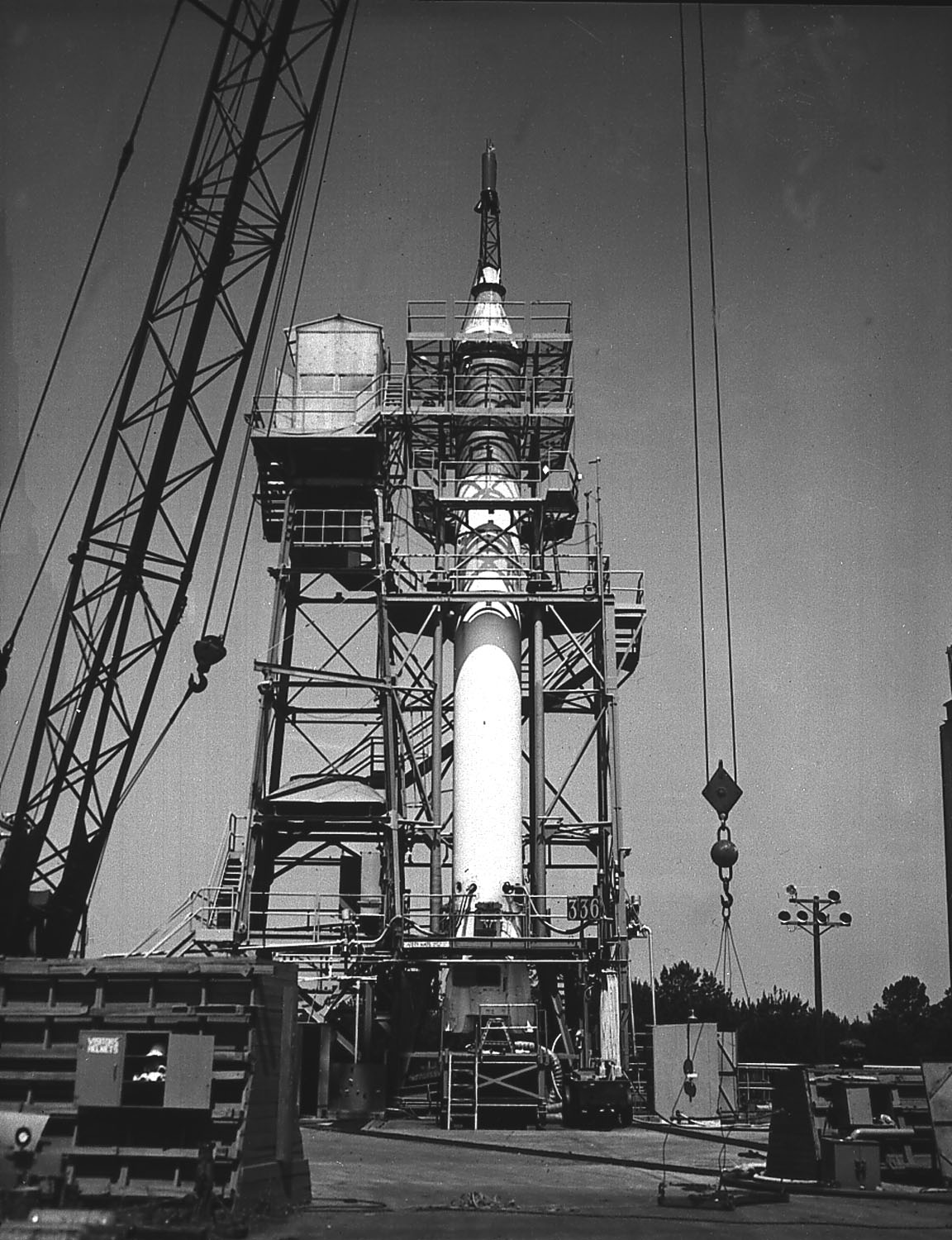
The Mercury-Redstone was America's first crewed launch vehicle: a single-stage Redstone with the Jupiter-C's stretched tanks and the missile's A-7 engine, reworked through some 800 modifications to carry the Mercury capsule on sub-orbital flights. It flew six times between November 1960 and July 1961, the last two carrying Alan Shepard and Gus Grissom.

- November 21, 1960
- First launch
- 347 kN
- Thrust
- No
- Reusable
History
Why the Redstone
For Project Mercury's sub-orbital flights NASA chose the Army's Redstone because it was the oldest missile in the American fleet: in service since 1953 and backed by many successful test flights. A standard Redstone, however, lacked the thrust to place a Mercury capsule on the planned ballistic trajectory. The first stage of the Jupiter-C, a Redstone with lengthened tanks, could carry enough propellant, so it became the starting point. The engine came from elsewhere: the Army was phasing out the Jupiter-C's powerplant, and to avoid parts shortages or design revisions the designers took the Rocketdyne A-7 from the latest military Redstone. Hans Paul and William Davidson, propulsion engineers at the Army Ballistic Missile Agency (ABMA), were tasked with making it safe and reliable for crewed flight. In 1959 most of ABMA was busy with Saturn, so man-rating was done by those who could find spare time.
Simpler and longer
The first step was deleting the staging capability, since the Mercury-Redstone would carry no upper stages, and stripping many advanced Jupiter-C components for reliability or because Mercury did not need them. The Jupiter-C burned Hydyne (60% UDMH, 40% diethylenetriamine), more powerful than alcohol but more toxic, a hazard to an astronaut in a pad emergency, and never used with the A-7. The designers returned to the Redstone mix of 75% ethyl alcohol and 25% water with liquid oxygen, which made the long tanks indispensable. The longer burn called for higher-quality graphite jet vanes, an additional nitrogen bottle for tank pressurisation and an extra hydrogen peroxide tank for the turbopump. The ST-80 inertial guidance gave way to the LEV-3 autopilot, a V-2 descendant: less precise, but simpler and more reliable. The instrument section, which on the missile separated with the warhead, was permanently attached to the booster, cooled before launch and pressurised in flight. Some 800 modifications were made in all, so many that NASA effectively had a new rocket, and this set von Braun's team, who wanted a foolproof abort system, against NASA, which wanted maximum booster reliability so that aborts would not happen at all.
A rocket that aborts by itself
The decisive change was the automatic in-flight abort sensing system. It monitored pitch, yaw and roll angles and rates, combustion chamber pressure and electrical power, and on an anomaly it shut down the engine and fired the capsule's escape tower. It could not cut the engine during the first 30 seconds, so that a malfunctioning rocket would not fall on the pad; in that window only the Range Safety Officer could terminate the flight. Flight data from more than 60 Redstone and Jupiter-C launches was reviewed to design it. The destruct system was delayed three seconds after engine cutoff to give the tower time to pull the capsule away.
Six flights
NASA bought eight boosters. MR-1, on 21 November 1960, shut down at lift-off: it rose about 10 cm and settled back on Launch Complex 5 at Cape Canaveral. The cause was a control cable meant for the military missile, longer than the Mercury one, which separated 29 milliseconds after the power cable; later boosters added a grounding strap about 30 cm long. MR-1A, on 19 December with booster MR-3, was a complete success: the capsule reached 210 km and came down 378 km downrange. MR-2, on 31 January 1961, carried the chimpanzee Ham; a liquid-oxygen regulator over-accelerated the rocket, thrust ended 1.2 s early and the escape tower yanked the capsule away. Von Braun then insisted on a booster development flight, MR-BD on 24 March, with a boilerplate capsule, corrected regulator and valves and 95 kg of insulation against vibration; it reached a 182.7 km apogee and a 494 km range. Then came Alan Shepard (MR-3, 5 May 1961), the first American in space, and Gus Grissom (MR-4, 21 July). Two boosters never flew: orbital flights passed to the Atlas.
Powerplant
One Rocketdyne A-7 engine of 347 kN, 215 s specific impulse and about 143.5 s burn time; 75% ethyl alcohol and 25% water with liquid oxygen, turbopump driven by hydrogen peroxide.
Multimedia

-1600.webp)


-1600.webp)
%2C_31_January_1961-1600.webp)


%2C_21_July_1961-1600.webp)
%2C_5_May_1961-1600.webp)