Family: R-7
R-7 Semyorka
Launch statistics
- 0
- Total launches
- 0
- Successes
- 0
- Failures
- —
- Success rate


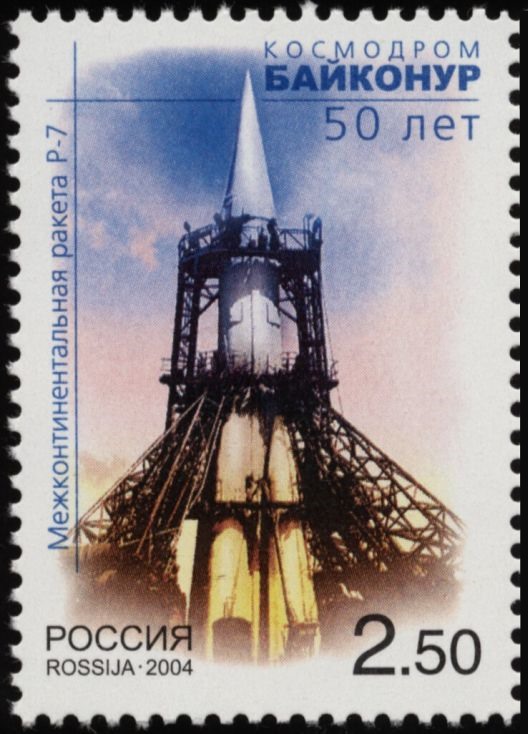


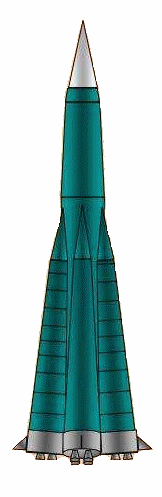


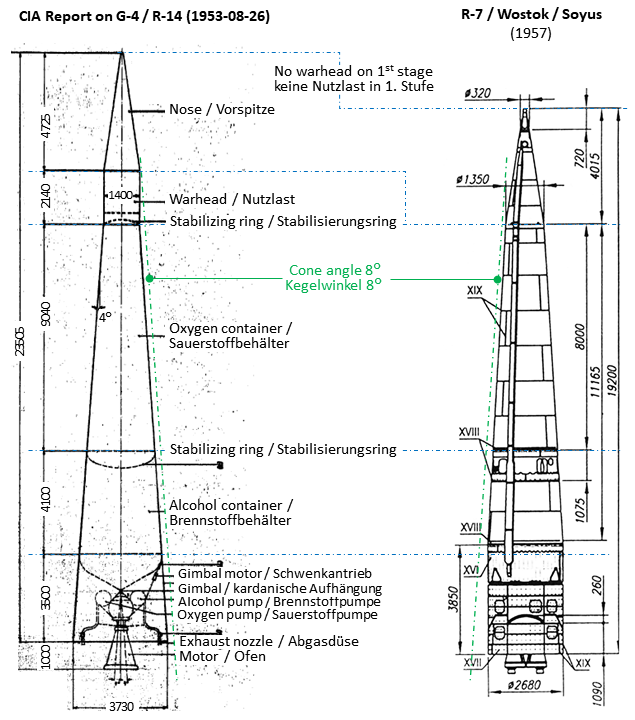
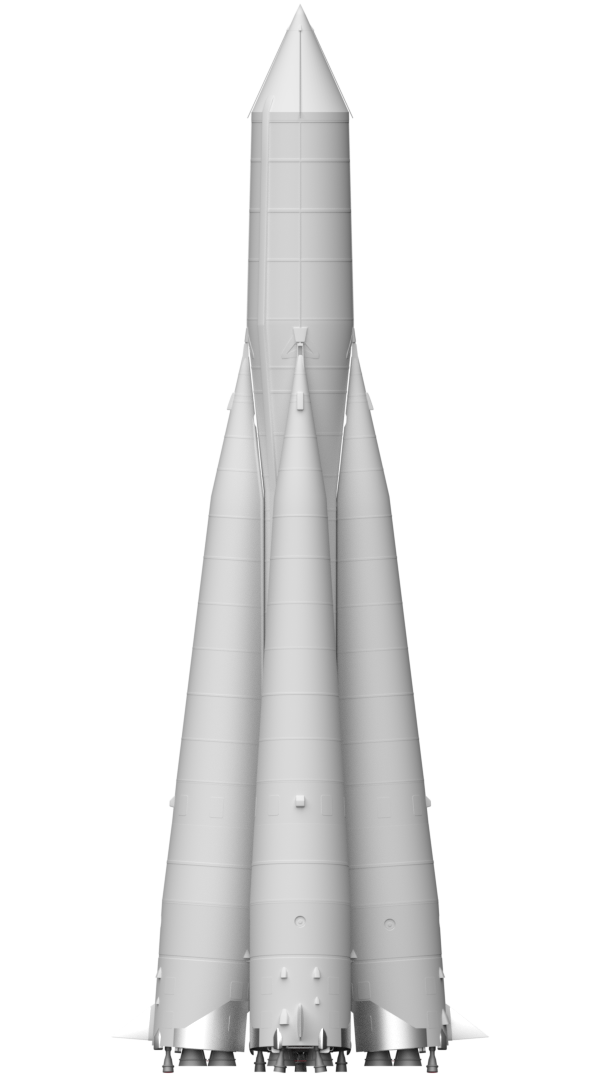

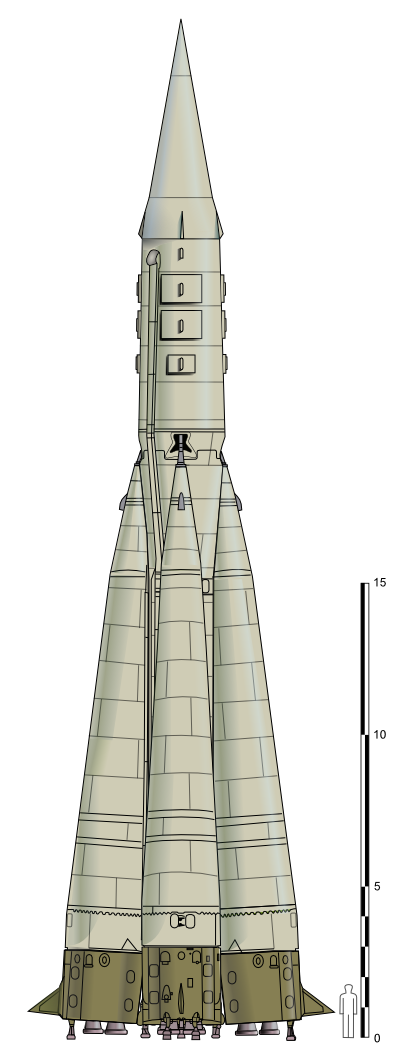

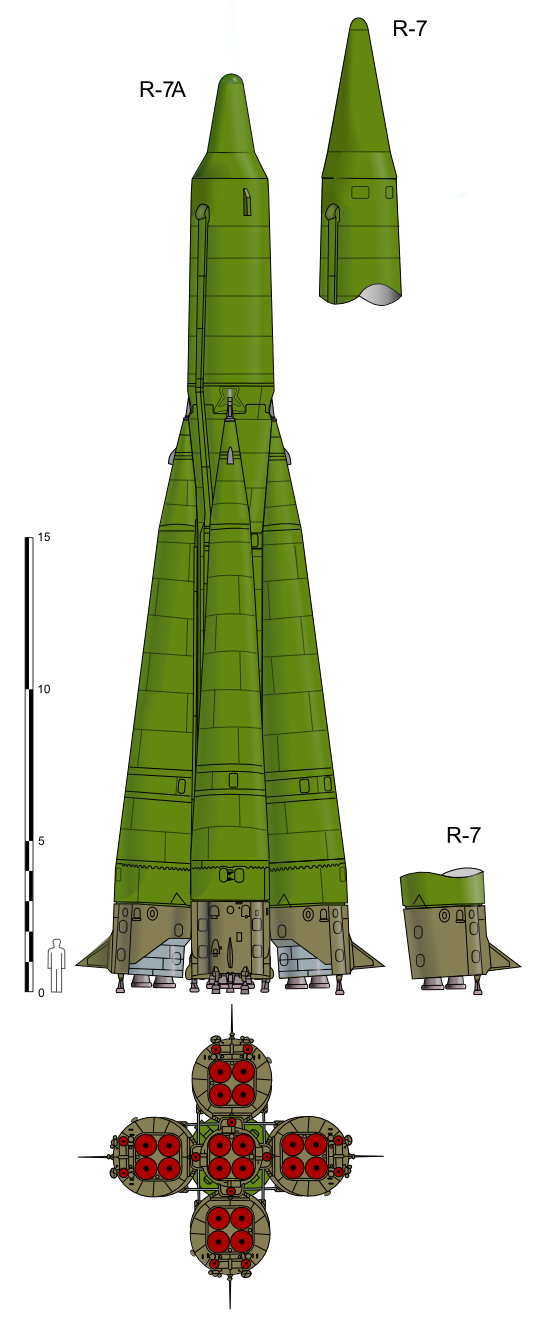

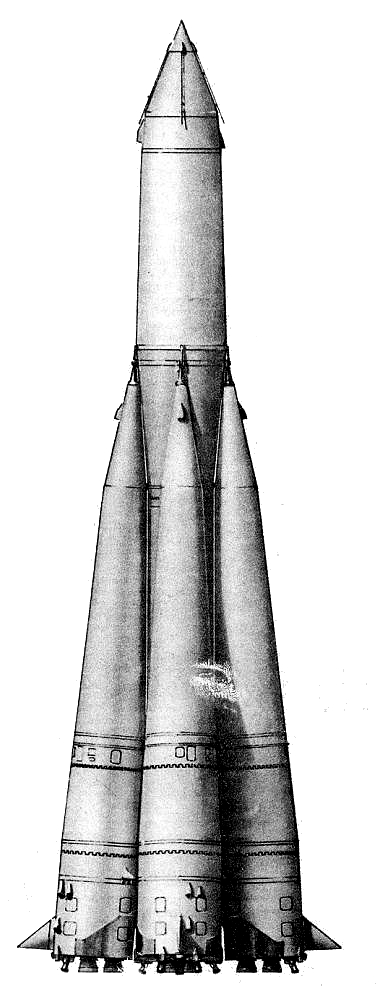


The R-7 Semyorka was the world's first intercontinental ballistic missile and, only months after its first successful flight, the vehicle that placed Sputnik 1 in orbit. Its layout of a central core ringed by four jettisonable boosters still survives in the Russian launchers descended from it.
Related events
Three-view drawing
History
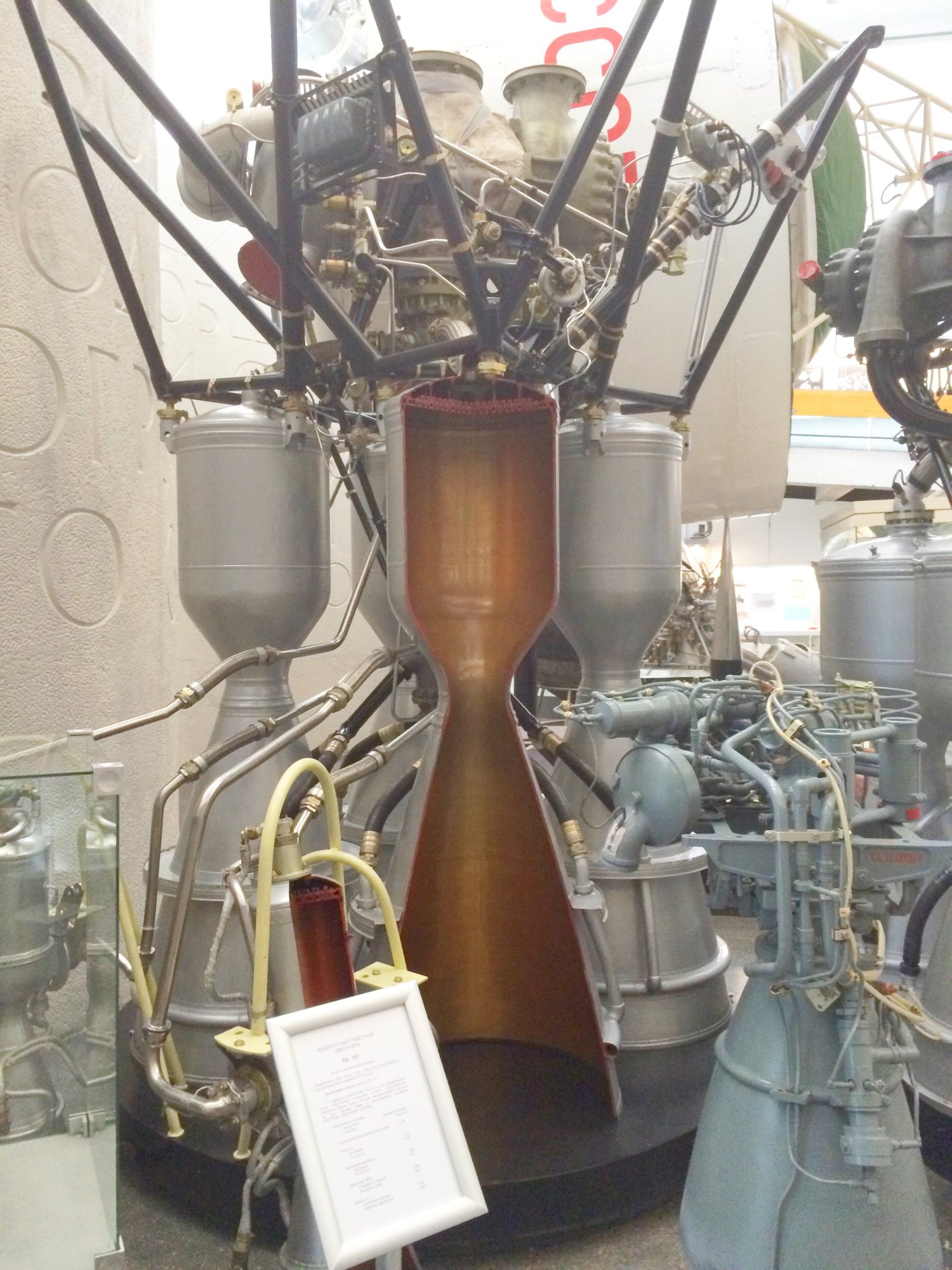
The design began at Sergei Korolev's OKB-1 in 1953, against a demanding requirement: 8000 km of range while carrying a thermonuclear warhead. The Soviet Council of Ministers approved development on 20 May 1954. To lift that payload, Valentin Glushko's bureau clustered four combustion chambers around a single turbopump, the solution behind the RD-107 of the four strap-on boosters and the RD-108 of the central core, all burning kerosene and liquid oxygen. Instead of jet vanes in the nozzle, small vernier engines provided steering.
The first test launch, on 15 May 1957 from Baikonur, ended when a booster failure destroyed the missile 98 seconds into flight. A second attempt on 12 July also failed. The third, on 21 August 1957, worked: it flew 6000 km to the Kamchatka test range, and the TASS news agency announced the success days later. With 10.3 m across the base, some 280 tonnes at liftoff and a single stage assisted by four boosters, the vehicle was outsized for what a weapon was expected to be.
As an operational missile it disappointed. It needed roughly twenty hours of preparation and could not stay on alert for more than a day because of liquid oxygen boil-off, so of the fifty pads once envisaged only a handful of units were fielded from late 1959. It remained in service until 1968, yet the first Soviet intercontinental missile deployed in numbers was Mikhail Yangel's R-16. Western estimates of a far larger deployment nonetheless fed the missile gap scare.
Its real career was a civilian one. A modified version put Sputnik 1 into orbit on 4 October 1957 and Sputnik 2 a month later, and the same stem produced the Luna, Vostok, Voskhod, Molniya and Soyuz launchers. Between 1957 and 2005 its derivatives delivered 1705 satellites with a 95.54 % success rate, and by 2026 the family had accumulated more than 2000 flights, the highest tally in spaceflight history.
Launch timeline
| Date | Launch site | Outcome | Payload |
|---|
Versions
| R-7 (8K71) | Sputnik (8K71PS) | Sputnik (8A91) | Luna (8K72) | Vostok-L (8K72) | Polyot (11A59) | Voskhod (11A57) | Molniya (8K78) | Molniya-M (8K78M) | R-7A (8K74) | Soyuz (11A511) | Vostok-2 (8A92) | Vostok-2M (8A92M) | Vostok-K (8K72K) | |
|---|---|---|---|---|---|---|---|---|---|---|---|---|---|---|
| First launch | May 15, 1957 | October 4, 1957 | April 27, 1958 | September 23, 1958 | May 15, 1960 | November 1, 1963 | November 16, 1963 | — | — | — | — | — | — | — |
| Last launch | — | November 3, 1957 | May 15, 1958 | April 16, 1960 | — | April 12, 1964 | June 29, 1976 | — | — | — | — | — | August 29, 1991 | — |
| Height | — | 30 m | 31.1 m | — | — | 30 m | 30.8 m | 43.4 m Best value in this row | — | — | — | — | — | — |
| Diameter | — | — | — | — | — | 3 m | 3 m | 10.3 m Best value in this row | — | — | — | — | — | — |
| Mass | — | 267,000 kg | 269,300 kg | 277,000 kg | — | 277,000 kg | 298,400 kg | 305,000 kg Best value in this row | — | — | — | — | — | — |
| Stages | 2 Best value in this row | 2 Best value in this row | 2 Best value in this row | 3 | 3 | — | 3 | 4 | 4 | 2 Best value in this row | 3 | 3 | 3 | 3 |
| LEO capacity | — | 500 kg | 1,327 kg | 4,000 kg | — | 1,400 kg | 5,900 kg Best value in this row | — | — | — | — | — | — | 4,725 kg |
| Reusable | No | No | No | No | No | No | No | No | No | No | No | No | No | No |
Images