Family: Minotaur
Minotaur IV
Launch statistics
- 9
- Launches (as of July 27, 2026)
- 1
- Successes
- 0
- Failures
- 100.0 %
- Success rate
.jpg)

-1600.webp)
-1600.webp)
-1600.webp)
-1600.webp)
-800.webp)

-1600.webp)
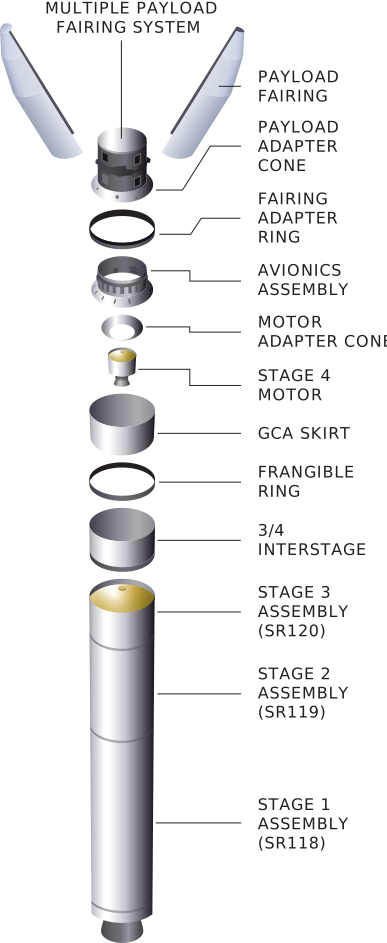
Minotaur IV, also known as Peacekeeper SLV and OSP-2 PK, is a US small-lift launch vehicle operated by Northrop Grumman that repurposes the motors of the retired LGM-118 Peacekeeper intercontinental ballistic missile. It measures 23.88 metres tall and 2.34 metres in diameter, has a mass of 86,300 kilograms, and in its standard four-stage configuration places up to 1,591 kilograms into low Earth orbit. The vehicle belongs to the Minotaur family, a set of solid-fuel launchers repurposed from decommissioned ICBMs. Within that family Minotaur IV is not a single rocket but a common trunk from which several configurations branch: the baseline version; Minotaur IV+, which swaps the Orion 38 fourth stage for a Star 48BV motor and gains roughly 200 kilograms of capacity; and the three-stage Minotaur IV Lite, which omits the fourth stage entirely and flies suborbital missions, typically hypersonic vehicle tests. The first three stages, using the Peacekeeper's SR-118, SR-119 and SR-120 motors, are common to all of them. Because it uses components from dismantled missiles, Minotaur IV may only launch United States government missions. Its simple architecture would allow launches from essentially anywhere in the country using mobile facilities, though that capability has never actually been needed.
Three-view drawing
History
From missile to launcher
Minotaur IV was developed by Orbital Sciences — now part of Northrop Grumman — under the US Air Force's Orbital Suborbital Program. The starting point was the LGM-118 Peacekeeper, an intercontinental ballistic missile deployed from 1985 until 2005 whose solid motors became available once the weapon was withdrawn. The launcher's first three stages are literally those motors: the SR-118 delivers 2,224 kN over 56.6 seconds, the SR-119 provides 1,223 kN for 61 seconds, and the SR-120 burns for 72 seconds at an average thrust of 289 kN. All three have thrust vector control, and the second and third also feature extendable nozzles.
The configurations
Several variants branch off that common trunk. The standard Minotaur IV adds an Orion 38 fourth stage — the same motor used on Pegasus, Minotaur I and Minotaur-C — which performs final orbital insertion. Minotaur IV+ replaces it with a Star 48BV carrying more propellant and offering thrust vectoring, uncommon in that motor series. Minotaur IV Lite drops the fourth stage and flies suborbital trajectories. The same trunk also yielded Minotaur V, with an extra Star 37FM stage for high-energy trajectories, and the Minotaur VI and VI+ concepts, which have never flown.
Flight record
The first lift-off took place on 22 April 2010 from SLC-8 at Vandenberg, in IV Lite configuration carrying the HTV-2a hypersonic vehicle: the launch itself worked, though the payload failed. The first orbital flight followed on 26 September 2010 with the Space Based Space Surveillance satellite for the Air Force. The STP-S26 mission of 20 November 2010, flown from Kodiak, deployed eight payloads and debuted the Hydrazine Auxiliary Propulsion System, which raised its orbit from 650 to 1,200 kilometres. For the ORS-5 mission in 2017 the rocket exceptionally flew with five stages, adding a second Orion 38 to reach an equatorial orbit. To date it has accumulated nine launches and nine successes, the most recent on 7 April 2026 with the STP-S29A mission from Vandenberg.
Launch timeline
| Date | Launch site | Outcome | Payload |
|---|---|---|---|
| Apr 7, 2026, 11:33 AM | Space Launch Complex 8 | Success | STP-S29A is a mission under the U.S. Department of Defense's Space Test Program (STP) that will deliver technology demonstrations to orbit and contribute to future space system development, with this launch delivering up to 200 kg of STP cubesats to Low Earth Orbit. The main payload will be STPSat-7, an ESPA class satellite based on the Aegis Aerospace M-1 satellite bus used on the STPSat-4 mission for hosting research and technology demonstration payloads for the Department of Defense (DoD). One of the payload is U.S. Naval Research Laboratory's (NRL) Lightsheet Anomaly Resolution and Debris Observation (LARADO) instrument, used to detect and characterize lethal non-trackable orbital debris with lasers in orbit. |
Versions
| Minotaur IV Lite | Minotaur IV | Minotaur IV/HAPS | Minotaur IV+ | Minotaur IV (ORS-5) | |
|---|---|---|---|---|---|
| First launch | April 22, 2010 | September 26, 2010 | November 20, 2010 | September 27, 2011 | August 26, 2017 |
| Last launch | August 11, 2011 | — | November 20, 2010 | September 27, 2011 | August 26, 2017 |
| Height | 23.9 m Best value in this row | 23.9 m Best value in this row | — | 23.9 m Best value in this row | — |
| Diameter | 2.3 m Best value in this row | 2.3 m Best value in this row | 2.3 m Best value in this row | 2.3 m Best value in this row | 2.3 m Best value in this row |
| Mass | — | 86,300 kg | — | — | — |
| Stages | 3 Best value in this row | 4 | — | 4 | 5 |
| LEO capacity | — | 1,591 kg | — | 1,837 kg Best value in this row | — |
| Reusable | No | No | No | No | No |
Images