Family: Long March
Long March 4C
Launch statistics
- 59
- Launches (as of July 27, 2026)
- 1
- Successes
- 0
- Failures
- 100.0 %
- Success rate

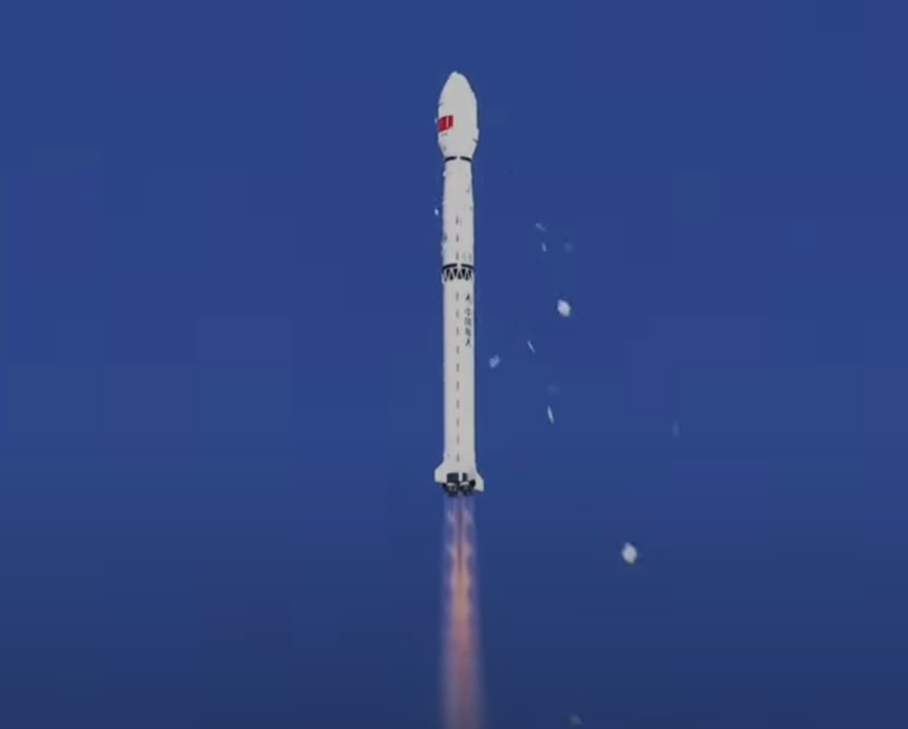
The Long March 4C, also known as Chang Zheng 4C, CZ-4C and LM-4C, is a Chinese orbital launch vehicle built by the Shanghai Academy of Spaceflight Technology. It flies from the Jiuquan, Taiyuan and Xichang launch centres and consists of three stages, all of which use storable rather than cryogenic propellants — dinitrogen tetroxide and UDMH — placing it firmly in the older generation of the Long March family. It is a configuration derived from the three-stage Long March 4B, from which it differs in two specific respects: a restartable third stage and a larger payload fairing. That restart capability is what allows more flexible insertion manoeuvres than its predecessor. Before it flew it was designated Long March 4B-II, which is why its first launch is often mistaken for a Long March 4B. It stands 45.8 m tall on a 3.35 m core and weighs 250,000 kg at liftoff. Quoted capability is 4,200 kg to low Earth orbit, 2,800 kg to Sun-synchronous orbit and 1,500 kg to geosynchronous transfer orbit. The first stage uses four YF-21C engines, the second a YF-24C assembly with a YF-22C main engine and four YF-23C verniers, and the third two YF-40A engines.
History
A variant born under another name
The Long March 4C was conceived as an evolution of the Long March 4B and still carried the designation Long March 4B-II at the time of its maiden flight, which is why that first launch is frequently misattributed to the 4B. Its two substantive differences from the model it derives from — the restartable third stage and the larger fairing — define its niche on their own: observation and reconnaissance missions that require precise placement into Sun-synchronous or low Earth orbits.
Maiden flight and typical payloads
The first CZ-4C lifted off on 26 April 2006 from Launch Area 7 at the Taiyuan Satellite Launch Center with the Yaogan 1 satellite. It went on to become the standard launcher for the Yaogan series of synthetic-aperture radar satellites — Yaogan 3, Yaogan 8 on 15 December 2009, Yaogan 9A/9B/9C, Yaogan 10 — and for the Fengyun polar-orbiting meteorological satellites, starting with Fengyun 3A on 27 May 2008. Over the years its launches spread to the Jiuquan and Xichang complexes as well.
Reliability
On 1 September 2016 a Long March 4C failed for reasons that were never made public: it blasted off from the Taiyuan Satellite Launch Center in Shanxi but failed to insert the Gaofen 10 observation satellite into its designated orbit. It is one of only two failures for the model. The cumulative record stands at 59 launches with 57 successes, and the most recent recorded flight is that of 17 April 2026, when a CZ-4C placed the Daqi-2 high-precision greenhouse gas detection satellite into Sun-synchronous orbit from Jiuquan. Twenty years after its debut the vehicle remains active despite belonging to the hypergolic generation that the new kerolox family is meant to replace.
Launch timeline
| Date | Launch site | Outcome | Payload |
|---|---|---|---|
| Apr 17, 2026, 4:10 AM | Launch Area 94 (SLS-2 / 603) | Success | Daqi-2 (DQ-2), also known as the Atmospheric Environment Monitoring Satellite/AEMS, is the second of follow-on series of Chinese satellites to the GF-5 series for high resolution atmospheric environment monitoring of greenhouse gases, such as atmospheric aerosol and carbon dioxide. |
Images