Family: Ariane
Ariane 5
Launch statistics
- 0
- Total launches
- 0
- Successes
- 0
- Failures
- —
- Success rate


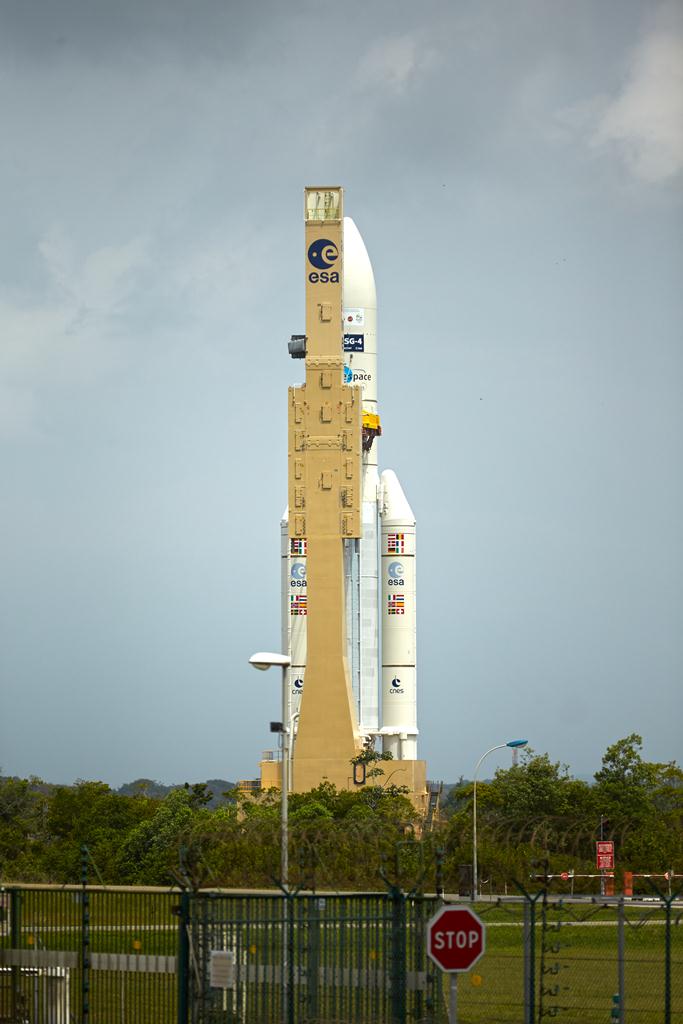


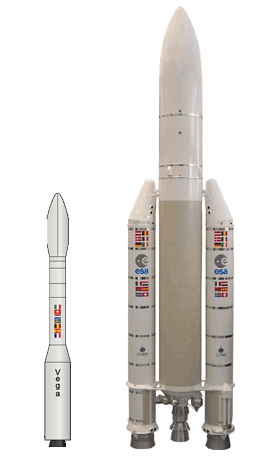


Ariane 5 was the European heavy-lift launcher that for almost three decades gave the European Space Agency its own access to geostationary orbit from French Guiana. After a catastrophic debut in 1996 it strung together 82 consecutive successes and bowed out on 5 July 2023, having placed the James Webb Space Telescope among its payloads.
Three-view drawing
History
The vehicle was conceived as an expendable launcher at CNES, the French space agency, in cooperation with European partners, and its manufacture was led by Aérospatiale and later ArianeGroup at the head of a multi-country contractor consortium. Although counted within the Ariane family, it is not a direct derivative of its predecessor. It was meant to launch the Hermes crewed spaceplane, which is why it was rated for human spaceflight, a requirement that shaped its design even though Hermes never flew. Operated by Arianespace, it lifted off from the Guiana Space Centre and served geostationary transfer orbit, low Earth orbit and escape trajectories.
The cryogenic main stage, known as the EPC, consisted of a tank 5.4 m in diameter and 30.5 m tall split into two compartments, one for liquid oxygen and one for liquid hydrogen, with a Vulcain 2 engine of 1390 kN vacuum thrust at its base. Two solid propellant boosters of roughly 277 tonnes each were attached to its sides, delivering on the order of 7080 kN and burning for 130 seconds before dropping into the ocean. Across the successive versions — G, G+, GS, ECA and ES — the stack ranged between 46 and 52 m in height, for a liftoff mass of 777 000 kg. The SYLDA system allowed two large communications satellites to share a flight, and SPELTRA up to three somewhat smaller payloads, with small auxiliary passengers riding on the ASAP platform.
The first flight, on 4 June 1996, was a famous failure: the rocket self-destructed 37 seconds after launch because of a fault in the control software. What followed was very different. Between 9 April 2003 and 12 December 2017 it recorded 82 consecutive successful launches, a streak that cemented its commercial standing, and it flew 117 times in all.
After the flight of 15 August 2020, Arianespace signed the contracts for its final eight launches before handing over to Ariane 6, in development since 2014 and first launched in 2024. One of those closing flights, on 25 December 2021, sent the James Webb Space Telescope towards its halo orbit at the Sun-Earth L2 point. The last Ariane 5 mission lifted off on 5 July 2023.
Launch timeline
| Date | Launch site | Outcome | Payload |
|---|
Versions
| Ariane 5G | Ariane 5ECA | Ariane 5G+ | Ariane 5GS | Ariane 5ES | Ariane 5ECA+ | Ariane 5ME | |
|---|---|---|---|---|---|---|---|
| First launch | June 4, 1996 | December 11, 2002 | March 2, 2004 | August 11, 2005 | March 9, 2008 | August 6, 2019 | — |
| Last launch | September 27, 2003 | November 26, 2019 | December 18, 2004 | December 18, 2009 | July 25, 2018 | July 5, 2023 | — |
| Diameter | 5.4 m Best value in this row | 5.4 m Best value in this row | 5.4 m Best value in this row | 5.4 m Best value in this row | 5.4 m Best value in this row | 5.4 m Best value in this row | — |
| Stages | 2 Best value in this row | 2 Best value in this row | 2 Best value in this row | 2 Best value in this row | 2 Best value in this row | 2 Best value in this row | — |
| LEO capacity | 16,000 kg | — | — | — | 21,000 kg Best value in this row | — | — |
| GTO capacity | 6,900 kg | 11,115 kg | 7,100 kg | 6,600 kg | — | — | 11,500 kg Best value in this row |
| Reusable | No | No | No | No | No | No | No |
Images