Ariane 5 version
Ariane 5ES
Ariane 5 version pairing the 5ECA core and boosters with the restartable EPS upper stage and its Aestus engine. It launched all five ATV cargo ships to the International Space Station and three quartets of Galileo satellites, flying eight times from 2008 to 2018 without a failure.

- March 9, 2008
- First launch
- 21,000 kg
- LEO capacity
- No
- Reusable
History
The Ariane 5ES (Evolution Storable) was the Ariane 5 version built for missions that required the upper stage to be reignited in flight, something the cryogenic stage of the commercial versions could not do. According to ESA, it was derived from the generic Ariane 5 but combined a more powerful lower composite with a small upgraded storable propellant stage that allowed reignition and long coast phases. In practice it took the core stage and boosters of the Ariane 5ECA, with all their performance improvements, and replaced the cryogenic ESC-A upper stage with the restartable EPS previously flown on the Ariane 5GS.
The EPS (Étage à Propergols Stockables, storable propellant stage) carried 10 t of propellant — monomethyl hydrazine and nitrogen tetroxide — and its Aestus engine delivered 2.7 t of thrust, according to ESA. Above it sat the Vehicle Equipment Bay (VEB), the 'brain' that autonomously controlled every system throughout the mission. The lower composite was identical to that of the Ariane 5ECA: a core stage powered by the Vulcain 2 engine burning liquid hydrogen and liquid oxygen, flanked by two solid rocket boosters. Unlike the HM7B engine of the cryogenic stage, which can only be started once in space, the Aestus burned a toxic but stable propellant mixture that could be stored for long periods, allowing the stage to operate for several hours after liftoff. The EPS restart capability had already been demonstrated on the flight launched on 5 October 2007 (called V26 in the English-language Wikipedia; ESA and Arianespace number it V178), though only as an engine test performed after the payloads had been deployed.
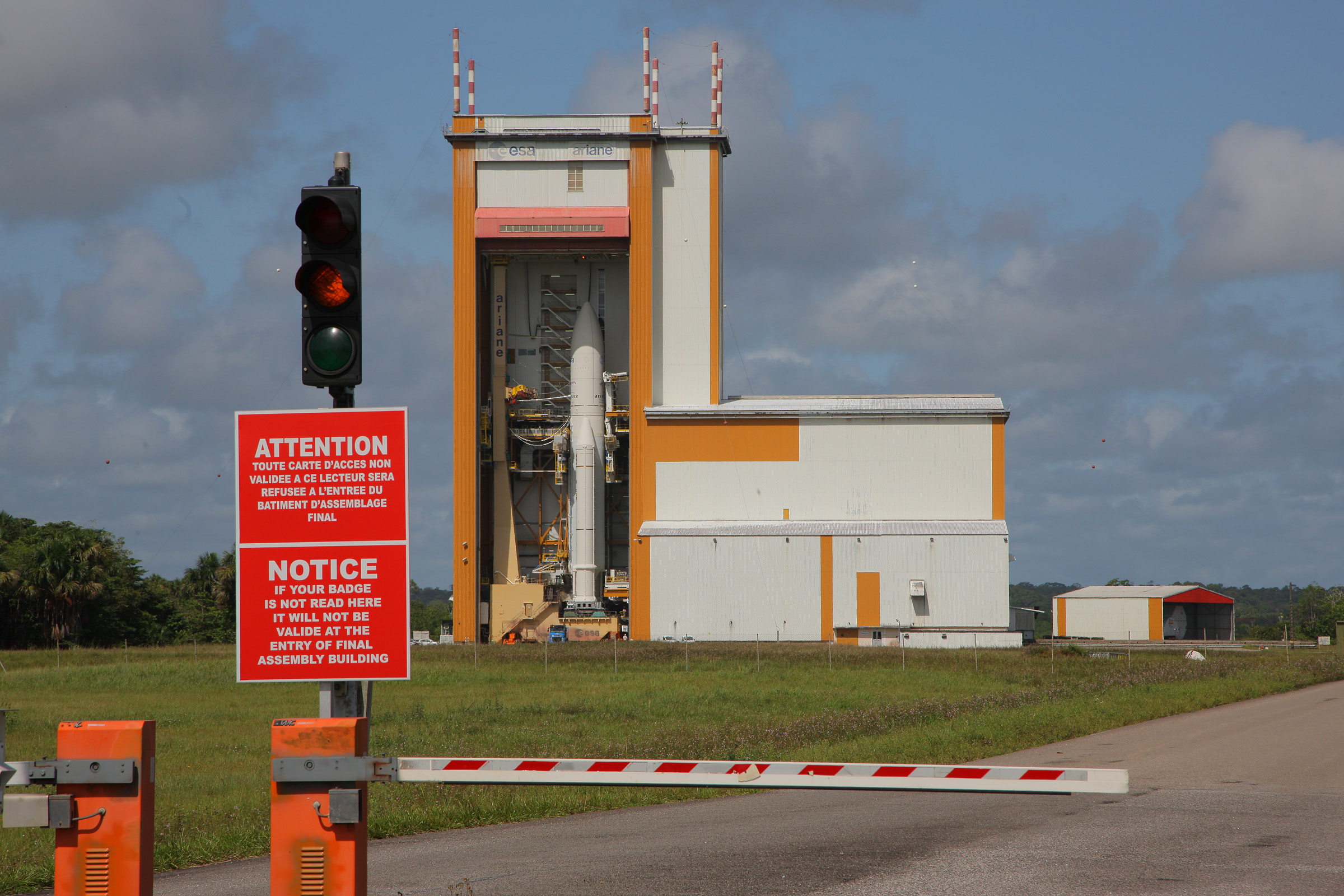
The 5ES made its debut on 9 March 2008 (flight V-181) carrying the first Automated Transfer Vehicle (ATV), Jules Verne, to the International Space Station. At 19,360 kg, the ATV was the heaviest payload yet launched by a European launch vehicle, and the flight made Kourou the third launch site, after Baikonur and Cape Canaveral, to send a payload to the station. It was also the first operational Ariane mission to restart the upper stage: two burns placed the ATV in a circular parking orbit, and a third burn after separation de-orbited the stage, a procedure repeated on every ATV flight. The version delivered the ATV to a 260 km circular low Earth orbit inclined at 51.6°, and its estimated low Earth orbit capacity was 21,000 kg.
The other four ATVs followed: Johannes Kepler (V-200, 16 February 2011, 20,050 kg), Edoardo Amaldi (VA-205, 23 March 2012, 20,060 kg), Albert Einstein (VA-213, 5 June 2013, 20,252 kg) and Georges Lemaître (VA-219, 29 July 2014, 20,293 kg), the final ATV launch. For these missions the launcher used the long fairing and flew with the EPS only half full.
From 2012 the Ariane 5ES Galileo was developed to speed up the deployment of Europe's satellite navigation system: it had to carry a much lighter payload, about three tonnes, but to a far higher altitude. ESA lists its differences as the medium Earth orbit destination, the medium-length fairing, a dispenser carrying four satellites, a lighter VEB structure that improved performance, a fully loaded EPS, and thermal and electrical adaptations for a ballistic phase of more than four hours, compared with about one hour on the ATV missions. The 418 kg dispenser, built by Airbus Safran Launchers, released the satellites in pairs 20 minutes apart using a pyrotechnic system, after which the stage was left in a stable graveyard orbit that does not interfere with the Galileo orbit.
The first Galileo flight, VA-233 on 17 November 2016, was the sixth Ariane 5ES launch: it delivered 3,276 kg to a circular orbit at an altitude of 22,922 km, of which 2,858 kg were the four satellites of 714 or 715 kg each. That launch was also the 75th consecutive Ariane 5 success, beating the Ariane 4 record. It was followed by VA-240 (12 December 2017, satellites FM-19 to FM-22) and VA-244 (25 July 2018, FM-23 to FM-26), the last flight of the version and of the Aestus engine, which there made its 33rd flight on the Ariane 5ES and earlier Ariane 5 versions. On that mission the Aestus ignited 9 min 19 s into flight for the first of the two burns needed for injection. In all, the Ariane 5ES flew eight times between 2008 and 2018 without a single failure.
Multimedia


-1600.webp)
-1600.webp)
-800.webp)
-1600.webp)
-1600.webp)
-1600.webp)

-800.webp)
-1600.webp)
-1600.webp)