Astronauts: United States Project Mercury, ca. 1960
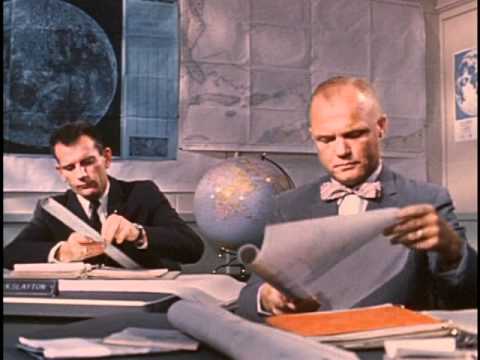
Video from the channel PublicResourceOrg about Project Mercury, linked on its Above Ten Thousand entry. Duration: 27:05. Language: English. Video type: Archive footage.
What it shows
A NASA film, preserved by the National Archives, about the selection and training of the first seven Project Mercury astronauts. It opens with the introductory press conference and explains the process: of the records of 473 Navy, Marine Corps, and Air Force test pilots, 110 met the basic requirements (test pilot school graduate, 1,500 flight hours, jet qualification, engineering training, under 40 years old, and no more than 5 feet 11 inches tall). 69 were called in; six turned out to be too tall, 16 declined, and 47 volunteered, of whom 32 moved on to testing. At the Lovelace Clinic in Albuquerque they underwent exhaustive medical exams, and at the Wright Air Development Center in Dayton, stress and psychological tests: a centrifuge at eight g's, a pressure chamber at 65,000 feet, a treadmill up to 180 beats per minute.
When and where it was filmed
Footage shot around 1959 and 1960: the April 9, 1959 press conference in Washington, McDonnell Aircraft, Langley Field, the Lewis Research Center in Cleveland, Wallops Island, the Bethesda naval medical center, the Johnsville centrifuge (Pennsylvania), Little Creek (Virginia), and Cape Canaveral.
Context
The chosen seven were Donald K. Slayton, Alan B. Shepard, Walter M. Schirra, Virgil I. Grissom, John H. Glenn, Leroy G. Cooper, and Scott Carpenter. At Langley, the Space Task Group led by Robert Gilruth organized their training, and each was assigned an area: Grissom flight control, Cooper ballistic flights with the Redstone, Shepard tracking and recovery, Glenn the cockpit, Carpenter communications and navigation, Slayton the Atlas, and Schirra the capsule environment. The film shows the selection of the pressure suit, the calorimeter at 114 °F, two hours at 3% carbon dioxide, Glenn withstanding 14 g in his molded seat, and diving with Underwater Demolition Team 21. It closes with an animation of the planned orbital mission and the Big Joe test flight, in which the capsule reached 100 miles and was recovered in the Atlantic.