Project Mercury · NASA · Uncrewed
Mercury-Redstone 1
- November 21, 1960
- Launch date
- 0 min
- Duration
- Failure
- Outcome
-1600.webp)


Mercury-Redstone 1 (MR-1) was the first attempt to fly together the two pieces on which the suborbital stage of Project Mercury depended: the McDonnell-built Mercury spacecraft and the Mercury-Redstone launch vehicle, the human-rated adaptation of the United States Army ballistic missile. The uncrewed mission was meant to qualify that combination on a ballistic trajectory before a primate and then an astronaut rode inside it. The attempt was made on November 21, 1960, from Launch Complex 5 at Cape Canaveral, with spacecraft number 2 and the first Redstone delivered to NASA. The flight never happened. Ignition was followed at once by engine cut-off, and the vehicle, barely clear of the pad, settled back onto it with only slight damage. Because the spacecraft received the cut-off signal, it started its emergency sequence: the escape tower fired and the recovery sequence began with the rocket still on the ground. The spacecraft itself was undamaged and was recovered for reuse. NASA records list the mission with a duration of two seconds, zero altitude and zero distance. The investigation pointed at a ground electrical problem rather than at the rocket. Premature engine cut-off was caused by the premature loss of electrical ground power to the booster, which in turn came from the power and control connectors separating from the ground equipment ahead of time. No flight system as such had failed, so the remedy was quick: another Redstone was prepared and the same spacecraft was reworked. The attempt was repeated twenty-eight days later. On December 19, 1960, Mercury-Redstone 1A flew and was completely successful, meeting the objectives MR-1 had left open: qualifying the spacecraft for space flight and qualifying the flight system for the primate flight scheduled shortly afterwards. With that, the programme recovered the schedule that led to the flights of Ham, of Alan B. Shepard and of Virgil I. Grissom. MR-1 is remembered as one of the most quoted episodes of NASA early history, and also as one of the most embellished in popular retellings. The institutional sources used for this entry describe it soberly: engine cut off, vehicle settled back on the pad with slight damage, escape and recovery sequence started by the spacecraft, and the spacecraft recovered intact.
Payload
The payload of MR-1 was a production Mercury spacecraft rather than a boilerplate test article: capsule number 2, assigned to the mission with the stated objective of qualifying the spacecraft/Redstone combination. NASA's records of the uncrewed Mercury missions list it as the payload alongside launch vehicle Redstone number 1 and register the crew as unmanned: neither a pilot nor an animal was aboard, unlike MR-2, which two months later would carry the chimpanzee Ham. The capsule was delivered on 30 June 1960 to the Marshall Space Flight Center in Huntsville for compatibility tests with the Redstone launch vehicle and was shipped to Cape Canaveral on 23 July 1960; the launch was attempted on 21 November from pad LC-5. It flew with its escape tower fitted and its automatic abort and recovery sequence armed, which is precisely what fired when the spacecraft received the engine cut-off signal with the rocket still on the pad. The spacecraft was undamaged and was recovered for reuse: reworked after the failed attempt, that same capsule number 2 flew MR-1A on 19 December 1960, with twenty-one weeks of preparation counted from its initial delivery to that launch. The institutional sources consulted for this entry give no payload mass and no detail of the onboard instrumentation.
History
An Army missile turned into a launch vehicle for people
The rocket that was to make its debut on MR-1 had not been born to carry people. Development of the Redstone missile began directly after the transfer of the Fort Bliss rocket team to Huntsville, Alabama, in 1950, and rested on two inheritances: the Army Hermes C-1 project and German experience with the V-2. In July 1950 the Army Guided Missile Center recommended further development of the proposed missile together with the North American XLR43-NA-1 engine; the contract to modify that engine was awarded on March 27, 1951, the development programme began on May 1 of that year, and on April 8, 1952, the new missile was assigned the name Redstone. Chrysler was issued a letter contract as prime contractor for production on October 28, 1952.
The Redstone was designed as a surface-to-surface ballistic missile with an original range of 500 miles, later reduced to 200. Its powerplant, the NAA 75-110, derived from the XLR43-NA-1 liquid-propellant engine originally designed for the Air Force Navaho project. Rocketdyne, the North American Aviation division, was asked to upgrade it to accommodate an increase in payload from 3,000 to 6,900 pounds, and the designation came from that work, referring to 75,000 pounds of thrust. Successive improvements produced seven engine types, designated A-1 through A-7, reaching a final performance of 78,000 pounds of thrust for a duration of 117 seconds, with a cylindrical combustion chamber instead of the spherical V-2 design.
The airframe was developed in-house at the Army Guided Missile Development Division, with Chrysler as prime contractor. William A. Mrazek, a Peenemunde veteran, was placed in charge of a structure built around pressurized aluminium propellant tanks; the tail unit was a riveted aluminium assembly with four stabilizing fins and air rudders, with carbon jet vanes extending into the exhaust stream. The first Redstone research and development test flight took place on August 20, 1953, at Cape Canaveral, and first operational deployment followed on June 18, 1958. Between August 1953 and November 1958, 37 Redstone missiles were fired and only 13 experienced any sort of malfunction. By the standards of the day this was a well understood and dependable rocket, and that is precisely why NASA looked at it.
From missile to a vehicle rated to carry people
On October 7, 1958, NASA formally organized Project Mercury with three aims: to place a crewed capsule in orbital flight around the Earth, to investigate the human reaction to that new environment, and to recover capsule and pilot safely. The previous day a tentative agreement had been reached with the Army Ordnance Missile Command under which the Army would supply ten Redstone and three Jupiter vehicles to the crewed programme. On January 8, 1959, NASA supplied the funds for eight Redstones and the Army Ballistic Missile Agency began production planning of the Mercury-Redstone. In January 1959 the funding reached the Army Ordnance Missile Command at the arsenal, and Wernher von Braun placed Joachim P. Kuettner in charge of the Mercury-Redstone Project Office.
Rating a ballistic missile for human spaceflight was not an easy project. Requirements included launching a two-ton payload to an apogee of 100 nautical miles and, above all, meeting demanding criteria of safety during launch, adequate human factors consideration, and the necessary performance margins. A key development decision was to adopt the Jupiter C variation of the Redstone: its design included a propellant tank six feet longer, a lighter overall structure, and improved performance capable of 78,000 pounds of thrust. The elongated tanks gave the vehicle an engine burn time of 143.5 seconds, twenty seconds more than the Redstone. Because the Mercury-Redstone configuration was less aerodynamically stable, ballast had to be added to the instrument compartment.
On July 1, 1960, a core group from the Army Ballistic Missile Agency transferred from the Army to NASA, formally creating the Marshall Space Flight Center, which took on overall responsibility for the Mercury-Redstone launch vehicles. By October of that year a status report on Marshall involvement in Mercury noted that the first two Mercury-Redstones had been assembled by the centre itself, with many components fabricated there, and that Chrysler had assembled an additional six. Of the eight vehicles, the first four had been static fired, and the first Mercury-Redstone was already on the launch pad at Cape Canaveral after a capsule-booster compatibility checkout in Huntsville. The first Mercury-Redstone static test firing had taken place in January 1960.
Preparing the flight
MR-1 was the first of three qualification flights planned for the Mercury-Redstone vehicle. Its stated objective was to qualify the spacecraft and Redstone combination, and for that it was assigned spacecraft number 2, delivered to the launch site on July 23, 1960, and Redstone launch vehicle number 1, which arrived at Cape Canaveral on August 3, 1960. Two days earlier, on August 1, the Marshall Space Flight Center had published the final standard trajectory for MR-1, the document setting out the expected flight profile.
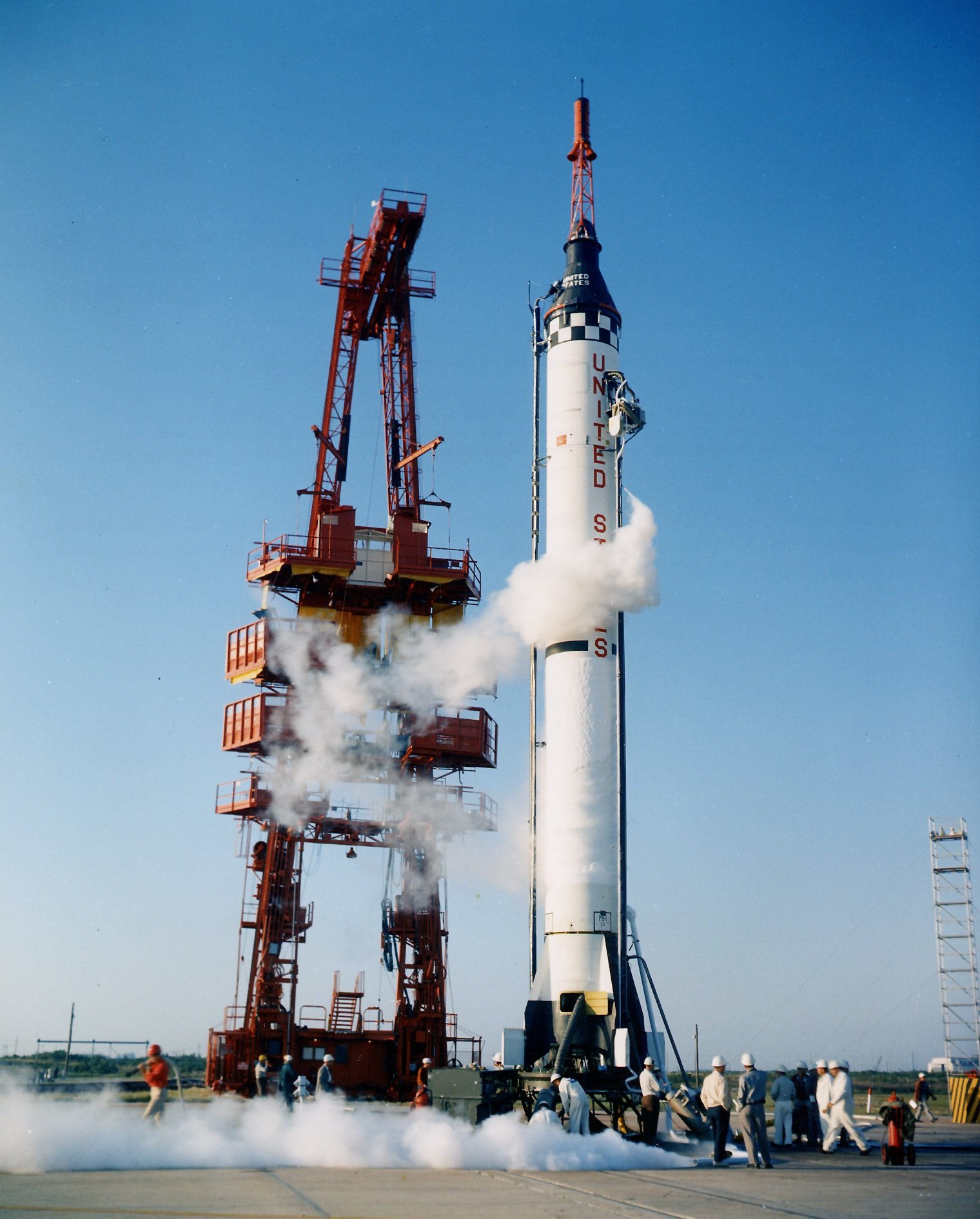
Operational paperwork was closed out through the autumn. On September 19, 1960, the format of subject matter coverage for the first Mercury-Redstone postlaunch report was issued, a document covering a full range of topics related to the mission and due within five days after launch; the instruction came from Robert R. Gilruth, director of Project Mercury. On October 18 the mission rules for MR-1 were issued, together with control centre operations, flight control procedures and countdown, and a revision was published on November 1. That same October, on the 24th, the mobile pad egress tower known as the cherry picker was delivered to Cape Canaveral. During MR-1 and its repeat MR-1A the complete Mercury Control Center staff also operated for the first time: the mission doubled as a rehearsal of the control organisation.
The first launch attempt never reached ignition. It was set for November 7, 1960, and was cancelled as a result of a helium leak in the spacecraft reaction control system relief valve. The count moved two weeks down the calendar.
November 21, 1960: a flight of a few inches
On November 21, 1960, an attempt was made to launch Mercury-Redstone 1 from Cape Canaveral. The uncrewed mission was unsuccessful because premature cut-off of the launch vehicle engines activated the emergency escape system when the vehicle was only about one inch off the pad. That is the figure given by the official chronology of the project; the Marshall account of the Mercury-Redstone vehicle says only that the vehicle rose a few inches before the engines shut down. Popular accounts have fixed the episode under the nickname of the four-inch flight, a label worth handling with care, because NASA sources themselves do not agree on the height reached.
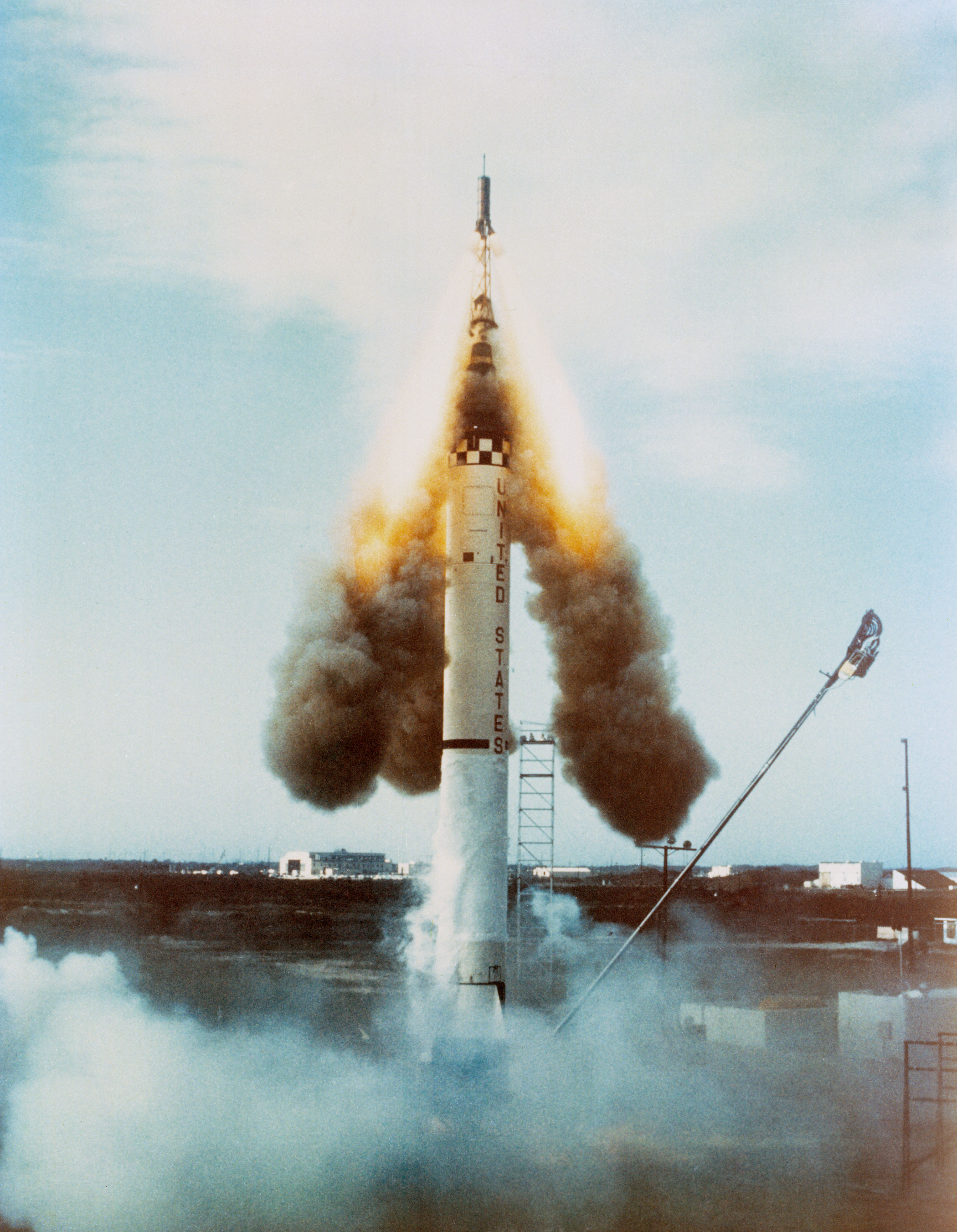
In the NASA record of uncrewed Mercury missions, MR-1 appears with a duration of two seconds, an altitude of zero statute miles and a distance of zero statute miles, and is listed flatly as a failure. It was the driest possible outcome: the rocket rose, shut down and settled back.
What happened next on the pad
The launch vehicle settled back on the pad with only slight damage. But the cut-off did not stay inside the rocket: the spacecraft received the cut-off signal and, on receiving it, started the sequence it was programmed to run in an emergency. The escape tower fired and the recovery sequence began, with the launch vehicle still on the ground. The spacecraft was undamaged and was recovered for reuse.
This is the point where popular retellings usually add details that the institutional sources used for this entry do not record: neither the project chronology nor the vehicle history published by Marshall describes the trajectory of the escape tower once fired, nor the later behaviour of the landing system over the pad, nor the hours that followed at the launch complex. What is documented is the material balance, and it is remarkable: slight damage to the launch vehicle and none to the spacecraft. The project launch site summary sets it down in a single dry line about spacecraft number 2, reworked after the MR-1 launch attempt in which the launch vehicle malfunctioned.
The technical cause: ground power lost too early
The investigation found no failure in the flight systems. Premature engine cut-off had been caused by the premature loss of electrical ground power to the booster. The origin of that loss, according to the vehicle history published by Marshall, was the premature disconnection of the power and control connectors from the ground equipment: connectors that were meant to separate from the rocket at lift-off and did so ahead of time, or in a sequence the system read as a cut-off command.
The diagnosis had two immediate consequences. The first was that nothing in the rocket or the spacecraft had to be redesigned: the problem lay in the interface with the ground equipment. The second was that the capsule had done exactly what was asked of it. Faced with an engine cut-off signal, the spacecraft fired the escape tower and started recovery; the automatic abort system worked, even though the situation that triggered it was a rocket standing still on its own pad.
The institutional sources used for this entry describe the cause in these terms and do not detail the specific modification made to the connectors for the next attempt. That point is declared a gap here: the source that develops it, the corresponding chapter of the official Project Mercury history, is not reachable on NASA servers at the time of writing.
From MR-1 to MR-1A: the repeat of December 19, 1960
NASA did not wait. On December 3, 1960, Redstone launch vehicle number 3 was shipped to Cape Canaveral for the Mercury-Redstone 1A mission, and spacecraft number 2, reworked after the failed attempt, went back to the pad; the launch site summary counts twenty-one weeks of preparation for it from initial delivery to launch.
MR-1A was launched from Cape Canaveral on December 19, 1960, as a repeat of the November 21 mission, and was completely successful. It was, strictly speaking, the third attempt to accomplish the objectives established for that flight: the first, on November 7, had been cancelled by the helium leak; the second, on November 21, could not be completed because of the premature engine cut-off. The objectives of MR-1A were to qualify the spacecraft for space flight and to qualify the flight system for a primate flight scheduled shortly thereafter.
Close attention was given to the spacecraft and launch vehicle combination as it went through the flight sequences: powered flight, acceleration and deceleration, performance of the posigrade rockets, performance of the recovery system, performance of the launch, tracking and recovery phases, retrorocket operation in a space environment, and operation of the instrumentation. Except that the launch vehicle cut-off velocity was slightly higher than normal, all flight sequences were satisfactory: tower separation, spacecraft separation, spacecraft turnaround, retrofire, retropackage jettison and landing system operation occurred or were controlled as planned. The spacecraft reached a maximum altitude of 130.68 statute miles, a range of 234.8 statute miles and a speed of 4,909.1 miles per hour. Fifteen minutes after landing in the Atlantic Ocean the recovery helicopter picked up the spacecraft. The uncrewed mission record lists MR-1A with a duration of 15 minutes and 45 seconds, a maximum dynamic pressure of 560 pounds per square foot and a maximum acceleration of 12.4 g.
What MR-1 meant for the programme
The MR-1 failure did not change the architecture of the programme, but it did change its schedule and its mood. Once the attempt was reordered, the suborbital sequence moved fast: on January 31, 1961, MR-2 carried the chimpanzee Ham, recovered safely after helping to test the spacecraft life support system, although a malfunction made the engine operate at a higher thrust level and the capsule impacted beyond the target area. Because of that thrust issue the Marshall team decided to insert an extra booster development mission, MR-BD, into the schedule to minimise risk; it flew as a complete success on March 24, 1961. The price of that caution was paid in headlines: the delay let the Soviet Union take them, as Yuri Gagarin became the first human to orbit the Earth on April 12.
On May 5, 1961, MR-3 carried Alan B. Shepard Jr., the first American in space, and on July 21 MR-4 carried Virgil I. Grissom on the flight that closed the Mercury-Redstone programme and opened the next step, orbital flight on the more powerful Mercury-Atlas. The Redstone missile programme itself was deactivated in June 1964.
Seen from there, MR-1 served a purpose no successful flight would have served in the same way: it forced attention onto the interface between vehicle and ground equipment before there was a man inside the capsule, and it demonstrated on the pad itself that the escape system responded to an engine cut-off signal. It was a cheap failure, and in a programme about to place people on top of a missile, that is exactly what an uncrewed qualification flight is for.
Images
Elsewhere
- Amusing PlanetThe Four Inch Flight: The Comical Beginning to Project Mercury ↗
- Daily KosMuseum Pieces: Mercury Redstone 1, the Four-Inch Flight ↗
- Spaceflight HistoriesThe Four-Inch Flight: Mercury-Redstone 1 Launch Failure ↗
- Drew Ex MachinaThe Infamous Launch Abort of NASA's Mercury-Redstone 1 ↗
- FlickrMercury Redstone (MR-1), launch, November 21, 1960 ↗
- FlickrJohn Glenn and the Space capsule: Mercury/Redstone 1 (MR-1), November 1960 ↗
- FlickrMercury-Redstone 1 and 1A (Mercury No.2) Capsule ↗
- GAD CollectionMercury Redstone 1, Pre launch ↗