Project Mercury · NASA · Uncrewed
Little Joe 1B
- January 21, 1960
- Launch date
- 8 min
- Duration
- Success
- Outcome

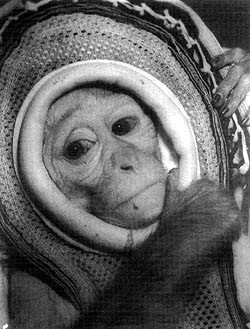


Little Joe 1B (LJ-1B) was an uncrewed Project Mercury test flight launched from Wallops Island, Virginia, on 21 January 1960. Its purpose was to prove the Mercury launch escape system at the harshest moment of a real ascent — the point of maximum dynamic pressure — and it carried a boilerplate capsule with a rhesus monkey named Miss Sam aboard. It was not a spaceflight but a safety experiment, and one of the most consequential run before any human being was strapped into that cabin. The test itself was not new: it was the third attempt at the same demonstration. Little Joe 1 was lost half an hour before its scheduled launch in August 1959, when an electrical leak fired the escape rocket on the pad; the capsule and tower flew off on a trajectory resembling an off-the-pad abort while the booster stayed on its launcher. Little Joe 1A, on 4 November 1959, flew as planned but its escape motor took several seconds to build thrust, so separation happened at a dynamic pressure of 168 pounds per square foot instead of the roughly 1,000 that characterise the critical phase of an Atlas launch. LJ-1B was scheduled specifically to repeat what had been left undemonstrated. This time it worked. NASA recorded the abort at 1,070 pounds per square foot of dynamic pressure, a peak acceleration of 4.5 g and a velocity of 2,022 miles per hour, with an apogee of about 9 statute miles — 15.0 km — and a range of some 12 miles out to sea. The whole flight lasted 8 minutes 35 seconds, of which 28 seconds were weightless. The capsule descended under parachute and splashed down off the Virginia coast. Miss Sam survived the flight in good condition. A Marine Corps helicopter picked the capsule out of the water and returned it to Wallops Island within about 45 minutes, a turnaround that doubled as a rehearsal of the search-and-recovery procedures Mercury would one day have to run with an astronaut inside. The biomedical element was secondary to the escape test, but it fitted a pattern: the Little Joe series carried animal passengers whenever the available telemetry allowed it. LJ-1B closed the development phase of the series. As of 21 January 1960 the five flights flown or attempted had consumed four of the six boosters North American Aviation had delivered to NASA and five prototype capsules built in the Langley shops; two boosters remained for the qualification phase, and the Space Task Group ordered the refurbishment of a seventh airframe that had been kept at Downey for static loading tests. January's success meant the next flight, Little Joe 5, would be the first to fly a genuine Mercury capsule off the McDonnell production line.
Payload
The payload of LJ-1B was a boilerplate Mercury capsule —a test article with the shape and weight of the real spacecraft but without the systems of an operational one—, of the kind McDonnell and the Langley shops had been building to test recovery and the escape tower; the launch mass associated with the flight was 1,007 kg. Inside rode the flight's only passenger, a female rhesus macaque (Macaca mulatta) named Miss Sam, placed in a moulded fibreglass couch and housed in a container within the capsule; her name echoed that of the macaque Sam, flown seven weeks earlier on Little Joe 2. What was carried served the two aims of the flight: testing the escape system in an abort at maximum dynamic pressure and taking biomedical measurements on the passenger during that jolt, within the scant telemetry of the series, which was supplemented by onboard recording because every capsule launched by Little Joe was recovered. What the payload went through was measured: separation at 1,070 pounds per square foot, a peak acceleration of 4.5 g, 2,022 miles per hour, an apogee of about 9 statute miles (15.0 km) and 28 seconds of weightlessness in a flight lasting 8 minutes and 35 seconds. A Marine Corps helicopter picked up the capsule and returned it to Wallops Island in about 45 minutes; Miss Sam came out of the container in good condition. No serial number is on record: it was a boilerplate test article, not a production spacecraft.
History
A cheap rocket for an expensive problem
The Little Joe series grew out of a very simple sum. When NASA looked for a booster for Project Mercury test flights it found that each Atlas would cost roughly $2.5 million and that even a Redstone ran to about $1 million per launch. Programme managers knew the development campaign would need many shots, and at those prices the schedule was unaffordable. The answer was to design a purpose-built solid-propellant vehicle costing some $200,000 apiece, one that could fly from facilities already standing at Wallops Island instead of competing for a pad at Cape Canaveral.
The idea dated from January 1958, when Max Faget and Paul Purser had worked out on paper how to cluster four solid-fuel Sergeant rockets — routine hardware at Wallops — to push a crewed nose cone above the stratosphere. In August of that year William Bland and Ronald Kolenkiewicz went back to those preliminary designs, and by October a NASA team had drawn up engineering layouts for the booster structure and a suitable launcher. The name came out of the drawings themselves: the first cross-sections showed four holes, which somebody linked to the craps throw of a double deuce, "little joe". Four smaller circles were later added for the Recruit motors, but the nickname stuck, helped along by the four large stabilising fins on the airframe. The name is generally attributed to Faget at the Langley Research Center.
Twelve firms answered the November 1958 invitation to bid for the airframe. Langley carried most of the administrative load of the technical evaluation, and the Missile Division of North American Aviation won the contract on 29 December 1958, starting work in Downey, California, on an order for seven booster airframes and one mobile launcher.
What the Little Joe series was asked to prove
The objectives set in late 1958 were fourfold: to study capsule dynamics at progressively greater altitudes, to test the escape system at maximum dynamic pressure, to qualify the parachute system and to verify search and retrieval methods. Early flights were to measure in-flight and impact loads; later ones, critical parameters at 20,000, 250,000 and 500,000 feet. To those minimum aims could be added studies of noise levels, heat and pressure loads, heat-shield separation and the behaviour of animal riders, so long as they fitted within the sparse telemetry available. Since every Little Joe capsule was expected to be recovered, onboard recording simplified the problem considerably.
The booster was the first of only two systems designed solely to qualify crewed capsules, and one of the pioneering operational vehicles built on the rocket-cluster principle. The four modified Sergeants — called Castor or Pollux depending on the modification — and four supplementary Recruit motors could be fired in different sequences, so lift-off thrust varied widely; maximum design thrust approached 230,000 pounds, about 1,020 kilonewtons. That was theoretically enough to place a spacecraft of some 4,000 pounds (1,800 kg) on a ballistic path over 100 miles high, so the ascent profile resembled what a crewed Atlas would impose, and the pull of the tractor escape rocket could be demonstrated under the most severe take-off conditions imaginable.
The test that kept slipping away: LJ-1 and LJ-1A
The max-q abort was the key demonstration. It is the moment when air density multiplied by the square of velocity peaks, when a separating capsule meets the harshest aerodynamic loads, and also the phase of heaviest vibration for the occupant. If the escape tower worked there, it would work at any other point of the ascent.
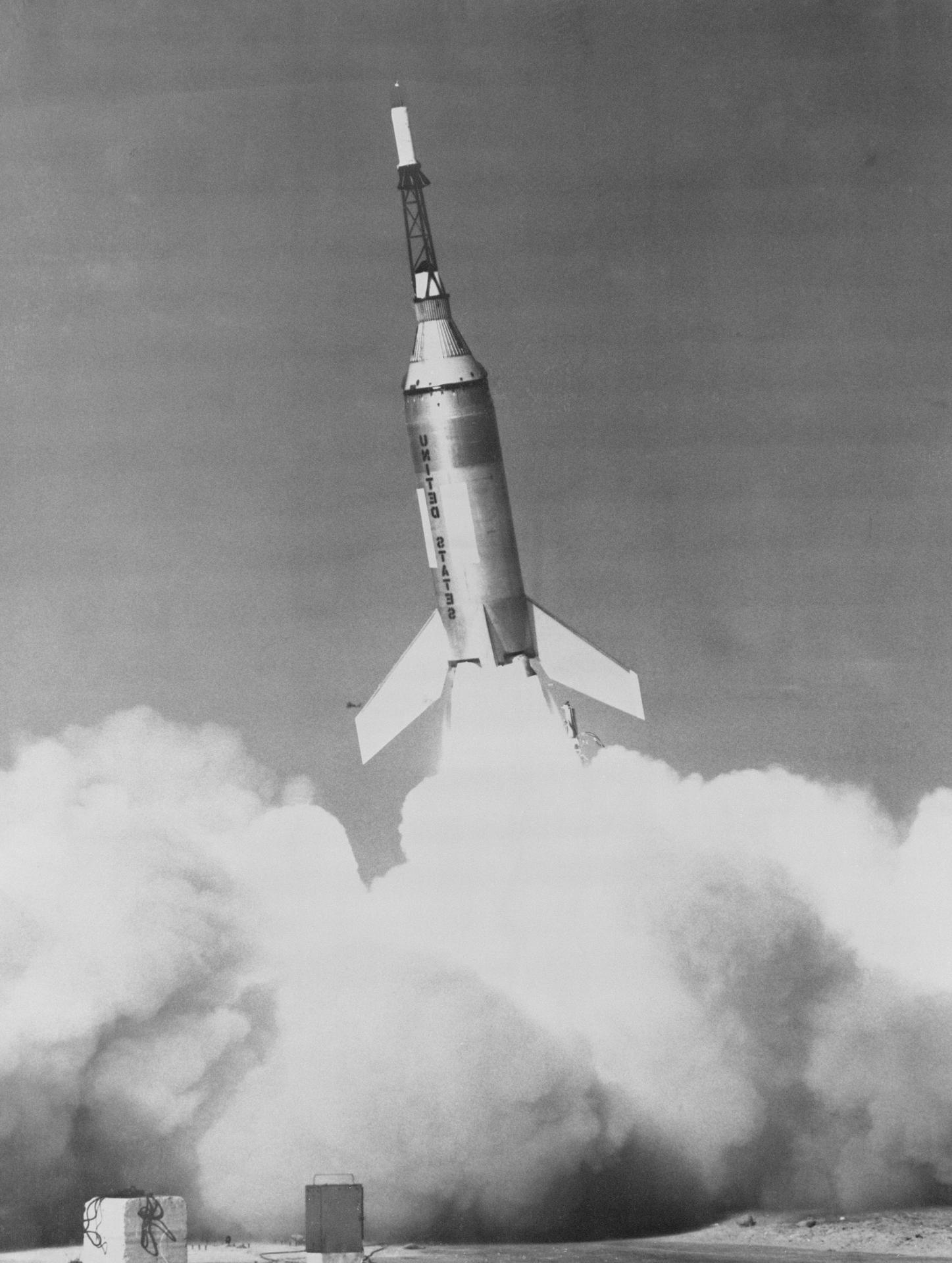
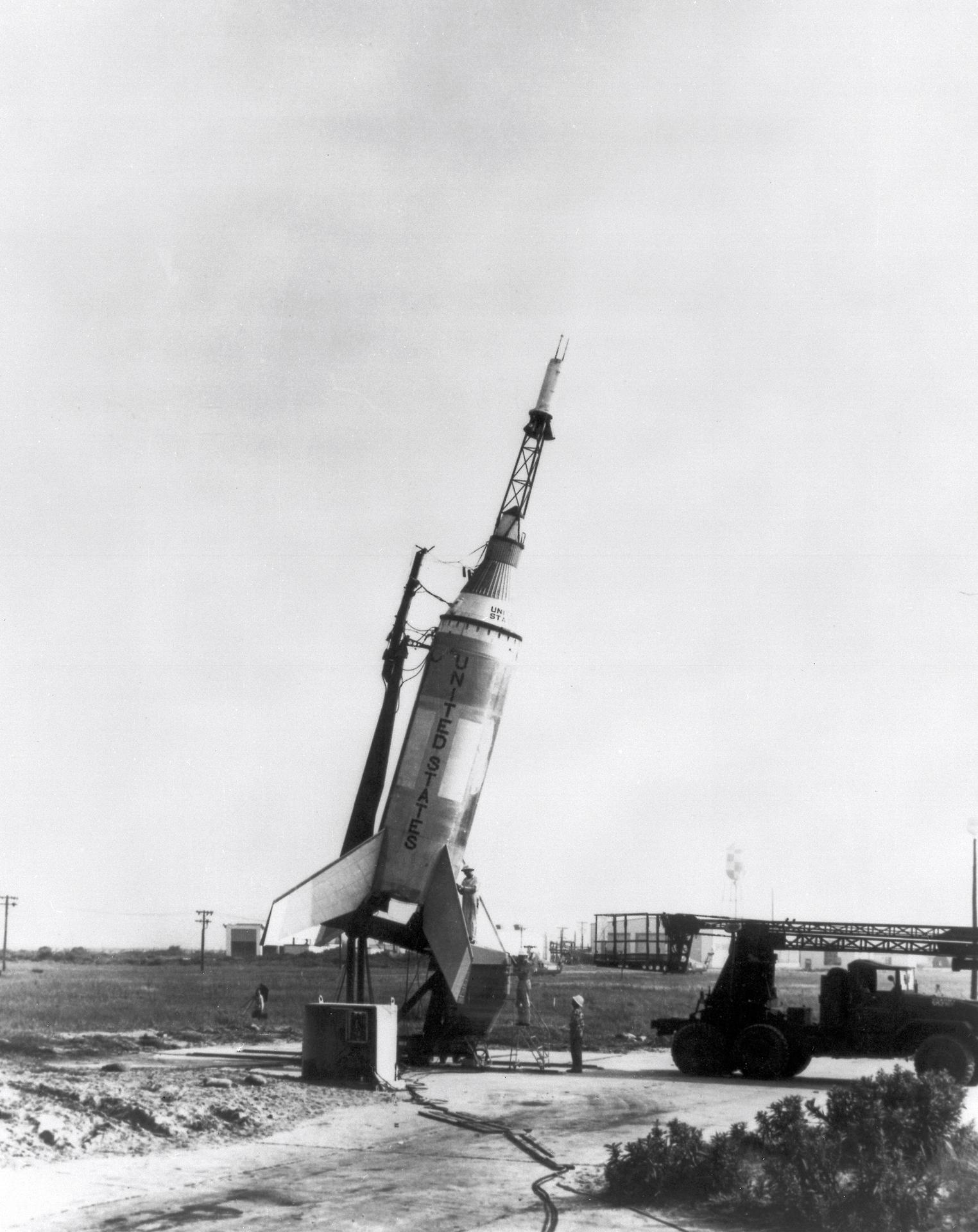
Little Joe 1 was to prove it in August 1959. Thirty-five minutes before launch the area evacuation was proceeding on schedule and the batteries for the programmer and the booster destruct system were being charged when, half an hour before the scheduled time, there was an explosive flash. As the smoke cleared it became clear that only the capsule and tower had flown, on a trajectory resembling an off-the-pad abort, while the booster and adapter clamp ring remained intact on the launcher. Near apogee, at about 2,000 feet, the ring holding tower to capsule released and the small pyrotechnic tower-jettison rocket fired. The accident report, issued on 18 September 1959, blamed the premature ignition of the Grand Central escape rocket on an electrical leak — the transients or "ghost voltages" of a relay circuit — and traced the fault to a coil whose very purpose was to protect biological specimens from too abrupt an abort. The mission met none of its objectives.
Little Joe 1A tried again on 4 November 1959. The pressure-sensing system was to signal the moment the abort dynamic pressure was reached, roughly thirty seconds after lift-off, and fire the explosive bolts separating capsule from booster; the same impulse ignited the escape motor. Everything worked to that point, but the motor took several seconds to build thrust and the abort manoeuvre was not carried out at the intended dynamic pressure: it came in at 168 pounds per square foot, far short of the roughly 1,000 typical of an Atlas ascent. The rest of the flight, through recovery, went off without incident: 9 statute miles of altitude, 11 miles of range, a peak speed of 2,022 miles per hour and a flight time of 8 minutes 11 seconds with a 1,007 kg payload. It was logged as a partial success, and a repeat was planned.
In between, on 4 December 1959, Little Joe 2 tested a primate escape at high altitude with the rhesus monkey Sam aboard: 53 statute miles of apogee, 194 miles of range, a maximum dynamic pressure of 2,150 pounds per square foot, 14.8 g and 3 minutes 13 seconds of weightlessness in a flight of 11 minutes 6 seconds. That mission did meet its objectives, but it was a different test — escape at altitude, not at peak aerodynamic load. The debt was still outstanding.
Miss Sam and the capsule
LJ-1B flew a boilerplate capsule — a full-scale, full-weight test article without the systems of an operational spacecraft — of the kind McDonnell and the Langley shops had been producing to test recovery gear and the escape tower. The launch mass associated with the flight was 1,007 kg, the same figure recorded for its sister tests in the series.
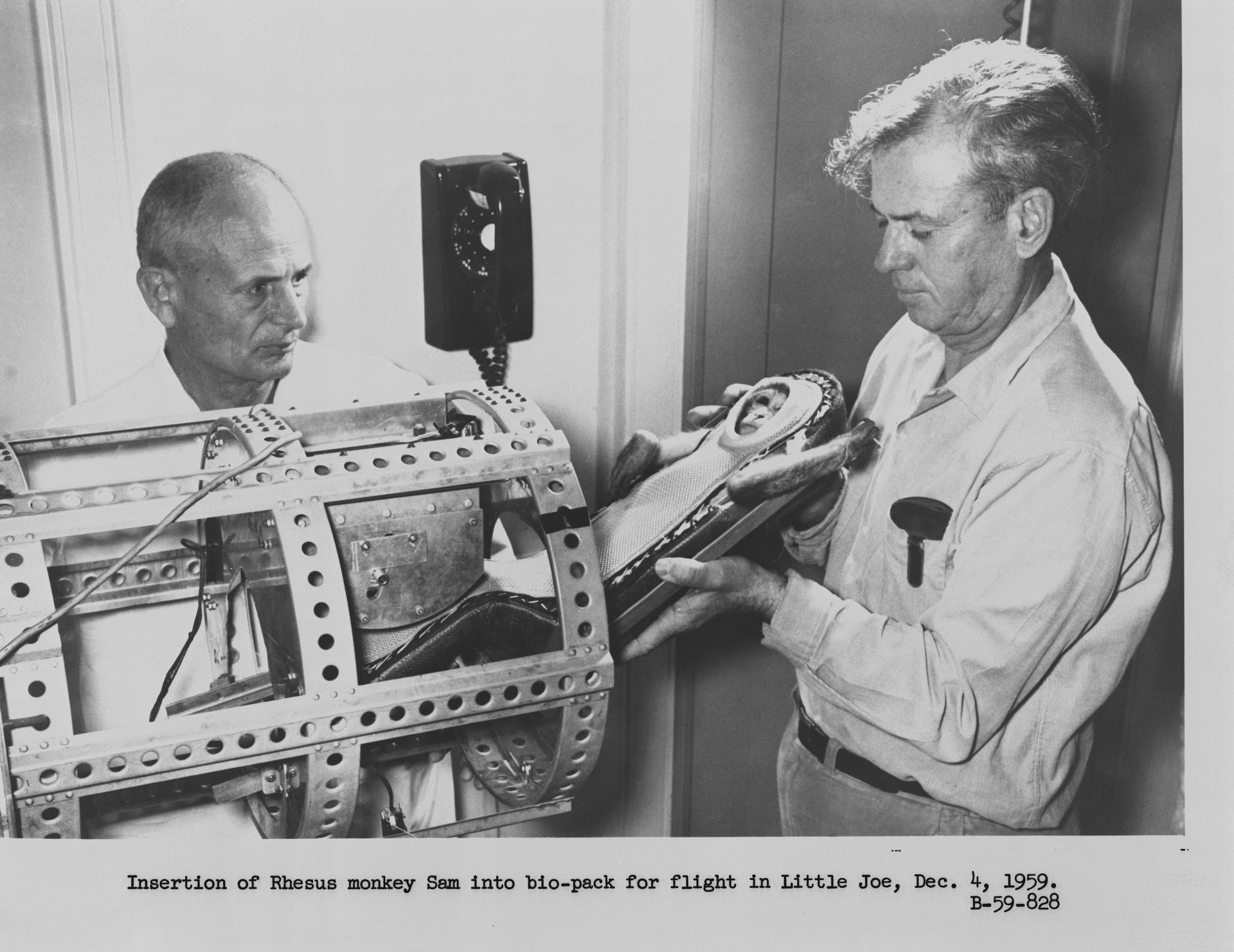
The passenger was a female rhesus monkey (Macaca mulatta) named Miss Sam, secured in a moulded fibreglass couch and placed inside a container within the capsule. Her name echoed that of Sam, the monkey flown seven weeks earlier on Little Joe 2. Carrying a primate and running an escape test were not competing goals: the series' standing instruction was to add observations on animal riders whenever telemetry allowed, and a max-q abort was precisely the occasion to measure what the most violent jolt in the whole flight profile did to a living creature.
The flight of 21 January 1960
The shot went off on 21 January 1960 from the Wallops Island pad, using the fifth Little Joe vehicle of the series. NASA's stated objective was, once again, a "max q abort and escape test".
This time the system did what was asked of it. Separation occurred at a dynamic pressure of 1,070 pounds per square foot — the order of magnitude sought from the outset and reached by neither LJ-1 nor LJ-1A — the capsule took a peak acceleration of 4.5 g and reached 2,022 miles per hour. Apogee came to about 9 statute miles, equivalent to 15.0 km, and range to some 12 miles out to sea. Between burnout and the start of the descent there were 28 seconds of weightlessness. The complete flight, lift-off to splashdown, lasted 8 minutes 35 seconds.
Recovery
The capsule came down off the Virginia coast and was picked up by a Marine Corps helicopter, which returned it to Wallops Island within about 45 minutes. Miss Sam came out of her container in good condition. The speed of the pickup was not incidental: verifying search and retrieval methods had been among the series' primary objectives since 1958, alongside the escape test and parachute qualification, and every flight measured how long the recovery force actually took to reach the capsule.
NASA logged the mission as successful.
What LJ-1B changed in the programme
The value of LJ-1B lies neither in its altitude — a bare 9 miles — nor in its duration, but in the file it closed. With it, an abort at the point of maximum dynamic pressure stopped being a reasonable expectation and became a measured fact, and Mercury's tractor escape system was demonstrated in the very condition that justified its existence. Later flights in the series could be spent on other questions.
It also marked the boundary between two phases. As of 21 January 1960, the five flights flown or attempted had consumed four of the six test boosters North American had delivered and five prototype capsules from the Langley shops. Two boosters were left for the qualification flights, and the Space Task Group ordered the refurbishment of the seventh airframe — held at Downey for static loading tests — to make three. The success of LJ-1B meant that the next shot, the sixth, designated Little Joe 5, would be the first to fly a real Mercury capsule from the McDonnell production line. In that step, from development tests with boilerplate models to qualification flights with the genuine spacecraft, the Space Task Group moved away from research and towards operations.
The series in perspective
The Little Joe programme used seven airframes for eight flights between 1959 and 1961, of which three were counted as successful. From the outside that is a mediocre record; from the inside it is exactly what a cheap test stand is for — failing on the ground and on boilerplate articles what must not fail later with a man aboard. Mercury's official numbering — two letters for the launch vehicle, a digit for the set of flight objectives and an optional letter to distinguish successive attempts at the same set — tells this mission's story by itself: the "B" in LJ-1B records that this was the third attempt to meet the objectives of the LJ-1 flight.
The concept outlived the programme. A successor, Little Joe II, was used between 1963 and 1966 for flight testing of the Apollo launch escape system, on the same logic: a solid booster, cheap, with no mission beyond proving that the crew could get out.
Images