Project Gemini · NASA · Crewed
Gemini VIII
- Mar 16, 1966, 4:41 PM
- Launch date
- 2
- Crew size
- 10 hr 41 min
- Duration
- Partial success
- Outcome
-1600.webp)


-1600.webp)


-8_postlaunch_activity%2C_Okinawa_recovery_(S66-18606)-1600.webp)

-1600.webp)
-1600.webp)
-1600.webp)

-1600.webp)
-8_extravehicular_system_diagram%2C_MSC_(S66-00303)-1600.webp)
-8_prelaunch_activity%2C_Cape_Kennedy_(S66-24446)-1600.webp)

-1600.webp)
-1600.webp)
-1600.webp)
Gemini VIII was the sixth crewed flight of NASA's Gemini program and the fourteenth crewed American spaceflight. It lifted off from Pad 19 at Cape Kennedy on March 16, 1966, at 16:41:02 UTC with Neil Armstrong as command pilot — the first American civilian to reach orbit — and David Scott as pilot. Its central objective was the one the program had been waiting on for two years: to dock in orbit with an Agena target vehicle, a manoeuvre NASA considered indispensable for the future lunar-orbit rendezvous of the Apollo program. The mission achieved it. At 23:14 UTC on that same March 16, after a chase of almost six and a half hours that began 1963 km behind the target, Armstrong eased the nose of his spacecraft into the docking cone of GATV-5003 and radioed the words that went into the record: they were docked, and it was "really a smoothie". It was the first docking between two spacecraft in history. Twenty-seven minutes later, the same flight became the first grave emergency of American crewed spaceflight. With the docked assembly out of range of the tracking stations and in the Earth's shadow, the spacecraft began to roll for no apparent reason. Crew and mission control suspected the Agena, because the target's attitude control system had been giving verification trouble; the suspicion was wrong. The culprit was thruster number 8 of the Gemini's own OAMS, stuck open by a short circuit and firing continuously whether or not its switch was on. After separating from the Agena, the spacecraft — now without the target's mass — reached a rate of one revolution per second, with both men near their physiological limits and their vision blurred. Armstrong shut down the OAMS and brought up the Reentry Control System, the only reserve left, and stopped the tumble. The manoeuvre saved their lives and ended the mission at the same time: a mission rule required the flight to be aborted as soon as the RCS was fired. The planned three days, four dockings and Scott's ambitious two-hour-and-ten-minute extravehicular activity were all cancelled. Gemini VIII splashed down in the western Pacific at 03:22:28 UTC on March 17 after 10 hours, 41 minutes and 26 seconds of flight, and was recovered by the destroyer USS Leonard F. Mason. The flight left three legacies. It proved that orbital docking was feasible and comparatively easy. It exonerated the Agena, which after the incident carried out ten propulsive manoeuvres on its own under ground command. And it forced permanent changes: rewiring the thrusters so a short circuit would leave a dead thruster rather than a firing one, a new formal failure-investigation procedure at NASA, and the decision to keep the contractor's engineers in Houston for the whole of every mission.
Objectives
The primary objectives were to perform rendezvous and four docking tests with the Agena target vehicle and to carry out an extravehicular activity. Further objectives were parking the Agena in a 410 km circular orbit, re-rendezvousing with it, conducting a systems evaluation, evaluating the auxiliary tape memory unit and demonstrating a controlled re-entry.
Payload
The spacecraft carried Neil Armstrong and David Scott, with the separately launched Gemini Agena Target Vehicle as the docking target; Scott was scheduled for a two-hour-and-ten-minute EVA that included retrieving a nuclear emulsion experiment and activating a micrometeoroid experiment on the Agena. Ten technological, medical and scientific experiments were carried on board, among them zodiacal light photography, frog egg growth, synoptic terrain photography, nuclear emulsions, spectrophotography of clouds and the Agena micrometeorite collection.
History
The Gemini program facing 1966
Christmas 1965 was the high-water mark of American crewed spaceflight up to that time. The rendezvous of Gemini VII and Gemini VI-A closed a year in which NASA had put ten men into orbit and brought them back; long-duration flight, extravehicular activity, orbital rendezvous and controlled reentry had all been demonstrated. Robert Gilruth summed up the balance at the press conference following the December 18 recovery by saying that most of Gemini's space objectives had been met. The repeated success had an unforeseen effect: crewed spaceflight began to look routine and lost news value, which was precisely the implicit goal of the Project Development Plan of December 1961.
NASA entered 1966 with as many crewed Gemini missions ahead as it had already flown, and with an expectation of stringing them together without a single failure. But the position was ambiguous. The key to the more sophisticated missions — the Agena target vehicle — was in serious technical trouble. Without the Agena, Gemini could not attempt docking, dual rendezvous, re-rendezvous or high-altitude flight, and all of those objectives were considered indispensable for Apollo. By late 1965 the Agena's career in crewed flight was again in doubt, and development of a substitute target had already been approved.
.jpg)
The Agena was not the only problem. Extravehicular activity, cancelled on the three preceding missions, had to jump to a far more advanced phase. NASA faced a considerably harder task than Edward White's walk on Gemini IV: flight-testing the Air Force's Astronaut Maneuvering Unit (AMU), a much more complex personal propulsion system. With the intermediate steps skipped, the EVA planned for Gemini VIII in mid-March had to bridge the gap in one stride.
There was also an underlying anxiety in Houston. With Apollo approaching its operational phase, many engineers feared for their jobs if the agency cut Gemini short, as James Webb had earlier done with Mercury. George Mueller, Associate Administrator for Manned Space Flight, knew of no manoeuvre to close the program and in December 1965 argued for flying all twelve planned missions: the medical fears had been dispelled by fourteen days in space, but rendezvous and extravehicular techniques were still missing, and an experienced cadre of crews was needed both for the missions and for training astronauts and controllers. LeRoy Day, his deputy director for Gemini, passed that assurance to program manager Charles Mathews. With the morale threat averted, the engineers could concentrate on the problem of making the Agena work.
The Agena crisis: from the GATV-5002 explosion to Project Surefire
The Agena's ills were by then chronic. By mid-1965 the target vehicle was pacing the whole program, to the point that the Gemini Program Office considered withdrawing the first production article, GATV-5001, from its role as a test vehicle in order to use it on Gemini VIII. All such plans were blown apart by the explosion of GATV-5002 on October 25, 1965 — the failure that forced the rescheduling of Gemini VI — which set off the most demanding piece of engineering detective work in the whole program. Curing the Agena took more than four months, much of it on three shifts a day, seven days a week.
An hour after the failure, mission director William Schneider flew from Houston to Florida, where Colonel John B. Hudson had convened a subpanel of the Agena Flight Safety Review Board for October 26. With telemetry data in hand the task list could already be set: find out why the Agena had failed and what the fixes implied for design, performance and schedule; decide whether GATV-5001 could be used and what preparing it would cost; and start cutting the paperwork that might slow the work down.
.jpg)
Lawrence A. Smith, Lockheed's Gemini manager, had already sent the telemetry tape to the Sunnyvale plant in California, where W. R. Abbott took charge of the failure-hunting team. The likeliest causes were a hard start — a backfire, like an automobile engine's — or a short circuit, and Abbott's group soon narrowed the search to the engine. On November 1 Hudson's subpanel travelled to Sunnyvale and agreed with Abbott: the hard start had occurred because fuel entered the chamber ahead of the oxidizer.
The root of the problem lay in NASA's own specification. The Gemini target had to be able to start and stop its main engine five times during a mission, against the standard Agena's two starts. That 150 percent increase in demand immediately raised a question of fuel and oxidizer economy. In the two-start engine the oxidizer flowed first, while a pressure switch restricted fuel flow until a given quantity of oxidizer had reached the chamber; this was known to improve starting but was wasteful, because oxidizer leaked before ignition and kept flowing after shutdown, so it ran out well before the fuel. Lockheed therefore accepted the proposal of the engine subcontractor, Bell Aerosystems, to remove the pressure switch and let the fuel enter first.
Abbott concluded that in space the presence of fuel in the thrust chamber — perhaps in considerable quantity — had produced the backfire when the oxidizer arrived, and with it the explosion. When General Ben Funk's review board met in Los Angeles on November 3 to plan a tentative engine requalification program, Abbott presented his findings.
His was not the only group at work. At Headquarters, Associate Administrator Robert Seamans directed Mueller to form a NASA review board to examine every aspect of the failure, technical and managerial; Mueller named Manned Spacecraft Center director Robert Gilruth co-chairman alongside General Osmond Ritland of the Air Force. At Cape Kennedy, Lockheed's Wulfgang C. Noeggerath was working with MSC engineer Horace E. Whitacre; convinced that two people were not enough, they proposed a symposium of rocket experts from across the country.
-8_postlaunch_activity%2C_Okinawa_recovery_(S66-18606).jpg)
The two-day symposium opened on November 12 with 19 scientists and engineers. Noeggerath and Whitacre argued that the most probable cause had been a premature engine shutdown: ignition had produced severe oscillations and mechanical damage, and temperature drops pointed to fuel spillage; when the electrical circuitry failed the engine stopped, but a valve controlling tank pressure stayed open, pressure rose and the tanks burst, which was an intended flight-safety precaution. They added a revealing point: the engine had never been tested at simulated altitudes above 34 000 meters, because no one believed the environment above that level affected ignition. On November 15 the symposium recommended modifying the engines so that oxidizer entered first and testing them at simulated altitudes above 76 000 meters.
Funk then formed a three-man "supertiger" team of senior engineers to review everything found. They concurred on the oxidizer-first start and on testing above 76 000 meters, and additionally asked Bell to run ground ignition tests. The Gilruth-Ritland board approved the recommendations and Lockheed announced a task group, Project Surefire, to carry them out. Reports and recommendations from other NASA centers kept reaching Gilruth until March 9, 1966, a week before Gemini VIII flew.
A stand-in rival: the ATDA
While the Agena's champions worked to restore it to health in time, McDonnell engineers were thinking about other ways to achieve rendezvous and docking. During the Gemini VII/VI-A launch preparations, McDonnell's technical director for Gemini, John Yardley, invited several NASA managers to his motel room in Cocoa Beach and sketched a plan for a poor man's target: bolt a docking adapter to a spacecraft's rendezvous and recovery section and mount it on an Atlas launch vehicle. An enthusiastic Mueller asked Mathews to prepare a defence of the concept for Seamans. To avoid any suspicion that a new development program was being opened, they simply called it the ATDA, the augmented target docking adapter, a name that described exactly what it was: a recombination of already developed and qualified hardware.
The immediate question was whether the Atlas could handle the ATDA, much lighter than the Agena but with no engine of its own to inject itself into orbit. A call to General Dynamics in San Diego — without revealing the still-unapproved plan — brought an encouraging answer. By December 5, 1965, Mathews had the case ready; Mueller put it to Seamans himself, who approved it, and four days later a work statement existed and McDonnell began building the substitute target.
.jpg)
The adapter became a sword of Damocles over Lockheed, and the Gemini Program Office had no qualms about using it. Jerome Hammack spurred Lockheed on by sending Smith a photograph of the alternative vehicle — commonly called "the blob" — and Mathews asked Crew Operations for an alternative flight plan that eliminated all Agena manoeuvres from Gemini VIII.
Project Surefire, meanwhile, was stumbling. The crucial tests of the modified engine at high simulated altitude could only be run at the Air Force's Arnold Engineering Development Center in Tennessee, and the center was fully booked. Hudson flew to Vandenberg and persuaded General Bernard Schriever to sign a letter putting the Agena at the head of the queue at Arnold. The test program also gained NASA priority when Mueller decided that Apollo lunar module engine tests could wait. On December 17, with the Project Surefire modifications complete, the Air Force accepted the main engine for GATV-5003; Bell had already begun the series of 48 sea-level firings the supertiger team had recommended.
One more threat of delay remained: Mueller demanded that GATV-5003, which reached the Cape on January 18, pass a static firing before he would commit it to Gemini VIII. An Agena team fearful that this requirement would make the Arnold tests pointless met late into the night of February 4, 1966, looking for a way to get Mueller to defer his decision. The next day Smith and Bernard Hohman argued that a static firing was not worth the delay; Mueller questioned them closely and asked for a written report on the pros and cons. February 14 stood as the deadline for choosing between Agena and ATDA, while the program office went on working on both.
The ATDA moved quickly because its parts were already qualified, and luck kept its cost down: a rendezvous and recovery section salvaged from the sea after Gemini VI-A could be reused. McDonnell assembled it on February 1 and NASA held the acceptance review the next day. In his written report Hohmann argued that static firing mainly served to train launch crews rather than to prove rockets: Mercury-Atlas 1 had failed in launch despite being statically tested, and a static firing would not have revealed the GATV-5002 problems. Smith stressed the penalties in money and time. A quick poll of opinion supported their position and Mueller dropped the idea.
.jpg)
The Arnold tests, by contrast, produced less happy results. After the first six, mismatched-hardware problems forced an acceleration of the ATDA tests. The seventh, on February 12, 1966, was nearly fatal: fuel lines contaminated with alcohol and water caused a hard start that badly damaged the engine. Fortunately Bell had almost finished its sea-level series and could ship that engine as a replacement. With time running out, the Agena's supporters worked literally day and night; Day and Mathews pleaded with Mueller more than once to keep the vehicle, and he finally gave them a week to restore it to health before the Washington review boards of March 6 and 7. Day later recalled his impression that Mueller was only squeezing Lockheed and MSC and never meant to cancel the Agena, though he did object to the cost: he was not willing to swallow what looked like a 15 million dollar overrun.
The new series at Arnold began on March 1. By the end of the fourth day, 22 firings at simulated altitudes between 83 800 and 114 300 meters had proved the modifications successful, and the Air Force Design Certification and Flight Safety boards approved the modified Agena. It arrived just in time: its rival was also ready, its test program completed on March 4. The ATDA went into storage at Cape Kennedy, ready to be rolled out if the Agena faltered again.
Armstrong and Scott: the Gemini VIII crew
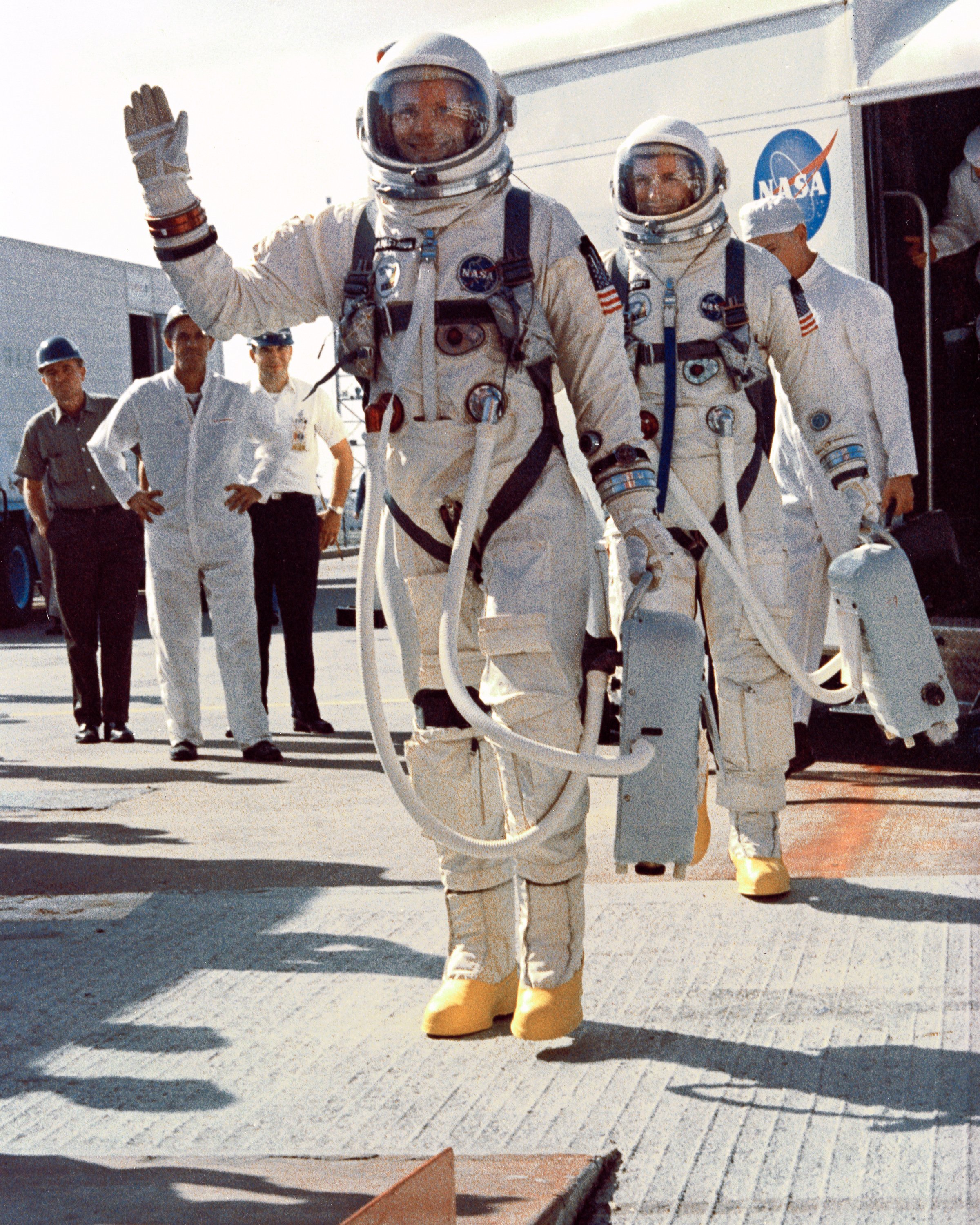
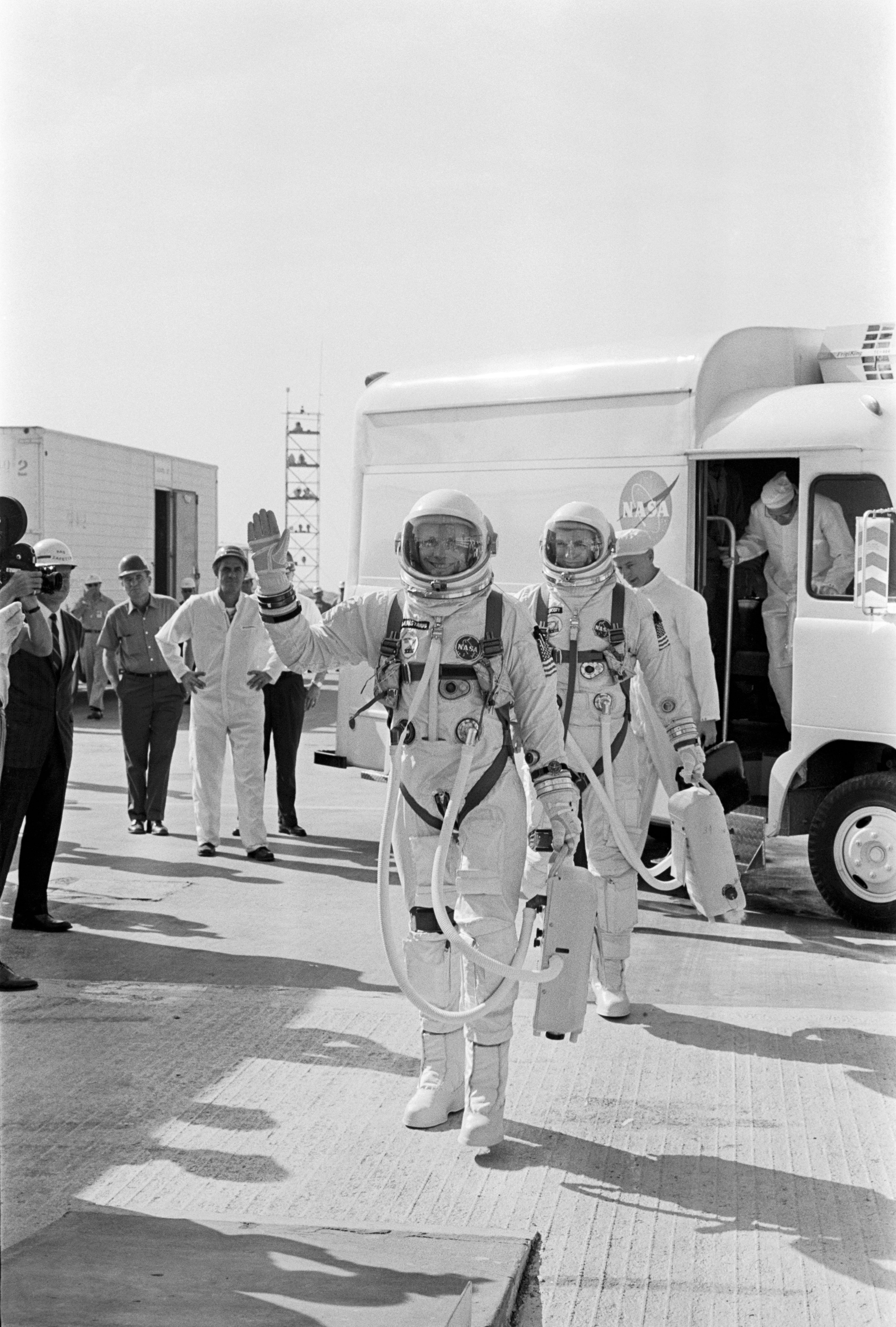
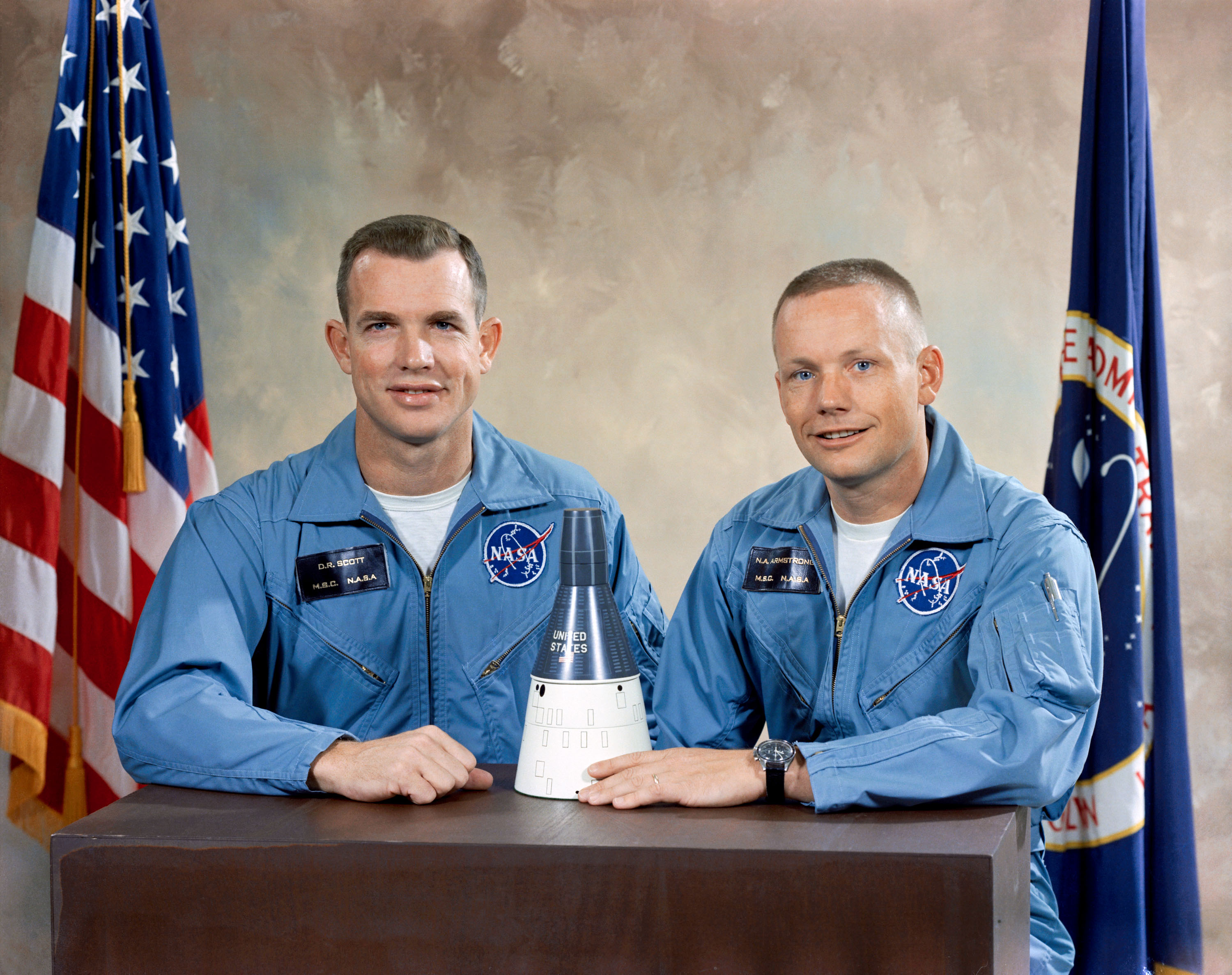
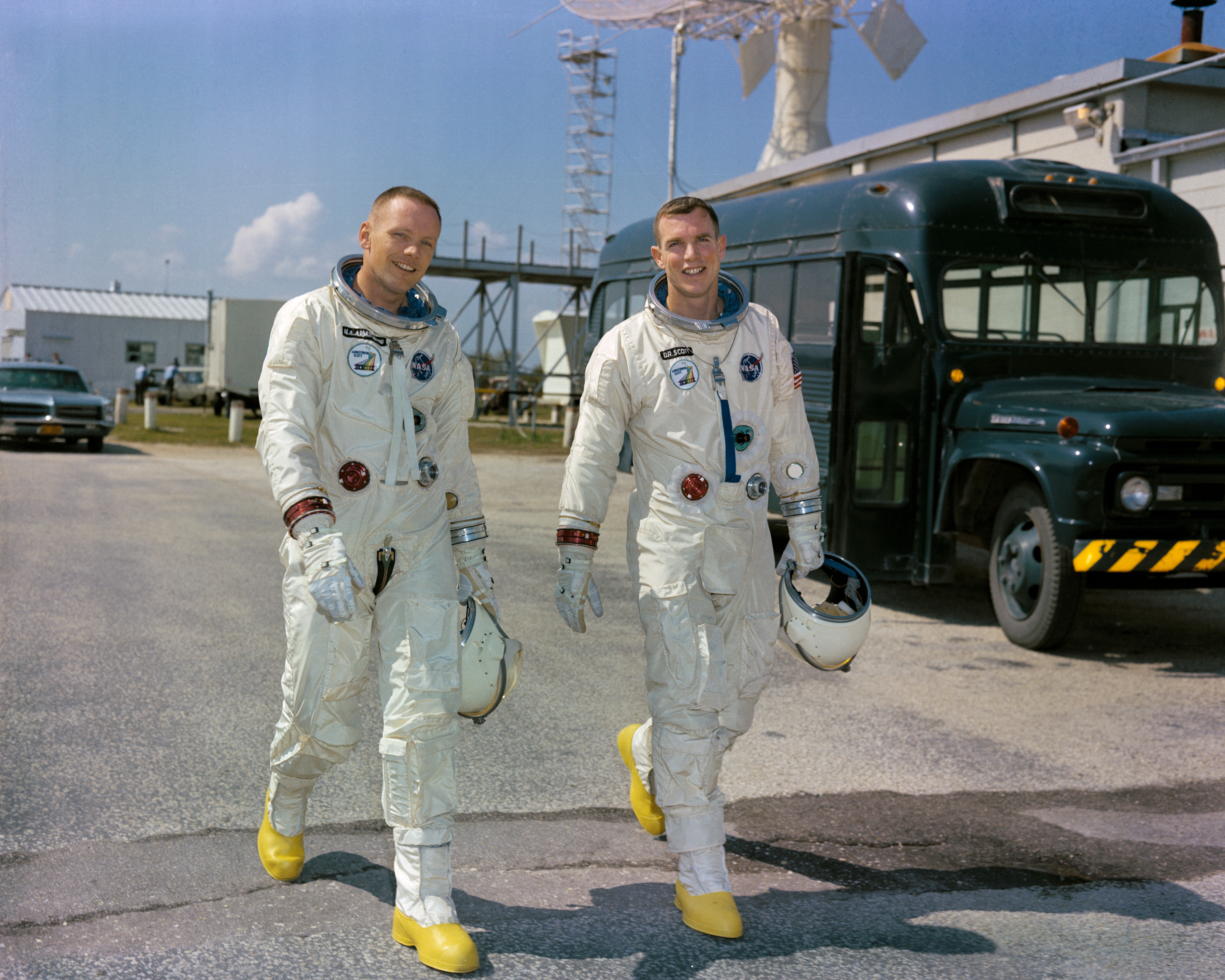
NASA announced the Gemini VIII crew on September 20, 1965. The command pilot was Neil Armstrong, a civilian test pilot with long experience on the X-15 rocket-plane program, who had already served as backup command pilot for Gemini V. Armstrong had resigned his commission in the U.S. Naval Reserve in 1960 and was selected as a Gemini VIII crew member in September 1965; his flight was the second time an American civilian flew into space — after Joe Walker on X-15 Flight 90 — and the first time an American civilian flew into orbit.
His crewmate, David Scott, was new to the Gemini program. The backup crew followed a similar pattern: Lieutenant Commanders Charles Conrad and Richard F. Gordon, Jr., the first with Gemini V experience and the second newly assigned. On the ground the team was completed by Walter Cunningham as capsule communicator at the Cape and James A. Lovell as capcom in Houston.
Preparing the extravehicular activity
While one group fought to restore the Agena, another faced qualification problems, on a smaller scale, with the extravehicular flight equipment. White's spectacular exit during Gemini IV had rested on comparatively simple technology: that first step only required an astronaut to leave the cabin and see what he could do, and White did it with style, improvising his plan as he went. His successor would not have that freedom, because he had to undertake specific tasks such as retrieving experiment packages. The ease of that first attempt led planners to think EVA would raise few problems, and no one worried when spacewalks were dropped from the missions between Gemini IV and VIII, even though the Astronaut Maneuvering Unit was still scheduled for Gemini IX.
.jpg)
The Air Force, by contrast, was uneasy. Colonel Daniel McKee, chief of its field office at MSC, complained of having been left out of the planning for White's exercise: his office should have taken part in the orderly planning leading to the use of the AMU, since at some 12 million dollars it was the most expensive Department of Defense experiment to be carried on Gemini. The AMU was designed to make the extravehicular astronaut independent of the spacecraft's systems: a cubical backpack with side-mounted controls, essentially three beams and support shelves carrying the tanks of the hydrogen-peroxide propulsion system and the oxygen supply. Because the spacecraft was so small, the AMU was stowed in the adapter section at the rear; the astronaut had to leave through the hatch on a tether, work his way aft and strap himself into the unit, which weighed some 76 kilograms and was no burden at all in weightlessness.
About three weeks before the crew announcement, McDonnell had presented the extravehicular equipment Gemini VIII would carry. It comprised two main units: an Extravehicular Life Support System (ELSS) and an Extravehicular Support Package (ESP), the backpack. The ELSS was a chest pack that fed the astronaut oxygen from the spacecraft supply, from a primary source in the backpack and from its own emergency reserve. The backpack did more: besides its own oxygen it carried a radio and 8 kilograms of propellant for a manoeuvring gun, and it connected to the spacecraft systems through an 8-meter oxygen hose that served as an umbilical. Once the oxygen was switched from spacecraft to backpack, the astronaut could add a 23-meter lightweight tether and, in theory at least, move as far as 30 meters from the spacecraft. Armstrong attended the St. Louis meeting and asked for help with the training program: the crews needed a realistic adapter on which to practise donning the backpack, and he also wanted the pilot to leave the spacecraft inside the altitude chamber and try out the backpack-chest pack combination.
As soon as he was assigned to the mission, Scott concentrated on the extravehicular exercise. He ended up flying more than 300 zero-gravity parabolas in aircraft and spending more than 20 hours on an air-bearing table, where astronauts practised manoeuvres supported on a 0.0254-millimeter cushion of air over a surface roughly 6 by 7 meters, using a gas gun to move about and get a sense of what starting and stopping in space would be like.
-8_extravehicular_system_diagram%2C_MSC_(S66-00303).jpg)
That training raised questions. Scott's gun carried about 15 times as much propellant as White's and used Freon instead of oxygen, multiplying its total impulse still further since Freon is about three times denser. The behaviour of oxygen in vacuum was reasonably well understood, that of Freon was not, and a problem soon appeared: at low temperature the Freon made the gun's valve stick open when fired, and the escaping gas threatened to tumble the astronaut. New seals and two extra shut-off valves settled the matter.
By December, Scott and Armstrong were raising a good many doubts about the equipment, from trifles to serious complaints. Among the latter was the possibility that an oxygen ejector in the chest pack might freeze and block the flow from both spacecraft and emergency supply; the life support system had been freezing in tests, and although the test conditions were more severe than those expected in flight, the warning could hardly be ignored. The designers installed 20-watt heaters next to the ejector. Another problem was the tangle of umbilicals, tethers and jumper cables that made donning the chest pack inside the spacecraft so difficult: in early tests Scott found his movements restricted and his view almost blocked by the pressurized suit as he tried to connect everything. By late December 1965, however, he was satisfied that he could don the unit, plug it in and open the hatch in McDonnell's altitude chamber at a simulated 46 000 meters, and in the final weeks before flight he made a complete dress rehearsal in MSC's 6-meter vacuum chamber: donning the chest pack inside the spacecraft, going outside, then putting on the backpack stowed in the adapter.
The flight plan and the experiments
The technical problems of the Agena and the extravehicular equipment were in the foreground, but they came on top of an already heavy load of mission planning. Gemini was entering a more advanced phase, with spacecraft and target facing missions of growing complexity, and managers had to balance the drive to reach program objectives against the danger of attempting too much too soon. Even at best, foreseeing and countering everything that could go wrong in four major dynamic systems — spacecraft, Titan launch vehicle, Atlas and Agena — made planning arduous. With technical difficulties clouding the picture, the Gemini VIII plans changed rapidly and often.
MSC's Mission Planning and Analysis Division had begun outlining the plan in the summer of 1965, and the first results were discussed on August 26 and 27. Among the rendezvous modes considered was one before the fourth revolution — the "standard" approach planned for Gemini VI: despite doubts about whether the flight control team could support anything earlier, the scheme called "M equals 2", with rendezvous in the second revolution, was worth studying. A phantom rendezvous with an imaginary target was also weighed, requiring an Agena main-engine thrust of at least 150 meters per second shortly after the first sleep period; the pilot would then go out for more than two hours of extravehicular activity, literally floating around the world, after which the spacecraft would undock and move away from the Agena to return later for a second rendezvous. Finally, the Gemini VIII Agena would remain in orbit as a passive target for Gemini IX.
.jpg)
No sooner was the plan on paper than caution flags went up. One issue was old and had already been fought over by earlier crews: sleeping in shifts. Lockheed recommended that one astronaut stay awake whenever spacecraft and Agena were docked; Mathews consulted Whitacre and denied the request, arguing that sleep at that point — after launch, rendezvous and docking, and before the EVA — was necessary for both men, and that Whitacre's analysis showed the tracking network could cope with almost any contingency. Another issue was time: fuel cell development problems had imposed a two-day limit on rendezvous flights, and the plan was too elaborate for so little margin. When a McDonnell study indicated that the cells could sustain a 72-hour flight with careful management of supplies, that question was settled. Firing the Agena's main engine with the spacecraft docked, on the other hand, was finally rejected for the same reason as on Gemini VI: it was still not considered safe enough. That eliminated the phantom rendezvous.
By late February 1966, with the problems apparently in hand, a "final" flight plan appeared which, like Gemini VII's, was more an outline than a precise timetable: crew and controllers had a range of options with which to adapt flexibly to circumstances.
Experiment planning ran in parallel. In November 1965 the Manned Space Flight Experiments Board had approved eight tasks for Gemini VIII, and ten experiments were finally approved, three of them involving extravehicular activity. Of these, two were scientifically oriented: S-9, nuclear emulsion, to expose an experiment package to radiation in space, especially in the South Atlantic Anomaly, and S-10, micrometeorite collection, mounted on the Agena to study the micrometeorite content of the upper atmosphere. In the third, proposed by the Department of Defense, Scott would use a powered, reactionless torque wrench: he would go to the adapter area, take out a box containing the tool, remove five nuts from a special panel and bolt it back onto the box. That simple task, performed with and without knee tethers, would be compared with the same job on the ground to measure the difference between working under gravity and in weightlessness. Scott and George C. Franklin of the Crew Support Division decided to extend the experiment by adapting an ordinary, cheap ratchet wrench to the nuts and to the pressurized glove: comparing the muscle-powered tool with the electric one would say something useful about energy expenditure in space.
The EVA plan Scott was to carry out during the first docking was ambitious: two hours and ten minutes outside the spacecraft, on a tether, for one and a half revolutions around the Earth. He would retrieve the nuclear emulsion experiment from the front of the spacecraft adapter, activate the micrometeorite experiment on the Agena, return to the Gemini and test the minimum-reaction power tool by loosening and tightening bolts on a work panel. Then, with Armstrong undocked from the Agena, Scott would don and test the ESP stowed at the back of the adapter, with its own oxygen supply, extra Freon for the hand-held manoeuvring unit and a tether extension, and would practise several manoeuvres in formation with the spacecraft and the Agena at separations of up to about 18 meters. The flight also carried further scientific and technological experiments and one medical experiment.
The final preparations
Mission plans and flight schedules were inseparable, and Apollo interfered again. The Apollo 201 mission was set for February 1966 and any delay pushed it into March. The problem was not the pads nor, in general, the personnel, but a tracking ship, the Rose Knot Victor: for Apollo 201, a suborbital flight, it had to sail in the Atlantic, but its station for Gemini VIII was in the Pacific. Mueller ruled that the Gemini flight had priority, though in the end Apollo 201 flew on schedule on February 26 and the slow Rose Knot had ample time to reach its appointment.
Flight control changed as well. Christopher Kraft, who had directed the Mercury flights and every Gemini mission through VII/VI-A, had to leave the program to begin planning the lunar landing missions, though he expected to keep an eye on Gemini lessons useful to Apollo. His departure left mission control short of experienced flight directors. His successor, John Hodge, chief of the Flight Control Division, split the job into twelve-hour shifts with Eugene Kranz, chief of the Flight Control Operations Branch, while Clifford E. Charlesworth, flight dynamics officer on earlier missions, began training as a director.
In the two weeks before launch, equipment problems remained a threat. The extravehicular gear in particular went on causing trouble, with lines freezing and valves cracking. Then, at Cape Kennedy, the spacecraft's environmental control system began to fail and, on Pad 14, loading the Atlas ran into difficulty. Those last two problems caused a one-day slip, from March 15 to March 16. After that everything was ready.
March 16, 1966: two launches in one morning
On March 16, 1966, five months after Walter Schirra and Thomas Stafford were left at the starting line in NASA's first attempt to launch two vehicles toward a rendezvous on the same day, the agency tried again. This time nothing spoiled either the Atlas-Agena or the Gemini spacecraft countdown. It was, by coincidence, the fortieth anniversary of the launch of the world's first liquid-fuelled rocket by Robert H. Goddard.
.jpg)
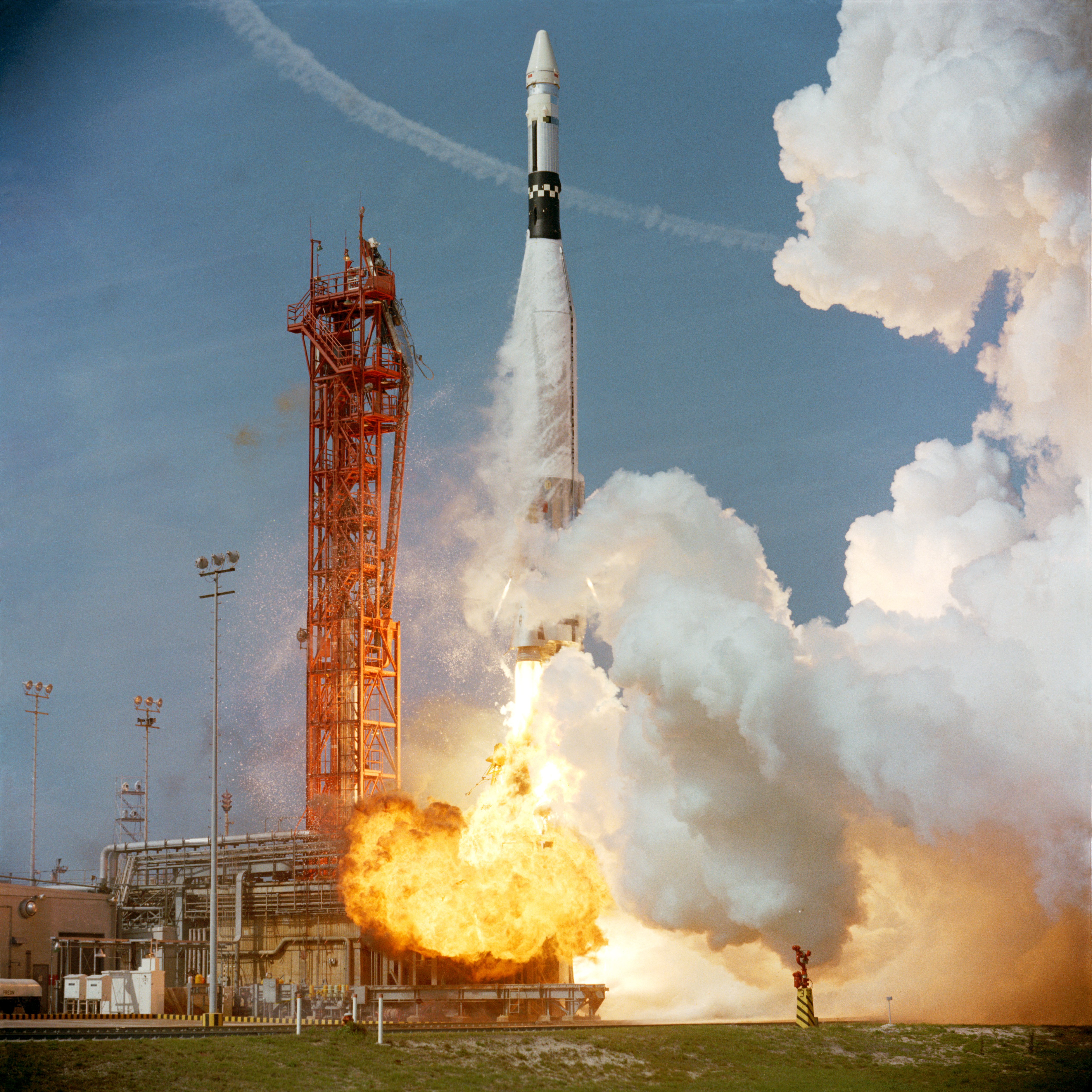
The target vehicle lifted off from Pad 14 at ten in the morning. Its trajectory came out low and to the right at first, south of the planned path, but the sustainer engine brought it back on course. In little more than five minutes the Atlas had done its work. It was the Agena's turn: after a brief coasting phase its secondary propulsion system started, and then came the crucial test, the main engine firing, with the engineers holding their breath. It worked. The engine ignited and carried the target into a 298-kilometer circular orbit. Planners had wondered whether the Agena could position itself so that the astronauts could reach it; the answer was yes.
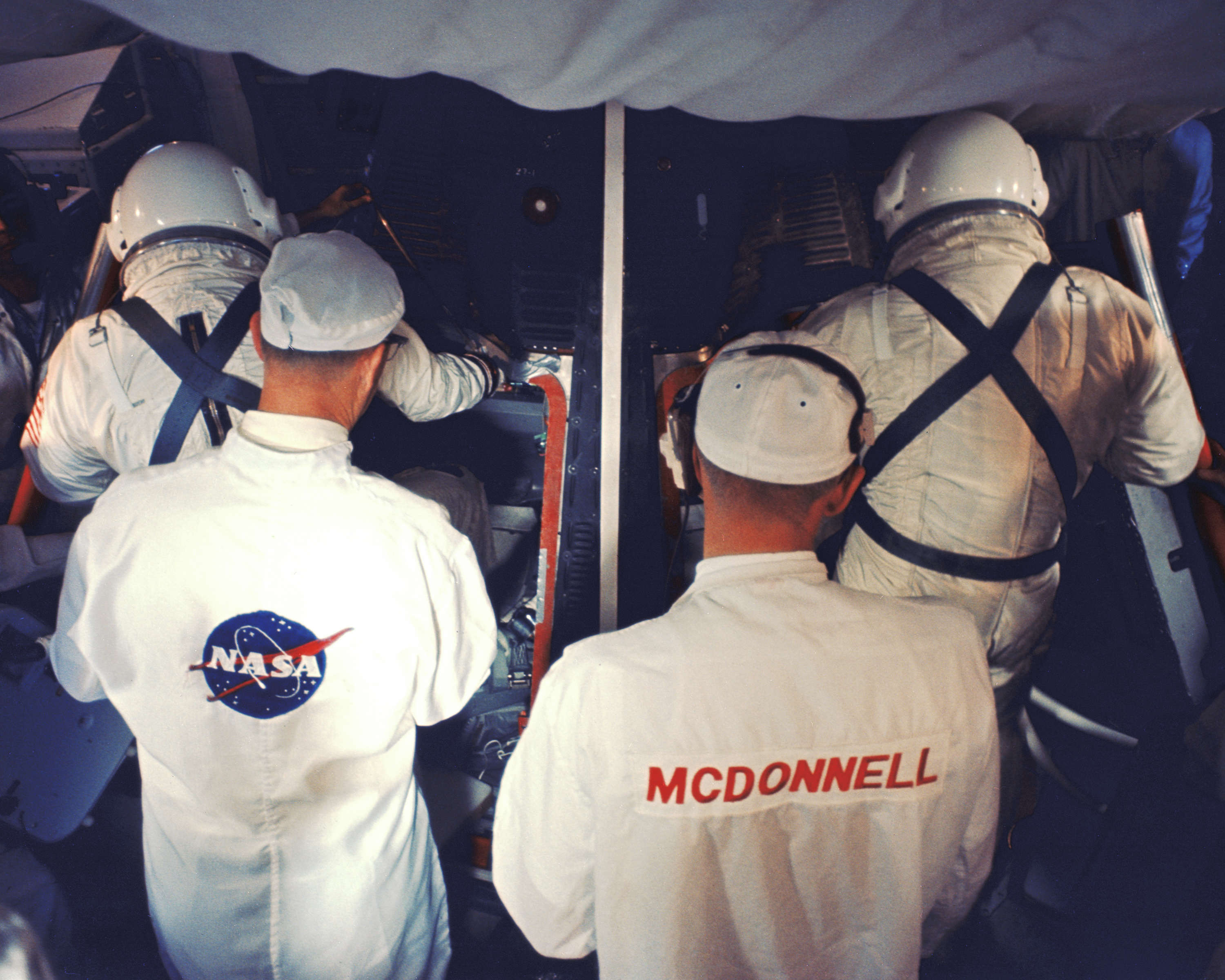
With one up and one still to launch, attention turned to Pad 19. Fourteen minutes before the Atlas-Agena lifted off, Armstrong and Scott had slid through the hatches into their seats. Helping Scott with his parachute harness, the pad crew found one of the fasteners full of glue; backup command pilot Conrad and McDonnell pad leader Guenter Wendt set about scraping it off. A trifle like that, Scott thought, "could have cost us a launch", though he could not help smiling at the sight of Conrad sweating. The fastener came free and Gordon, the backup pilot, worked it several times to show Scott that it functioned. On hearing of the Agena's near-perfect orbit, Armstrong said: "Beautiful, we will take that one."
Given the target's orbital characteristics, the Gemini launch vehicle had to lift off at 10:40:59 a.m. local time. The Titan II engines started exactly on time and the two men felt the hold-down bolts cut. GLV-8 came out slightly low, like the Atlas, but soon straightened up to carry the 3788-kilogram spacecraft into an elliptical orbit of 160 by 272 kilometers. Neither the Titan II nor the spacecraft showed significant anomalies.
The chase
With the first obstacle behind them, the next was to catch the target. The procedures closely resembled those of Gemini VI-A, though this time there was no friendly target pointing a transponder at the spacecraft's radar. Armstrong and Scott began the chase 1963 kilometers behind the Agena.
.jpg)
Thirty-four minutes into the flight the Sun set and, in the darkness, the crew could see the bright fires streaming from their thrusters: as the adapter radiator expelled water, the thrusters fired to counter a sideways motion. Carnarvon station in Australia told them the radiator was no great problem and passed on the flight director's go for one day of flight.
Over the Pacific they had a little time to look. Molokai, Maui and Hawaii stood out clearly; Armstrong tried to see Kauai and Oahu but cloud banks hid them. Minutes later Scott pointed out Baja California, though Armstrong had his eyes on the Los Angeles harbour and answered by marvelling at the number of ships. He then picked out Rogers Dry Lake and looked, without being sure he had found it, for Edwards Air Force Base, where he had spent seven years flying experimental aircraft. Over Texas both men wanted to see whether they could make out their houses, but work took precedence over sightseeing.
At the low point of their first circuit of the Earth, Armstrong aligned the inertial platform for a height adjustment manoeuvre. At 1 hour 34 minutes elapsed time he fired the thrusters retrograde for five seconds to lower the apogee slightly, and noticed a problem in cutting off the residual thrust, which made the computer readings vary and the exact deceleration achieved hard to know.
Schirra and Stafford had been so absorbed in their mission that they had not eaten, and reached the rendezvous with Borman and Lovell hungry and tired. Scott and Armstrong, knowing they would be very busy for three days, each took a food package and set about preparing it, which took longer than expected. When they had to break off to align the platform for the perigee-raising manoeuvre, they left the packages stuck to the cabin ceiling: weightlessness was convenient.
Near the second apogee, at 2 hours 18 minutes 25 seconds, Armstrong fired the thrusters to add 15 meters per second to their speed; again the thrust tail-off made the computer reading difficult. Then they retrieved their food from the ceiling. Armstrong's chicken and gravy, despite half an hour of rehydration, was still dry in places and not much like home cooking, but he finished it and washed it down with juice to avoid dehydration; then he tried a pack of brownies which were stuck together and crumbled, and were hard to eat without scattering weightless crumbs around the cabin.
The next manoeuvre had to put the spacecraft in the target's orbital plane. Armstrong yawed the nose of Gemini VIII 90 degrees south of the flight path and, over the Pacific, 25 minutes before completing the second revolution — at 2 hours 45 minutes 50 seconds — fired the aft thrusters for a horizontal velocity change of 8 meters per second. He waited for the controllers to tell him whether an adjustment was needed and, hearing nothing, assumed his burn had been correct. Over the Guaymas station in Mexico, Lovell cut suddenly into the remote-site line to order him to add 0.6 meters per second. With barely a minute to prepare, there was no time to turn the spacecraft or align the platform: it was, in Scott's words, "a pretty quick and loose burn without much preparation".
The rendezvous radar test then began. They did not expect a lock as quick as Schirra and Stafford's, but the Westinghouse development team had promised target acquisition at 343 kilometers; the radar locked on solidly at 332 kilometers, which was good enough.
Over the Tananarive station, at 3 hours 48 minutes 10 seconds after launch, Armstrong pitched the nose down 20 degrees and applied the aft thrusters for an in-plane velocity change of 18 meters per second. That left them in a nearly circular orbit some 28 kilometers below the target's, in position to begin the terminal phase of the rendezvous.
The rendezvous
The crew sighted a bright object 140 kilometers ahead, which had to be the Agena. Closing to 102 kilometers dispelled any doubt: the target was gleaming in the sunlight. Scott switched the computer from the catch-up mode to the rendezvous mode and watched the range dwindle automatically on the slide rule. Just before sunset the Agena suddenly vanished, but in the twilight its acquisition lights appeared.
-8_prelaunch_activity%2C_Cape_Kennedy_(S66-24446).jpg)
When the Agena was at the right angle, ten degrees above them, Armstrong aligned the inertial platform for the translation manoeuvre. He pitched the nose of Gemini VIII up 31.3 degrees and rolled the vehicle 16.8 degrees left. At 5 hours 14 minutes 56 seconds elapsed time he fired the aft thrusters and then made two small corrections. High above the tracking ship Coastal Sentry Quebec, at 5 hours 43 minutes 9 seconds, he braked the spacecraft. Since he could see the Agena, Armstrong judged the braking by eye while Scott called out range and relative velocity from the radar. At 46 meters, the relative velocity between the two vehicles was nulled. It was the Gemini program's second rendezvous.
For 36 minutes, Armstrong's delicate flying kept the spacecraft in formation with the target. While he flew, Scott inspected the Agena: antennas, docking lights and the rest. Since he had trouble seeing all the indicators on the target's panel beside the docking cone, he used the telescopic sight of a hand-held sextant, though a real inspection would have to wait for docking, when those instruments would become a second instrument panel. Armstrong, meanwhile, studied the Agena's general appearance; it looked steady to him and he brought the spacecraft to within barely a meter of the target. At 6 hours 32 minutes 42 seconds, Keith K. Kundel, capcom aboard the Rose Knot Victor, radioed: "Go ahead and dock."
The first docking between two spacecraft
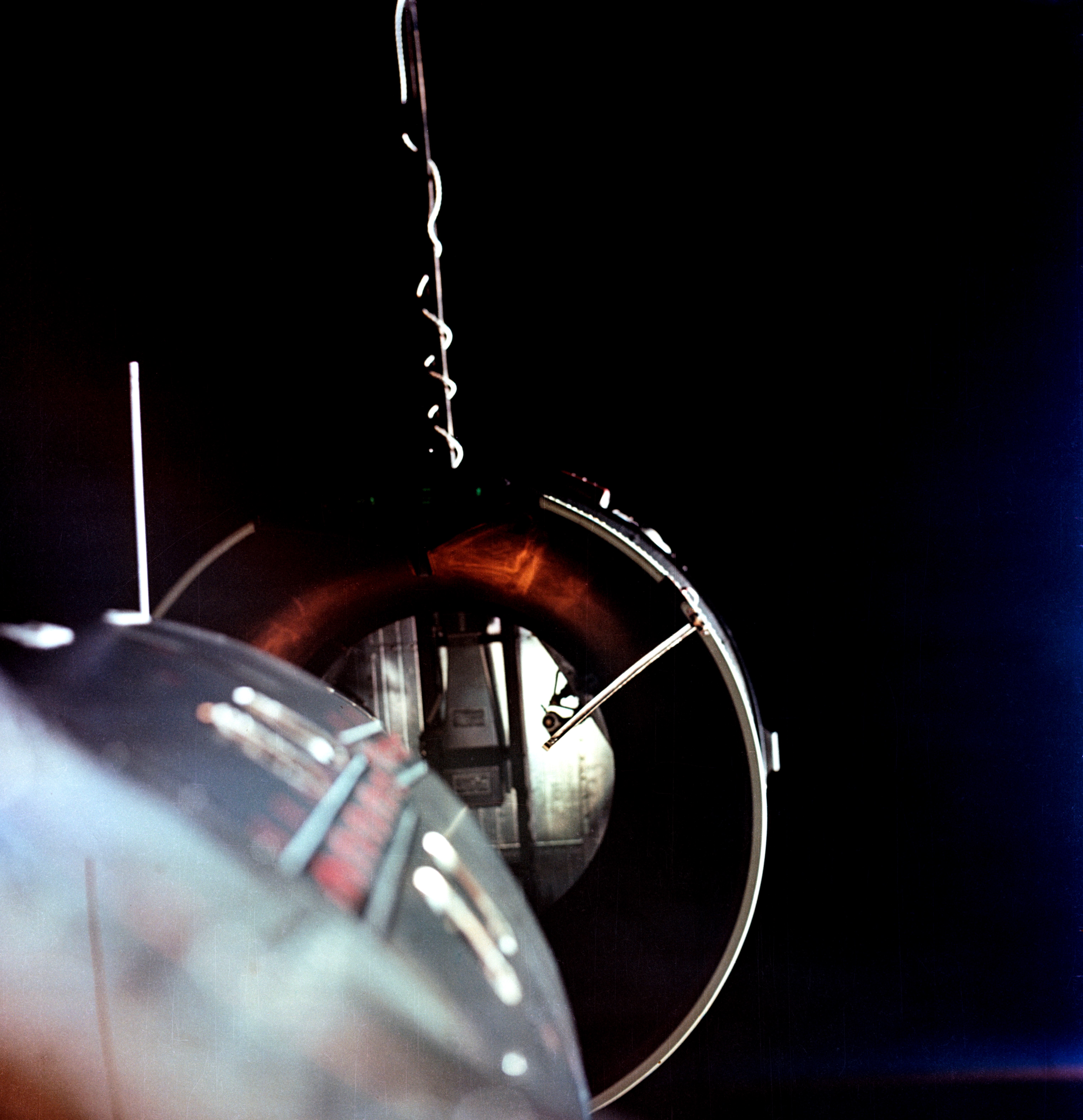
Armstrong moved Gemini VIII toward the target at an almost imperceptible 8 centimeters per second. "About two feet out," he reported to the Rose Knot Victor. Within seconds the Agena's latches clicked and a green light showed the docking was complete. "Flight, we are docked. It's really a smoothie, no noticeable oscillations at all," Armstrong reported jubilantly. For a moment the controllers in Houston could hardly believe they had done it; then came pandemonium of backslapping, handshakes, cheers and enormous grins. It was the first docking between two spacecraft in history, and the time went into the record as 23:14 UTC on March 16, 1966.
The joy came with a warning. Because there had been some difficulty verifying the stored commands uplinked to the Agena for the docked yaw manoeuvre and in loading the target's velocity meter, controllers suspected that the Agena's attitude control system might be misbehaving. Indeed Lovell, through the Tananarive remote link and just before the spacecraft passed out of communications range, told the crew that if they got into trouble and the Agena's attitude control system went wild, they should turn it off and take control with the spacecraft. With that warning ringing in their ears, Armstrong and Scott began their docked tasks.
"Neil, we're in a bank"
The Agena was designed to obey commands from both spacecraft and ground control. Scott ordered the target's attitude control system to turn the combined assembly 90 degrees to the right; the manoeuvre took five seconds less than the expected minute. Scott next keyed in the command to start the Agena's tape recorder and glanced toward Armstrong. As he did so, his eye caught the spacecraft's control panel. Something was wrong: Gemini VIII should have been in level flight, but the ball indicator showed a 30-degree bank. He knew there was no point checking the horizon through the window, since they were passing through the Earth's shadow, and there would be no help from the tracking stations either: they were still out of communications range.
"Neil, we're in a bank," said Scott. He thought his attitude indicator might have gone awry, but Armstrong's showed the same thing. The command pilot managed, with bursts of the OAMS, to stop the motion temporarily, but it soon began again. The immediate reaction of both men was to blame the Agena. As soon as the vehicles were reasonably steady, Scott commanded the target to shut down its attitude control system, exactly as the capcom had told them. For four minutes the two craft stabilized and straightened out: the problem seemed to be over. Armstrong began manoeuvring to put the docked assembly in the correct horizontal position and suddenly they were rolling again, faster and faster.
The pilots wondered what the trouble was now. They had been scheduled to make a small test to find out what loads the linkage between the two vehicles could tolerate; the question became academic, because what mattered urgently was whether it would hold through this wild shaking. As Armstrong wrestled with the controls, Scott photographed the interaction between the two spacecraft through his window. The command pilot reported shortly afterwards that the OAMS propellant had dropped to 30 percent, a strong indication that the culprit might be a spacecraft thruster rather than the target. While Armstrong fought the controls, Scott cycled the target vehicle switches off and on, and Armstrong worked the spacecraft switches as well to try to isolate the problem. Nothing they did seemed to have any effect.
Separation: one revolution per second
The crew realized they would have to break free of the Agena to analyze the situation. Their simulator training gave them no clue as to what was happening or how to handle it. A larger risk also weighed on them: if the rotation went further out of control it might damage one or both vehicles, or even rupture the propellant-laden Agena. Scott switched control of the target back to the ground stations — which had been locked out to prevent spurious signals — and Armstrong worked to steady the assembly enough to allow undocking. "Go," said Armstrong, and Scott hit the undock button; Armstrong gave the thrusters a long, hard burst and the spacecraft backed straight away.
Almost at once the suspicion of a spacecraft control problem became established fact: the spacecraft rotated even faster. "And then we really took off," both men said afterwards. Gemini VIII soon came within range of the Coastal Sentry Quebec. James R. Fucci, capcom aboard the ship, was worried and puzzled: he could not get a solid electronic lock, though a flashing light indicated the spacecraft had undocked. Not knowing that the spacecraft was spinning and that its antennas therefore could not hold position, he called the crew to find out what the strange signals on his console meant.
The exchange went into the record. Fucci asked for a communications check; Scott replied that they had serious problems, that they were tumbling end over end and had come loose from the Agena. Fucci acknowledged the free-spacecraft indication and asked what the trouble appeared to be. Armstrong answered that they were rolling and could not turn anything off, in a left roll that was increasing steadily. Thirty-seven seconds later, at a further call, Scott specified: they had a violent left roll, could not turn off the reaction control systems nor fire them, and certainly had a stuck hand controller.
After backing away from the Agena, the spacecraft had begun spinning at a dizzying rate of one revolution per second. Armstrong suspected the manoeuvring thrusters had little left. Both men were also having difficulty reading the dials on the upper panel: their physiological limits seemed close, they were dizzy and their vision was blurring. Something had to be done.
The Reentry Control System and the mission rule
"All we have left is the reentry control system," said Armstrong. "Go ahead," Scott replied. The two men began throwing switches to shut down the OAMS and bring up the RCS. Armstrong tried his hand controller: nothing. Scott tried his: nothing either. They cycled circuits again, in case something had been left in the wrong position.
The controls answered.
Armstrong steadied the motion and then shut down one of the two rings of the reentry control system to conserve propellant. He carefully reactivated the manoeuvring thrusters one at a time and so identified that number 8 had "failed on": it had stuck firing. The whole sequence, from the first bank to stabilization, lasted nearly thirty minutes. According to Wikipedia, the tumble rate reached 296 degrees per second and almost 75 percent of the reentry manoeuvring fuel was used to stop it.
Using the reentry thrusters meant the mission had to end as soon as possible: it was a mission rule. The spacecraft was operating in a backup mode, but that backup was precisely the primary mode for reentry. If those thrusters developed leaks, the crew would have no way to put the spacecraft in the correct attitude for the retrofire, and attitude control before and after reentry was essential to enter the atmosphere safely. This was a case in which the fail-safe manoeuvres Headquarters had imposed early in the program were impossible: there was practically no manoeuvring capability left in the orbital thrusters. Armstrong and Scott recalled wistfully that Kraft, the controllers and the engineers had carried other missions through to the end despite malfunctions, but it was a fleeting hope: the capcom at the Hawaii station told them to put the spacecraft in the reentry attitude.
Gemini VIII's problems were the most frustrating the program had met. The flight control team's ability to respond to real problems on earlier missions, keeping spacecraft flying to wring every useful datum from failures as well as successes, had bolstered confidence in the program and promoted real-time planning. This time the failure forced the astronauts to fall back on their last resort for attitude control before the ground teams had a chance to offer alternatives that might have allowed the flight to continue.
Houston decides: splashdown in the western Pacific
John Hodge, in his first test as lead flight director, had only one decision left: which contingency recovery area was best. If he waited much longer, the crew would need a whole day — fifteen revolutions — to reach a landing point from which they could be recovered quickly. Since the orbital track had precessed westward, a landing on the sixth or seventh orbit would have to be in the Pacific Ocean. When the Landing and Recovery Division recommended splashdown on the seventh circuit, Hodge agreed. The original plan had Gemini VIII landing in the Atlantic, but three days later.
Kranz had dropped into the control center to listen to the docking. Since Hodge had been eleven hours at the flight director's console, they decided the second shift should come on at once, get up to speed and direct the final phases: had the flight lasted three days, reentry would have fallen in Kranz's shift anyway, and his team had more practice in recovery procedures.
The engineers who had fought so hard over the Agena lived through the situation with the same exasperation as the controllers. After the docking, Smith, Harold W. Nolan and others from Lockheed had retired to nearby motel rooms to celebrate. Shortly afterwards Smith called Nolan to say they had problems; Nolan turned on the television and heard the commentators reporting that the Agena was the culprit. Smith's room became Lockheed's first failure-analysis command post, with the initial hypothesis that the target's attitude control system had failed.
Many other engineers and managers learned of the spacecraft's tumble while cut off from the minute-by-minute developments. Mueller, for instance, had stayed at Cape Kennedy only through the launch and early phases; he then took off for Washington to attend the annual dinner in memory of Robert H. Goddard, organized by the National Space Club. The NASA aircraft's pilot heard what was happening over the onboard radio and informed Mueller; they returned to Florida, where Merritt Preston met the group with a motorcycle escort for a headlong drive to the old Mercury Control Center, in time for the retrofire.
In fact most of NASA's leadership had already left for the Goddard dinner, the most prestigious social occasion of the year for the space community. At the opening reception Deputy Administrator Seamans — who had been sworn in on December 21, 1965, replacing Hugh Dryden, who had died on December 2 — was called to the telephone and told of Gemini VIII's plight. He immediately called flight control in Houston and learned the tumble had been stopped. When he reported the problem to the dinner's chairman, he was asked to make a brief announcement: he said the flight would have to be aborted, but that the crew did not appear to be in immediate danger. Vice President Hubert H. Humphrey, the keynote speaker, asked to be told as soon as the crew was recovered, and before finishing his speech he was able to tell the audience that Armstrong and Scott had landed safely. Seamans vowed that a critical phase of a flight would never again catch him at a public function: he needed privacy and better communications with the control center. At Armstrong's home, NASA turned off the squawk box carrying the air-to-ground communications, alarming his wife.
McDonnell, the spacecraft prime contractor, customarily sent several of its Cape experts to Houston after launch and the first orbit, to have them available as troubleshooters. On March 16, 1966, a NASA Gulfstream left Florida for Texas with some fourteen passengers, among them several senior McDonnell engineers. Over New Orleans the pilot patched a commercial radio broadcast into the cabin: the announcer was talking about an imminent recovery in the Pacific, and that was the end of the news. Something had clearly gone wrong, but there was nothing to do but wait until they reached Houston.
Reentry and rescue
The naval recovery forces in the Pacific got under way. The destroyer USS Leonard F. Mason steamed at full speed toward the planned landing point, 800 kilometers east of Okinawa and 1000 kilometers south of Yokosuka, Japan.
.jpg)
With Gemini VIII flying over southern latitudes, Kranz had only three stations in position to keep contact with the crew: Coastal Sentry Quebec, Rose Knot Victor and Hawaii. The spacecraft was in darkness over the Congo when the Houston controllers began the final count for retrofire. Through the remote sites, Scott reported the thrusters off and Armstrong said to hang on; seconds later Scott confirmed that all four retrorockets had fired in automatic mode.
Armstrong feared they might end up in some remote wilderness where they would be hard to find. He said afterwards that he had been thinking of the liner Andrea Doria, sunk in the Atlantic on July 26, 1956: even though her radios worked, rescue ships had taken a day and a half to locate her. He wanted Scott to double-check every action — "I still think there's something we've forgotten," he kept saying, "but I don't know what it is" — and Scott calmly answered that they had done everything they knew. Over China, Gemini VIII slipped into the upper atmosphere, out of range of NASA's tracking stations.
Everything worked properly during the descent. Near splashdown, Armstrong asked his crewmate whether he could see water; Scott, looking toward the first light of dawn, answered at first that he saw only haze, and then, his voice quickening: "Oh yes, there's water! It's water!" Less than two minutes later he shouted: "Safe landing." The flight had lasted 10 hours, 41 minutes and 26 seconds, and splashdown went into the record at 03:22:28 UTC on March 17, 1966.
The crew ran quickly through the post-splashdown checklist, putting switches and valves in place, and deployed the antennas to talk to the recovery forces. Scott called the rescue and search services at Naha without getting an answer, but they were not unduly worried: flight control had told them the rescue aircraft would arrive soon and the Mason would be there in three hours, which meant their splashdown had fallen very close to the contingency point.
Several aircraft raced to find them, among them two HC-54 Rescuemasters, one from Naha Air Base on Okinawa and one from Tachikawa in Japan. The Naha aircraft arrived first. Suddenly the pilot called out that he had it: he had seen the spacecraft descending toward the surface with the main parachute fully deployed. Three pararescuers were equipped and ready to jump, and Armstrong and Scott watched one of them come down. The swell made attaching the flotation collar to the spacecraft difficult and made the rescuers seasick, a sensation the astronauts shared, but the swimmers persisted and secured the collar within forty-five minutes of splashdown. The Department of Defense recovery forces reacted to an emergency landing as though it were a normal one, evidence of excellent cooperation with NASA and of careful planning; Armstrong and Scott had few complaints about recovery in so remote an area.
Three hours later, as planned, the Mason came alongside and secured the spacecraft. Climbing the Jacob's ladder in a four-to-five-meter swell was hard going, but they managed it. On deck the exhausted astronauts still had smiles and waves for the sailors who greeted them. Still nauseated, they went straight to sick bay, where the medical staff helped them out of their pressure suits; their underwear was soaked with sweat and they were thirsty, though the clinical examination showed minimal dehydration. They slept for nine hours.
The next morning the ship docked at the port of Naha. Astronaut Walter Schirra and other NASA officials flew in to greet them before they were summoned back to the ship for medical tests and post-flight debriefing. Afterwards they were taken by limousine to waiting helicopters, which flew them to Kadena Air Base and then on to Florida in a C-135. The spacecraft, on its return, travelled covered with a tarpaulin.
The Agena's solo: the target exonerated
With the crewed phase over, Hodge and Kranz turned their attention to the target vehicle. Because Scott had had the foresight to return control of the Agena to the ground, there was a chance to put it through its paces and see how it responded to commands. There was still hope that this Agena could serve as a passive target for Gemini IX or X.
After undocking, the Agena had stabilized quickly. On the fifteenth revolution, over Carnarvon station and more than twenty-one hours after launch, flight control commanded two main-engine firings to place it in a circular orbit 407 kilometers high. The first firing did its half of the job; the second did not, and the resulting parameters were 407 by 626 kilometers.
Melvin F. Brooks, the Agena systems monitor in flight control, began conferring with Lockheed engineers to understand what had happened. They suspected the vehicle's center of gravity had been miscalculated and looked for a way to compensate by remote command, but the attempt failed on the next firing. Brooks and the engineers met again and came to agree that there also appeared to be a problem in the yaw hydraulics, allowing the engine to gimbal further than it should. The target's orbit now measured 211 by 476 kilometers.
If this Agena was to be the passive target for Gemini IX or X, there were two major problems: it carried too much fuel and its orbit was still too high. The excess fuel was dangerous because the target's electrical system would be dead before a later visit and, with no way to control it, the propellant load would be a hazard in any rendezvous attempt. Hodge and his controllers decided to attempt no further plane changes and simply to bring the vehicle to the desired altitude. The next firing, retrograde, convinced them they had got the hang of it, and from then on they concentrated on burning off the fuel in the primary and secondary tanks.
In all, ten manoeuvres were carried out with the two propulsion systems, sometimes firing both at once: considerably more than the five starts the contract required. The Agena's command and communications system accepted 5439 commands, 45 of them sent from Gemini VIII, where Lockheed's contract called for only 1000.
Just before docking, Scott had remarked that he bet the Lockheed people were jumping for joy. So they were, and the elation was snuffed out by the news of the spacecraft's plight. The Agena's solo manoeuvres swept away any suspicion about its behaviour: the fault lay elsewhere. The question remained why thruster number 8 had failed in the open position. Four months later, the crew of Gemini X met that inert Agena and astronaut Michael Collins retrieved its micrometeorite collector.
Thruster number 8: the investigation
From its splashdown point in the Pacific the spacecraft was taken back to its birthplace, the McDonnell plant in St. Louis, for engineers to analyze its problems. Installed in a controlled laboratory where the investigation could proceed without interference, the spacecraft was thoroughly examined for more than a month. Only the most probable cause could be identified. Scott Simpkinson's evaluation team concluded that the unintended opening of the number 8 thruster valves had probably been due to an electrical short circuit, and that there were several points in the spacecraft where the failure might have occurred. The most widely accepted hypothesis points to a static electricity discharge; the result was that power still flowed to the thruster even when its switch was off.
To prevent a recurrence, McDonnell changed the attitude control circuit switch so that, in the off position, no current at all could reach the thrusters. Previously, cutting power to the electronic packages did not stop current from reaching the thrusters, which could keep firing. The principle was stated bluntly in Chris Kraft's account: never put electrical power to any system unless it is supposed to be on, and the OAMS was rewired so that a short circuit would always give a dead thruster, not one that kept firing until an astronaut opened a circuit breaker. In design terms, the solution was to give each thruster an isolated circuit.
So the Gemini VIII mission ended on a discordant chord: high success — the first space docking — undeniable failure — the shortening of the mission — and much relief at the astronauts' safe recovery from a dangerous situation. The timing of the failure was especially frustrating. Being out of communications left controllers and engineers helpless, and they said again and again in later interviews that if the spacecraft had been over a ground station, telemetry would have told them that thruster number 8 was firing continuously and they could have told the crew what to do before the reentry control system was activated and it was too late. Even so, although the Gemini team was disappointed by the early landing, knowing that docking could be achieved with relative ease went a long way toward easing their chagrin; and the Agena's solo had shown the target could support more elegant missions. There was no pause in the program.
Consequences
The incident changed procedures inside and outside NASA. Deputy Administrator Robert Seamans, whom the emergency had caught at the Goddard dinner, reviewed the agency's problem-investigation procedures, modelled on military crash investigations, and on April 14, 1966, formalized a new procedure, Management Instruction 8621.1, Mission Failure Investigation Policy and Procedures. It gave the Deputy Administrator the option of performing independent investigations of major failures, beyond those for which the various Program Office officials were normally responsible, and declared it NASA policy to investigate and document the causes of all major mission failures and to take appropriate corrective action as a result of the findings. Seamans first invoked the procedure immediately after the fatal Apollo 1 fire on January 27, 1967, and invoked it again after the next critical in-flight failure, that of Apollo 13 in April 1970.
McDonnell also changed how it worked. Before the accident its top engineers attended the launch at Cape Kennedy and then flew to Houston for the rest of the mission; the Gemini VIII problem occurred exactly while they were in transit. Raymond Hill, the company's Gemini manager at the Cape, recalled that company policy changed radically after they were caught, in his words, with their pants down. Thereafter the senior men — Hill, Walter Burke, John Yardley and Robert Lindley — would not all be travelling at the same time during a flight: Hill stayed at the Cape, Burke went to Houston for the first day and returned to St. Louis, and Yardley and Lindley remained in Houston until the end of the mission. The McDonnell specialists who had previously stayed in St. Louis answering queries by telephone and teletype moved, along with their subcontractor counterparts, to Houston, to work directly with the program office's systems engineers.
The failure also had immediate effects on the next spacecraft. As Cape crews combed the adapter area around spacecraft 9's thrusters, they found several probable causes of the kind of failure suffered and corrected them on the spot; in St. Louis, engineers explored ways of dealing with a short in the thruster circuit. The program office and McDonnell settled on a master switch that would cut all current to the thrusters simultaneously, so that in case of trouble the crew could check the system circuit breaker by circuit breaker until they found the short. The switch was installed in spacecraft 9 without affecting the launch schedule. As Merritt Preston summed it up, in Gemini they got into trouble routinely but it never caught them, because they could always fix it.
The flight also weighed on the debate over safety tethers in extravehicular activity. The Air Force had long argued for untethered EVA with the AMU, and NASA had stated its official position: William Schneider had wired Mathews that extravehicular activity would be based on the use of a tether on all flights through Gemini XII. The uncontrolled tumble of March 16 gave the Air Force an opening: what would have happened if Scott had been outside and tethered to the spacecraft when it lost control? He might have been wound up like a broken window blind. The Air Force suggested adding at least a quick-disconnect safety device as long as NASA insisted on the tether. Within the agency there was also thought about the plight of a crewman caught outside a tumbling spacecraft. Scott maintained that he would have been able to detect the thruster problem and get back inside to help Armstrong, but many in the Office of Manned Space Flight were convinced that if trouble arose with the pilot outside, the best thing was for him to come back in as quickly as possible: there were too many hazards in diagnosing a malfunction from outside to add cutting loose from the safety tether. The active debate ended there, though some continued to think the idea deserved trying in future programs.
Scott's cancelled EVA remained outstanding. The AMU was still scheduled for Gemini IX, whose original crew, Elliot See and Charles Bassett, died on February 28, 1966, when their T-38 crashed into McDonnell's building 101 in St. Louis, precisely where work was under way on the spacecraft they were to fly; their backups, Stafford and Cernan, inherited the mission. Scott would not fly again until Apollo 9, where his outstanding spacewalk finally found a place.
Assessment
Gemini VIII achieved the objective that had blocked the program for two years and, at the same time, exposed a weakness no one had foreseen. It proved that two spacecraft could rendezvous and physically join in orbit, with no noticeable oscillations and with an ease that surprised the engineers themselves; without that datum, Apollo's lunar-orbit rendezvous mode would have remained a gamble. It exonerated the Agena, whose subsequent solo performance — ten propulsive manoeuvres and 5439 commands accepted against the contract's 1000 — showed the target could support far more ambitious missions. And it taught, at the price of an emergency that came close to costing two lives, two lessons in engineering and operations: that a system must not be given power unless it is supposed to be on, and that a crewed spacecraft out of telemetry range depends entirely on the judgement of its crew.
Armstrong's performance became a benchmark. Scott summed up years later what he saw from the right-hand seat: the guy was brilliant, he knew the system so well, he found the solution and activated it under extreme circumstances, and it was his lucky day to be flying with him. Three years and four months after that night over the Pacific, Armstrong would command Apollo 11.
Images
Elsewhere
- NASA Image and Video LibraryGemini 8 crew stands on deck of recovery vessel ↗
- NASA Image and Video LibraryGEMINI-8 - Gemini/Agena rendezvous - outer space ↗
- NASA Image and Video LibraryAstronaut David Scott practicing for Gemini 8 EVA ↗
- DVIDSAstronaut David R. Scott - training - weightlessness - GT-8 prime crew ↗
- DVIDSGemini-Titan-8 - training - command pilot holds HHSMU ↗
- National Air and Space MuseumFirst Docking in Space - Agena Viewed by Gemini VIII ↗
- National Air and Space MuseumNeil Armstrong and David Scott Board Gemini VIII ↗
- National Air and Space MuseumGemini VIII crew aboard the recovery ship ↗
- FlickrGemini-Titan-8 Training - Water Egress ↗
- Internet ArchiveGEMINI-TITAN-8 - Recovery - spacecraft hoisted aboard ↗
- Internet ArchiveGemini 8 launched by Titan booster ↗
- Internet ArchiveGemini-Titan 8 Press Kit ↗