Project Gemini · NASA · Crewed
Gemini IV
- Jun 3, 1965, 3:15 PM
- Launch date
- 2
- Crew size
- 4 days 1 hr
- Duration
- Success
- Outcome
-1600.webp)


_en_la_plataforma_LC-19-1600.webp)


Gemini 4 (GT-4) was the second crewed mission of Project Gemini and the flight on which an American first left his spacecraft for open space. Command pilot James A. McDivitt and pilot Edward H. White II lifted off from Complex 19 at Cape Canaveral on 3 June 1965 atop a Titan II and stayed in orbit for four days, until splashdown in the western Atlantic on 7 June. The primary objective was not the spacewalk but the endurance test itself: how crew and spacecraft would stand up to a long flight, and how work procedures, schedules and mission planning would hold up over four days. The mission reached the pad with two ambitions trimmed and two added. Lagging fuel-cell development forced NASA in August 1964 to cut the flight from seven days to four, and radar problems had already pushed the rendezvous evaluation pod off the flight plan. In their place came extravehicular activity, approved by Administrator James E. Webb on 25 May 1965, and a station-keeping exercise with the spent second stage of the mission's own launch vehicle. The attempt on that second stage failed. The crew chased the target by eye, spent close to half of their control propellant and discovered first-hand that orbital mechanics does not behave like a chase on the ground. The lesson, absorbed by the rest of the programme, proved as valuable as the day's visible triumph. On the third revolution White opened the hatch, went outside with a hand-held cold-gas manoeuvring gun and an eight-metre umbilical, and floated for twenty-three minutes over the Pacific and the Atlantic; getting back in and latching the hatch left both men exhausted. The rest of the flight was flown drifting to conserve propellant, with eleven engineering, medical, scientific and Department of Defense experiments aboard. Gemini 4 also inaugurated the new Mission Control Center in Houston and its three-shift operation. A computer failure on revolution 48 ruled out the planned guided re-entry and forced a Mercury-style ballistic descent; the capsule came down some eighty kilometres from its aim point and the crew was recovered by the carrier USS Wasp.
Objectives
The objective of Gemini IV was to test the performance of the astronauts and the capsule and to evaluate work procedures, schedules and flight planning for an extended stay in space. Secondary objectives included demonstrating extravehicular activity, conducting stationkeeping and rendezvous maneuvers, evaluating spacecraft systems, demonstrating significant in-plane and out-of-plane maneuvers and use of the maneuvering system as a backup reentry system, and conducting eleven experiments.
Payload
Spacecraft Gemini 4, with a launch mass of 3,574 kg, flown by James A. McDivitt as command pilot and Edward H. White II as pilot. For the spacewalk White had a hand-held gas gun and an 8-metre tether keeping him attached to the spacecraft. Eleven experiments were carried out aboard — among them four engineering experiments and two Department of Defense experiments, on radiation and simple navigation — all of them successfully.
History
A mission cut down by the fuel cells
The Gemini flight plan revised in April 1963 remained the framework for programme operations through 1965 and 1966, but it proved too optimistic on several fronts. Lagging fuel-cell development forced the Gemini Program Office in August 1964 to settle for four days rather than seven for the fourth mission: if batteries had to replace fuel cells, no more endurance was available. The same round of cuts removed the practice rendezvous with the evaluation pod, dropped when radar design problems made it unlikely that the equipment would be ready in time. Gemini 5, in turn, had to defer its rendezvous with an Agena target.
In exchange the mission gained the two features that would define it. Extravehicular activity emerged as a new element of Gemini 4, and the new Mission Control Center in Houston took over flight control duties for the first time from the old centre at Cape Kennedy. Only two months would separate Gemini 4 from Gemini 5, a sign of how quickly NASA was turning spaceflight into something close to routine. Together the two missions swept aside the programme's underlying fear: that astronauts might not survive long periods of weightlessness.
The crew that pushed to get out of the spacecraft
NASA announced the Gemini 4 crews on 27 July 1964, and two days later McDivitt and White faced reporters in Houston alongside their backups, Frank Borman and James A. Lovell Jr. McDivitt and White, aged thirty-five and thirty-four, had known each other since college and had been in the same class at the Air Force test pilot school; Borman and Lovell, both thirty-six, had first met while undergoing NASA selection testing. All four belonged to the astronaut group chosen in September 1962. Their first job was to review the state of the spacecraft, still being built in St. Louis and delayed by a shortage of parts, and of the launch vehicle being assembled in Baltimore. They then spent five weeks clearing up work left over from earlier assignments, because mission training could not begin until late November, when Gemini Simulator 2 became operational in Houston.
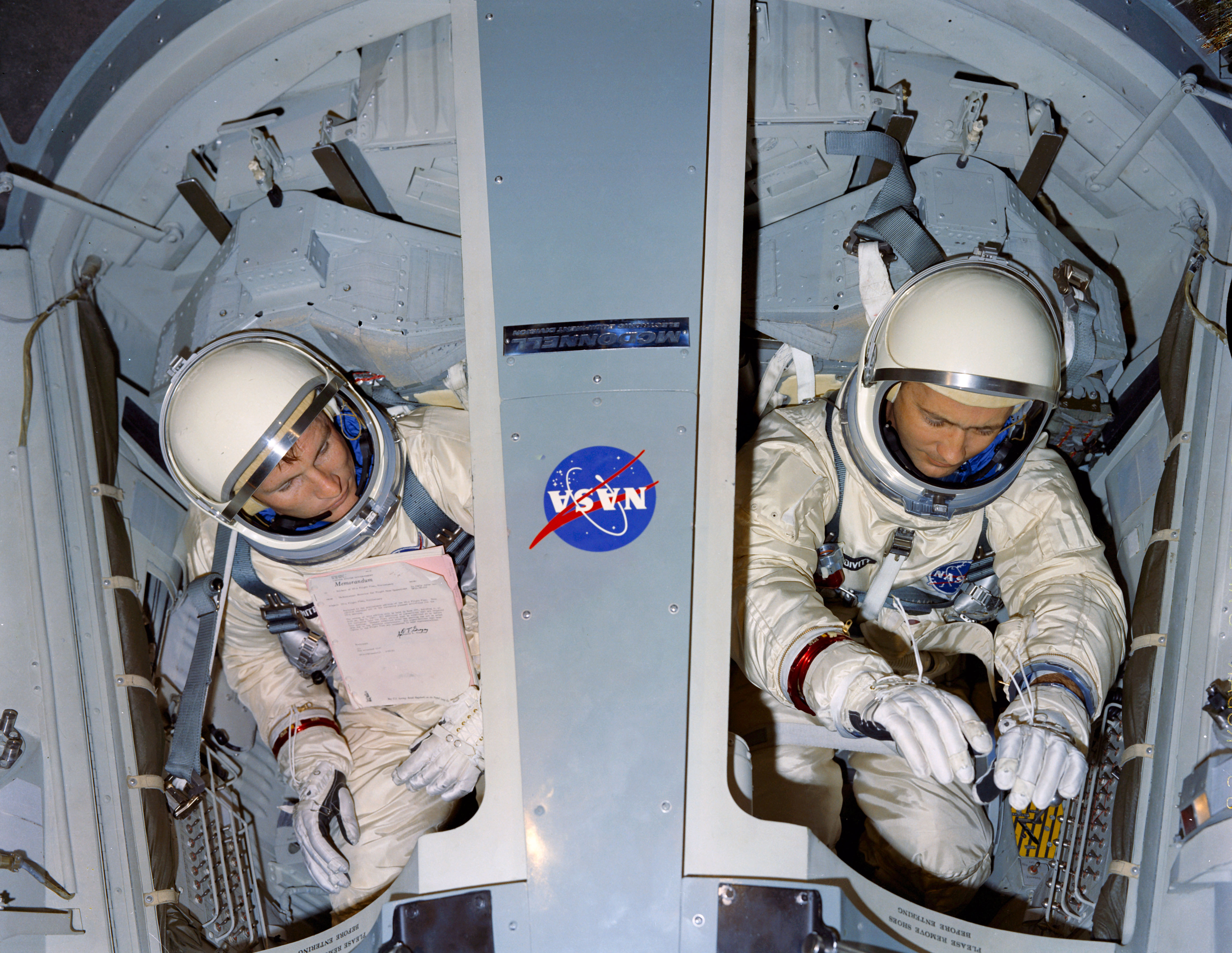
Meanwhile, knowing that a spacewalk might be added to their flight, McDivitt and his crewmates took every chance to press the case. That persistence won NASA management's consent to provide the special suits extravehicular activity required. Without the crew's pressure, the G4C suit would hardly have been ready in time to allow so late a decision. The episode illustrates something about the programme: the astronauts were not merely chauffeurs, but active participants in deciding what would be done and when, far beyond the usual role of a test pilot.
From a 1962 study to a decision in May 1965
The idea was not new. Studies of extravehicular activity in Gemini had begun as early as 1962, and the mission first appeared as the programme's lead-off EVA flight in a "Program Plan for Gemini Extravehicular Operation" in January 1964. Management's response was cool, largely because equipment development was only starting. The following months improved matters: AiResearch was awarded the contract for the extravehicular chestpack, the David Clark Company received specifications for the extravehicular suit, and McDonnell was authorised to begin an EVA design that was eventually applied to Spacecraft 6. At the same July 1964 press conference where the crew was introduced, deputy programme manager Kenneth Kleinknecht had said one of the crew might open the hatch and put his head outside; McDivitt was surprised how little notice reporters took of the remark.
Inside NASA the debate continued. The Manned Spacecraft Center's Engineering and Development Directorate, and its Crew Systems Division in particular, opposed any EVA until crews had faced realistic ground simulations. Alexei Leonov's spacewalk on 18 March 1965, during the Voskhod 2 flight, revived press complaints that the United States was lagging and raised fears that a year might pass before an American matched the feat. When, little more than two months later, NASA announced that White would step outside and use a gas gun to propel himself, most observers assumed the agency was simply chasing its Soviet rival. As far as timing went there was something in that; but the chronology undercuts the simple version, because the public linking of EVA with Gemini 4 preceded Voskhod 2 by nearly eight months.
Formal approval was nonetheless late and contested. Hugh Dryden objected strongly, believing the decision smacked too much of a reaction to the Russians. At Webb's request Robert Seamans drew up a brief setting out the reasons for putting EVA on the current mission, concluding that the hardware was flight qualified, the astronauts trained, and extravehicular activity a primary goal of the programme. On 25 May 1965 Dryden called Seamans into his office and, without a word, handed him the document with a note scribbled in one corner: approved, after discussing with Dryden, signed J. E. Webb. The press was told the same day that White would walk in space; the press kit, released on 21 May, already contained a page headed "Possible Extravehicular Activity".
A rendezvous born of a joke over the radio
The other late addition to the flight plan had an unlikely origin. On 23 March 1965, during Gemini 3, Gordon Cooper joked over the communications link with Grissom, giving him the time and elevation at which he would pass near his booster's second stage and suggesting he try to rendezvous with it. Robert Gilruth and George Low, overhearing, thought it a good idea. Low checked with the programme office and Crew Systems, got an enthusiastic response, and in May 1965 station-keeping joined EVA in the Gemini 4 flight plan: the spacecraft would match velocities with the orbiting stage in the same orbital plane and hold that position for a time.
The exercise was far more ambitious than it looked. Grissom had manoeuvred his spacecraft, but without a target; McDivitt and White would have to spot and track theirs by eye, because the rendezvous radar was still unavailable. Martin fitted flashing lights to the launch vehicle's second stage to help the crew locate it. Nor was there any way to train: neither the Cape nor the Houston simulator was built for the task, so McDonnell rigged equipment in St. Louis to give a simulated view of the target against a star background, and McDivitt and Borman spent half a day on it. It was makeshift at best.
The medicine of a four-day flight
Charles A. Berry, the programme's medical director, was troubled by the leap from the three orbits of Gemini 3 to a seven-day flight and wanted the duration halved; the fuel-cell troubles ended up proving him right. Even four days did not reassure him. Cardiovascular problems had appeared on the last two Mercury missions, and the physiologists he met kept asking the same unsettling question: did he not realise these men might stand up, pass out, and even die after the flight? The reasoning was that bodies deconditioned by days of weightlessness would have to absorb high re-entry g forces; if an astronaut fainted during or after landing, his harness would hold him upright and force an already overtaxed heart to pump blood to his head.
Against that risk the astronauts had two things going for them: the muscular effort of flight tasks and a bungee exerciser adapted from the strap and handle of a spear gun, which required a force of three hundred newtons to stretch it thirty centimetres. EVA added a further concern, the disorientation and motion sickness that might overtake a man floating with no sense of up or down. Soviet reports in early May 1965 described Leonov having trouble with vision and orientation when he could not see his spacecraft. Berry, McDivitt and White studied a filmed interview showing scenes of that spacewalk and noticed that the cosmonaut used numerous reference points — the Sun, the spacecraft, the Earth — to stay oriented. That became White's prescription: always know where you are relative to the spacecraft.
Countdown, a stuck erector and lift-off
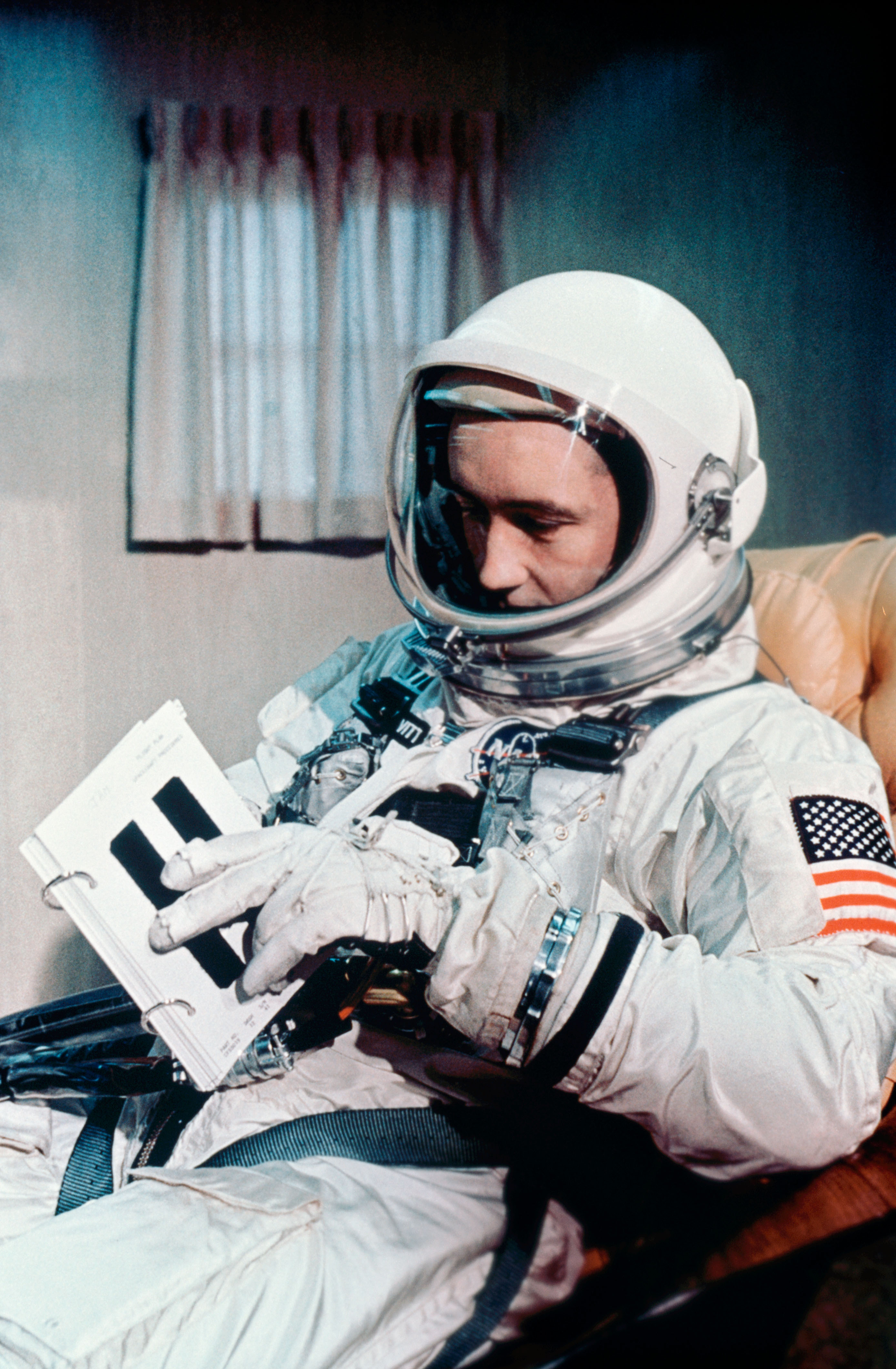
About twelve hours before the scheduled lift-off, the Martin crew began fuelling the booster and calibrating its propellant loads. Borman and Lovell, the backup crew, flipped spacecraft switches, tested communications circuits and handled the chores that relieved the prime crew. McDivitt and White had gone to bed at half past eight the night before; they were woken at ten past four, given a brief physical, had breakfast and left their Merritt Island quarters for the suit-up area, where they were helped into their suits while breathing pure oxygen to purge nitrogen from their systems and prevent the bends. They reached pad 19 at seven minutes past seven and climbed into the spacecraft at T-100 minutes.
Thirty-five minutes before the scheduled launch, as the erector was being lowered, it stuck at twelve degrees from the booster. Raised to full height and lowered again, it stuck once more. After more than an hour technicians found a connector wrongly installed in a junction box, replaced it correctly, and this time the erector came down. That hold of one hour and sixteen minutes was the mission's only delay — an eloquent contrast with the six holds and two scrubs that had plagued the second crewed launch of the Mercury programme.
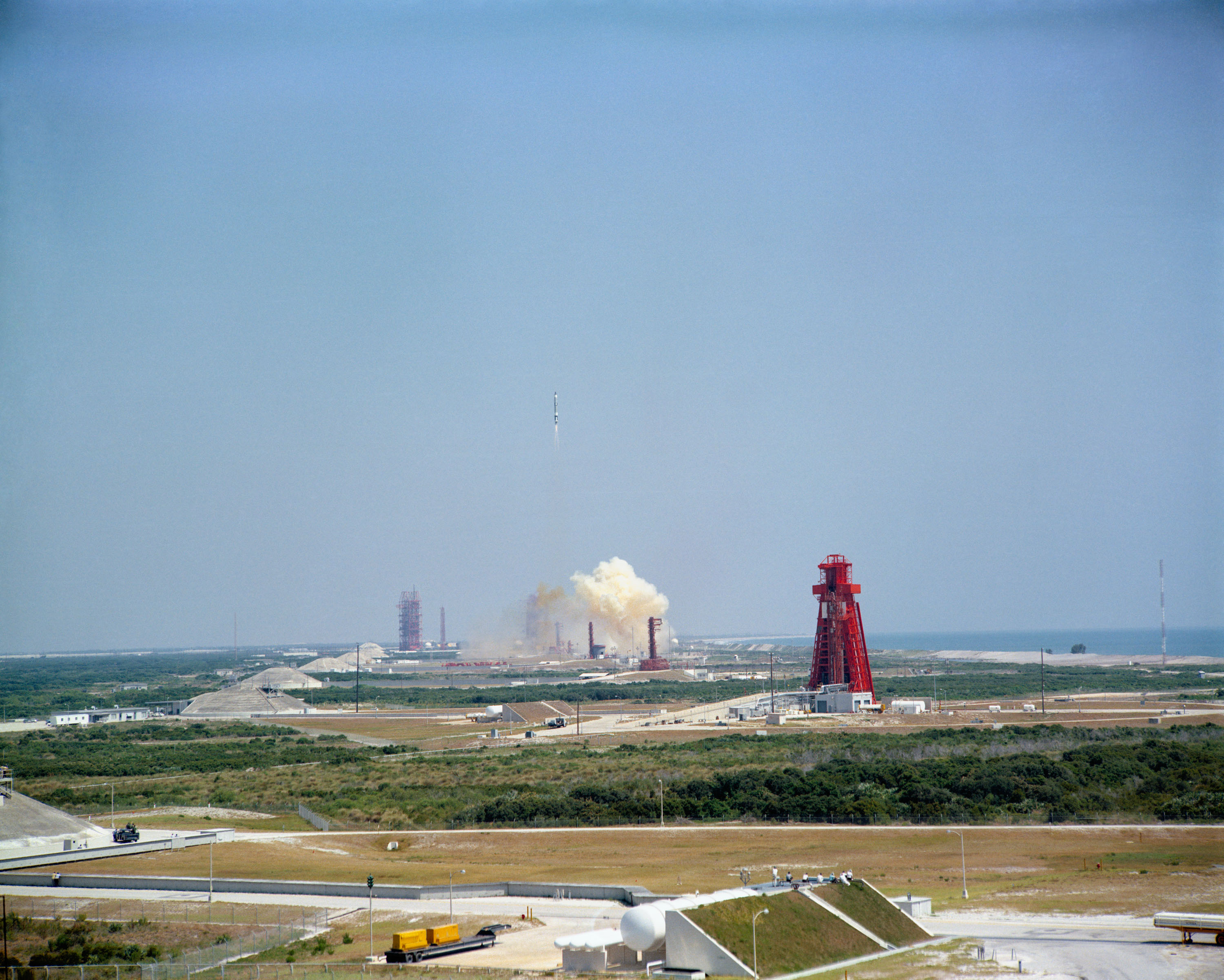
On the morning of Thursday 3 June 1965 the Titan II rose before a worldwide audience: for the first time launch coverage was broadcast to twelve European nations via the Early Bird satellite. Inside the spacecraft the ascent was surprisingly quiet, broken only by a few seconds of longitudinal oscillation — the booster's characteristic pogo effect — and by the pyrotechnics of stage separation. The spacecraft entered an elliptical orbit of 162.3 kilometres at perigee by 282.1 at apogee. Mass at launch was 3,574 kilograms.
Chasing a stage that would not be caught
As Gemini 4 separated from its booster, McDivitt turned the spacecraft to look for the stage. White saw it venting, propellant streaming from the nozzle. How far away was it? The commander guessed one hundred and twenty metres; the pilot, about seventy-five. McDivitt braked, aimed and thrusted toward the target. After two bursts the stage seemed to move away and downward. He repeated the sequence several times with the same result. As night fell he spotted the flashing lights and estimated the gap had stretched to perhaps six hundred metres. For a while he seemed to gain — McDivitt thought he got within sixty metres, White estimated two hundred and sixty to three hundred — but the running lights faded into the dawn, and when the target reappeared three to five kilometres away, no amount of thrusting brought it closer.
Aware that he was pioneering orbital rendezvous, McDivitt had asked Mission Director Christopher Kraft before the flight which mattered more, rendezvous or EVA. The spacewalk, Kraft had answered. With that priority in mind, the commander broke off the chase. They had used close to half their control propellant, in a spacecraft whose tanks held only half the capacity of later models and whose fuel had to be reserved for fail-safe manoeuvres.
The explanation came later. As programme office engineer André Meyer put it, neither the crew nor anyone else at the centre had reasoned out the orbital mechanics involved; the failure made everyone a great deal smarter and led to the rendezvous techniques Apollo would use. Catching an object in orbit is nothing like running one down on the ground. Adding speed raises the orbit, and a higher orbit has a longer period: the spacecraft that speeds up actually falls behind its target, which appears to pull ahead and away. The correct technique is the opposite — slow down, drop into a lower and faster orbit, gain on the target, and at the right moment add speed to rise into the target's orbit with relative motion nearly eliminated. Only then, on station, does a direct approach behave as intuition expects.
Twenty-three minutes outside
White had been so busy helping his commander that he had given little thought to the EVA. With the chase over, he assembled the manoeuvring gun while McDivitt read off the checklist: pull out the umbilical package, fit the suit connectors for the tether and the emergency oxygen chestpack. Twenty minutes before cabin depressurisation the commander noticed his pilot already looked tired and hot, and told the Kano tracking station that EVA would be postponed to the third revolution so White could rest. They talked with Grissom, the Houston capcom, about the view of the Gulf of Mexico and all of Florida, the Cape and its launch complexes included. After a fifteen-minute break they picked up the list again. It was clear to McDivitt that the flight planners had badly underestimated how long preparing for a spacewalk would take.
Over the Indian Ocean everything was ready: hoses connected, umbilical laid out, gun in hand, chestpack in place. Near Carnarvon, Australia, they began depressurising the cabin — the suit was pressurised to 3.7 pounds per square inch and cabin pressure reached zero — and then a mechanical problem appeared: the hatch would not unlatch because a spring had failed to compress. After much yanking and poking at the ratchet the door cracked open; pushing it up proved as hard in zero g as it had been on the ground. White stood up two minutes later.
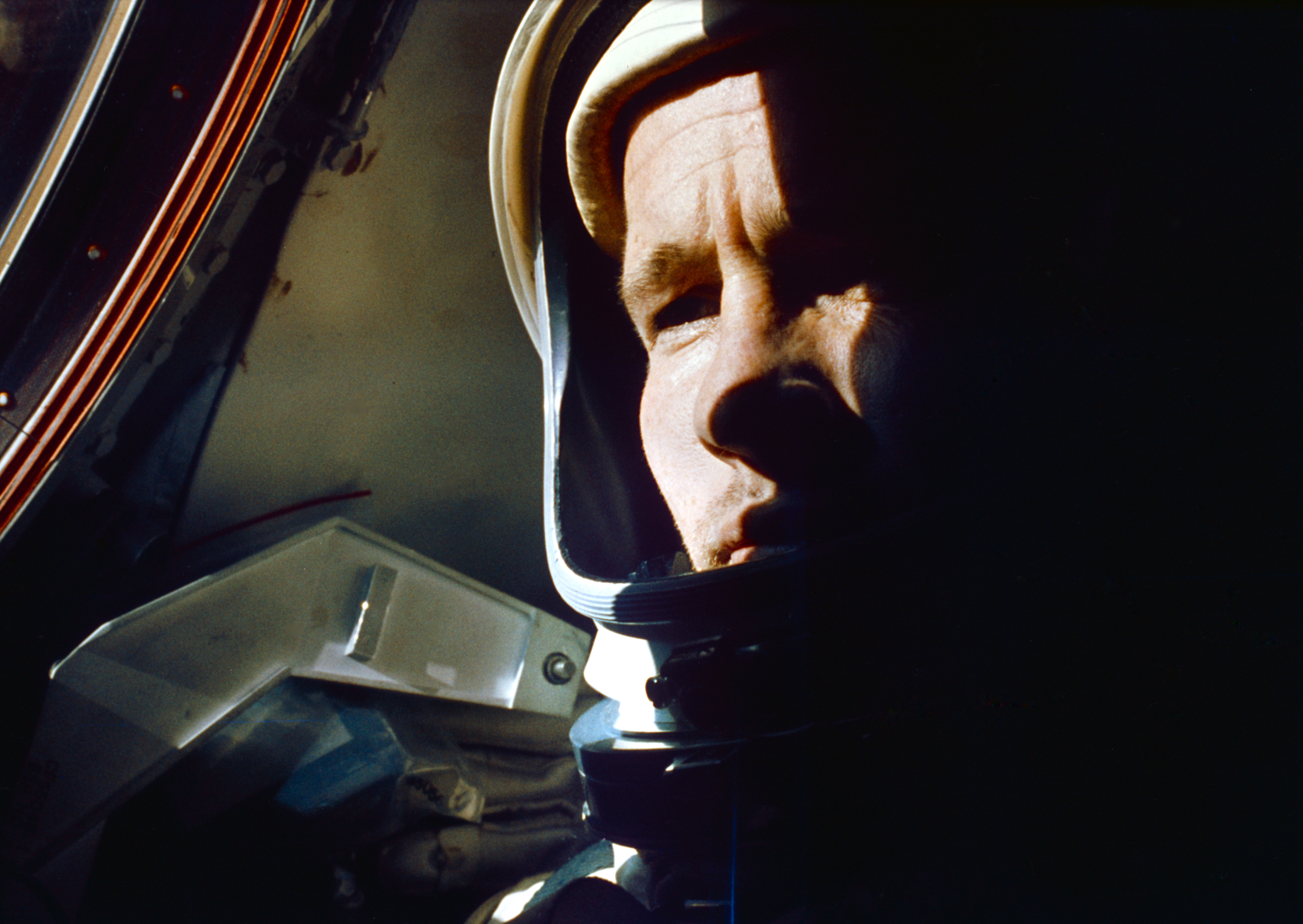
He mounted a camera to record his movements and pushed away from the spacecraft, the manoeuvring gun tethered to his right wrist and an eight-metre umbilical connecting him to the vehicle. One burst lifted him above the hatch without imparting motion to the spacecraft. Experimenting with the device he travelled about five metres, though he ended higher than intended when trying to reach McDivitt's window. Short bursts worked well in pitch and yaw, much as on the air-bearing table in training; roll seemed harder to control without burning too much gas. He preferred to tug on the tether and pull himself aft and up onto the adapter. Seeing the thrusters firing plumes of flaming gas as McDivitt steadied the spacecraft, he propelled himself clear across the top of the vehicle and out beyond its nose. He made two pitchovers and two body turns with the gun, stopping easily each time, and then the compressed oxygen bottle ran dry, three minutes after he had started using it.
During the usual loss of communications between Hawaii and Guaymas, Mission Control had no idea how he was doing. Once voice was restored the world heard a human satellite describe the Earth, the pictures he was taking and how well he felt, with no vertigo or disorientation whatever. When McDivitt had to tell him it was time to come back, his sigh was heard everywhere: it was the saddest moment of his life. White had lost track of the time and, since the crew were on the internal link, flight control could not break in; after fifteen minutes and forty seconds McDivitt cut away to ask the ground whether they wanted anything, and Kraft chuckled that they should tell him to get back in. The extravehicular activity lasted twenty-three minutes in all.
Over the Atlantic, White returned to the hatch, dismounted the camera, removed the electrical connections and handed everything, gun included, to his commander, who helped him settle and guided his feet into the footwells. Closing proved as hard as opening: the handle would not catch, and pushing lifted the pilot out of his seat, so McDivitt had to pull on him for leverage until the door latched. Cabin repressurisation followed. White sat back exhausted, sweat streaming into his eyes and fogging his faceplate. Both men rested before extending an antenna to report that all was well; Carnarvon answered. The crew of Gemini 4 had almost circled the globe in an unpressurised spacecraft.
Three days adrift and eleven experiments
While White recovered, McDivitt began powering down systems to save electrical power and control propellant: the spacecraft would drift for the next thirty hours and much of what remained of the mission. Seven and a half hours after lift-off White went to sleep. They had intended alternating four-hour sleep periods, but it proved hard: the constant crackle of radio traffic, the automatic thruster firings and the inevitable nudges in so small a bedroom kept the sleeper awake.
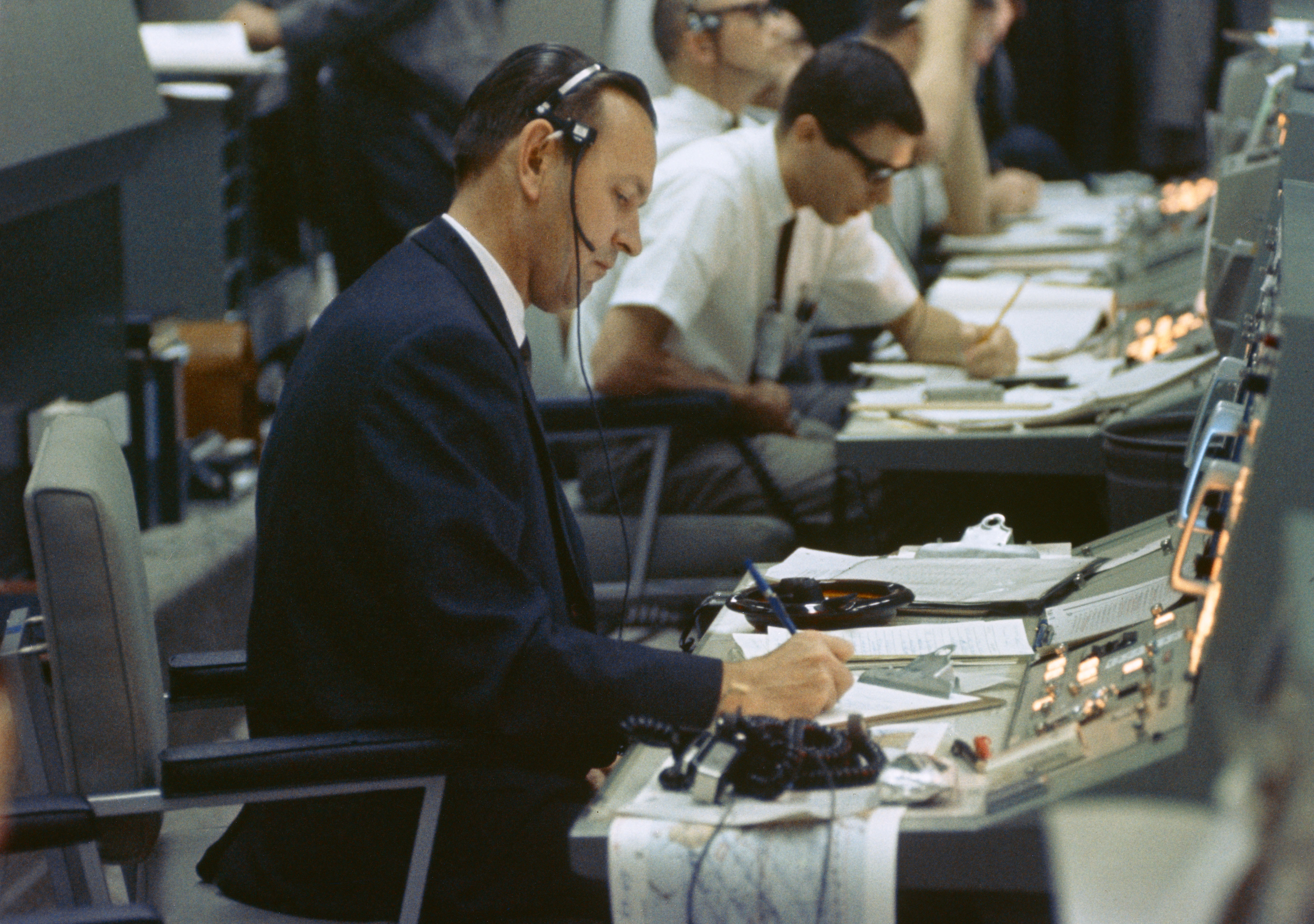
Gemini 4 was the first of the programme's longer missions and it imposed new demands on ground control, which moved for the first time into three-shift operation. Kraft served as Mission Director for the whole flight and Flight Director of the first shift, focused on helping the crew carry out the flight plan; Eugene F. Kranz ran the second, concerned mainly with systems performance and the use of consumables such as oxygen and fuel; John Hodge ran the third, whose speciality was real-time flight planning and which each morning produced specific instructions on what to do or drop in the day ahead, based on what had been achieved and what stocks remained. Behind the control teams, in the support rooms of the new centre, stood NASA and contractor specialists, while at their home plants other teams kept systems running under simulated flight conditions to answer problems quickly. Principal investigators for the experiments, now handled by a new Experiments Program Office under Robert Piland, were on hand as well. A Mission Evaluation Team of one hundred and fifty people, led by Willis Mitchell and Scott Simpkinson, began work at lift-off and continued through post-flight inspection.
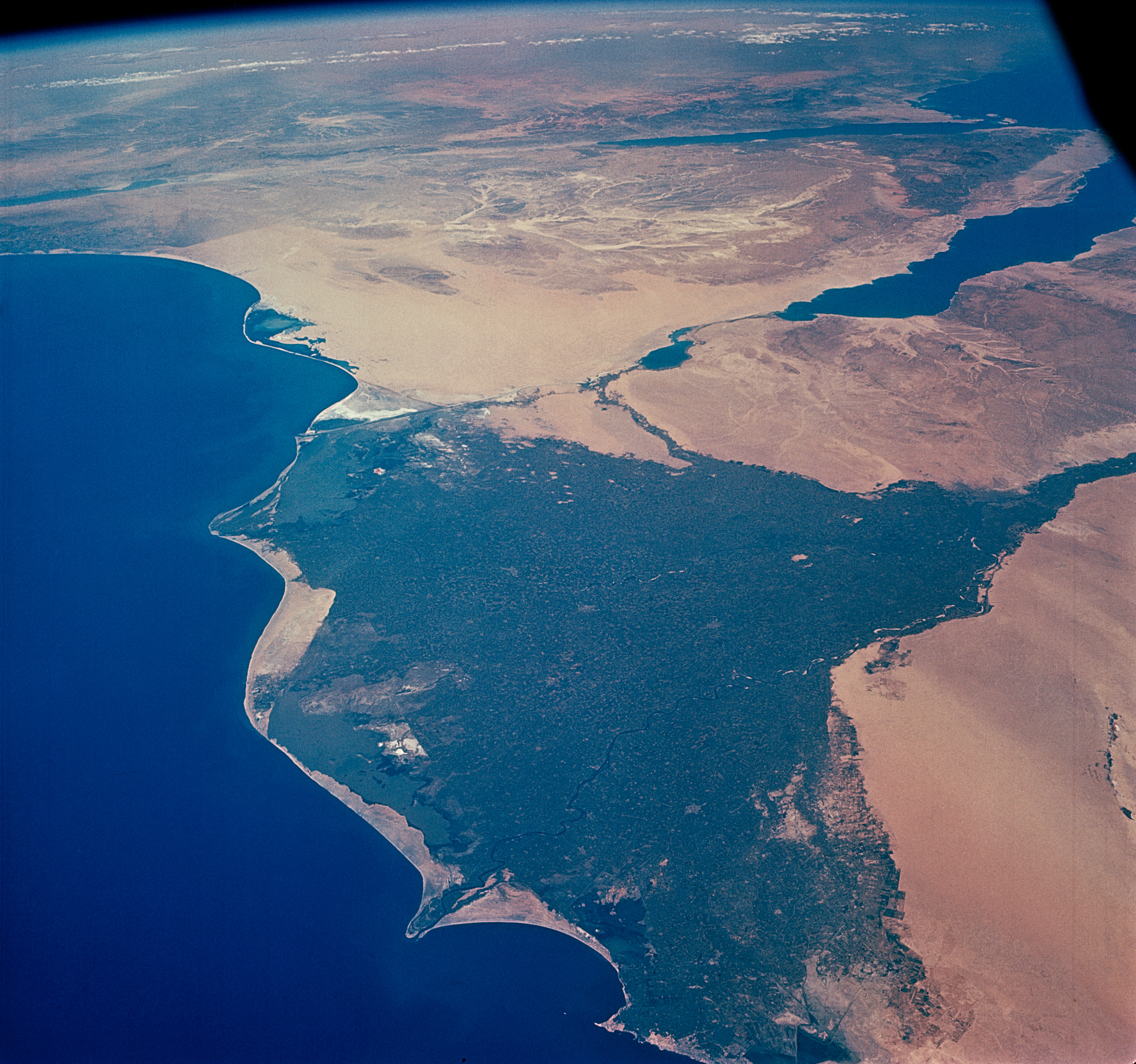
The eleven experiments made Gemini 4 the first American mission to bear some resemblance to a crewed space laboratory, although the propellant constraint hampered several activities. Five dosimeters measured radiation inside the spacecraft, especially while passing through the South Atlantic Anomaly. In the simple navigation experiment the pilots used a hand-held sextant to take celestial readings and judge its usefulness; both agreed it might serve for Apollo. Synoptic terrain and weather photography went well with a seventy-millimetre Hasselblad: they were taken with the Nile valley — one saw Cairo, the other Alexandria — shot a sequence from the Pacific coast to Texas with good geological detail, and gave meteorologists a closer look than the Tiros satellites, which covered from six hundred and forty kilometres, at cellular cloud patterns, cloud layers in tropical disturbances, lines of cumulus over the ocean and thunderstorm areas.
The crew used the bungee exerciser more than planned, though White later said his appetite for strenuous work dwindled during the flight, perhaps from lack of sleep as McDivitt suggested; both concluded that long missions would need a systematic exercise programme. Sensors for the in-flight phonocardiogram recorded essentially normal heart rates except during lift-off, EVA and re-entry. The bone demineralisation experiment showed greater mass loss in the little finger and heel than in bed-rested patients on the ground. Among the engineering experiments, electrostatic charge gave higher readings than expected — later traced to moisture from thruster and water-boiler operation producing a charge that dissipated very quickly — which laid to rest concerns that docking might generate a harmful jolt; the proton-electron spectrometer and tri-axis magnetometer returned useful data on the radiation environment and local geomagnetic field, and red-blue Earth limb photography was designed to help train Apollo astronauts in navigational fixes.
A computer that would not switch off, and a Mercury-style re-entry
After forty-eight revolutions and seventy-five hours of flight, the onboard computer was updated during a stateside pass. Told to switch it off, McDivitt found he could not. Work began on the ground at once, and for the next few revolutions the crew tried different switch positions, but the computer finally quit altogether. Without it the planned lifting bank-angle re-entry was impossible, and a rolling Mercury-type ballistic descent had to be flown instead.
On revolution 62, at 97 hours 28 minutes, they fired the manoeuvring thrusters in the proper retro attitude for two minutes forty-one seconds, jettisoned the equipment adapter and lit the retrorockets. White watched the dusty Texas plains pass by before releasing the retroadapter. At about one hundred and twenty thousand metres McDivitt started the rolling re-entry; as the spacecraft rotated the crew watched the trailing adapter turn into an orange mushroom as it burned. They suspected that without the computer they would land short of the planned Atlantic point, and they were right. The rising g forces caused White no dimming of vision and no shortness of breath; they talked, watched the instruments and enjoyed the view.
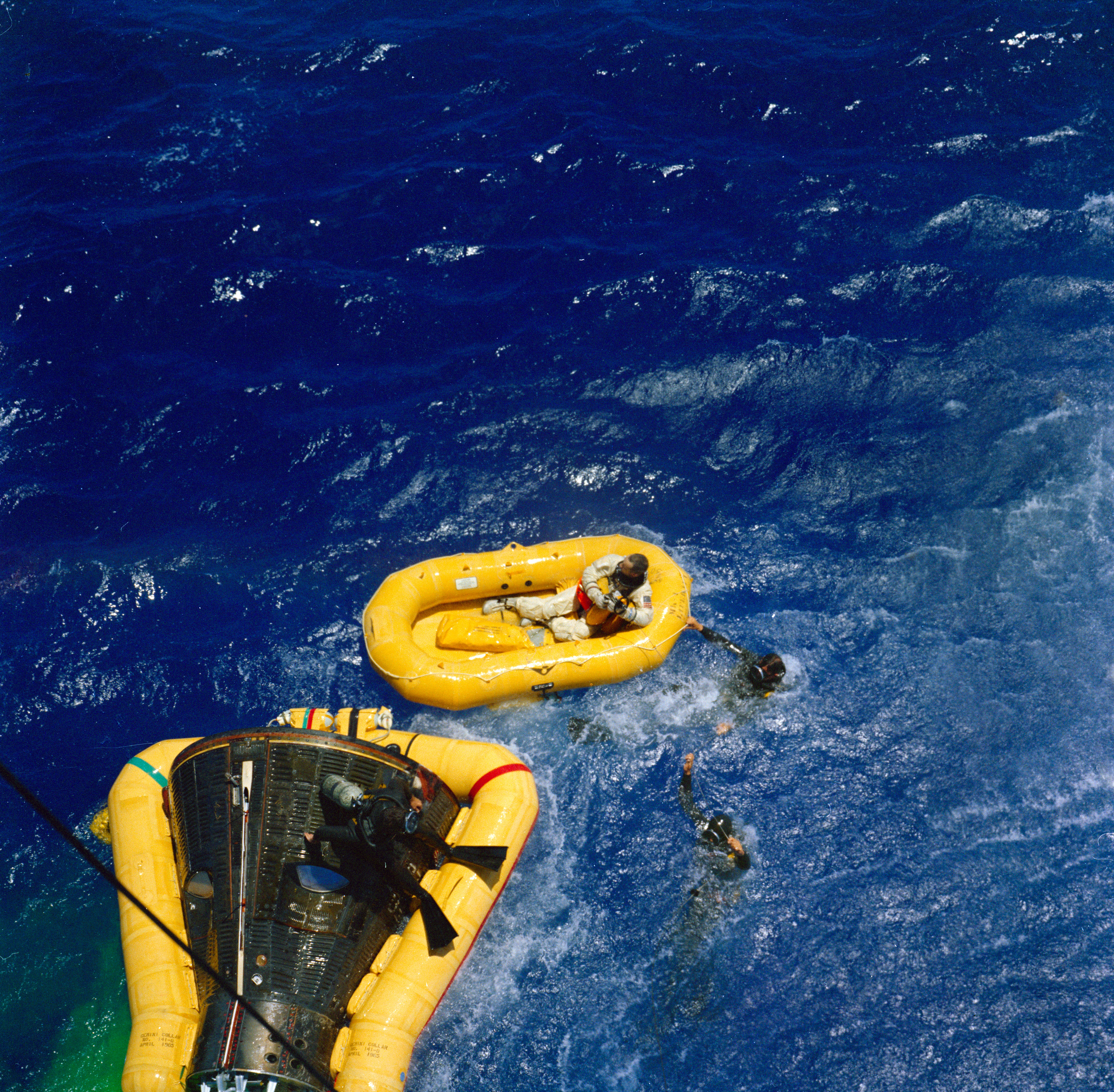
At twenty-seven thousand metres McDivitt slowed the roll, stopping it completely at twelve thousand. Shortly after he punched out the drogue parachute, which set the spacecraft gyrating instead of stabilising it. The main parachute deployed at 3,230 metres with a comforting shock, and at fifteen hundred metres the spacecraft shifted to two-point suspension, a lurch that threw the crew forward and back without either man striking his helmet. Splashdown, ninety-seven hours fifty-six minutes and twelve seconds after lift-off, was rough; but they were down and safe. The capsule landed at 27.73 degrees north and 74.18 degrees west in the western Atlantic, some eighty kilometres from its aim point. Several recovery ships were already moving toward the site and a helicopter crew watched the spacecraft come down.
Afterwards: the day the straw men fell down
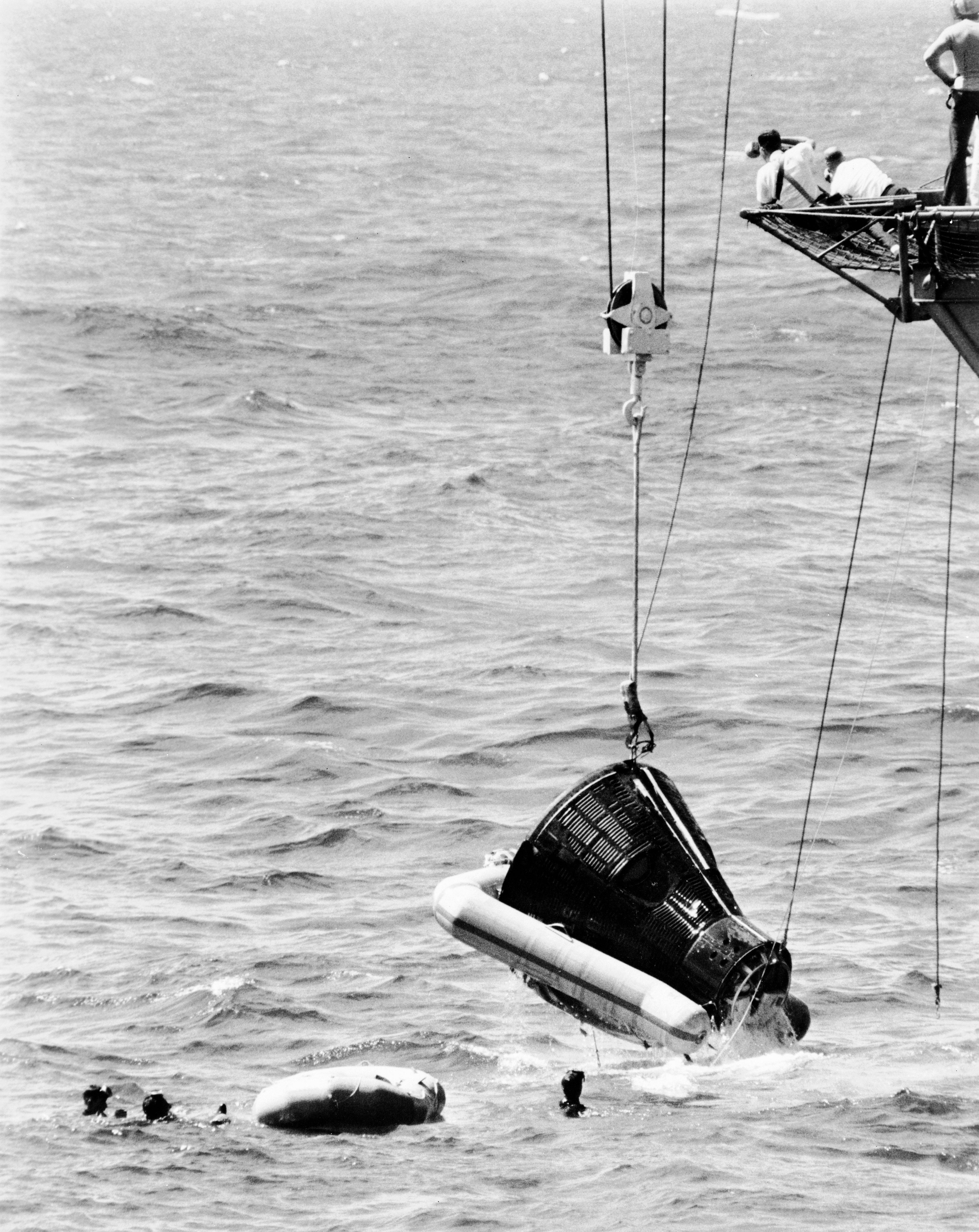
Within minutes of splashdown swimmers were in the water attaching a flotation collar; the pilots were hoisted into a helicopter and fifty-seven minutes after touchdown they stepped onto a red carpet on the deck of the carrier Wasp. A centre physician reported from the helicopter that the crew seemed in good shape, but the question of what four days of weightlessness had done to them remained open. A NASA information specialist who had seen Cooper stagger after his Mercury flight was surprised to watch White do a jig-step, and the tension dissipated at once. Berry and his medical team examined them aboard ship over sixty-six hours and found no major problems; the day after landing, on his way to the medical ward, White joined a tug-of-war between marines and midshipmen for fifteen minutes. His side lost, but the man was plainly strong.
The medical findings were not trivial. Beyond the expected bone mass loss in heel and little finger, physicians were startled to find a drop in circulating plasma volume. Both men lost weight: McDivitt two kilograms, White four. None of it stopped the mission from paving the way for an even longer flight. McDivitt and White later inscribed a photograph of the two of them crossing the red carpet with a phrase that summed up the relief: the day the straw men fell down.
Gemini 4 stirred an excitement no later mission in the programme would match. Interest in the spacewalk and in the debut of the Houston centre overwhelmed the plans: the centre's eight-hundred-seat auditorium fell far short of the accreditation requests, and NASA had to lease and fit out a nearby building to house the news centre, a decision the local press criticised once its cost became known. The flight's daily activities filled newspapers around the world and even pushed aside the dark clouds of 7 June, the day of the return, when the US military command in South Vietnam announced its troops would fight alongside Vietnamese forces. President Johnson came to Houston to congratulate the crew, a million Chicagoans showered them with ticker tape, and Webb sent them, at the President's request, to the Paris International Air Show, where they met cosmonaut Yuri Gagarin.
Legacy
The spacecraft had no name, official or otherwise, and its pilots wore no distinctive patch, as every later Gemini crew would; a few newsmen called the ship "Little Eva" for the extravehicular activity.
The technical scorecard was nearly complete: every objective was met except rendezvous and computer-controlled re-entry. But Gemini 4's most lasting contribution was not a box ticked; it was three lessons. First, that a human being could leave the spacecraft, manoeuvre and return — though the physical effort of the EVA and of the hatch proved far greater than expected, a lesson that would be paid for on later missions until restraints and work pacing were mastered. Second, that orbital closure cannot be improvised by eye and demands an understanding of the mechanics, a road that would lead to the successful rendezvous of later missions and then to Apollo's manoeuvres. Third, that mission control, real-time flight planning and systematic data evaluation were now infrastructure as critical as the spacecraft itself. Gemini 4 served, in short, as a training ground for pilots, flight controllers and evaluators alike, and set the style for the Gemini missions and Apollo flights that followed.
Images
Elsewhere
- Smithsonian National Air and Space MuseumCapsule, Gemini IV ↗
- Smithsonian National Air and Space MuseumHatch, Right, Gemini IV ↗
- NASAGemini IV photo gallery ↗
- NASAFirst American Spacewalk ↗
- Internet ArchiveS65-30427 — Ed White durante la EVA sobre Hawái (primera fotografía de un ser humano en el espacio) ↗
- Internet ArchiveGEMINI-TITAN-4 — SPACECRAFT (EVA) ↗
- Internet ArchiveRecovery of Gemini 4 spacecraft and astronauts ↗
- FlickrEd White — First American spacewalk — Gemini 4 ↗
- DVIDSRecovery of Gemini 4 spacecraft and astronauts ↗
- AlamyThe recovery ship for the Gemini 4 spacecraft, the USS Wasp ↗
- Library of CongressAstronauts Edward H. White and James A. McDivitt prepare for Gemini-4 simulated test at Cape Kennedy ↗
- BonhamsGemini IV — The first-ever photograph of a human in space ↗