Northrop to Northrop Grumman with Kent Kresa, Northrop Grumman CEO Emeritus
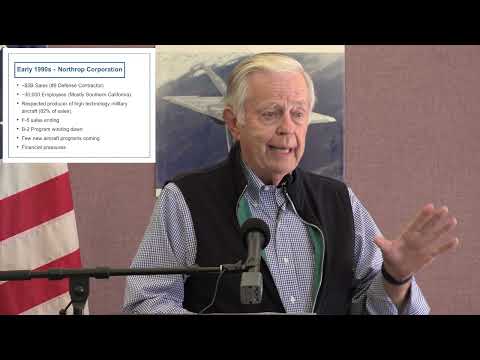
Video from the channel Western Museum of Flight about Northrop Grumman, linked on its Above Ten Thousand entry. Duration: 1:03:14. Language: English. Video type: Documentary.
What it's about
Kent Kresa, CEO Emeritus of Northrop Grumman, reviews at a Western Museum of Flight conference how Northrop stopped being an airframe manufacturer and became a diversified defence group. Kresa had succeeded Tom Jones at the head of the company in the early 1990s. He explains the acquisition strategy he led and what capabilities he sought with each purchase.
Historical context
The starting point is the end of the Cold War. At a 1993 meeting known as the "Last Supper," Defense Secretary Les Aspin warned the major contractors that the defence budget would be roughly halved and that the sector would have to consolidate. Northrop was then the ninth-largest contractor, with 30,000 employees and the B-2 programme. It decided to grow by buying other companies, relying on the cash generated by the B-2 and a pension plan with a surplus. Around 1993, a strategic analysis set the priority areas: global force projection, precision strike, surveillance, survivability (electronic warfare and stealth), information warfare and missile defence.
Key facts
In 1992, together with the Carlyle Group, Northrop had already bought LTV's Vought division. It then took over Grumman through a hostile takeover bid in which it competed against Lockheed. That purchase brought it the Joint STARS, the E-2C and electronic and computer warfare capabilities. Later came Westinghouse's radar division, Logicon, Teledyne Ryan (with the Global Hawk), Litton (which included the Pascagoula shipyards), Newport News and TRW. In the case of Newport News, the government approved the purchase after rejecting General Dynamics' offer. Years later Scaled Composites and Orbital ATK were added. The merger with Lockheed Martin, announced in 1997, never happened due to government opposition. In total there were 26 acquisitions and one spin-off, that of Huntington Ingalls in 2011. The company also sold its commercial aerostructures arm to Carlyle and divested its IT mission systems business. As major recent successes, Kresa cited the B-21 and the LGM-35 Sentinel. During the Q&A he spoke about moving the headquarters to Washington, the YF-23's defeat against the F-22, the Webb telescope (whose contract had been won by TRW) and his own career at Avco, MIT and ARPA.