Why Everyone Feared The "Flying Pencil" | Dornier Do 17
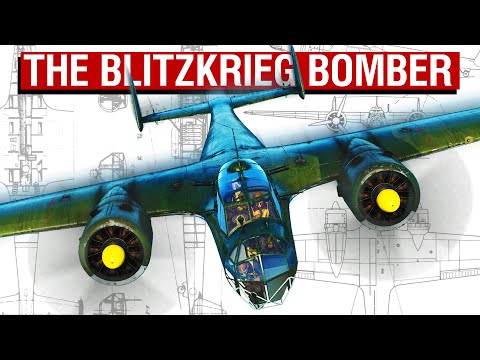
Video from the channel Rex's Hangar about Dornier, linked on its Above Ten Thousand entry. Duration: 1:15:24. Language: English. Video type: Documentary.
What it's about
A roughly 75-minute documentary about the Dornier Do 17, the Luftwaffe's light bomber known as the "flying pencil" for its narrow fuselage, and its derivative, the Do 215. It covers the design's origins, the prototypes, the production series and the aircraft's operational career from the Spanish Civil War to its retirement. It includes a segment sponsored by a video game.
Historical context
The aircraft's origin is disputed. The video presents three versions: a fast transport for Deutsche Lufthansa that Robert Untucht supposedly rescued, a covert ministry commission, or a military design from the outset. Following Karl Kössler, it leans toward the third. The V1 prototype, with a single tail fin and BMW VI engines, first flew on 23 November 1934. It later adopted a twin tail, and 21 prototypes were built. The bomber E-1 series and reconnaissance F-1 series entered service in 1937 with KG 153. That same year, from March, between 27 and 31 aircraft operated in Spain with the VB/88 unit. The MV1 was shown in Zurich in 1937 with DB 601 engines. The M and P series followed, with Bramo 323 and BMW 132N radial engines, then the R, S and U, and the Z, with a cabin enlarged for four crew.
Key facts
The Do 17 E-1 carried two 750 hp BMW VI engines, reached 330 km/h at 3,000 m, and had an 18 m wingspan and a length of 16.2 m. It carried between 500 and 750 kg of bombs with a crew of three. The F-1 version had a range of about 2,050 km. The Z-2, with 1,000 hp Bramo 323P engines, carried 1,000 kg of bombs with a 320 km combat radius. In the war it saw action in Poland, where KG 3 attacked the Dirschau bridge, and in Norway and France, with the Vraux raid of 11 May 1940. In the Battle of Britain it attacked Kenley on 18 August. On 15 September, Zehbe's aircraft was rammed by Ray Holmes. There were Z-7 and Z-10 Kauz night fighters, some 36 Yugoslav Do 17Ks plus about 70 built under licence, and 105 Do 215s. The aircraft also fought in the Balkans and in the USSR, and towed gliders until 1945. More than 2,100 units were built. On 10 June 2013 a Z-2 was recovered from the Goodwin Sands.