Did you know…
Where does a rocket land?
Short answer
Most rockets don't land at all: their stages fall into the ocean or uninhabited areas. Only reusable boosters come back, like SpaceX's Falcon 9, which touches down on concrete landing pads near the pad or on autonomous drone ships at sea, and Starship's Super Heavy, caught in midair by its tower's arms.

The usual case: they don't land
A conventional rocket is expendable. The first stage separates a few minutes after liftoff and falls, in pieces or whole, into a previously closed exclusion zone: the Atlantic for launches from Florida, the Pacific for Vandenberg, the steppes of Kazakhstan for Soyuz rockets launched from Baikonur, or mainland China for Long March vehicles. Upper stages usually reenter and break up, or remain in orbit as space debris.
The ones that do come back
SpaceX changed that logic in December 2015 with the first vertical landing of a Falcon 9 first stage. Today its boosters have two possible destinations: landing zones on the ground (LZ-1 and LZ-2 at Cape Canaveral, LZ-4 at Vandenberg), concrete pads just a few kilometers from the launch pad, or autonomous drone ships stationed hundreds of kilometers out at sea, used when the mission demands more speed and there's no propellant left to return to shore.
Blue Origin's suborbital New Shepard lands in the Texas desert right next to its launch site. And Starship's Super Heavy booster doesn't touch the ground at all: it returns to the launch tower, whose arms catch it in midair, something SpaceX achieved for the first time in October 2024.
How they touch down
Landing is a controlled reentry: the booster orients itself with cold-gas thrusters and grid fins, relights some engines to slow down, and deploys its legs seconds before contact. The flight computer handles all of it; no pilot is involved. Uncontrolled falling stages, by contrast, require closing off corridors and warning maritime and air traffic.
More questions
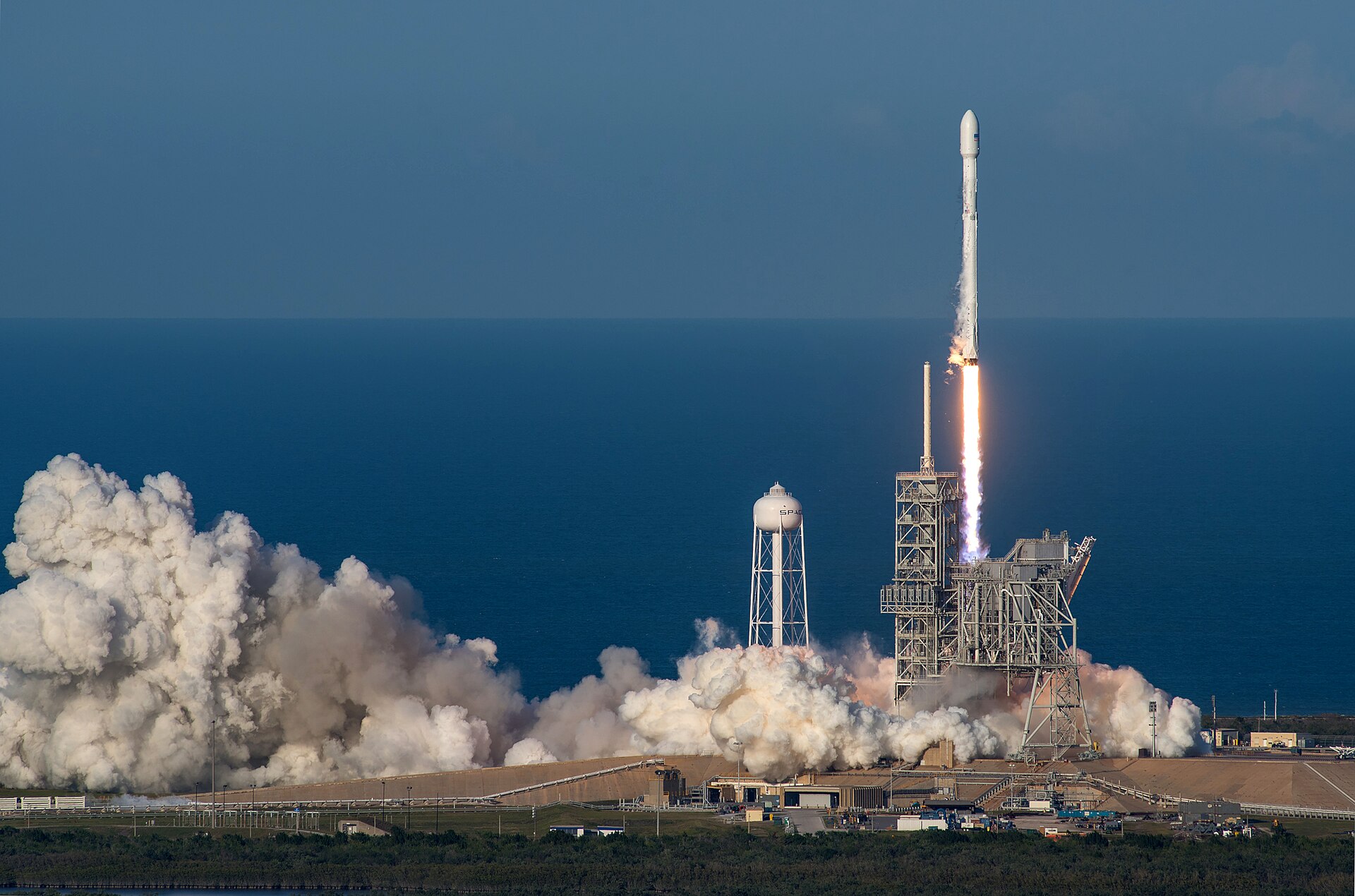
Foto: SpaceX (CC0) Rockets and launches
How many horsepower does the Falcon 9 have?
Rockets aren't measured in horsepower, but in thrust: the Falcon 9's first stage's nine Merlin engines deliver 7,686 kN (1,710,000 lbf) combined at sea level… more…
Foto: SpaceX (CC0) Rockets and launches
How much a rocket weight?
Rockets range from about 13 t for Rocket Lab's Electron to roughly 549 t for Falcon 9, 2,800 t for Saturn V and close to 5,000 t for Starship with its Super… more…

Rockets and launches
What does the saturn v look like?
Saturn V looked like a white needle 110.6 m (363 ft) tall and 10.1 m wide at the base, painted with black roll-pattern stripes, the words UNITED STATES and… more…
Foto: SpaceX (CC0) Rockets and launches
Why do rockets launch from florida?
Rockets launch from Florida because the Cape sits at 28.5 degrees north, low enough to gain about 410 m/s from the Earth's rotation on an eastward launch, and… more…
Foto: SpaceX (CC0) Rockets and launches
How much falcon 9 launch cost?
SpaceX lists a standard Falcon 9 mission at 69.75 million dollars, with the booster recovered (data as of January 2025). Small satellites can share a ride… more…
Rockets and launches
How does the saturn v work?
Saturn V worked by staging: a kerosene first stage with five F-1 engines (about 34,000 kN) lifted the 2,800 t rocket for two and a half minutes, a… more…
