Did you know…
Why do rockets fly in space?
Short answer
A rocket doesn't need air to propel itself: it carries both fuel and oxidizer on board and moves forward by reaction, expelling gas at high speed through the nozzle. By Newton's third law, that mass thrown backward pushes the vehicle forward, and in a vacuum the absence of air even improves the engine's performance.
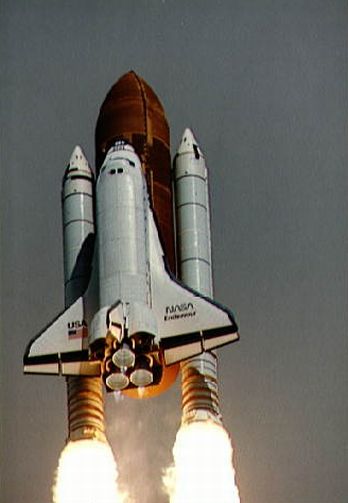
Thrust by reaction, not by pushing against something
The intuitive idea that an engine "pushes off" the air is false. A rocket works by expelling mass: it burns propellants in the combustion chamber, accelerates the resulting gases through a nozzle, and ejects them backward at several kilometers per second. Newton's third law states that this action produces an equal and opposite reaction on the vehicle. Nothing external is involved; the thrust is generated entirely inside the engine, the same on the launch pad as at 400 km altitude.
The oxidizer travels on board
An aircraft jet engine draws oxygen from the atmosphere to burn kerosene, which is why it stops working as soon as air becomes scarce. A rocket avoids that limit by carrying its own oxidizer, whether liquid oxygen, nitrogen tetroxide, or the perchlorate used in a solid propellant. It's an expensive solution in terms of mass, since the oxidizer usually weighs more than the fuel, but it's the only one that allows an engine to ignite in a vacuum or on the surface of the Moon.
The vacuum works in its favor
Contrary to popular belief, space actually improves a rocket engine's performance. In the atmosphere, outside pressure slows the expansion of gases in the nozzle and reduces thrust; in a vacuum that pressure disappears and the same amount of propellant produces more impulse. That's why upper stages use nozzles that are much longer and wider than those of the first stage, designed to work where there is no air. Moreover, without aerodynamic drag, a small push is enough to change orbit, and satellites can maintain their trajectory for years with tiny engines.
More questions
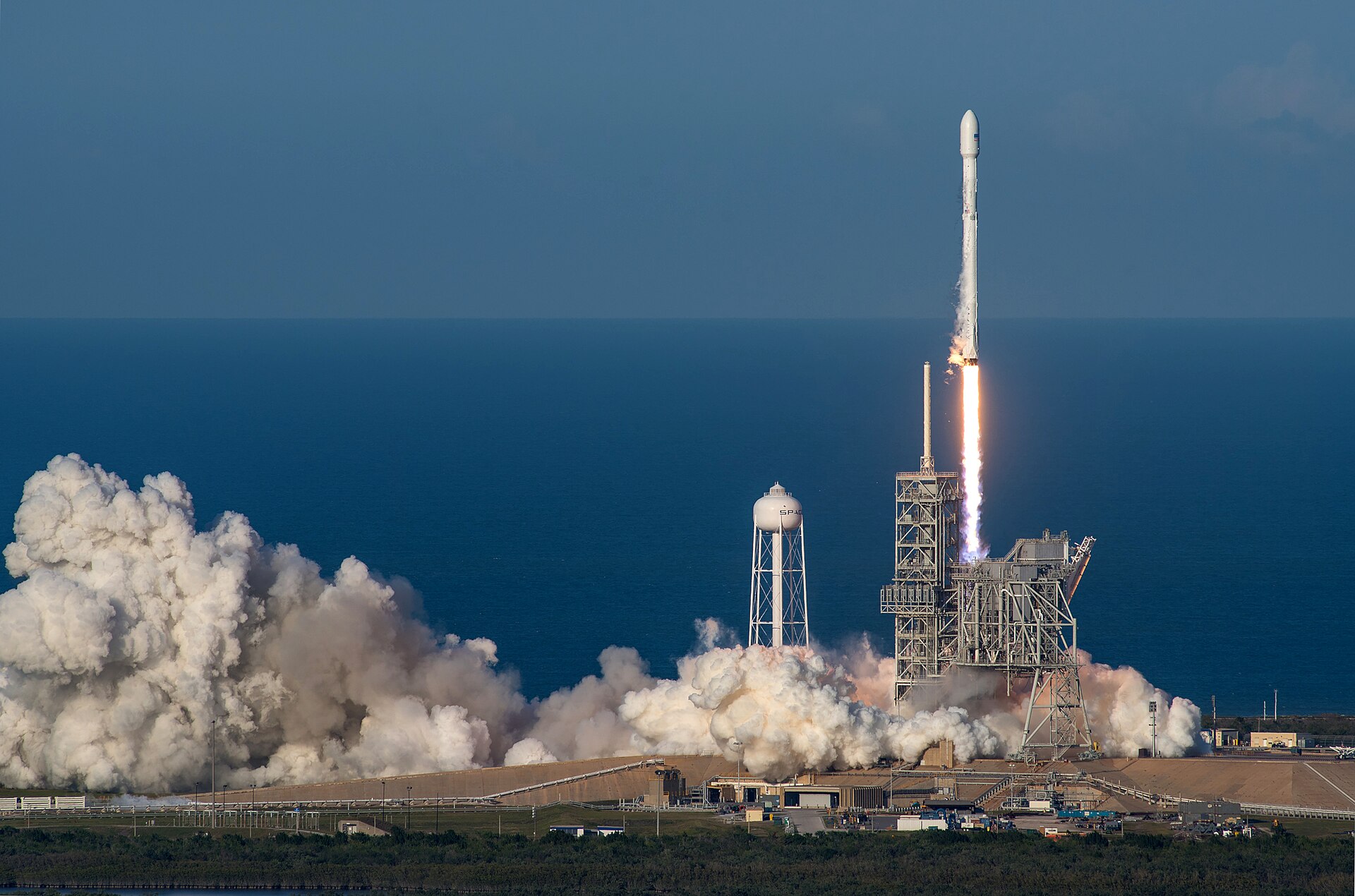
Foto: SpaceX (CC0) Rockets and launches
How many horsepower does the Falcon 9 have?
Rockets aren't measured in horsepower, but in thrust: the Falcon 9's first stage's nine Merlin engines deliver 7,686 kN (1,710,000 lbf) combined at sea level… more…
Foto: SpaceX (CC0) Rockets and launches
How much a rocket weight?
Rockets range from about 13 t for Rocket Lab's Electron to roughly 549 t for Falcon 9, 2,800 t for Saturn V and close to 5,000 t for Starship with its Super… more…

Rockets and launches
What does the saturn v look like?
Saturn V looked like a white needle 110.6 m (363 ft) tall and 10.1 m wide at the base, painted with black roll-pattern stripes, the words UNITED STATES and… more…
Foto: SpaceX (CC0) Rockets and launches
Why do rockets launch from florida?
Rockets launch from Florida because the Cape sits at 28.5 degrees north, low enough to gain about 410 m/s from the Earth's rotation on an eastward launch, and… more…
Foto: SpaceX (CC0) Rockets and launches
How much falcon 9 launch cost?
SpaceX lists a standard Falcon 9 mission at 69.75 million dollars, with the booster recovered (data as of January 2025). Small satellites can share a ride… more…
Rockets and launches
How does the saturn v work?
Saturn V worked by staging: a kerosene first stage with five F-1 engines (about 34,000 kN) lifted the 2,800 t rocket for two and a half minutes, a… more…

