Did you know…
Where did the Trislander carry its third engine?
Short answer
On the fuselage's longitudinal axis, atop a lengthened fin: that third engine mounted high on the tail was the most visible change. The Trislander was developed as a larger derivative of the Islander, with the fuselage stretched and reinforced for greater payload capacity.
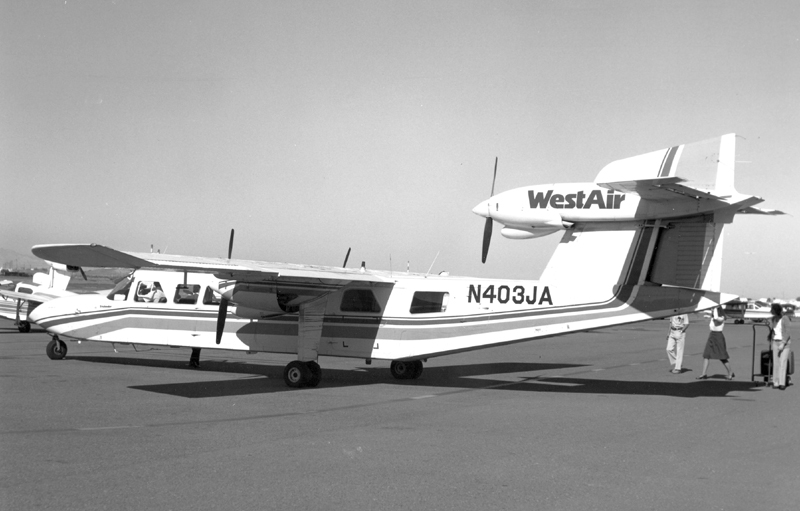
A larger, derived Islander
Keen to capitalize on the Islander's success, company management chose to develop a larger aircraft derived from its predecessor, in order to make use of common elements and cut development costs. In 1968 the firm flew a stretched variant of the aircraft, known as the BN-2E Islander Super, which was never taken through to certification in favor of a more radical design alternative: the Trislander. To give it considerably greater payload capacity, the Islander's fuselage was lengthened and reinforced substantially.
The third engine, on the fin
The most visible change was the addition of a third engine mounted on the fuselage's longitudinal axis, atop a lengthened fin. In terms of construction, the Trislander resembled the Islander closely enough for both aircraft to share the same final assembly line.
Variants and equipment
Some versions were fitted with auto-feathering propellers and auxiliary rocket-assisted takeoff (RATO) equipment. The III-2 variant carried a 350 lb (160 kg) RATO system.
More questions

Aviation history
Which was the most-produced American fighter of the Second World War?
The Republic P-47 Thunderbolt, of which 15,636 or 15,683 units were built, depending on the source. It was also one of the heaviest fighters of the conflict… more…

Aviation history
Who flew the E-66 at 2,149 km/h?
Konstantin or Vladimir Kokkinaki, depending on the source. Konstantin is credited with the absolute record on a closed 100 km circuit, at 2,148.66 km/h, set… more…

Fly-by-Owen (CC BY SA), vía commons Aviation history
How many I-11Bs were built?
Between 208 and around 450, depending on the source: one of the AISA I-11 reference sheets gives 208 examples built, while All-Aero speaks of around 400 built… more…

Aviation history
How many HH-53s could be converted to Pave Low III?
Eight HH-53C aircraft received an improved systems package and were redesignated HH-53H Pave Low III. The other figure in circulation, nine MH-53H and 32… more…

SCDBob (CC BY SA), vía commons Aviation history
What did the A129 Mangusta's armor protect?
The fuselage: the A129's airframe is armored and, according to All-Aero, designed to protect against 12.7 mm rounds, with partial protection against 23 mm… more…
Fly-by-Owen (CC BY SA), vía commons Aviation history
What landing gear and canopy did the AISA I-11B have?
According to one account, AISA reduced the cockpit canopy and fitted tailwheel gear on the production I-11B. All-Aero claims the opposite: the I-11B was… more…


