Did you know…
What unusual wheels did the Albatros G.II have?
Short answer
It had a twin set of nose wheels, intended to reduce damage in nose-over accidents and while at rest with the centre of gravity shifted forward. That landing gear spoiled the lines of the G.II, a medium bomber of which only one prototype was built.
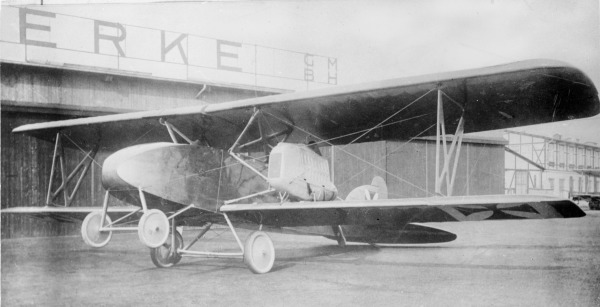
An unusual landing gear
The graceful lines of the Albatros G.II's fuselage were spoiled by the twin set of nose wheels, intended to reduce damage in nose-over accidents and while at rest, when the centre of gravity was shifted forward.
A medium bomber unrelated to the G.I
Conceived as a medium bomber, the G.II shared no attributes with the larger G.I: it was a single-bay biplane with thick-section upper wings and rigid X-form interplane struts. Its powerplant consisted of two water-cooled, six-cylinder in-line Benz Bz.III engines of 112 kW (150 hp) each. The engines were installed in pusher nacelles supported by struts from the fuselage, and the trailing edges of the lower wing had cutouts that allowed them to be mounted further forward than would otherwise have been possible. Only one prototype was built, which showed relatively poor performance, so development was concentrated on the more powerful Albatros G.III.
Before and after: the G.I and the G.III
The G.I first flew on 31 January 1916, piloted by Alexander Hipleh, and testing revealed poor flying qualities and poor performance, leading to the abandonment of its development. The G.III was a large single-bay biplane of unequal span with no stagger between the wings. It was powered by two Benz Bz.IVa engines in pusher configuration, installed in nacelles supported between the wings. An unusual feature of its design was that the lower wing had cutouts for the propellers, so that the nacelles could be mounted further forward than would otherwise have been possible. Few were built, and they served mainly on the Macedonian front in 1917.
More questions

Aviation history
What was special about the Vertol 76?
Vertol's VZ-2 tested the tiltwing concept for vertical take-off and landing. After ground trials beginning in April 1957, it first took off on 13 August only… more…

Aviation history
Which was the most-produced American fighter of the Second World War?
The Republic P-47 Thunderbolt, of which 15,636 or 15,683 units were built, depending on the source. It was also one of the heaviest fighters of the conflict… more…

Aviation history
Who flew the E-66 at 2,149 km/h?
Konstantin or Vladimir Kokkinaki, depending on the source. Konstantin is credited with the absolute record on a closed 100 km circuit, at 2,148.66 km/h, set… more…

Fly-by-Owen (CC BY SA), vía commons Aviation history
How many I-11Bs were built?
Between 208 and around 450, depending on the source: one of the AISA I-11 reference sheets gives 208 examples built, while All-Aero speaks of around 400 built… more…

Aviation history
How many HH-53s could be converted to Pave Low III?
Eight HH-53C aircraft received an improved systems package and were redesignated HH-53H Pave Low III. The other figure in circulation, nine MH-53H and 32… more…

SCDBob (CC BY SA), vía commons Aviation history
What did the A129 Mangusta's armor protect?
The fuselage: the A129's airframe is armored and, according to All-Aero, designed to protect against 12.7 mm rounds, with partial protection against 23 mm… more…


