Did you know…
Which bomber introduced the RAF's first enclosed, powered nose turret?
Short answer
The Boulton Paul Overstrand: the first aircraft fitted with a fully enclosed, power-operated turret. A development of the Boulton Paul Sidestrand, which had first flown in 1928, it carried the turret in the nose, with three.303 in (7.7 mm) Lewis guns split between it and the dorsal and ventral positions.
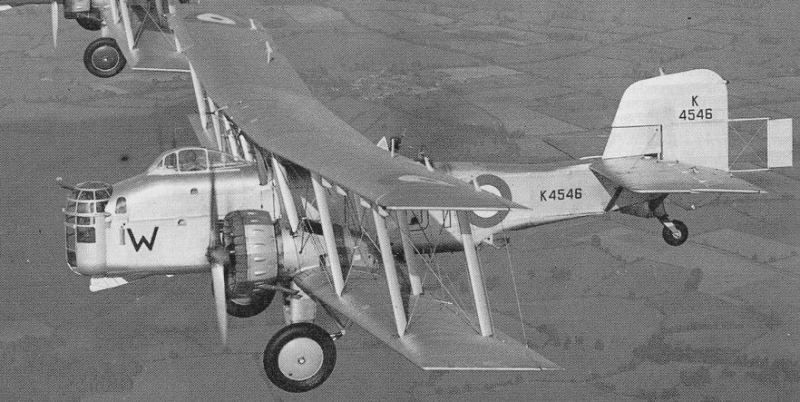
A bomber derived from the Sidestrand
The Overstrand was a development of the Boulton Paul Sidestrand, an aircraft that had made its first flight in 1928. Among the changes in the new machine was a noticeable sweep added to the outer wing sections, intended to compensate for the greater weight of the nose section. Power came from two nine-cylinder Bristol Pegasus IIM.3 radials, each rated at 580 hp (430 kW). With these, it reached a maximum speed of 148 mph (238 km/h, 129 kn) at 6,500 ft (2,000 m), and could carry a bomb load of up to 1,500 lb (680 kg).
The turret that made it unique
The Overstrand was the first aircraft fitted with a fully enclosed, power-operated turret. Its defensive armament consisted of three.303 in (7.7 mm) Lewis machine guns, distributed between the nose turret and the dorsal and ventral gun positions.
A single squadron
The RAF acquired a total of 24 Overstrands, a number that made it possible to fully replace the Sidestrands flown by No. 101 Squadron — the only squadron equipped with the type — in a process that began in January 1935.
More questions

Aviation history
What was special about the Vertol 76?
Vertol's VZ-2 tested the tiltwing concept for vertical take-off and landing. After ground trials beginning in April 1957, it first took off on 13 August only… more…

Aviation history
Which was the most-produced American fighter of the Second World War?
The Republic P-47 Thunderbolt, of which 15,636 or 15,683 units were built, depending on the source. It was also one of the heaviest fighters of the conflict… more…

Aviation history
Who flew the E-66 at 2,149 km/h?
Konstantin or Vladimir Kokkinaki, depending on the source. Konstantin is credited with the absolute record on a closed 100 km circuit, at 2,148.66 km/h, set… more…

Fly-by-Owen (CC BY SA), vía commons Aviation history
How many I-11Bs were built?
Between 208 and around 450, depending on the source: one of the AISA I-11 reference sheets gives 208 examples built, while All-Aero speaks of around 400 built… more…

Aviation history
How many HH-53s could be converted to Pave Low III?
Eight HH-53C aircraft received an improved systems package and were redesignated HH-53H Pave Low III. The other figure in circulation, nine MH-53H and 32… more…

SCDBob (CC BY SA), vía commons Aviation history
What did the A129 Mangusta's armor protect?
The fuselage: the A129's airframe is armored and, according to All-Aero, designed to protect against 12.7 mm rounds, with partial protection against 23 mm… more…


