Did you know…
What are the rockets?
Short answer
The main orbital rockets in service are SpaceX's Falcon 9 and Falcon Heavy, ULA's Vulcan, NASA's SLS and Blue Origin's New Glenn; Ariane 6 and Vega C in Europe; Soyuz-2 and Angara in Russia; the Long March family in China; H3 in Japan; PSLV and LVM3 in India; and Electron among light-lift vehicles (as of May 2026).

United States
SpaceX's Falcon 9 is the most-launched rocket in the world, with more than a hundred flights a year, and its three-core version, the Falcon Heavy, covers the heaviest payloads. United Launch Alliance has replaced the Atlas V and Delta IV with the Vulcan, which debuted in 2024. Blue Origin flew the New Glenn for the first time in January 2025, and NASA reserves the SLS for the Artemis lunar missions. Starship, still in testing, aims to replace all of them. Among light-lift vehicles, Rocket Lab's Electron stands out.
Europe, Russia and Japan
Europe has the Ariane 6, in service since July 2024, and the light-lift Vega C, both launched from French Guiana and marketed by Arianespace. Russia maintains the Soyuz-2, descended from the 1957 R-7 family and the most-flown launcher in history, alongside the Proton, being phased out, and the Angara that replaces it. Japan has moved from the H-IIA to the H3, which flew for the first time in 2023, and keeps the Epsilon for small payloads.
China, India and the new players
China operates the Long March family, from the Long March 2 to the heavy-lift Long March 5, plus a growing number of commercial launchers. The Long March 5 launched the modules of the Tiangong space station and the Chang'e lunar probes. India has the PSLV, the GSLV and the LVM3, the latter used on the Chandrayaan-3 lunar mission. South Korea has debuted the Nuri. Adding to all of these is a generation of reusable rockets in development, from Rocket Lab's Neutron to Chinese projects with propulsive landing, seeking to repeat the Falcon 9 model.
More questions
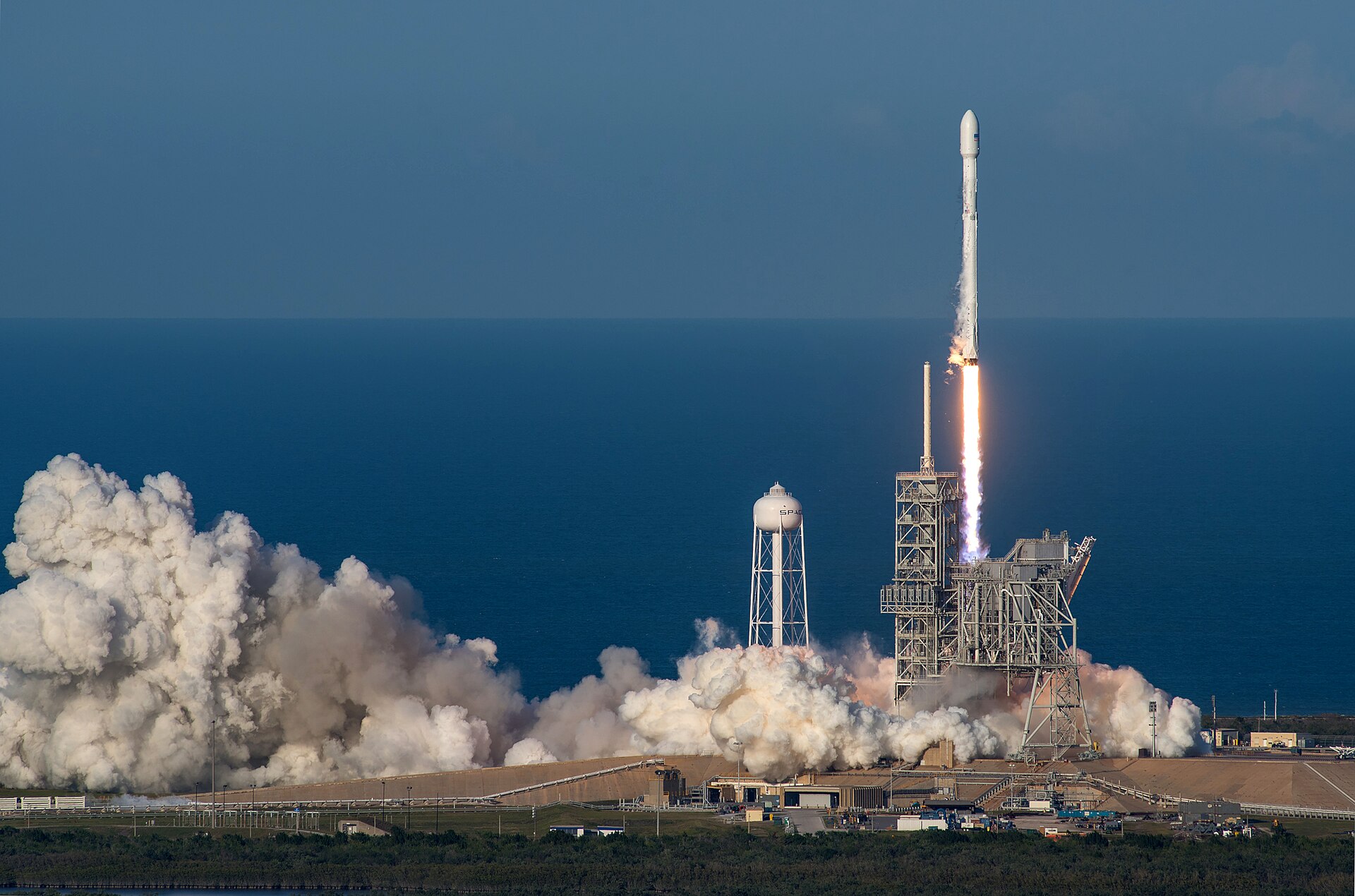
Foto: SpaceX (CC0) Rockets and launches
How many horsepower does the Falcon 9 have?
Rockets aren't measured in horsepower, but in thrust: the Falcon 9's first stage's nine Merlin engines deliver 7,686 kN (1,710,000 lbf) combined at sea level… more…
Foto: SpaceX (CC0) Rockets and launches
How much a rocket weight?
Rockets range from about 13 t for Rocket Lab's Electron to roughly 549 t for Falcon 9, 2,800 t for Saturn V and close to 5,000 t for Starship with its Super… more…

Rockets and launches
What does the saturn v look like?
Saturn V looked like a white needle 110.6 m (363 ft) tall and 10.1 m wide at the base, painted with black roll-pattern stripes, the words UNITED STATES and… more…
Foto: SpaceX (CC0) Rockets and launches
Why do rockets launch from florida?
Rockets launch from Florida because the Cape sits at 28.5 degrees north, low enough to gain about 410 m/s from the Earth's rotation on an eastward launch, and… more…
Foto: SpaceX (CC0) Rockets and launches
How much falcon 9 launch cost?
SpaceX lists a standard Falcon 9 mission at 69.75 million dollars, with the booster recovered (data as of January 2025). Small satellites can share a ride… more…
Rockets and launches
How does the saturn v work?
Saturn V worked by staging: a kerosene first stage with five F-1 engines (about 34,000 kN) lifted the 2,800 t rocket for two and a half minutes, a… more…
