Did you know…
What name did Avro want for the Vulcan?
Short answer
"Ottawa". Avro strongly recommended that name, in honour of the company's ties to Avro Canada; Flight magazine proposed "Albion". In the end, the Chief of the Air Staff's preference for a V-named bomber series won out, and the aircraft was called Vulcan.
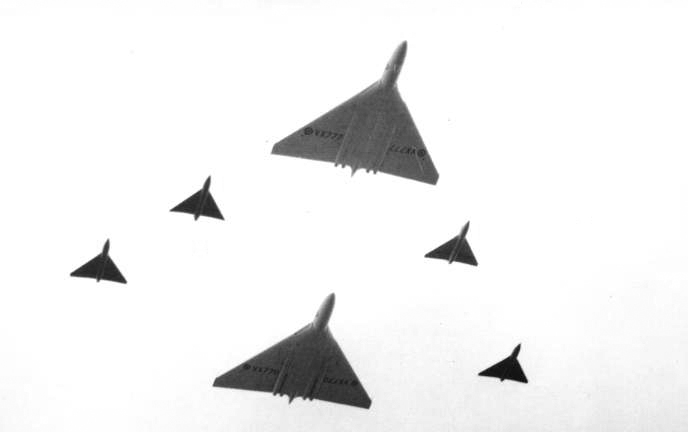
A bomber without a name
After the Avro 698 appeared at the 1952 Farnborough air show, the aircraft's final name became a matter of speculation. RAF bombers had traditionally been named after inland cities of the British Commonwealth or towns linked to industry.
The proposals
Avro strongly recommended the name Ottawa, in honour of the company's relationship with Avro Canada. The weekly magazine Flight, for its part, suggested Albion, after rejecting Avenger, Apollo, and Assegai. None of those ideas went anywhere.
The V series
The Chief of the Air Staff preferred a class of bombers with names starting with V, and that was the option that prevailed. The following month it was announced that the 698 would be called Vulcan, after the Roman god of fire and destruction. The name fit with the other two aircraft born from the same programme, the Vickers Valiant and the Handley Page Victor, and the three became known as the V bombers.
The Vulcan changed its designation once more: from July 1963 it was officially renamed Hawker Siddeley Vulcan, although for almost everyone it remained the Avro Vulcan.
The aircraft originated from the British Ministry of Supply's B.35/46 specification. The first prototype flew on 30 August 1952, and the RAF received its first Vulcan B.1 in September 1956. Deliveries of the much-improved Vulcan B.2 began in 1960, and the last example reached the RAF in January 1965. In the mid-1960s, after the Skybolt missile was cancelled in November 1962, the RAF began using it with low-level tactics.
More questions

Aviation history
Which was the most-produced American fighter of the Second World War?
The Republic P-47 Thunderbolt, of which 15,636 or 15,683 units were built, depending on the source. It was also one of the heaviest fighters of the conflict… more…

Aviation history
Who flew the E-66 at 2,149 km/h?
Konstantin or Vladimir Kokkinaki, depending on the source. Konstantin is credited with the absolute record on a closed 100 km circuit, at 2,148.66 km/h, set… more…

Fly-by-Owen (CC BY SA), vía commons Aviation history
How many I-11Bs were built?
Between 208 and around 450, depending on the source: one of the AISA I-11 reference sheets gives 208 examples built, while All-Aero speaks of around 400 built… more…

Aviation history
How many HH-53s could be converted to Pave Low III?
Eight HH-53C aircraft received an improved systems package and were redesignated HH-53H Pave Low III. The other figure in circulation, nine MH-53H and 32… more…

SCDBob (CC BY SA), vía commons Aviation history
What did the A129 Mangusta's armor protect?
The fuselage: the A129's airframe is armored and, according to All-Aero, designed to protect against 12.7 mm rounds, with partial protection against 23 mm… more…
Fly-by-Owen (CC BY SA), vía commons Aviation history
What landing gear and canopy did the AISA I-11B have?
According to one account, AISA reduced the cockpit canopy and fitted tailwheel gear on the production I-11B. All-Aero claims the opposite: the I-11B was… more…


