Did you know…
How much speed did the Courier gain from retractable gear?
Short answer
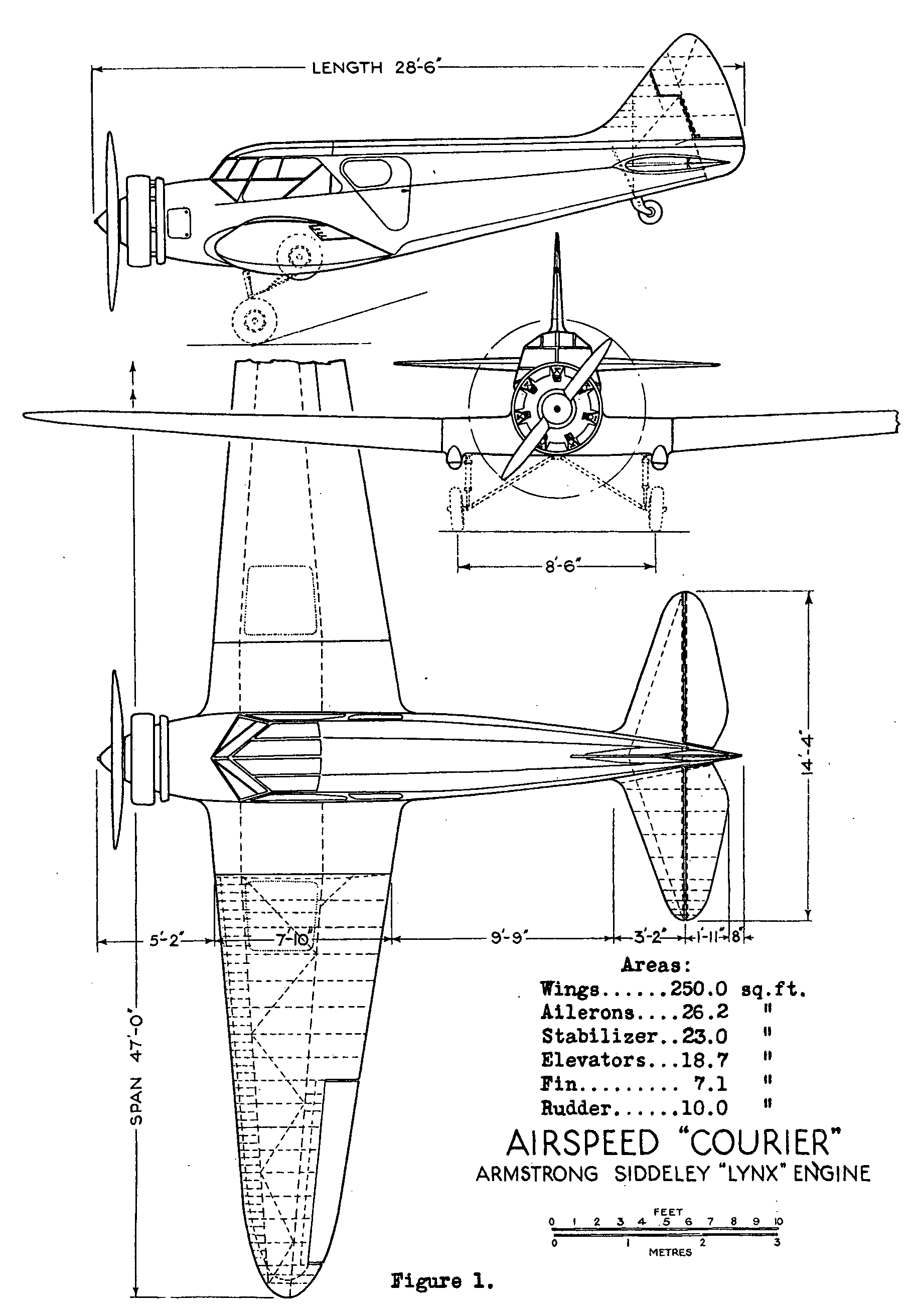
About 20 mph more cruising speed, thanks to reduced drag, at the cost of 30 lb of extra weight from the gear retraction mechanism. The Courier was the first British aircraft with retractable gear to enter series production; its prototype, G-ABXN, first flew on 10 April 1933.
20 mph for 30 lb
The extra weight of the gear retraction and extension mechanism was estimated at 30 lb, while the reduced aerodynamic drag allowed a 20 mph increase in cruising speed. The decision to fit hydraulically operated retractable gear is believed to have been inspired by the similarly sized Lockheed Orion, whose gear was manually operated.
The first British type in series production
The Courier was the first British aircraft with retractable landing gear to enter series production. It was designed by A. H. Tiltman. The prototype, G-ABXN, first flew on 10 April 1933, after being reassembled, piloted by George Stainforth of the Royal Aircraft Establishment. It was powered by an Armstrong Siddeley Lynx IVC.
Airspeed, the Ferry and the war
Airspeed's directors included Sir Alan Cobham, the aviation pioneer who wanted a compact, multi-engined airliner for the "air experience" flights of his National Aviation Day displays. The first Ferry, G-ABSI Youth of Britain II, flew on 5 April 1932 piloted by H. V. Warrall. Only four examples were built, at the company's York works, in the early 1930s. When the Second World War broke out, most surviving Couriers were requisitioned by the RAF, where they were typically used for liaison duties.
More questions

Aviation history
What was the An-2 called before it became an Antonov?
SKh-1. The letters stood for Sel'sko Khozyaystvennyi — pervoy, "agricultural, the first," and corresponded to the first design from Antonov's bureau, later… more…
Aviation history
At what altitude did the weather-research An-4 biplane fly?
Up to 10,000 m: the An-4 — the design-bureau designation for the meteorological An-2ZA, intended for high-altitude weather research — could maintain power up… more…
Aviation history
How many ANBO II and III aircraft were built?
The ANBO III was the first Lithuanian-designed aircraft built in series: two batches of four built in 1930 and 1931. The ANBO II, built in Lithuania in 1927… more…

emmett anderson (CC BY), vía commons Aviation history
How many Anderson Kingfishers were under construction around 1982?
The figure on record is from 1978, not 1982: by then 200 kit sets had been sold and 100 Kingfishers were reported under construction. The EA-1 Kingfisher is a… more…
Giorces (CC BY), vía commons Aviation history
What does "Balilla" mean in the Ansaldo A.1?
"Balilla" isn't a technical designation but the nickname of the Ansaldo A.1 fighter, taken from a popular Genoese hero. The aircraft was the only… more…
ZemplinTemplar (CC BY SA), vía commons Aviation history
Why did Italy prefer the SPAD over the Ansaldo A.1 in 1917?
In 1917 there was no clear-cut preference: the A.1 wasn't even accepted by the Corpo Aeronautico Militare until December that year, because test pilots… more…


