Did you know…
Why did falcon 9 hit the moon?
Short answer
Because a spent upper stage on a lunar trajectory has no mission and no way to steer. A Falcon 9 upper stage from the January 2025 Firefly Blue Ghost 1 launch hit the Moon on 5 August 2026, leaving a crater 60 feet wide. The 2022 impact once blamed on Falcon 9 was a Chinese Long March 3C.

The crater of 5 August 2026
Between 11 and 12 August 2026 NASA's Lunar Reconnaissance Orbiter photographed a fresh scar on the Moon. It had formed on 5 August, when a SpaceX Falcon 9 upper stage impacted the surface following its January 2025 launch of the Firefly Blue Ghost 1 mission. The crater is 60 feet wide and, judging by the length of its shadow, less than 10 feet deep, at 19.4759°N, 266.7138°E. A trajectory prediction from NASA's Center for Near Earth Object Studies proved accurate to about 0.6 miles. Korea's Danuri orbiter imaged the crater with its high-resolution LUTI camera and sent the coordinates to the LRO team, and LRO captured its series of images while passing about 60 miles above the Moon, travelling 1 mile per second.
A spent stage has nowhere to go
Nothing was aimed at the Moon. A stage that has just thrown a lander onto a translunar trajectory retains almost all of that energy, and once the payload separates it has no mission, usually no usable propellant and no way to steer. What follows is a wandering orbit shaped by the Earth, the Moon and the Sun, and sooner or later such a path can intersect the lunar surface. There is no atmosphere to burn the hardware up and no ocean to swallow it, so the arrival leaves a permanent mark.
The impact that was not a Falcon 9
The question is often really about March 2022, when an object catalogued as WE0913A struck near Hertzsprung crater and left a double crater: an 18-metre pit superimposed on a 16-metre one, unlike any previous rocket impact. It was first believed to be an errant Falcon 9 booster from a 2015 launch. Trajectory tracking and spectroscopy by a University of Arizona team then showed it was the third stage of a Long March 3C from China's 2014 Chang'e 5-T1 mission, apparently carrying undeclared mass at its nose.
More questions
Moon and Mars
How does neil armstrong look like?
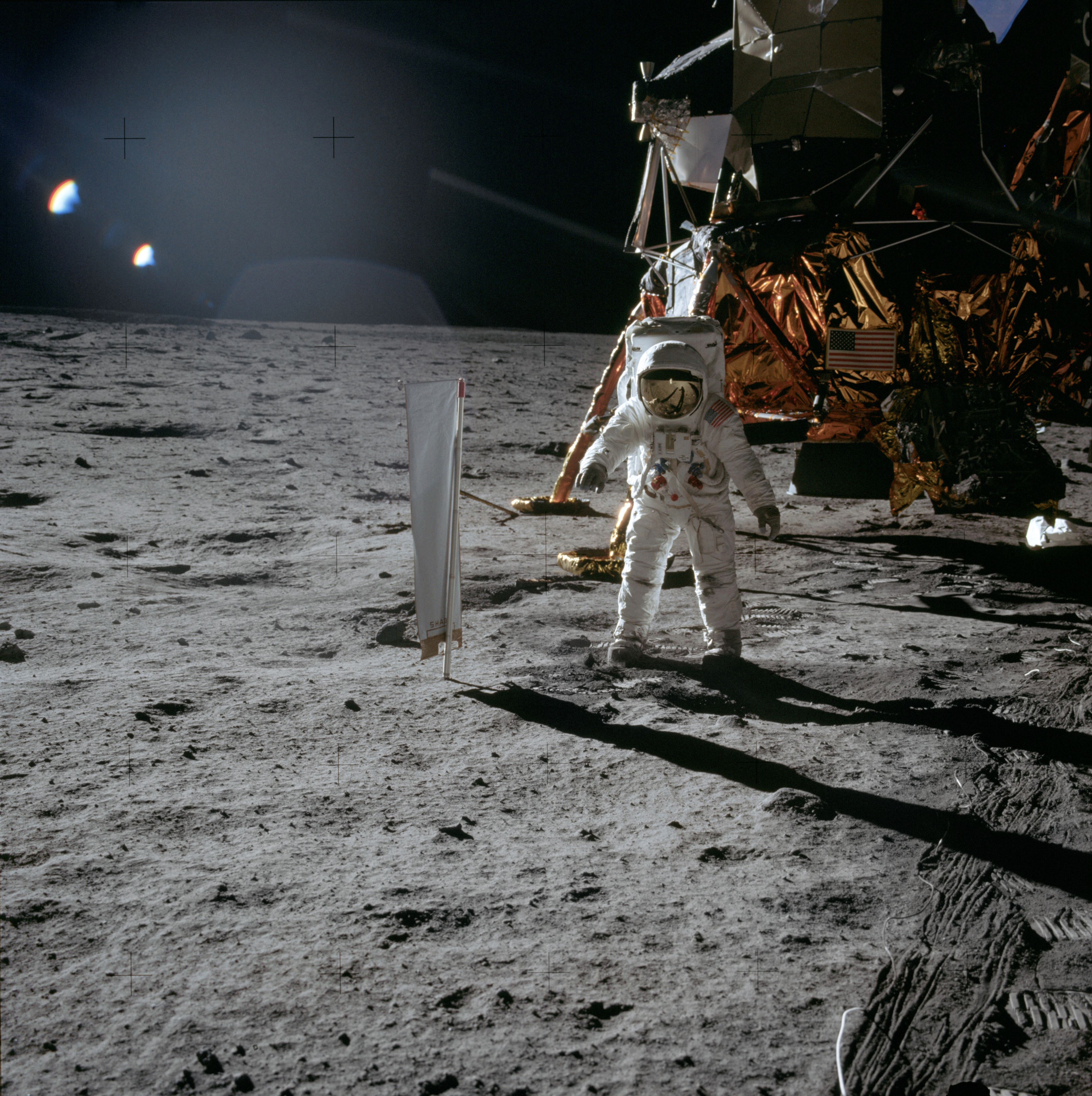
The face most people picture is not his: the gold-visored astronaut in the famous Apollo 11 photograph is Buzz Aldrin, shot by Armstrong. Armstrong himself is… more…

Richard Dorrell (CC BY SA), vía commons Moon and Mars
How does the moon affect the tides?
By pulling unevenly on it. Tidal forces vary inversely as the cube of the distance, so the near side of the Earth is tugged harder than the far side: one… more…
Moon and Mars
Why does neil armstrong have a hollywood star?
Strictly he does not have a star. Armstrong, Aldrin and Collins share four circular monuments resembling the Moon, one at each corner of Hollywood and Vine… more…
Moon and Mars
How much apollo 11 cost?
NASA never published a price for Apollo 11 on its own; what is documented is the program. The United States spent $25.8 billion on Project Apollo between 1960… more…
Moon and Mars
How much time neil armstrong spent on moon?
Armstrong and Aldrin spent 21 hours, 36 minutes on the Moon's surface, almost all of it inside the lunar module Eagle. Armstrong stepped onto the surface… more…
Moon and Mars
How much did neil armstrong get paid?
Nothing extra for the Moon. Armstrong flew as a civilian federal employee and was paid the salary of the post he held, with no per-flight fee; when NACA hired… more…
