Did you know…
How high do rockets go?
Short answer
An orbital rocket doesn't climb to a fixed altitude: its goal is an orbit. Most satellites and the International Space Station fly between 200 and 2,000 km; geostationary communications satellites sit at 35,786 km. Suborbital rockets just clear the 100 km Kármán line, and NASA's scientific probes reach over 1,000 km.

Three families, three answers
The answer depends on the type of rocket. Sounding rockets, which NASA and other agencies use for brief experiments, climb in a parabola and fall back: they reach anywhere from about 50 km to over 1,000 km, offering between five and twenty minutes of microgravity. Suborbital tourist vehicles, such as Blue Origin's New Shepard, aim to pass 100 km, the Kármán line, the conventional boundary of space, and return to the ground within about ten minutes. Orbital launchers, by contrast, aren't chasing altitude but speed: their goal is to reach roughly 7.8 km/s horizontally so the payload doesn't fall back down.
The most frequented orbits
Almost everything launched today goes to low Earth orbit, between 200 and 2,000 km. The International Space Station orbits at around 400 km, and internet constellations sit between 500 and 600 km. Navigation satellites like GPS or Galileo occupy medium orbits, around 20,000-23,000 km. Geostationary TV and weather satellites sit at 35,786 km above the equator, where their period matches Earth's rotation and they appear motionless from the ground. To get there, the rocket's upper stage or the satellite itself performs additional burns after a parking orbit.
Beyond Earth
When the destination is the Moon, Mars, or deep space, altitude stops being meaningful and the relevant figure becomes escape velocity, about 11.2 km/s. The rocket places the probe on a trajectory that takes it away from Earth for good; in that case, the upper stage can end up orbiting the Sun alongside the payload. The distance record belongs to the Voyager probes, both now over 20 billion kilometers away (as of January 2025), though on that journey the rocket only provided the first few minutes of thrust.
More questions
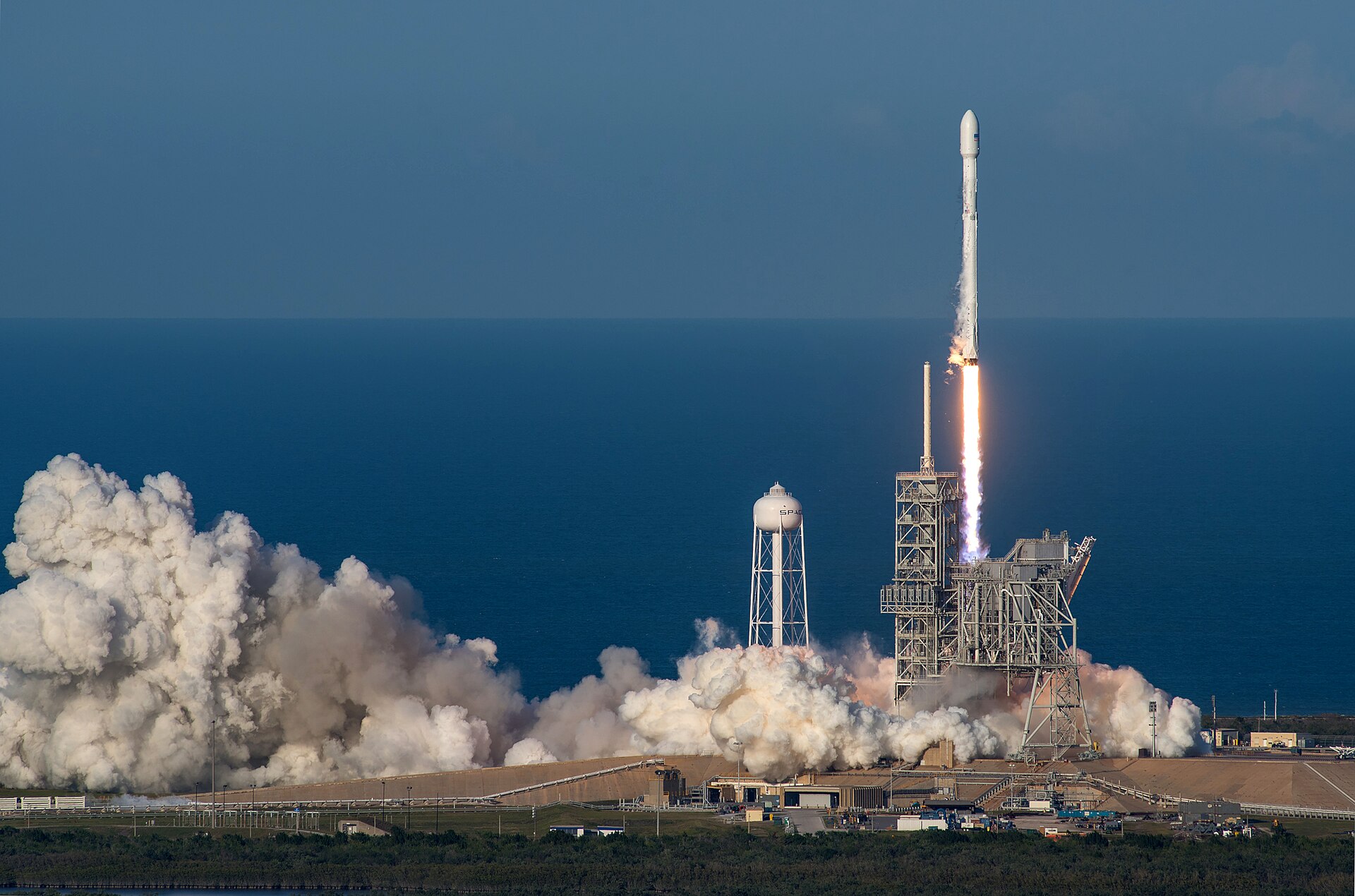
Foto: SpaceX (CC0) Rockets and launches
How many horsepower does the Falcon 9 have?
Rockets aren't measured in horsepower, but in thrust: the Falcon 9's first stage's nine Merlin engines deliver 7,686 kN (1,710,000 lbf) combined at sea level… more…
Foto: SpaceX (CC0) Rockets and launches
How much a rocket weight?
Rockets range from about 13 t for Rocket Lab's Electron to roughly 549 t for Falcon 9, 2,800 t for Saturn V and close to 5,000 t for Starship with its Super… more…

Rockets and launches
What does the saturn v look like?
Saturn V looked like a white needle 110.6 m (363 ft) tall and 10.1 m wide at the base, painted with black roll-pattern stripes, the words UNITED STATES and… more…
Foto: SpaceX (CC0) Rockets and launches
Why do rockets launch from florida?
Rockets launch from Florida because the Cape sits at 28.5 degrees north, low enough to gain about 410 m/s from the Earth's rotation on an eastward launch, and… more…
Foto: SpaceX (CC0) Rockets and launches
How much falcon 9 launch cost?
SpaceX lists a standard Falcon 9 mission at 69.75 million dollars, with the booster recovered (data as of January 2025). Small satellites can share a ride… more…
Rockets and launches
How does the saturn v work?
Saturn V worked by staging: a kerosene first stage with five F-1 engines (about 34,000 kN) lifted the 2,800 t rocket for two and a half minutes, a… more…

