Did you know…
How fast does the Falcon 9 travel?
Short answer
The Falcon 9 accelerates its payload to about 7.8 km/s, around 28,000 km/h, in just under nine minutes to reach low Earth orbit. The first stage separates at about 2.3 km/s (8,000 km/h) and 70 km altitude so it can return and land; on geostationary missions, the second stage keeps pushing past 10 km/s.

Ascent speeds
The Falcon 9 lifts off with nine Merlin engines producing about 7,600 kN of thrust at sea level, just a bit more than needed to lift its 549 t. That's why the first seconds are slow, and the rocket takes nearly a minute to break the sound barrier. Around two and a half minutes in, the first stage shuts down at about 70 km altitude and roughly 8,000 km/h; on missions with recovery, SpaceX cuts it off earlier to save propellant. After separation, the second stage's single vacuum-optimized Merlin engine burns for six more minutes until the payload reaches 7.8 km/s, around 28,000 km/h, the speed that keeps it in orbit at about 200-500 km.
The booster's return trip
The first stage flips over, and on missions returning to shore it performs a boostback burn that reverses its trajectory. On reentering the atmosphere at more than 4,000 km/h, a three-engine burn slows it down so the grid fins can steer it. One final burn, with a single engine, takes it from supersonic speeds to zero in under half a minute, over the drone ship or the landing pad on land. This profile is what allows the same stage to fly dozens of times.
Faster to go farther
When the destination is geostationary transfer orbit, the second stage keeps pushing to about 10.2 km/s, raising the apogee to 35,786 km. For interplanetary probes, like NASA's DART, the Falcon 9 has placed the payload on an escape trajectory, above 11 km/s. On the most demanding missions SpaceX gives up recovering the first stage, because every kilogram of propellant reserved for landing takes speed away from the payload.
More questions
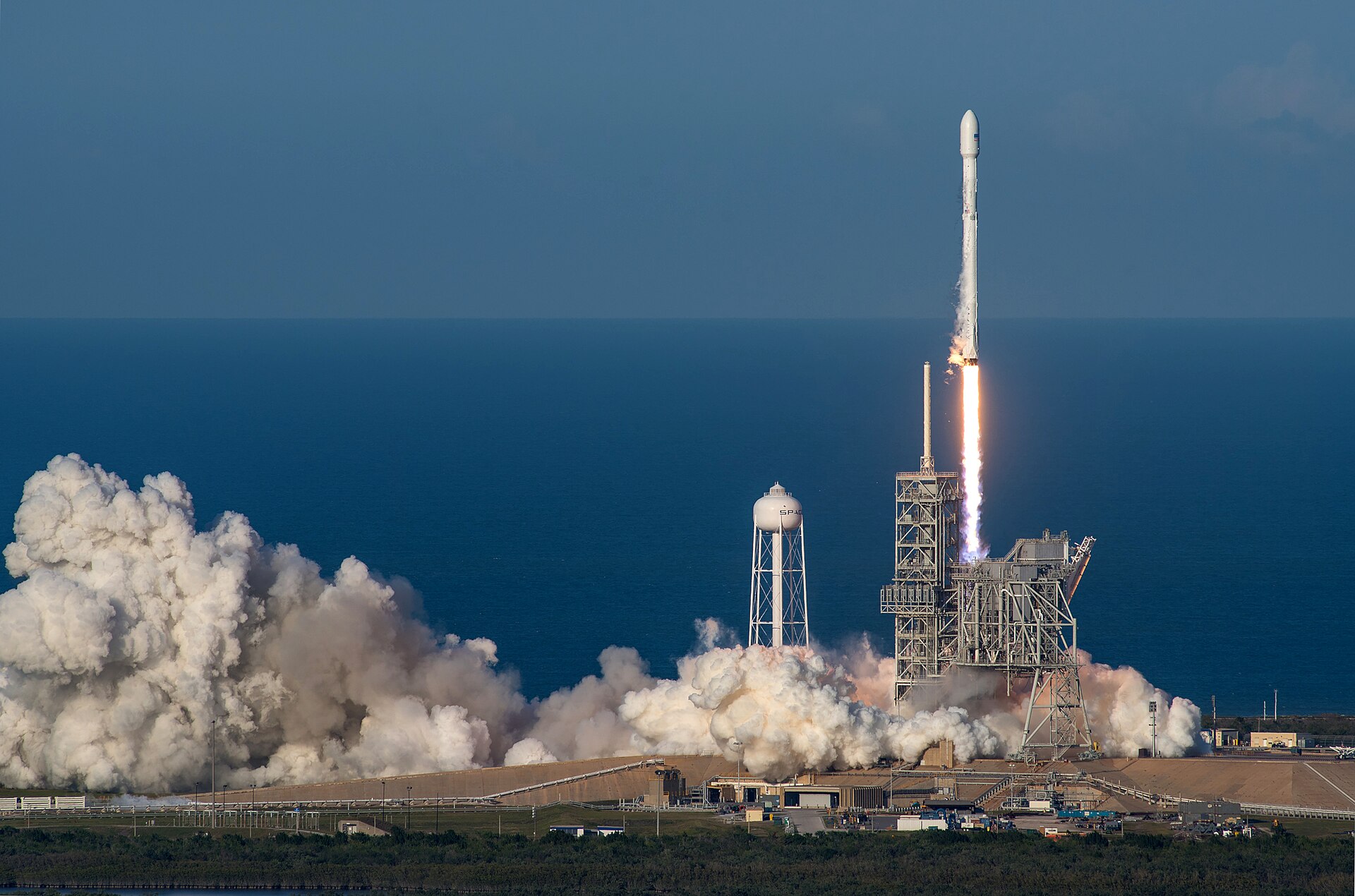
Foto: SpaceX (CC0) Rockets and launches
How many horsepower does the Falcon 9 have?
Rockets aren't measured in horsepower, but in thrust: the Falcon 9's first stage's nine Merlin engines deliver 7,686 kN (1,710,000 lbf) combined at sea level… more…
Foto: SpaceX (CC0) Rockets and launches
How much a rocket weight?
Rockets range from about 13 t for Rocket Lab's Electron to roughly 549 t for Falcon 9, 2,800 t for Saturn V and close to 5,000 t for Starship with its Super… more…

Rockets and launches
What does the saturn v look like?
Saturn V looked like a white needle 110.6 m (363 ft) tall and 10.1 m wide at the base, painted with black roll-pattern stripes, the words UNITED STATES and… more…
Foto: SpaceX (CC0) Rockets and launches
Why do rockets launch from florida?
Rockets launch from Florida because the Cape sits at 28.5 degrees north, low enough to gain about 410 m/s from the Earth's rotation on an eastward launch, and… more…
Foto: SpaceX (CC0) Rockets and launches
How much falcon 9 launch cost?
SpaceX lists a standard Falcon 9 mission at 69.75 million dollars, with the booster recovered (data as of January 2025). Small satellites can share a ride… more…
Rockets and launches
How does the saturn v work?
Saturn V worked by staging: a kerosene first stage with five F-1 engines (about 34,000 kN) lifted the 2,800 t rocket for two and a half minutes, a… more…
