Did you know…
How fast does a NASA rocket launch?
Short answer
At the moment of liftoff, a NASA rocket moves very slowly: the Saturn V took about 12 seconds to clear the launch tower, at under 100 km/h. Speed builds later: Artemis's SLS exceeds the speed of sound in just over a minute and reaches about 28,000 km/h, orbital velocity, eight minutes after launch.

A slow start
A rocket doesn't shoot off instantly. On the pad, engine thrust barely exceeds the weight of the loaded vehicle, so initial acceleration is small. The Saturn V, weighing about 2,900 t at ignition, took about 12 seconds to clear the height of its umbilical tower, at a speed comparable to a car in city traffic. This apparent slowness is deliberate: accelerating faster would require larger engines and a heavier structure, and the dense atmosphere of the first few kilometers punishes any excess speed.
The sound barrier and maximum pressure
As it burns propellant, the rocket gets lighter and accelerates more and more. Between 60 and 90 seconds after liftoff, NASA's launch vehicles exceed the speed of sound and pass through the point of maximum dynamic pressure, called max Q, where the combination of speed and air density subjects the structure to its greatest aerodynamic load. Many vehicles briefly reduce thrust during this phase to protect the airframe; the space shuttle did so routinely.
From zero to orbit in eight minutes
Once outside the dense atmosphere, the growth in speed is dizzying. The Saturn V's first stage separated at about 2.7 km/s, and the following stages carried the spacecraft to the 7.8 km/s of low Earth orbit, about 28,000 km/h. Artemis's SLS follows a similar profile: the solid boosters release at two minutes and the core stage shuts down at eight, with the Orion spacecraft already at orbital velocity. Escaping Earth toward the Moon requires an additional burn that raises the figure to about 39,000 km/h.
More questions
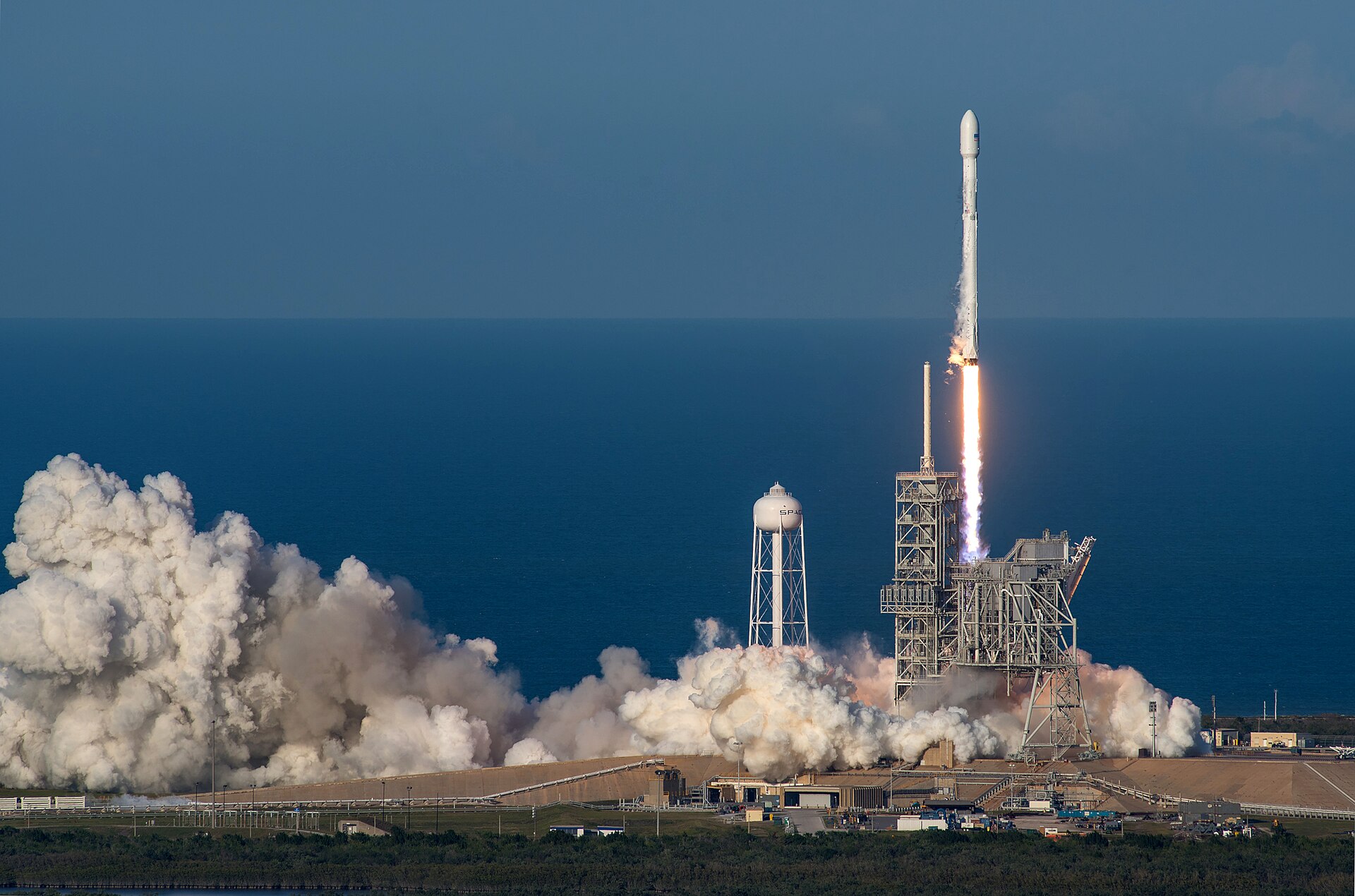
Foto: SpaceX (CC0) Rockets and launches
How many horsepower does the Falcon 9 have?
Rockets aren't measured in horsepower, but in thrust: the Falcon 9's first stage's nine Merlin engines deliver 7,686 kN (1,710,000 lbf) combined at sea level… more…
Foto: SpaceX (CC0) Rockets and launches
How much a rocket weight?
Rockets range from about 13 t for Rocket Lab's Electron to roughly 549 t for Falcon 9, 2,800 t for Saturn V and close to 5,000 t for Starship with its Super… more…

Rockets and launches
What does the saturn v look like?
Saturn V looked like a white needle 110.6 m (363 ft) tall and 10.1 m wide at the base, painted with black roll-pattern stripes, the words UNITED STATES and… more…
Foto: SpaceX (CC0) Rockets and launches
Why do rockets launch from florida?
Rockets launch from Florida because the Cape sits at 28.5 degrees north, low enough to gain about 410 m/s from the Earth's rotation on an eastward launch, and… more…
Foto: SpaceX (CC0) Rockets and launches
How much falcon 9 launch cost?
SpaceX lists a standard Falcon 9 mission at 69.75 million dollars, with the booster recovered (data as of January 2025). Small satellites can share a ride… more…
Rockets and launches
How does the saturn v work?
Saturn V worked by staging: a kerosene first stage with five F-1 engines (about 34,000 kN) lifted the 2,800 t rocket for two and a half minutes, a… more…
