Did you know…
How fast do space rockets travel?
Short answer
A rocket entering low Earth orbit reaches about 7.8 km/s, that is, about 28,000 km/h, in less than ten minutes from liftoff. Escaping Earth's gravity to travel to the Moon or Mars requires about 11.2 km/s (40,000 km/h). At liftoff, however, a rocket moves slowly: it takes several seconds just to clear the tower.

From zero to 28,000 km/h in nine minutes
A rocket doesn't need to be fast at the start; it needs to be fast at the end. In the first few seconds it barely exceeds the speed of a city car, because thrust only slightly exceeds its weight and almost all the propellant is still on board. As it burns fuel it gets lighter and accelerates: around the minute-and-a-half mark it usually crosses the sound barrier and endures maximum aerodynamic pressure. When the first stage shuts down, at two to three minutes, the vehicle is traveling at between 6,000 and 8,000 km/h. The second stage finishes the job in the vacuum of space, and at around nine minutes the payload is moving at about 7.8 km/s, roughly 28,000 km/h, the speed that keeps it in low Earth orbit.
Why that figure and not another
Orbital velocity isn't a design whim, it's a consequence of gravity. At 400 km altitude, an object moving at about 7.7 km/s falls toward Earth at exactly the same rate the curved surface drops away beneath it; that's why it never reaches the ground. The higher the orbit, the lower the speed needed: in geostationary orbit, at 35,786 km, about 3.1 km/s is enough. To leave the planet altogether requires escape velocity, about 11.2 km/s at sea level, although probes reach it at higher altitude, where the value is somewhat lower.
The fastest rockets
NASA's Parker Solar Probe, launched by a Delta IV Heavy, has become the fastest object ever built by humans, grazing 690,000 km/h during its passes by the Sun, though it owes that speed to solar gravity rather than to the rocket. Among launchers, the record for departure speed belongs to the Atlas V that sent New Horizons toward Pluto in 2006, at over 16 km/s relative to Earth.
More questions
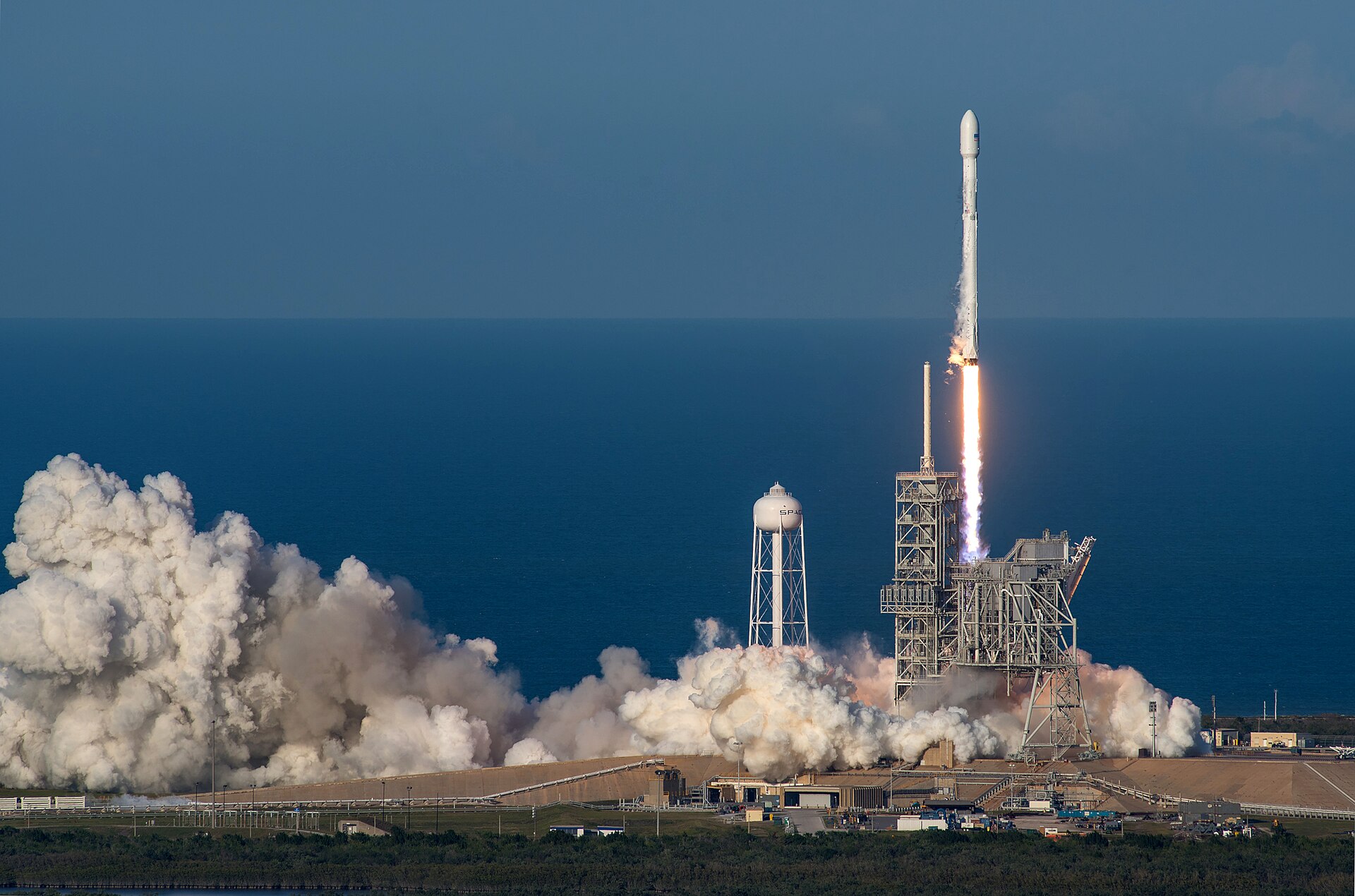
Foto: SpaceX (CC0) Rockets and launches
How many horsepower does the Falcon 9 have?
Rockets aren't measured in horsepower, but in thrust: the Falcon 9's first stage's nine Merlin engines deliver 7,686 kN (1,710,000 lbf) combined at sea level… more…
Foto: SpaceX (CC0) Rockets and launches
How much a rocket weight?
Rockets range from about 13 t for Rocket Lab's Electron to roughly 549 t for Falcon 9, 2,800 t for Saturn V and close to 5,000 t for Starship with its Super… more…

Rockets and launches
What does the saturn v look like?
Saturn V looked like a white needle 110.6 m (363 ft) tall and 10.1 m wide at the base, painted with black roll-pattern stripes, the words UNITED STATES and… more…
Foto: SpaceX (CC0) Rockets and launches
Why do rockets launch from florida?
Rockets launch from Florida because the Cape sits at 28.5 degrees north, low enough to gain about 410 m/s from the Earth's rotation on an eastward launch, and… more…
Foto: SpaceX (CC0) Rockets and launches
How much falcon 9 launch cost?
SpaceX lists a standard Falcon 9 mission at 69.75 million dollars, with the booster recovered (data as of January 2025). Small satellites can share a ride… more…
Rockets and launches
How does the saturn v work?
Saturn V worked by staging: a kerosene first stage with five F-1 engines (about 34,000 kN) lifted the 2,800 t rocket for two and a half minutes, a… more…

