Did you know…
How does the Falcon 9 rocket work?
Short answer
Falcon 9 is a two-stage SpaceX rocket. The first stage, with nine kerosene/liquid-oxygen Merlin engines, burns for about two and a half minutes, separates, slows itself down and lands to fly again. The second stage, with a vacuum Merlin, carries the payload to orbit. It stands 70 m tall.

Two stages and a single engine type
Falcon 9 combines simplicity and repetition: both of its stages burn the same pair of propellants, aerospace-grade kerosene (RP-1) and liquid oxygen, and use variants of the same Merlin engine. The first stage mounts nine Merlins in an "octaweb" arrangement (eight around a central one), which allows it to keep flying even if one fails. The second stage carries a single Merlin Vacuum engine, with a much larger nozzle to work outside the atmosphere. According to SpaceX, the vehicle stands 70 m tall and 3.7 m in diameter, with a liftoff mass of around 549 t.
The sequence of a typical flight
After liftoff, the first stage burns for about two and a half minutes. It separates, and the second stage ignites its engine to carry the payload to the desired orbit; on geostationary missions it performs a second burn after a coast phase. Meanwhile, the discarded booster flips using cold-gas nitrogen thrusters, performs a boostback or re-entry burn, deploys titanium grid fins to steer itself, and ends with a final burn that slows it down to land on deployable legs, either on the ground or on an autonomous drone ship at sea.
Why reuse matters
Recovering the first stage, the most expensive part of the rocket, changed launch economics. SpaceX has reflown boosters dozens of times each and also recovers the payload fairings, which open at high altitude and descend by parachute. The current version, Falcon 9 Block 5, was designed to minimize maintenance between flights. The manufacturer's published capacity is 22,800 kg to low Earth orbit and 8,300 kg to geostationary transfer orbit, figures that drop when the booster must save fuel to land.
More questions
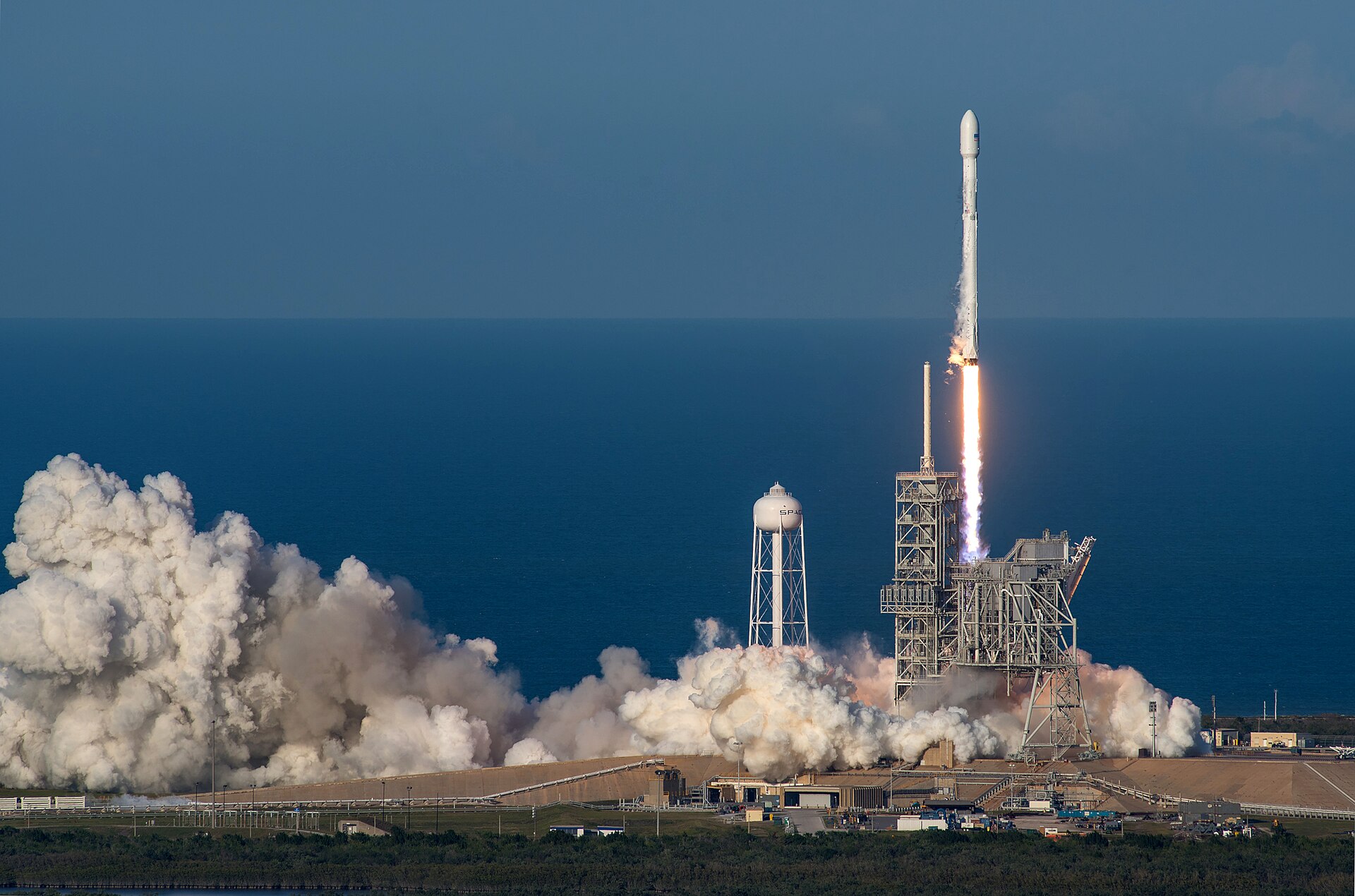
Foto: SpaceX (CC0) Rockets and launches
How many horsepower does the Falcon 9 have?
Rockets aren't measured in horsepower, but in thrust: the Falcon 9's first stage's nine Merlin engines deliver 7,686 kN (1,710,000 lbf) combined at sea level… more…
Foto: SpaceX (CC0) Rockets and launches
How much a rocket weight?
Rockets range from about 13 t for Rocket Lab's Electron to roughly 549 t for Falcon 9, 2,800 t for Saturn V and close to 5,000 t for Starship with its Super… more…

Rockets and launches
What does the saturn v look like?
Saturn V looked like a white needle 110.6 m (363 ft) tall and 10.1 m wide at the base, painted with black roll-pattern stripes, the words UNITED STATES and… more…
Foto: SpaceX (CC0) Rockets and launches
Why do rockets launch from florida?
Rockets launch from Florida because the Cape sits at 28.5 degrees north, low enough to gain about 410 m/s from the Earth's rotation on an eastward launch, and… more…
Foto: SpaceX (CC0) Rockets and launches
How much falcon 9 launch cost?
SpaceX lists a standard Falcon 9 mission at 69.75 million dollars, with the booster recovered (data as of January 2025). Small satellites can share a ride… more…
Rockets and launches
How does the saturn v work?
Saturn V worked by staging: a kerosene first stage with five F-1 engines (about 34,000 kN) lifted the 2,800 t rocket for two and a half minutes, a… more…
