Did you know…
How did the space shuttle land?
Short answer
The shuttle, retired in 2011, landed as an unpowered glider: after a deorbit burn in orbit, it reentered nose-high to shed heat, performed S-turns to lose speed, and descended on a path seven times steeper than an airliner's before touching down at about 350 km/h (190 kn) and braking with a drag chute.

A 100-ton glider
The shuttle orbiter had no usable engines for landing: its three main engines only worked with the external tank during ascent, and the OMS orbital engines were useless in the atmosphere. From the deorbit burn to the runway, the vehicle was a heavy glider with a double-delta wing and a very poor glide ratio. That's why the landing was planned with precision: there was only one chance, with no option to go around and try again.
From orbit to the atmosphere
About an hour before landing, on the far side of the planet, the orbiter turned tail-first and fired the OMS engines for about three minutes to slow down by just 300 km/h — just enough for the orbit to graze the atmosphere. It then turned again, nose-first, at an angle of attack of about 40 degrees, so that the belly tiles and the reinforced carbon leading edge absorbed the reentry heat, close to 1,650 °C. At hypersonic speeds, the flight computer executed a series of S-turns — wide banking maneuvers that lengthened the trajectory and shed energy without overheating the structure.
The final approach
In the final approach phase, beginning at about 25 km altitude, the commander took manual control and lined the vehicle up with an imaginary heading alignment cylinder. The descent path, about 20 degrees, was roughly seven times steeper than that of a commercial airliner. At about 600 m altitude the flare began, the landing gear deployed in the final seconds, and the main wheels touched down at about 350 km/h (190 kn). A drag chute, added in 1992, and the wheel brakes stopped the orbiter within 3 km of runway, at Kennedy or Edwards.
More questions
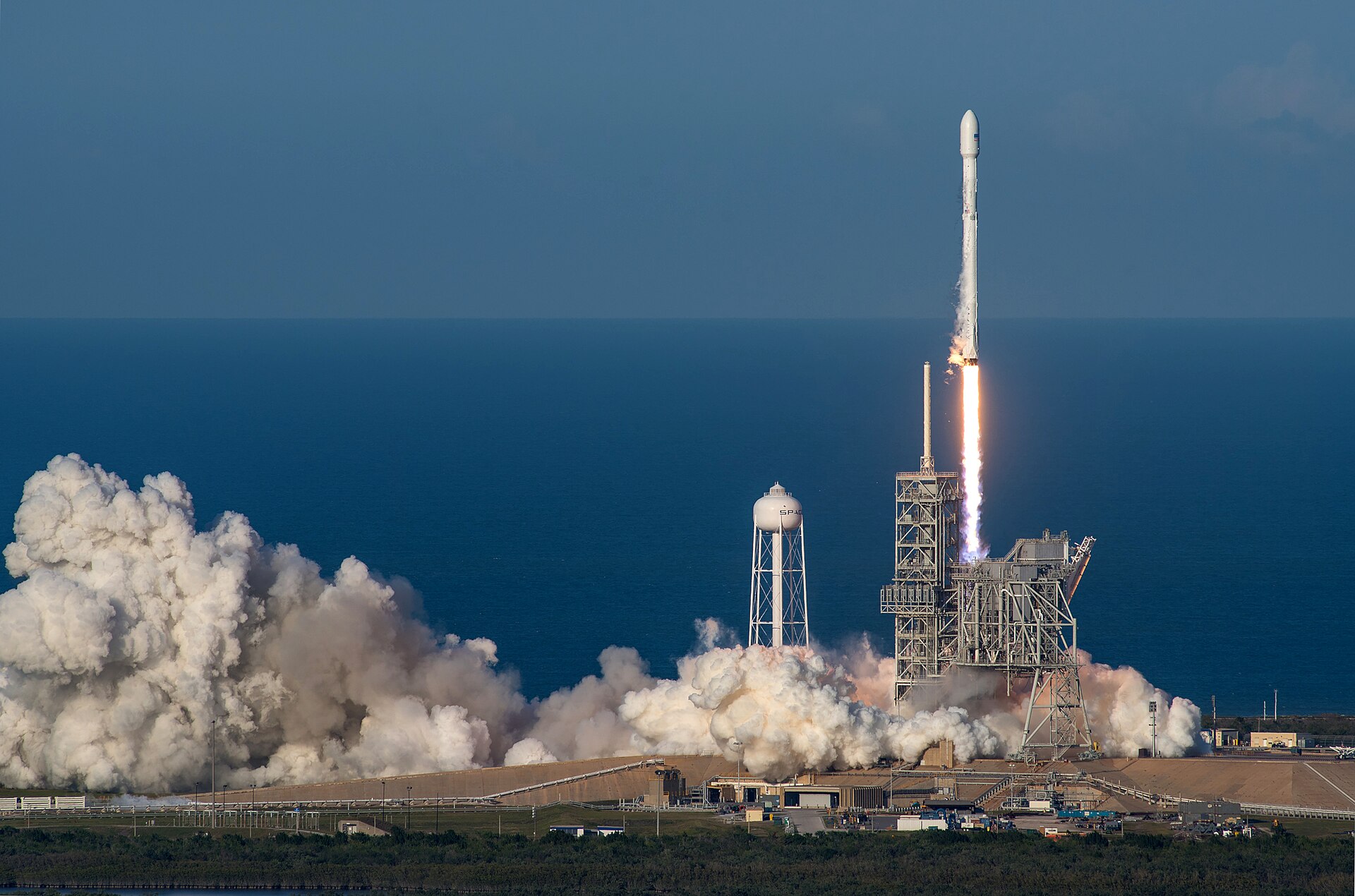
Foto: SpaceX (CC0) Rockets and launches
How many horsepower does the Falcon 9 have?
Rockets aren't measured in horsepower, but in thrust: the Falcon 9's first stage's nine Merlin engines deliver 7,686 kN (1,710,000 lbf) combined at sea level… more…
Foto: SpaceX (CC0) Rockets and launches
How much a rocket weight?
Rockets range from about 13 t for Rocket Lab's Electron to roughly 549 t for Falcon 9, 2,800 t for Saturn V and close to 5,000 t for Starship with its Super… more…

Rockets and launches
What does the saturn v look like?
Saturn V looked like a white needle 110.6 m (363 ft) tall and 10.1 m wide at the base, painted with black roll-pattern stripes, the words UNITED STATES and… more…
Foto: SpaceX (CC0) Rockets and launches
Why do rockets launch from florida?
Rockets launch from Florida because the Cape sits at 28.5 degrees north, low enough to gain about 410 m/s from the Earth's rotation on an eastward launch, and… more…
Foto: SpaceX (CC0) Rockets and launches
How much falcon 9 launch cost?
SpaceX lists a standard Falcon 9 mission at 69.75 million dollars, with the booster recovered (data as of January 2025). Small satellites can share a ride… more…
Rockets and launches
How does the saturn v work?
Saturn V worked by staging: a kerosene first stage with five F-1 engines (about 34,000 kN) lifted the 2,800 t rocket for two and a half minutes, a… more…

