Did you know…
How long does it take Starship to get to Mars?
Short answer
No Starship has flown to Mars yet (as of October 2026). SpaceX's plan targets transits of three to four months, which require departing with full tanks after in-orbit refueling; with minimum-energy trajectories, NASA puts the trip at seven to ten months.

A fact that doesn't exist yet
It's worth separating the plan from the record: so far no Starship has made the trip to Mars, so any duration is a forecast rather than a measurement. SpaceX's roadmap calls for the first Starships to fly uncrewed, with the number of vehicles growing on each following opportunity, which recurs every 26 months.
Three or four months, with a condition
The duration the company cites, three to four months, depends on a piece of technology that is not yet proven: in-orbit refueling. A Starship that departs for Mars with full tanks can afford a faster, more energy-intensive trajectory; if it leaves with less propellant, the transit stretches out. That is the real bottleneck of the Mars timeline, more than the vehicle itself or its payload capacity.
The robotic benchmark
For comparison, missions that have already made the trip use minimum-energy trajectories: with chemical propulsion, NASA puts the journey at seven to ten months, citing an interplanetary cruise phase of around 200 days, and notes that the favorable alignment between Earth and Mars only recurs every 26 months. Shortening that trip isn't impossible, but it costs propellant at both ends, since the vehicle must accelerate harder on departure and shed more speed on arrival, with a more violent atmospheric entry on a planet with very thin air. Until a flight actually happens, the three-to-four-month range remains an engineering promise, not a record.
More questions
Moon and Mars
How does neil armstrong look like?
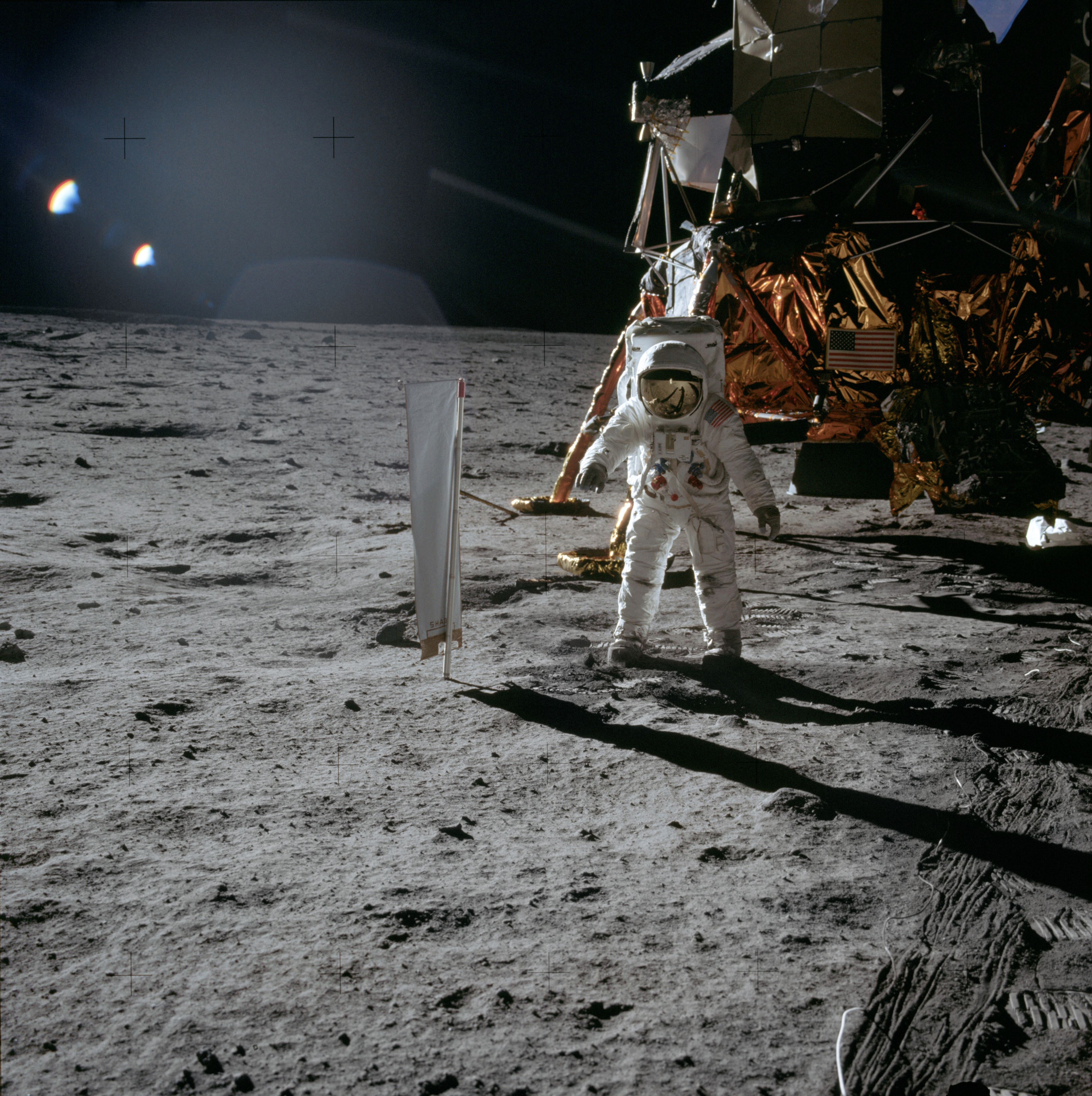
The face most people picture is not his: the gold-visored astronaut in the famous Apollo 11 photograph is Buzz Aldrin, shot by Armstrong. Armstrong himself is… more…

Richard Dorrell (CC BY SA), vía commons Moon and Mars
How does the moon affect the tides?
By pulling unevenly on it. Tidal forces vary inversely as the cube of the distance, so the near side of the Earth is tugged harder than the far side: one… more…
Moon and Mars
Why does neil armstrong have a hollywood star?
Strictly he does not have a star. Armstrong, Aldrin and Collins share four circular monuments resembling the Moon, one at each corner of Hollywood and Vine… more…

Foto: SpaceX (CC0) Moon and Mars
Why did falcon 9 hit the moon?
Because a spent upper stage on a lunar trajectory has no mission and no way to steer. A Falcon 9 upper stage from the January 2025 Firefly Blue Ghost 1 launch… more…
Moon and Mars
How much apollo 11 cost?
NASA never published a price for Apollo 11 on its own; what is documented is the program. The United States spent $25.8 billion on Project Apollo between 1960… more…
Moon and Mars
How much time neil armstrong spent on moon?
Armstrong and Aldrin spent 21 hours, 36 minutes on the Moon's surface, almost all of it inside the lunar module Eagle. Armstrong stepped onto the surface… more…

