Did you know…
At what altitude did the Ju 87 recover automatically?
Short answer
About 450 m (1,480 ft): that was the usual minimum height at which the contact altimeter's light marked the bomb release point, and on release the Ju 87 automatically began a 6g recovery. Red tabs on the wing warned the pilot the system would act if they blacked out.
The Contact Altimeter
When the aircraft was reasonably close to the target, a light came on at the contact altimeter — an altimeter fitted with an electrical contact that triggers at a preset altitude — to indicate the bomb release point, normally at a minimum height of 450 m (1,480 ft). An elongated U-shaped fork beneath the fuselage swung the bomb clear of the propeller's path, and the aircraft automatically began a 6g recovery.
Designed for Pilot Blackout
Red tabs protruding from the wing's upper surfaces served as a visual indicator for the pilot: they signaled that, should the pilot black out from g-force, the automatic dive-recovery system would activate.
The Sound of the Dive
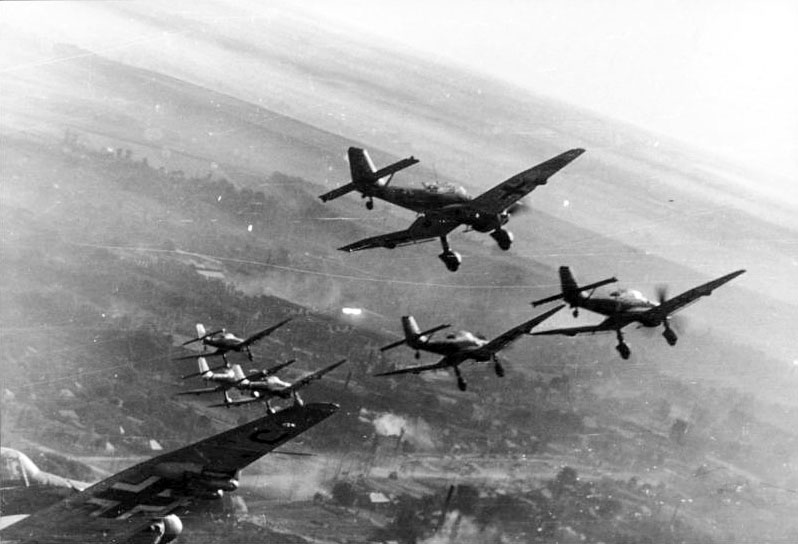
Sirens driven by ram air, officially called "Lärmgerät" (noise device), were mounted on the leading edges of the fixed main landing gear leg fairings. They became a propaganda symbol of German air power and of the Blitzkrieg victories of 1939-1942, and also gave the Stuka pilot an audible reference for speed. There were two propeller-driven sirens, 0.7 m (2.3 ft) in diameter, fitted to the Ju 87 B-1 model. They were mounted either on the wing's leading edge or on the front edge of the fixed main landing gear fairing. They cost the bomber 15 mph in speed due to the drag they generated, a flaw that proved lethal against anti-aircraft guns and fighters.
More questions

L-Bit (CC BY SA), vía commons Military aviation
How many Anson Mk I were built?
6,688 or 6,742 Avro Anson Mk I were built, according to different sources; History of War, which gives the second figure, places 3,935 at Woodford and the… more…

Military aviation
Which flying boats rescued the crew of the Kensington Court in 1939?
They were two RAF Sunderland flying boats: according to uboat.net, an aircraft of Squadron 228 and L5802 of Squadron 204 landed on the water next to the… more…

Military aviation
How long did Catalina convoy escort flights to the USSR last?
Many of the Catalina flights protecting convoys to the Soviet Union lasted between 15 and 20 hours and ended at Gryaznaya Bay (Murmansk) or at Arkhangelsk… more…

Military aviation
How many aircraft did the Axis lose in Crusader?
Around 332 aircraft destroyed and around 228 abandoned in the operation's tally, which took place between 18 November and 30 December 1941. According to their… more…

Military aviation
How many victories did No. 604 Squadron, the RAF night-fighter squadron, claim?
Around 127 aerial victories over the course of the war, 41 of them since May 1944. No. 604 (County of Middlesex) Squadron RAF spent most of the Second World… more…

Military aviation
Why did the "Torch" P-40Fs carry a flag on the fuselage?
To deter Vichy French forces from shooting them down: aircraft with yellow-outlined roundels sometimes had an American flag added in front of the roundel. The… more…


