Airliner · Civil · Russia
Yakovlev Yak-40
- October 21, 1966
- First flight
- 1968
- Introduced
- In service
- Status
- 1,011
- Units built

_at_MAKS_2013-800.webp)


-800.webp)


_at_Helsinki-Vantaa%2C_24_September_1995-800.webp)


-1600.webp)



-1600.webp)


-800.webp)

-1600.webp)
-1600.webp)


-800.webp)
-800.webp)


_%E2%80%94_first_flight_with_a_carbon-composite_wing%2C_Yeltsovka_Airport%2C_Novosibirsk%2C_4_December_2018-800.webp)
)_Cockpit-800.webp)


-1600.webp)


-800.webp)


-1600.webp)

-800.webp)
_del_36.%C2%BA_regimiento_polaco%2C_Museo_de_la_Aviaci%C3%B3n_Polaca%2C_Cracovia-1600.webp)
-1600.webp)


-800.webp)
-800.webp)

-800.webp)

-1600.webp)
_Tulpar_Air)-800.webp)

-1600.webp)


-1600.webp)


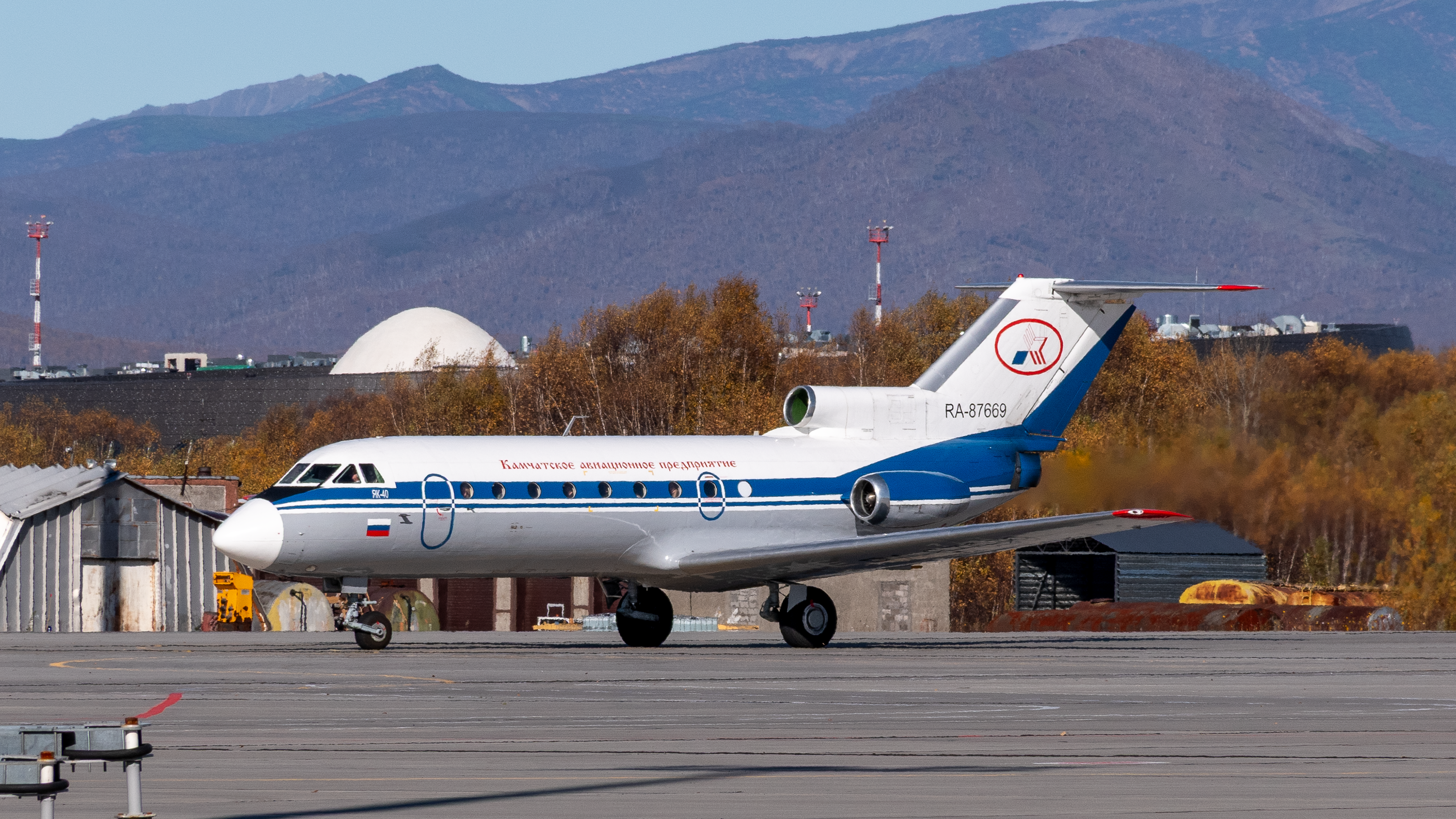
The Yakovlev Yak-40 (Як-40; NATO reporting name "Codling") was the world's first jet airliner designed specifically for local air routes: a straight-winged trijet with a T-tail and retractable tricycle gear, able to work from grass or unpaved strips shorter than 700 m without ground support. It answered an Aeroflot requirement to replace the Ilyushin Il-12 and Il-14 and the Lisunov Li-2 — the Soviet licence-built DC-3 — which still flew the regional network in the early 1960s. Much of that network could not take a demanding aeroplane: as Piotr Butowski records, of the 2,980 Soviet airfields suitable for small airliners a thousand had grass runways under 700 m, usable only by the 12-seat An-2 biplane or the four-seat Yak-12. Aleksandr Yakovlev's OKB-115 first examined turboprop layouts and even vertical take-off configurations with dedicated lift engines, before settling around 1964-1965 on a simple straight-winged trijet for twenty to twenty-five passengers. Power came from the new Ivchenko AI-25 turbofan developed at Zaporizhzhia, rated at 14.7 kN (3,300 lbf) each: two engines on short side pylons and a third buried in the rear fuselage, fed by a dorsal intake through an S-duct. An auxiliary power unit and integral ventral airstairs allowed the aircraft to turn round at airfields with no equipment at all. The first of five prototypes flew on 21 October 1966 and production began in 1967 at the Saratov Aviation Plant. Soviet type certification followed in 1968, and on 30 September of that year aircraft CCCP-87675 flew the first scheduled passenger service, from Moscow to Kostroma. The Yak-40 became the backbone of Aeroflot's local network: eleven aircraft in 1968, 232 by 1972 and 542 by 1975, with more than 43.5 million passengers carried by 1 January 1976 and links to 276 cities by 1980. The Yak-40 was the first Soviet-built airliner designed to Western airworthiness requirements and the first Soviet aircraft to obtain Italian and West German certificates. It was demonstrated in 75 countries and exported to some twenty of them, although the American campaign foundered on Cold War trade policy. Production ended at Saratov in 1981 after a little over a thousand aircraft, spawning a freight version (Yak-40K), a long list of military and laboratory conversions, and the later Yakovlev Yak-42. Long gone from mass scheduled service, the type survived mainly as a VIP and corporate transport — the "Russian bizjet" of the 1990s — and as a testbed: the SibNIA institute in Novosibirsk re-engined it with Honeywell TFE731 turbofans and used it as the basis of the composite-wing STR-40DT demonstrator, which first flew on 4 December 2018.
Related sheets
Category
Three-view drawing
History
An air network that jets could not serve
By the early 1960s the Soviet Union had two civil aviations laid on top of one another. Trunk routes, domestic and international, already flew behind jets and turboprops; local services were still run by obsolete piston aircraft — Ilyushin Il-12, Il-14 and Lisunov Li-2 — often from grass airfields. The problem was not speed but infrastructure. According to the figures gathered by Piotr Butowski, that decade counted 2,980 Soviet airfields suitable for small airliners; a thousand of them had grass runways under 700 m, good only for the twelve-seat An-2 biplane or the four-seat Yak-12, and another 1,250 had soft-surface or concrete strips between 700 and 1,200 m, which is where the Li-2s and Il-14s landed.
What Aeroflot wanted was a single aircraft to replace that whole mixed fleet and cut maintenance and operating costs, as simple and undemanding as the aeroplanes it succeeded but capable of twice their speed. The condition was safe and reliable operation from poorly equipped airports, with unpaved runways shorter than 700 m, in bad weather. The USSR Council of Ministers decree ordering a replacement for the Il-12 and Il-14 was issued in 1960. GlobalSecurity explains the weight given to the programme in one line: the regional services it was aimed at accounted for around 50% of Aeroflot's passenger traffic.
From vertical take-off project to straight-winged trijet
The work went to Aleksandr Yakovlev's OKB-115 in Moscow, which approached it along very different lines before arriving at the definitive aircraft. The prehistory goes back to 1962, when Yakovlev proposed a twenty-seat machine with three R19-300 engines of 1150 kgf thrust. Shortly afterwards the project was recast along the fashionable lines of the day: turning it into a vertical take-off and landing aircraft by adding, to three uprated R19-300s of 1200 kgf, six RD35-36 lift engines in two blocks of three, one in each wing nacelle. So configured it would have carried up to ten passengers over 600 km at a cruising speed of 500 to 550 km/h, rising to twenty seats in short take-off mode with a ground run of little more than a hundred metres. The Main Directorate of the Civil Air Fleet examined the proposal in September 1963 and received it favourably.
One further project was studied, with two cruise turbofans on the sides of the rear fuselage combined with eight RD-36-35 lift engines in the fuselage, in two groups of four ahead of and behind a fifteen-seat cabin. The VTOL airliner concept was then set aside. The English Wikipedia summarises the same process from the other end: Yakovlev evaluated turboprop and jet formulas, including vertical take-off layouts with lift jets in the fuselage or in wing-mounted pods, and finally settled on a straight-winged trijet for twenty to twenty-five passengers. Key.Aero adds that Yakovlev's offer, initially for twenty passengers and later twenty-four, competed with Ilyushin's Il-70 and with the An-Be-20 from the combined Antonov and Beriev team.
The design: a big wing, a T-tail and engines at the back
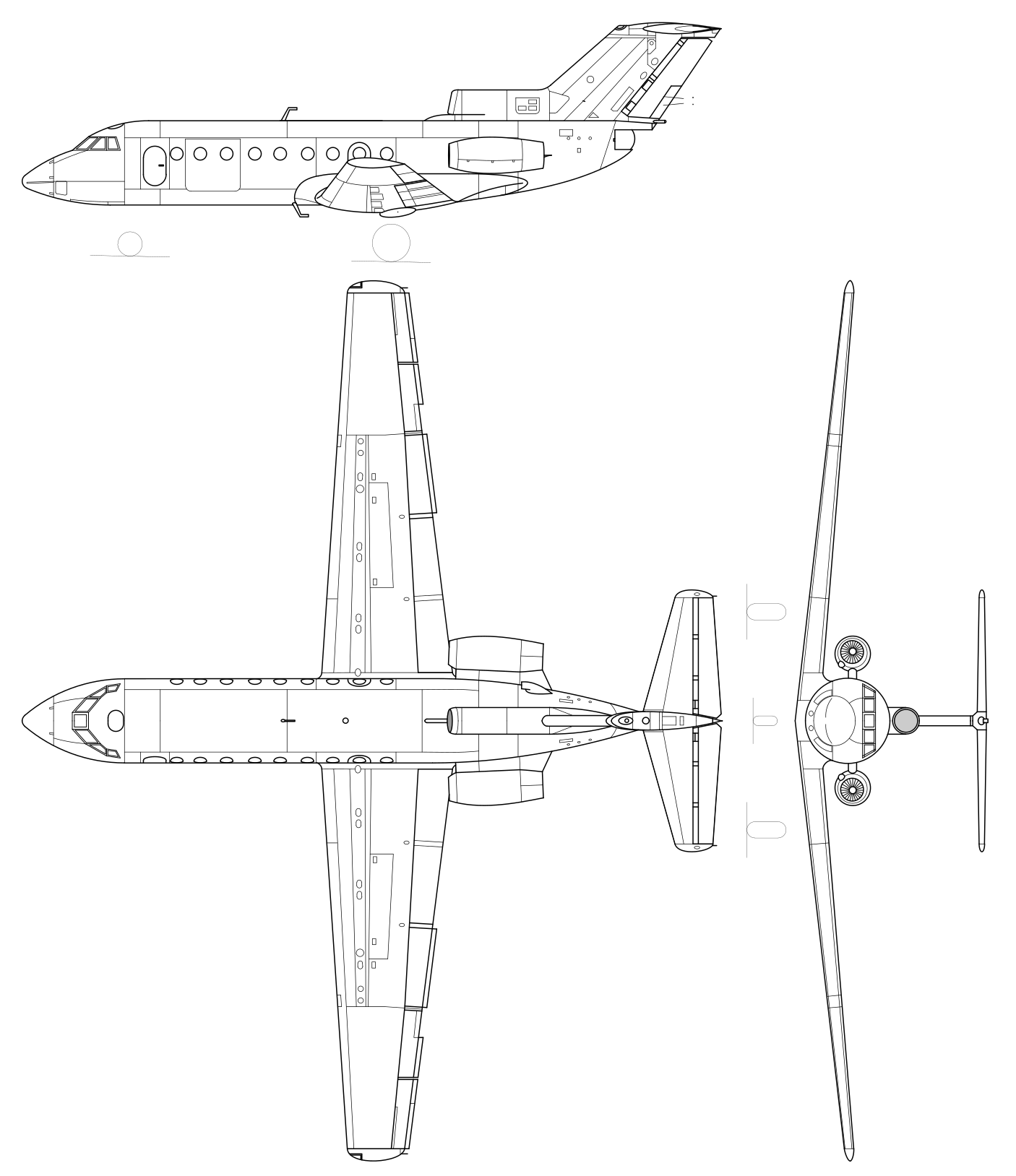
The Yak-40 is a low-wing cantilever monoplane with an unswept wing, a T-tail and retractable tricycle landing gear. The passenger cabin sits ahead of the wing and the short rear fuselage carries the three turbofans: two in nacelles on short side pylons and the third inside, fed by a dorsal intake through an S-duct, alongside the auxiliary power unit that allowed engine starting without ground support at primitive airfields. The pressurised fuselage is 2.4 metres in diameter; pilot and co-pilot sit side by side, and passengers board by ventral airstairs in the tail.
The wing has no centre section: its panels join on the fuselage centreline with a main spar running continuously from tip to tip, and it houses integral tanks with a capacity of 3,800 litres. The trapezoidal planform covers 70 m², with zero sweep at the 25% chord line, an incidence angle of +3° and +5° 30' of dihedral. High-lift devices are deliberately austere — large trailing-edge slotted flaps and nothing else — because the low wing loading is enough to deliver the required short-field performance. The flaps deflect 20° for take-off and 35° for landing, and the two-section ailerons, aerodynamically balanced and mass-balanced, move 19° up and 15° down. Each wing tank takes up to 1500 kg of fuel. The very large fin is swept 50° to move the tailplane aft and compensate for the short rear fuselage; the horizontal tail itself is unswept.
.jpg)
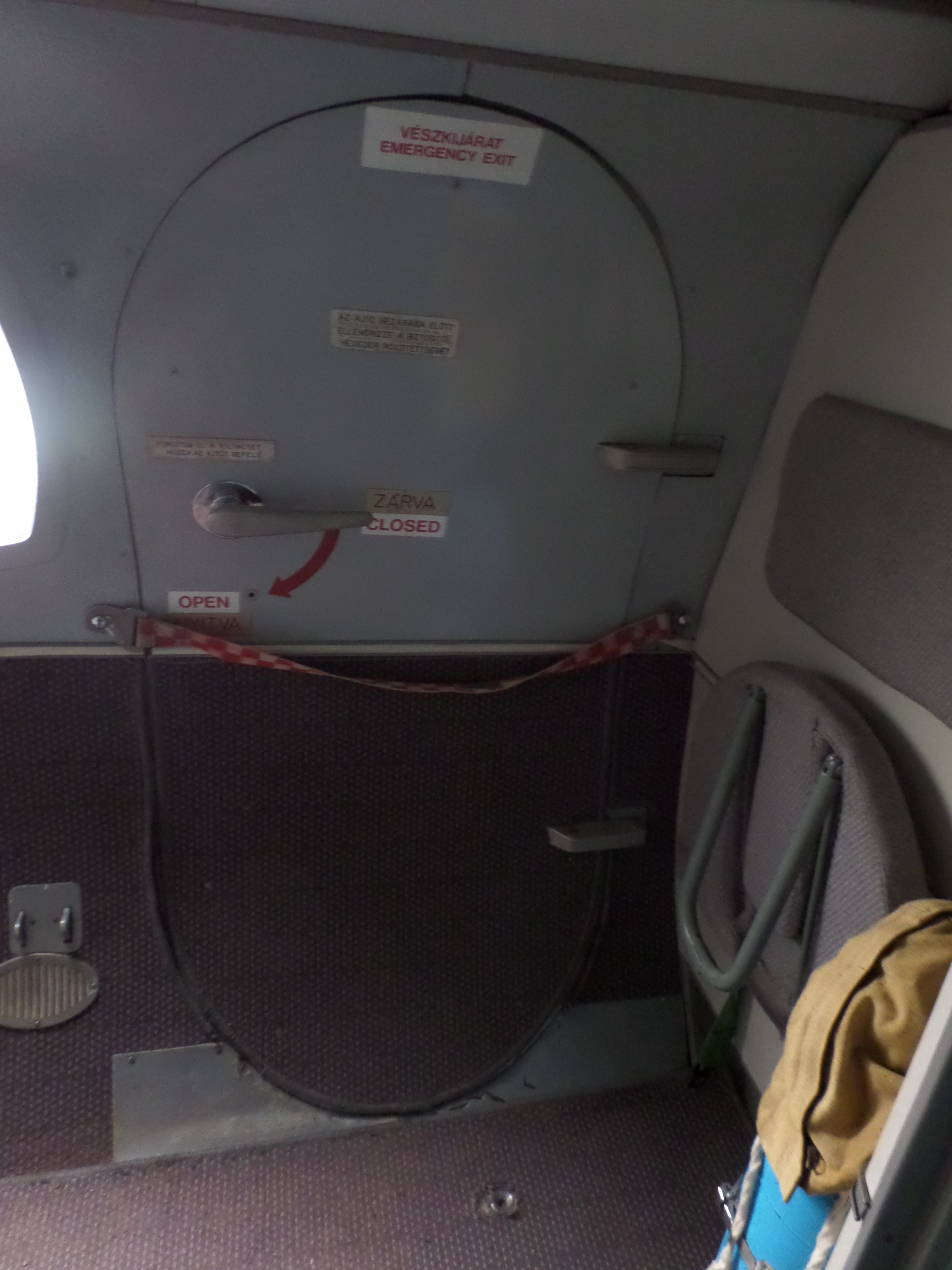
Inside, the cabin is arranged three-abreast for 24 to 27 passengers, with the option of four-abreast seating for 32; GlobalSecurity quotes layouts of 32 to 36 seats. A small baggage compartment sits in the tail. Placing the entire powerplant on the rear fuselage freed the wing across its full span for high-lift devices, cut cabin noise and simplified day-to-day engine maintenance. The Yak-40 was also the first Soviet-built airliner designed to Western airworthiness requirements.
The AI-25s and self-sufficient operation
The three engines are two-shaft Ivchenko AI-25 turbofans developed at Zaporizhzhia, rated at 14.7 kN (3,300 lbf, about 1500 kgf) of take-off thrust and around 1120 kgf of nominal thrust each. Originally they had no jetpipes and no thrust reversers; the centre-engine reverser arrived with the second production series. Three engines were not a stylistic choice: they gave redundancy and good short-field, hot-climate and high-altitude performance, which mattered greatly in Siberia, the Far East, the Caucasus and the Urals. Flight testing showed that the aircraft could continue its take-off with any one of the three engines shut down, and that level flight remained possible on a single engine.
The other half of the equation was independence from airport equipment. The auxiliary power unit in the tail and the built-in folding airstairs allowed boarding and starting without mobile steps or ground carts, and the landing gear, with powerful shock absorption and large-diameter wheels, coped with unprepared strips. GlobalSecurity adds that the combination allowed operation from airports up to 2,500 metres above sea level and at high temperatures.
Prototypes, certification and the first commercial flight
Development of the definitive aircraft began in April 1965 and the first prototype was built that same year; five test aircraft were completed in all. On 21 October 1966, with test pilots L. Kolosov and Yu. V. Petrov at the controls, the first of them made its maiden flight on three AI-25s — the date was also the first public mention of the programme. Production machines differed from the prototypes in details such as the slightly inclined centre-engine air intake and a marginally lengthened cabin.
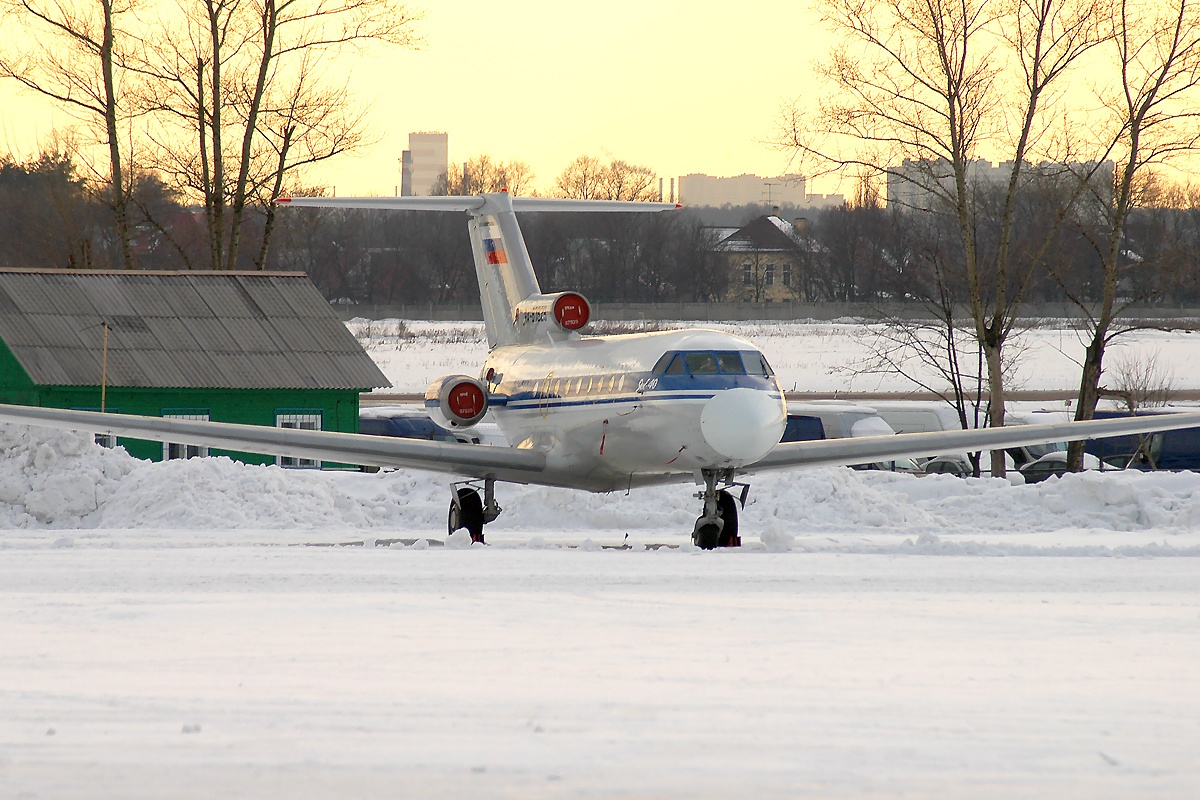
Production was launched in 1967 at the Saratov Aviation Plant and Soviet type certification was granted in 1968. On 30 September 1968 the Yak-40 registered CCCP-87675 flew the first scheduled passenger service, on the Moscow-Kostroma route. Export models began to follow in 1970.
Production series and how the aircraft evolved
The design did not freeze on entry into service. The second series, introduced in 1969, strengthened the landing gear, added a ninth row of seats, increased fuel capacity and fitted the thrust reverser on the centre engine. The third series arrived in 1973 with more passenger capacity and changes to the tail. The fourth and last, from 1975, raised payload and allowed a two-class cabin or a quick conversion to freight; from it came the cargo aircraft designated Yak-40K, with a freight door behind the fuselage door.
The English Wikipedia records the same evolution against different milestones: a spin-behaviour correction in the 1972 version, an increase in non-stop range in 1974 — with the forward right-hand door moved to the level of the sixth window — and, in 1975, a reduction from nine to eight cabin windows on the right-hand side. In terms of weights, the aircraft was initially built with a take-off mass of 14.7 t and 27 seats, giving a range of 710 km with reserves; the improved version then went to 16.1 t and 32 seats with greater range, and finally take-off mass and fuel capacity rose to 17.2 t and 6 t, allowing ranges of up to 2,500 km.
Aeroflot: the backbone of the local network
Operating figures are the best measure of what the Yak-40 meant. Aeroflot started in 1968 with eleven aircraft, reached 232 by 1972 and 542 by 1975. Annual flights went from 1,256 in 1968 to nearly 620 thousand in 1975, a year in which around 17 million passengers were carried. By 1 January 1976 the fleet had accumulated more than 43.5 million passengers and 443 thousand tonnes of freight, with some two million flight hours and 882 million kilometres flown; it worked from 59 base airports and covered more than 515 routes serving 196 cities, in which up to 35% of the runways were unpaved. By 1980 the type linked 276 Soviet cities over 669 scheduled routes. The English Wikipedia puts at 354 million the passengers carried by Aeroflot's Yak-40s up to 1993.
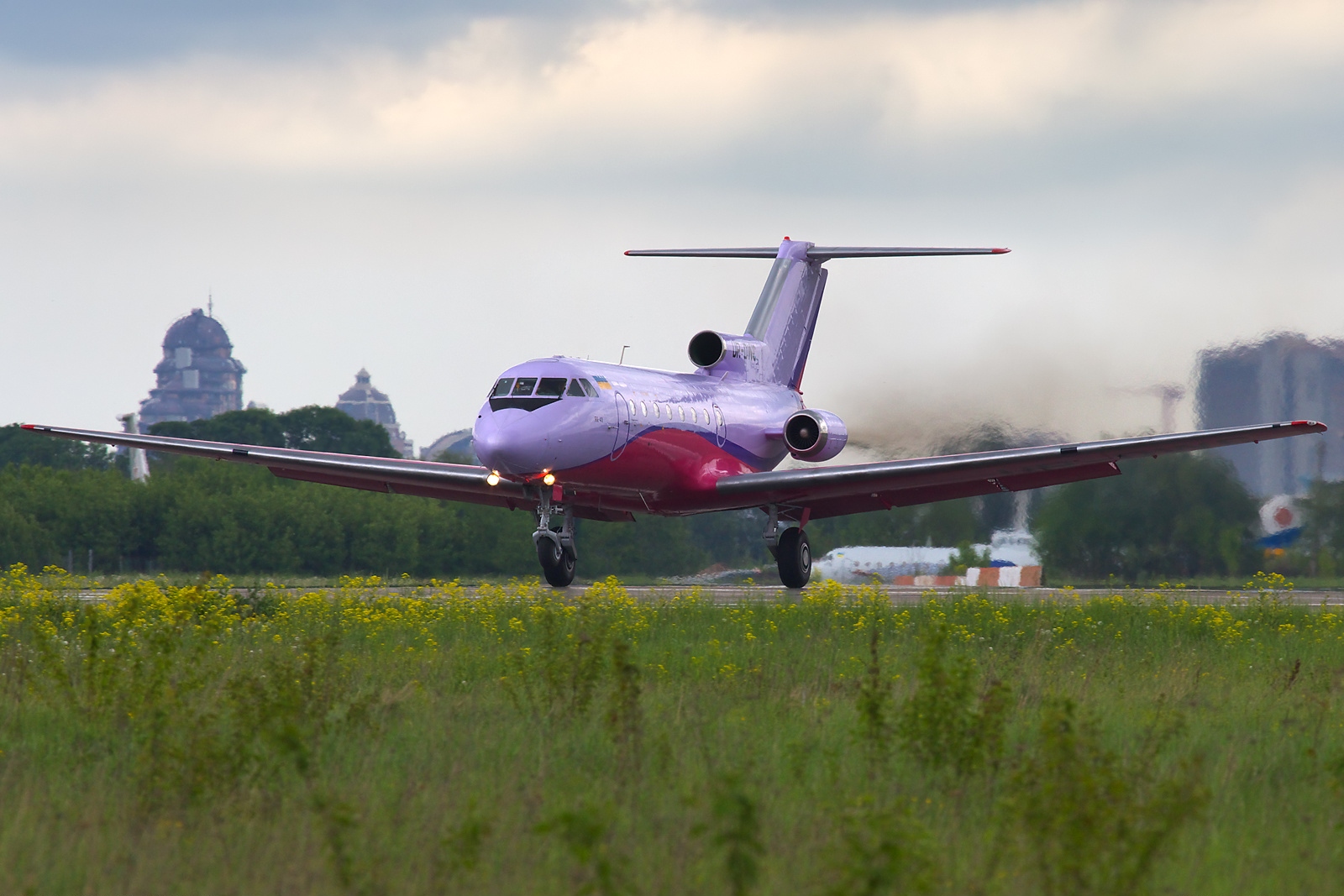
Geographical expansion was just as fast. In 1969, at Khorog airfield, GosNII GA specialists tested Yak-40 number 0304 (CCCP-87693) to establish whether it could operate from high-mountain aerodromes; by 1971 the type was already working Tajikistan's routes, where the difficulty lay in flying below the summits, along gorges and valleys. In 1970 the Bratsk air enterprise became the first in Eastern Siberia to operate it, on the Bratsk-Zheleznogorsk-Ilimsky route.
Western certification and the export campaign
The Yak-40 was the first Soviet aircraft to obtain airworthiness certificates from Italy and West Germany, a fact Russian literature underlines consistently and which rests on the aircraft having been designed from the outset with Western requirements in view. On that basis an ambitious commercial campaign was mounted: the aircraft was demonstrated in 75 countries, including the United States, and orders were placed.
Export figures differ by source. The English Wikipedia gives 130 aircraft exported and lists Afghanistan, Angola, Bulgaria, Cambodia, Cuba, Czechoslovakia, Equatorial Guinea, Ethiopia, Germany, Guatemala, Honduras, Hungary, Italy, Laos, Madagascar, the Philippines, Poland, Syria, Vietnam, Yugoslavia and Zambia; GlobalSecurity speaks of 125 aircraft exported to 18 countries. Either way, and as Key.Aero recalls, Western success was limited: the bulk of the sales went to the Eastern Bloc.
The American attempt
The American episode shows how far a civil aircraft could be caught in Cold War politics. As early as 1971 the United States refused to grant a licence for the sale of the Yak-40 in its market. American companies were keen to sell there, and the Soviets wanted in exchange to place their small jet and their helicopters in the United States, plus American participation in equipping an integrated aircraft production facility and joint design and development of a new, advanced commercial aircraft. The US government made the bilateral airworthiness agreement — essential to any sale — contingent on purchases of American aircraft, while policy tightly limited the participation of US firms in a Soviet manufacturing facility and precluded joint development. Talks on a bilateral airworthiness agreement to certify the Yak-40 were attempted, but the Soviets' main prospective sales partner, Rockwell International, pulled out of the deal in 1974.
Yak-40K, military versions and flying laboratories
The derivative family is remarkably long. The Yak-40K was the freight and combi version, with a large cargo door and a maximum commercial payload of 3,200 kg in the pure freighter configuration; it was produced between 1975 and 1981. The Yak-40D ("Dalniy", long-range) added two extra fuel caissons that raised maximum capacity to 6 tonnes, with centralised refuelling, a discrete gauge for measuring the fuel in the supplementary caissons, and air navigation equipment for international routes. The Yak-40DTS was the assault-transport and ambulance variant. Export designations included the Yak-40EC and the Yak-40V, the latter with three AI-25T engines.
Military and special conversions include the Yak-40-25, with the nose of a MiG-25R and an SRS-4A Elint installation; the Yak-40 "Kalibrovshchik", used to check the operation of ground radio beacons; and a series of electronic-warfare and weather-laboratory aircraft named "Akva", "Liros", "Meteo", "Fobos" and "Shtorm", carrying nose probes, pylon-mounted sensors, fuselage dispensers, dorsal viewing domes, dipole antenna arrays or underwing active jammer pods. The Yak-40REO carried a large ventral canoe for an infrared linescan and a lateral observation blister. The Yak-40/M-602 served as a flying testbed for the Czechoslovak M-602 turboprop, installed in the nose.
There were also proposals that came to nothing. The Yak-40M was a stretched forty-seat version. The Yak-40L, a joint Skorost and Textron Lycoming programme, would have carried two Lycoming LF507-1N turbofans, the original design having a slightly swept wing; the Yak-40P was that same configuration with large nacelles projecting ahead of the wings. The Yak-40TL is described as a re-engined version with Textron-Lycoming LF507-1N engines.
Performance according to the official flight manual
The Yak-40's Rukovodstvo po Lyotnoy Ekspluatatsii — the official flight manual, in the 1995 edition that reproduces the 1980 one with all its amendments — is the most precise source on performance, and it shows an aircraft whose figures shift considerably with the authorised maximum take-off mass. The manual tabulates four cases: 14,850, 16,100, 16,800 and 17,200 kg. The corresponding maximum taxi masses are 14,915, 16,165, 16,865 and 17,265 kg; normal landing mass runs from 13,250 kg in the lightest case to 15,500 kg in the others, and maximum zero-fuel mass lies between 12,200 and 13,750 kg. Maximum commercial payload ranges from 2,280 to 2,300 kg for 24 to 27 seats and from 2,435 to 3,240 kg for layouts of 27 to 36 seats, with 3,200 kg in the freighter version.
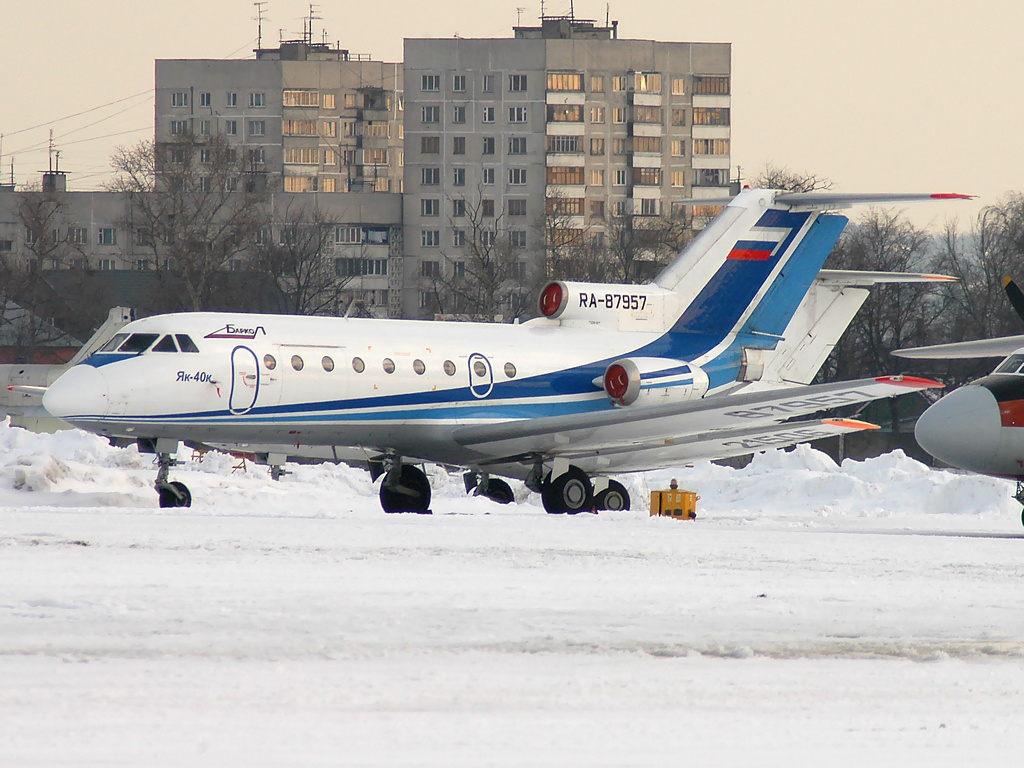
In standard atmosphere, the take-off run on a paved runway is 630 m at 14,850 kg, 755 m at 16,100 kg and 800 m at 16,800 kg; on an unpaved strip it rises to 850 m and 960 m for the first two cases. Unstick speed ranges from 185 to 202 km/h indicated. Rate of climb at nominal power is 8.5 m/s at sea level in the lightest case, falling to 7.0 m/s in the heaviest, and time to 6,000 m goes from 15.5 to 19.0 minutes. True cruising speed at 6,000 m is 510 km/h in all four cases, while maximum speed at that altitude drops from 568 to 546 km/h as mass increases.
On landing, touchdown speed at maximum permitted landing mass runs from 175 to 192 km/h indicated, and at normal landing mass between 165 and 180 km/h. The landing roll on a paved runway at normal landing mass is 400 m in the lightest case and 550 m in the others using the thrust reverser, and 570 and 750 m respectively without it; landing distance from 15 m to a full stop runs from 700 to 840 m with the reverser and from 930 to 1,000 m without. The operational centre-of-gravity envelope allows a forward limit of 13% of mean aerodynamic chord for landing and an aft limit of 32%.
Catalogue data, rounder in nature, describe the same aircraft: 20.36 m long, 25.0 m in span, 6.50 m high, 70 m² of wing area, 9,400 kg empty, 3,910 litres of fuel, an 8,000 m service ceiling and a range of around 1,700 to 1,800 km. With maximum commercial payload the practical range falls to about 820 km, rises to some 1,280 km with full tanks and reaches 2,500 km on a ferry flight. In the 2000s, additional navigation equipment — GPS, TCAS and an early ground proximity warning system — allowed Yak-40s to meet BRNAV RNP-5 area navigation requirements for European airspace, and the aircraft meets the noise limits of Chapter 3, Annex 16, Volume 1 of the Convention on International Civil Aviation.
Production and safety record
The Saratov plant built the Yak-40 between 1967 and 1981, at a rate that climbed quickly — 6 aircraft in 1967, 41 in 1969, 107 in 1972 — to a peak of 143 units in 1975, then fell away sharply: 91 in 1977, 60 in 1978, 12 in 1979, 8 in 1980 and 2 in 1981. The exact total is disputed among reputable sources, which give 1,009, 1,010, 1,011 or 1,013 aircraft.
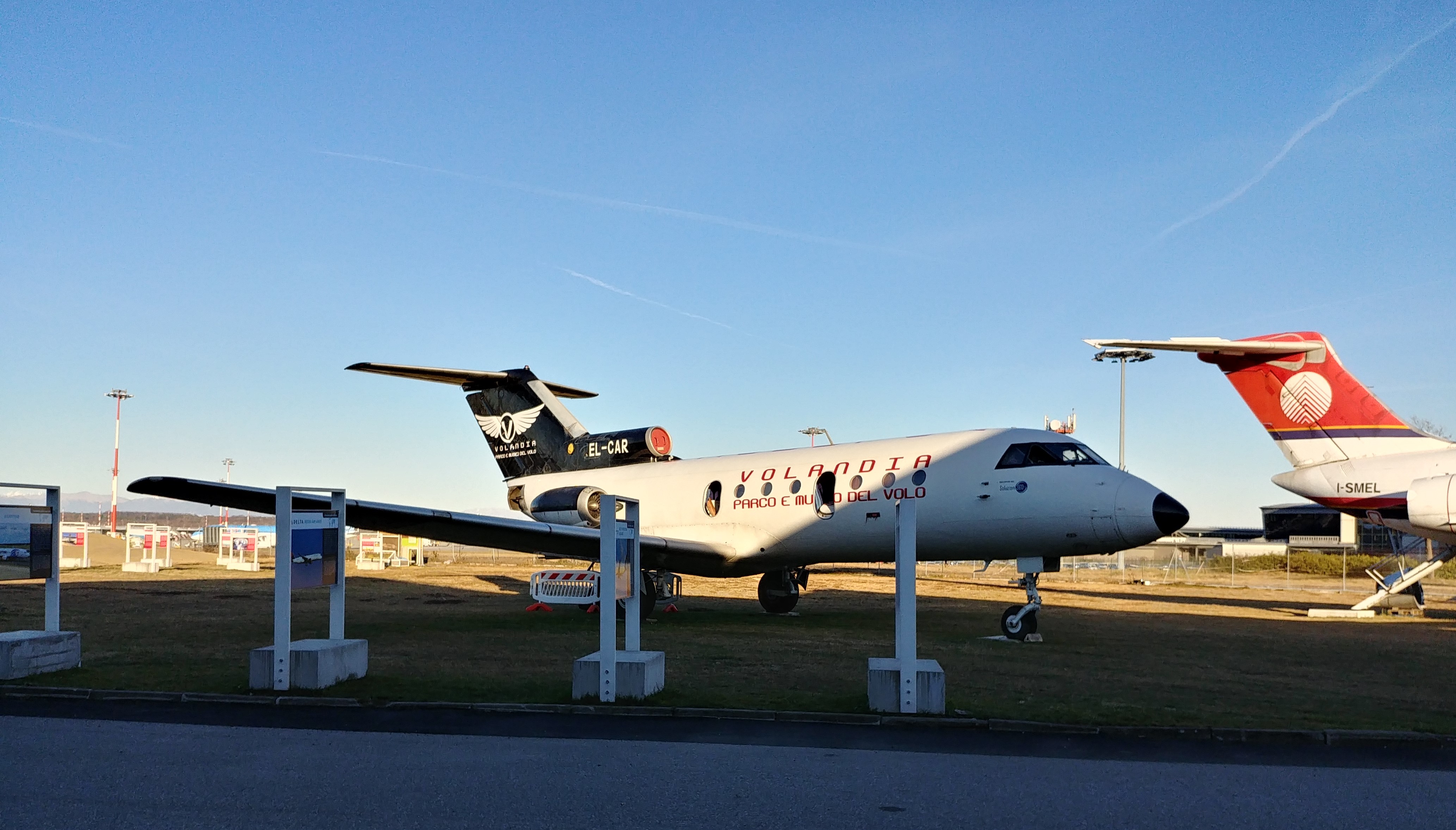
On safety, the type's accident and incident record runs to 155 events with 870 fatalities across its whole operating life. The first fatal accident and hull loss came on 3 September 1970, when Aeroflot Flight Sh-4 (CCCP-87690) struck the side of Mount Airy-Tash northeast of Leninabad — today Khujand, in the then Tajik SSR — at 2,100 m through pilot error, killing all 21 on board. The pattern of later occurrences reflects the environment the aircraft was designed for: runway overruns after fast landings, loss of control from windshear, and icing on take-off from northern aerodromes.
Re-engining, SibNIA and the STR-40DT
After the political changes of 1990 the Yak-40 found a second market as a business jet: several Russian companies, among them energy and machinery plants, went on using it as a corporate aircraft, and much of the surviving fleet was refitted with VIP interiors. In parallel, work was done to extend the airframe's life to 40 000 flight hours and 35 000 landings, with a service life of 38 years and up to 18 years between overhauls.
The most ambitious technical initiative came from the S. A. Chaplygin Siberian Aeronautical Research Institute (SibNIA) in Novosibirsk, which proposed a deep modernisation replacing the AI-25s with engines of Honeywell's TFE731 family. For this it converted a production machine, number 40-04, built at Saratov in 1975 and registered 87216, into a flying laboratory. With one TFE731-3 and two AI-25s it first flew on 8 December 2012; with two TFE731-3s and a single central AI-25, on 20 May 2013; and in full twin-engine configuration, on 29 November 2016 at Yeltsovka airfield. The TFE731-3s envisaged gave around 1700 kgf of take-off thrust each, and SibNIA developed new pylons to install them. The English Wikipedia also records an experimental Yak-40MS with two Honeywell TFE731-5s.
The next step was the composite wing. On 4 December 2018, at that same Yeltsovka airfield, the STR-40DT technology demonstrator made its first flight with a polymer-composite wing fitted with winglets and two TFE731-5BR engines together producing more than 4200 kgf of thrust; the crew was led by Igor Moseikin, head of SibNIA's aviation certification centre. The programme aimed to document the use of composite materials in light jet aircraft at speeds of 600 to 700 km/h and to prepare a future all-composite machine for 19 to 32 seats. The English Wikipedia notes that the STR-40DT, proposed as a twin-engine composite-wing derivative along the lines of the TVS-2DTS, was endorsed but not supported by Yakovlev. In July 2021 yet another experiment was recorded: a Yak-40 began testing an electric propeller engine in the nose.
Retirement, survivors and legacy
Withdrawal was gradual and uneven. In September 2009 the Spanish Wikipedia counted 411 aircraft still in active service out of the 1,011 built; ten years later, in July 2019, the English Wikipedia put the figure at 22 aircraft with civil operators, most of them reconfigured for VIP charter work and fewer than ten in scheduled passenger service, with the airworthiness of several machines belonging to small Russian and Central Asian carriers in doubt. On the military side, by November 2012 no more than 17 aircraft remained in service, and the World Air Forces 2026 report published by FlightGlobal in late 2025 no longer recorded a single Yak-40 in service with any air force in the world. Former military operators include North Korea, whose air force ordered eleven aircraft in 1978, delivered in 1980, for VIP transport.
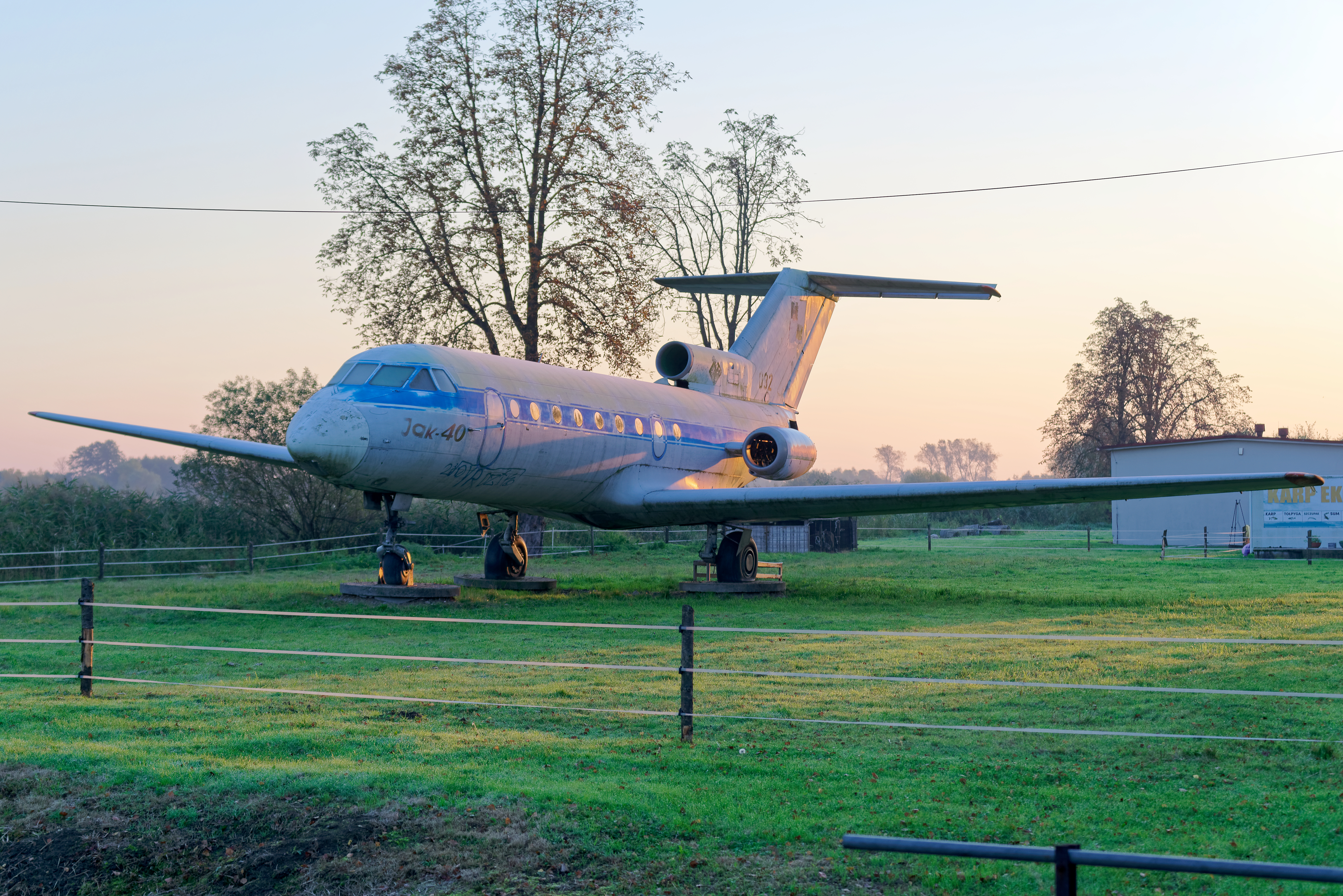
The Yak-40's legacy is twofold. On one hand it was the world's first jet airliner conceived for local routes and, for decades, the only one of its class in large-scale service anywhere: it preceded the Embraer ERJ-135 and the Dornier 328JET by some three decades. On the other, its structure and its operating experience led directly to the Yakovlev Yak-42, a larger swept-wing aircraft developed from it. That an aeroplane conceived for grass strips shorter than 700 m should end up certified in Italy and West Germany, demonstrated in 75 countries and recycled half a century later as a testbed for carbon-fibre wings is the measure of how well the original problem had been solved.
Variants
| Yak-40 | Yak-40 (prototype) | Yak-40MS | STR-40DT | Yak-40-25 | Yak-40 (2nd series) | Yak-40 (3rd series) | Yak-40 Akva | Yak-40D | Yak-40DTS | Yak-40EC | Yak-40 Fobos | Yak-40K | Yak-40 Kalibrovshchik | Yak-40L | Yak-40 Liros | Yak-40M | Yak-40 M-602 | Yak-40 Meteo | Yak-40P | Yak-40REO | Yak-40 Salon | Yak-40 Shtorm | Yak-40T | Yak-40TL | Yak-40V | |
|---|---|---|---|---|---|---|---|---|---|---|---|---|---|---|---|---|---|---|---|---|---|---|---|---|---|---|
| First flight | October 21, 1966 | October 21, 1966 | November 29, 2016 | December 4, 2018 | — | — | — | — | — | — | — | — | — | — | — | — | — | — | — | — | — | — | — | — | — | — |
| Aircraft type | Regional jet airliner | — | — | — | — | — | — | — | — | — | — | — | — | — | — | — | — | — | — | — | — | — | — | — | — | — |
| Powerplant | 3 × Ivchenko AI-25 turbofans of 14.7 kN each (1,500 kgf at take-off): two in nacelles on the sides of the rear fuselage and a third buried in the tail, fed by an S-duct intake. | — | — | — | — | — | — | — | — | — | — | — | — | — | — | — | — | — | — | — | — | — | — | — | — | — |
| Powerplant | 3 × Ivchenko AI-25 | 3 × Ivchenko AI-25 | 2 × Honeywell TFE731-5 | 2 × Honeywell TFE731-5BR | 3 × Ivchenko AI-25 | 3 × Ivchenko AI-25 | 3 × Ivchenko AI-25 | 3 × Ivchenko AI-25 | 3 × Ivchenko AI-25 | 3 × Ivchenko AI-25 | 3 × Ivchenko AI-25 | 3 × Ivchenko AI-25 | 3 × Ivchenko AI-25 | 3 × Ivchenko AI-25 | 2 × Lycoming LF507-1N | 3 × Ivchenko AI-25 | 3 × turbofan | 3 × Ivchenko AI-25 (M 602 turboprop testbed in the nose) | 3 × Ivchenko AI-25 | 2 × Lycoming LF507-1N | 3 × Ivchenko AI-25 | 3 × Ivchenko AI-25 | 3 × Ivchenko AI-25 | 3 × Ivchenko AI-25 | 3 × Lycoming LF 507 | 3 × Ivchenko AI-25T |
| Thrust per engine | 14.7 kN | — | — | — | — | — | — | — | — | — | — | — | — | — | 31.1 kN Best value in this row | — | — | — | — | 31.1 kN Best value in this row | — | — | — | — | 31.1 kN Best value in this row | — |
| Length | 20.4 m Best value in this row | — | 20.4 m Best value in this row | — | — | 20.4 m Best value in this row | 20.4 m Best value in this row | — | 20.4 m Best value in this row | — | — | — | 20.4 m Best value in this row | — | — | — | — | — | — | — | — | 20.4 m Best value in this row | — | — | — | — |
| Wingspan | 25 m Best value in this row | — | — | — | — | — | — | — | — | — | — | — | 25 m Best value in this row | — | — | — | — | — | — | — | — | — | — | — | — | — |
| Height | 6.5 m Best value in this row | — | — | — | — | — | — | — | — | — | — | — | 6.5 m Best value in this row | — | — | — | — | — | — | — | — | — | — | — | — | — |
| Wing area | 70 m² | — | — | — | — | — | — | — | — | — | — | — | — | — | — | — | — | — | — | — | — | — | — | — | — | — |
| Empty weight | 9,400 kg | — | — | — | — | — | — | — | — | — | — | — | — | — | — | — | — | — | — | — | — | — | — | — | — | — |
| MTOW | 16,100 kg | — | — | — | — | — | — | — | — | — | — | — | — | — | — | — | — | — | — | — | — | — | — | — | — | — |
| Top speed | 558 km/h | — | — | — | — | — | — | — | — | — | — | — | — | — | — | — | — | — | — | — | — | — | — | — | — | — |
| Max speed altitude | 6,000 m | — | — | — | — | — | — | — | — | — | — | — | — | — | — | — | — | — | — | — | — | — | — | — | — | — |
| Cruise speed | 510 km/h | — | — | 700 km/h Best value in this row | — | — | — | — | — | — | — | — | — | — | — | — | — | — | — | — | — | — | — | — | — | — |
| Cruise altitude | 6,000 m | — | — | — | — | — | — | — | — | — | — | — | — | — | — | — | — | — | — | — | — | — | — | — | — | — |
| Service ceiling | 8,000 m | — | — | — | — | — | — | — | — | — | — | — | — | — | — | — | — | — | — | — | — | — | — | — | — | — |
| Initial climb rate | 8 m/s | — | — | — | — | — | — | — | — | — | — | — | — | — | — | — | — | — | — | — | — | — | — | — | — | — |
| Range | 1,800 km | — | — | — | — | — | — | — | — | — | — | — | — | — | — | — | — | — | — | — | — | — | — | — | — | — |
| Ferry range | 2,500 km | — | — | — | — | — | — | — | — | — | — | — | — | — | — | — | — | — | — | — | — | — | — | — | — | — |
| Combat radius | 0 km | — | — | — | — | — | — | — | — | — | — | — | — | — | — | — | — | — | — | — | — | — | — | — | — | — |
| Range conditions | 1,800 km with full tanks and about 820 km with the maximum commercial payload; 2,500 km on a ferry flight with no payload. Service ceiling 8,000 m and 550 km/h cruise at 7,000 m. | — | — | — | — | — | — | — | — | — | — | — | — | — | — | — | — | — | — | — | — | — | — | — | — | — |
| Armament | None | — | — | — | — | — | — | — | — | — | — | — | — | — | — | — | — | — | — | — | — | — | — | — | — | — |
| Max weapons load | 0 kg | — | — | — | — | — | — | — | — | — | — | — | — | — | — | — | — | — | — | — | — | — | — | — | — | — |
| Payload | 3,240 kg Best value in this row | — | — | — | — | — | — | — | — | — | — | — | 3,200 kg | — | — | — | — | — | — | — | — | — | — | — | — | — |
| Cargo capacity | Cabin seating 27 to 32 depending on layout, with high-density fits of up to 36; maximum commercial payload of 3,240 kg. The rear ventral airstair allows boarding without ground equipment, suiting unpaved or grass strips. | — | — | — | — | — | — | — | — | — | — | — | — | — | — | — | — | — | — | — | — | — | — | — | — | — |
| Crew | 3 Best value in this row | 3 Best value in this row | — | — | — | 3 Best value in this row | 3 Best value in this row | — | 3 Best value in this row | 3 Best value in this row | 3 Best value in this row | — | 3 Best value in this row | — | — | — | — | — | — | — | — | 3 Best value in this row | — | 3 Best value in this row | — | 3 Best value in this row |
| Passengers | 32 | — | — | — | — | — | — | — | — | — | — | — | — | — | — | — | 40 Best value in this row | — | — | — | — | 20 | — | 34 | — | — |
| Units built | 1,011 Best value in this row | 6 | 1 | 1 | 1 | — | — | 1 | — | — | — | 1 | — | — | — | 1 | — | 1 | 1 | — | 1 | 83 | 1 | 1 | — | — |
Images
Elsewhere
- RussianPlanes.netYakovlev Yak-40 de Air Kazakhstan, matrícula UN-87492 (RussianPlanes.net) ↗
- RussianPlanes.netYakovlev Yak-40 de VZLÚ (instituto de investigación checoslovaco), matrícula OK-020 (RussianPlanes.net) ↗
- RussianPlanes.netYakovlev Yak-40 de Aeroflot - MGA URSS, matrícula CCCP-87748 (RussianPlanes.net) ↗
- RussianPlanes.netYakovlev Yak-40 de Aeroflot - MGA URSS, matrícula CCCP-87359 (RussianPlanes.net) ↗
- RussianPlanes.netYakovlev Yak-40 de propietario privado (n.f. 9540245) (RussianPlanes.net) ↗
- RussianPlanes.netYakovlev Yak-40 de Aerolíneas Armenias, matrícula EK-88256 (RussianPlanes.net) ↗
- RussianPlanes.netYakovlev Yak-40 de Rusia (URSS) - MAP, matrícula CCCP-19661 (RussianPlanes.net) ↗
- ABPicYakovlev Yak-40 de Aeroflot, matrícula RA-87344 (ABPic) ↗
- ABPicYakovlev Yak-40 de Air Ukraine, matrícula UR-87345 (ABPic) ↗
- ABPicYakovlev Yak-40 de Centrafrican Airlines, matrícula TL-ACP (ABPic) ↗
- ABPicYakovlev Yak-40 de Sankuru Air Services, matrícula RA-88238 (ABPic) ↗
- ABPicYakovlev Yak-40 de Aviakompanija Lietuva, matrícula LY-AAD (ABPic) ↗
Show the 12 more
- ABPicYakovlev Yak-40 de Tatarstan Airlines, matrícula RA-87239 (ABPic) ↗
- ABPicYakovlev Yak-40 de Volga-Dnepr Airlines, matrícula RA-87344 (ABPic) ↗
- Spotters.AeroYakovlev Yak-40 de Aeroflot, matrícula CCCP-87683 (Spotters.Aero) ↗
- Spotters.AeroYakovlev Yak-40 sin identificar, matrícula UR-EEE (Spotters.Aero) ↗
- Spotters.AeroYakovlev Yak-40 de Aeroflot, matrícula CCCP-87683 (Spotters.Aero) ↗
- Spotters.AeroYakovlev Yak-40 de VEGA, matrícula UR-EEE (Spotters.Aero) ↗
- Spotters.AeroYakovlev Yak-40 de Uzbekistan Airways, matrícula UK-87996 (Spotters.Aero) ↗
- Spotters.AeroYakovlev Yak-40 de Dniproavia, matrícula UR-87965 (Spotters.Aero) ↗
- FlightAwareYakovlev Yak-40 (motobanco de pruebas Walter M-601), matrícula OK-EEA (FlightAware) ↗
- FlightAwareYakovlev Yak-40, matrícula UR-LRZ (FlightAware) ↗
- Airliners.netYakovlev Yak-40 de Syrian Air, matrícula YK-AQB (Airliners.net, captura de archivo) ↗
- Planepictures.netYakovlev Yak-40 de propietario privado, matrícula UR-MHG, Kiev-Zhulyany (Planepictures.net) ↗




![Ukrainian GOLD! Motor Sich Yakovlev Yak-40 Ultimate Cockpit Movie: TOP Sounds & Sights! [AIRCLIPS]](https://i.ytimg.com/vi/nfPb28yRNKI/hqdefault.jpg)
![Tiny Jet, busy Cockpit! Yakovlev Yak-40 Landing into Minsk, Belarus! [AirClips]](https://i.ytimg.com/vi/TskXPndirJ4/hqdefault.jpg)
![Amazingly LITTLE Climb Rate: Yakovlev Yak-40 Cockpit Takeoff from Minsk! [AirClips]](https://i.ytimg.com/vi/VS2cV6yqB9Q/hqdefault.jpg)
![Engines: 3, Pilots: 3, Climb Rate: 0. :) Yak-40 loud but shallow Minsk Takeoff! [AirClips]](https://i.ytimg.com/vi/nahWXIBakag/hqdefault.jpg)

![CLASSIC JET: Three engines, three pilots! Yakovlev 40 into Minsk Airport, Motor Sich! [AirClips]](https://i.ytimg.com/vi/FAtKgU2UYXY/hqdefault.jpg)


![RARE Motor Sich Yakovlev Yak-40 Passenger Window View during SMOOTH Landing in Minsk! [AirClips]](https://i.ytimg.com/vi/SP8B93kVHxs/hqdefault.jpg)
![Yakovlev Yak-40 RARE Cockpit Takeoff from Minsk for Merlintour Joyride! [AirClips]](https://i.ytimg.com/vi/eP8TfCExjYM/hqdefault.jpg)
![Your Chance to fly Yak-40, Il-76, An-12, An-26, Mi-26, Mi-8 & more! Cockpit Clips!!! [AirClips]](https://i.ytimg.com/vi/4xAKC2r9l6g/hqdefault.jpg)