WHY DOES THE TU-95'S NOISE STILL MAKE NATO TREMBLE?
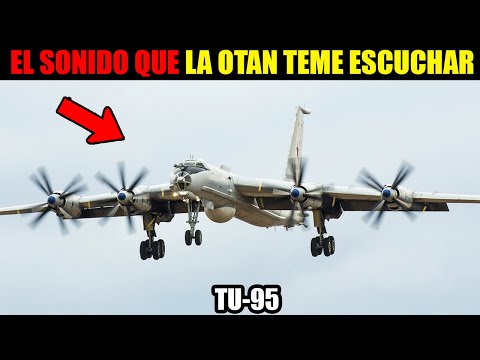
Video from the channel Batallas en los Cielos about Tupolev Tu-95, linked on its Above Ten Thousand entry. Duration: 27:46. Language: Spanish. Video type: Documentary.
What it's about
Spanish-language documentary about the Tupolev Tu-95, the strategic bomber NATO knows as Bear. It covers its design, its role in the Cold War, its modernizations and its current use in Russian strategic aviation.
Historical context
According to the video, the Soviet Union designed it in the mid-1950s to carry nuclear weapons over intercontinental distances without relying on bases near the enemy, as a response to the American B-52. The Tupolev design bureau chose turboprops over jet engines for their lower fuel consumption: this gave it greater range without giving up a speed comparable to some subsonic jets of the time. During the Cold War it patrolled the North Atlantic, the Arctic and the Pacific near NATO airspace, and its appearance forced allied interceptors to take off and escort it. In November 2015 it launched Kh-101 cruise missiles against targets in Syria for the first time, in a mission that departed from Engels air base.
Key facts
It is powered by four Kuznetsov NK-12 turboprops of about 15,000 SHP each, with contra-rotating propellers. With them it approaches 925 km/h and exceeds 15,000 km of range without refueling. The video credits it with a 50.1 m wingspan, 46.2 m length and about 20 tonnes of weapons payload. Its biggest weakness is its acoustic and radar signature: the roar of the propellers gives away its presence from a great distance. The Tu-95MS and Tu-95MSM versions incorporate digital avionics, GLONASS navigation, electronic warfare and Kh-55, Kh-101 and Kh-102 missiles; according to the video, the Kh-102 has nuclear capability and a range of more than 5,500 km. The documentary compares it with the B-52, the Avro Vulcan, the Mirage IV, the B-2 and the Tu-160, and notes that Russia plans to keep it in service at least until 2040.