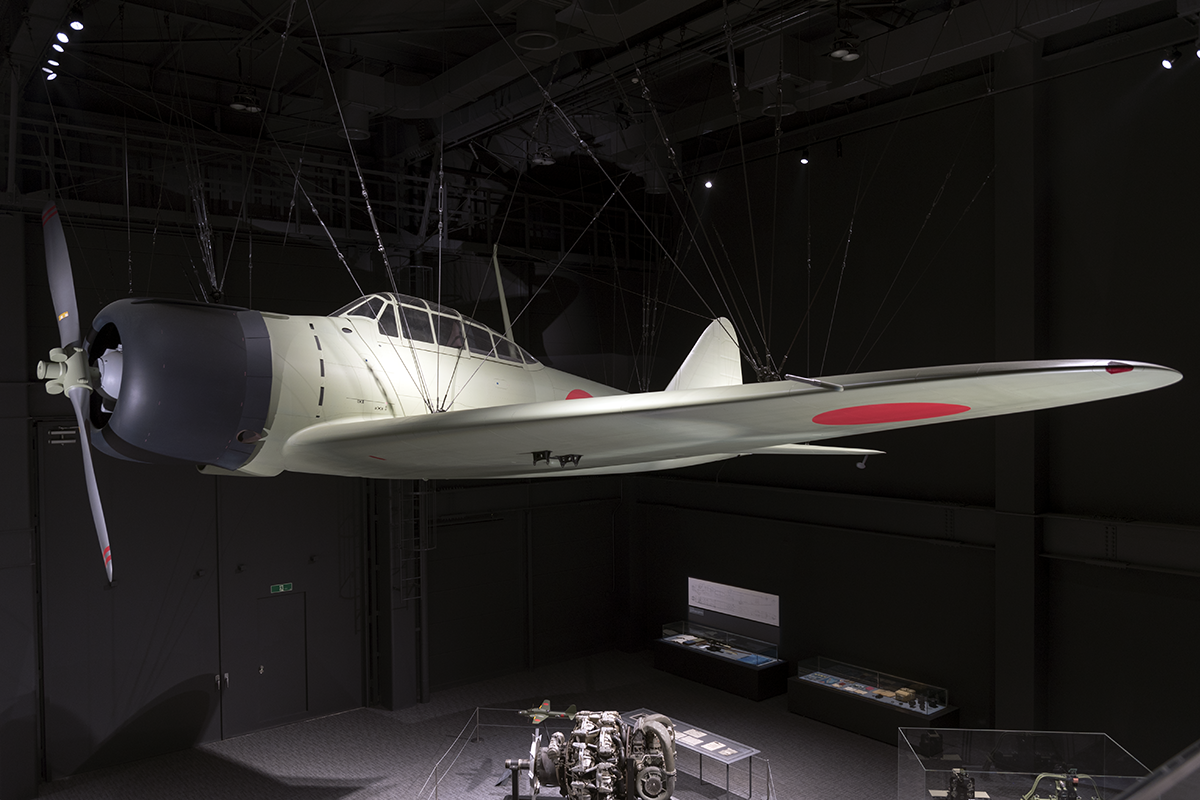
Mitsubishi A6M Zero variant
Mitsubishi A6M Zero A6M1
The two original prototypes of the 12-Shi carrier fighter, powered by the 780 hp Mitsubishi Zuisei 13; the first flew on 1 April 1939 at Kagamigahara. The third airframe, re-engined with the Sakae 12, became the A6M2.

- April 1, 1939
- First flight
- 2
- Units built
History
The A6M1 was the original form of the carrier fighter that the Imperial Japanese Navy had ordered under the experimental designation "12-Shi carrier fighter" (十二試艦上戦闘機). Its starting point was the requirement that the Navy circulated to manufacturers in draft form in May 1937 and issued as a formal document on 5 October 1937. That specification called for an aircraft able to serve both as an escort fighter, superior in close combat to any enemy light fighter, and as an interceptor capable of catching and destroying attacking formations. The figures were ambitious for the time: a top speed of at least 270 knots at 4,000 metres, a climb to 3,000 metres in no more than three and a half minutes, an endurance of more than six hours at cruising speed with a drop tank, and an armament of two 20 mm cannon and two 7.7 mm machine guns, plus an optional load of two 30 kg or 60 kg bombs. All of this had to be achieved without compromising the take-off and landing qualities demanded by carrier operations.
Mitsubishi's design team, led by engineer Jirō Horikoshi, was already at work on the project in the summer of 1937, as shown by a group photograph dated July of that year. To meet the specification, Horikoshi opted for an extremely light structure, with an in-house aerofoil, flush riveting over the whole airframe and numerous lightening holes. Wing loading was deliberately set well below contemporary fighter practice in order to satisfy the demands for manoeuvrability and carrier operation.
%2C_c_n_Mitsubishi_201%2C_Gifu-Kakamigahara_Air_and_Space_Museum.jpg)
The first prototype was completed on 16 March 1939 and made its maiden flight on 1 April 1939 at the Army airfield of Kagamigahara, in Gifu Prefecture. The first two aircraft were powered by the Mitsubishi Zuisei 13, a fourteen-cylinder air-cooled radial rated at 780 hp (580 kW) for take-off and 875 hp at 3,600 metres, initially driving a two-blade propeller. Testing progressed remarkably quickly: the aircraft showed excellent flying qualities, although its speed, which Spanish-language sources put at 489 km/h, fell short of the requirement and came close to costing Mitsubishi the contract. A constant-speed propeller was tried and improved overall performance, and a vibration problem found during trials was cured by switching to a three-blade propeller. By September 1939 the aircraft had already been accepted for official Navy testing as the "A6M1 Type 0 Carrier Fighter".
The answer to the shortage of power came from the Navy itself, which suggested fitting the third prototype with the 940 hp Nakajima Sakae 12. Mitsubishi had its own engine in that class, the Kinsei, and agreed with some reluctance, but on 1 May 1939 the third airframe, now with the Sakae 12, was redesignated A6M2, and that change marked the end of the A6M1 line after only two airframes. The A6M2 was formally adopted on 24 July 1940 as the Type 0 Model 11.
The fate of the second prototype illustrates the price of such extreme lightness. According to Japanese accounts, in March 1940 the second prototype broke up in flight after flutter caused by the fatigue failure of an elevator mass balance, and test pilot Masumi Okuyama was killed. English-language sources merely record that the aircraft was written off without explanation in July 1940 after completing the company's flight test programme. Horikoshi would later acknowledge that the structural theory underlying the design had not kept pace with the aircraft themselves.
Although it never entered service, the A6M1 established the formula that would define the Zero throughout its career: a light airframe, very long range, heavy 20 mm armament and a level of manoeuvrability that would become legendary. As a prototype, its exact performance figures vary from source to source, so this entry records only the values supported by the material consulted.
Multimedia
%2C_c_n_Mitsubishi_201%2C_Gifu-Kakamigahara_Air_and_Space_Museum-1600.webp)