Fighter · Military · Russia
Mikoyan-Gurevich MiG-15
- December 30, 1947
- First flight
- In service
- Status
_(26800302615)-1600.webp)

_FAGOT_B_-_DPLA_-_cf8207db1559b8d7892e624f4e82bba8_(page_1)-1600.webp)
_FAGOT_B_-_DPLA_-_cf8207db1559b8d7892e624f4e82bba8_(page_2)-1600.webp)
_(9169768870)-1600.webp)
-1600.webp)
_01_(32837000932)-1600.webp)
_MiG-15_aircraft_parked_on_a_flight_line_DF-ST-85-03638-1600.webp)


-1600.webp)


-1600.webp)
_-_Soviet_Air_Force_-_301_Red_at_Flugausstellung_Hermeskeil%2C_pic1-1600.webp)


_(7701250132)-800.webp)

_'197'_(13277124545)-1600.webp)

_FAGOT_B_-_DPLA_-_cf8207db1559b8d7892e624f4e82bba8_(page_3)-1600.webp)


_used_in_Mig-15%2C_Mig-17%2C_IL28_at_Flugausstellung_Hermeskeil%2C_pic1-1600.webp)


-1600.webp)


-800.webp)


-1600.webp)


_jet_fighter_aircraft_-_%CE%91%CE%B5%CF%81%CE%B9%CF%89%CE%B8%CE%BF%CF%8D%CE%BC%CE%B5%CE%BD%CE%BF_%CE%BC%CE%B1%CF%87%CE%B7%CF%84%CE%B9%CE%BA%CF%8C_%CE%B1%CE%B5%CF%81%CE%BF%CF%83%CE%BA%CE%AC%CF%86%CE%BF%CF%82_(26999656936)-1600.webp)
-1600.webp)
-1600.webp)
_02_(32991885285)-1600.webp)
-1600.webp)


-1600.webp)

The Mikoyan-Gurevich MiG-15 (NATO reporting name "Fagot") was the first mass-produced Soviet swept-wing jet fighter, and with it the Soviet Union drew level with Western combat aviation almost overnight. The I-310 "S-01" prototype — a single-seater conceived specifically to intercept formations of heavy bombers at altitude — first flew on 30 December 1947 with Captain Viktor N. Yuganov at the controls, barely three months after the North American F-86 Sabre it would later be measured against. Wings and tail carried 35° of sweep, the design bureau having studied captured plans and wind-tunnel models of the German Focke-Wulf Ta 183 even though the MiG's structure and proportions were its own, and each wing had two fences to tame the spanwise flow. The armament announced the mission: one 37 mm Nudelman N-37 and two 23 mm Nudelman-Suranov NS-23 cannon grouped under the nose — few rounds, very heavy ones, against a large target. The Soviet weakness lay not in aerodynamics but in turbines: in 1946 no domestic engine offered more than modest thrust or lasted many hours. Aviation minister Mikhail Khrunichev and designer A. S. Yakovlev proposed to Stalin that the engine be bought in Britain; the canonical story has Stalin asking what fool would sell his secrets, then approving the trip anyway. The British Labour government and its trade minister, Sir Stafford Cripps, agreed to sell the Rolls-Royce Nene complete with blueprints and a manufacturing licence: 25 Nenes were purchased between September 1946 and March 1947 — 55 jet engines in all counting the Derwents — and Vladimir Klimov adapted them for Soviet industry as the RD-45. A second evolution with better metallurgy, the 26.5 kN VK-1, produced the MiG-15bis, in service from early 1950 with larger air brakes, NR-23 cannon in place of the NS-23, and later underwing racks for bombs or rockets. The first production MiG-15 flew on 31 December 1948 and the first regiments were operational during 1949. Output was vast — the available tallies give more than 13,000 aircraft, and one popular source raises the figure above 18,000, with no properly cross-checked breakdown by factory and country — split between Soviet plants and Eastern Bloc licences: Poland built the Lim-1 and Lim-2 at WSK Mielec, Czechoslovakia the S-102, S-103 and two-seat CS-102 at Aero, and China assembled the JJ-2 trainer (exported as the FT-2) at Shenyang. The dual-control MiG-15UTI two-seater, "Midget" to NATO, became the jet school of half a dozen air arms and stayed in the line long after the single-seat fighter had been overtaken. Its baptism of fire came over China in the spring of 1950, when Soviet pilots of the 50th Fighter Aviation Division stopped the Nationalist raids on Shanghai, and it became a legend in Korea. On 1 November 1950 MiGs appeared over the Yalu river in North Korean markings, flown by Soviet pilots in disguise; Soviet sources place the first jet-versus-jet combat in history on that same day, while the American account credits the first jet kill to Lieutenant Russell J. Brown in an F-80C on 8 November. In "MiG Alley" the new fighter rendered the Gloster Meteor, F-80, F-84 and F9F obsolete at a stroke, and only the F-86 Sabre could meet it: the MiG climbed and accelerated better, had a higher ceiling (15,500 m) and hit harder, while the Sabre held the advantage below 8,000 m and carried a far better radar-ranging gyroscopic gunsight. Against the B-29 it did exactly what it had been designed for: "Black Thursday", 12 April 1951, damaged or destroyed a quarter of the Far East heavy bomber force and drove the four-engined bombers out of daylight raids. The scoreboards remain disputed — the Soviet 64th Fighter Aviation Corps claimed 1,106 aircraft shot down, and both sides inflated their tallies. The West waited three years to examine a complete example. On 21 September 1953 North Korean lieutenant No Kum-Sok landed his MiG-15bis at Kimpo air base after a seventeen-minute flight and collected the $100,000 offered by Operation Moolah, a reward he said he had never heard of; the aircraft went to Okinawa, where Captain H. E. Collins and Major Chuck Yeager flew it, and it is preserved today at the National Museum of the United States Air Force — the technical substance of that evaluation survives only through popular accounts. By then the MiG-15 was already giving way to the MiG-17, yet it went on being exported to more than thirty air forces across Eastern Europe, Asia, Africa and the Middle East, and it still featured in one famous tragedy: Yuri Gagarin, the first man in space, was killed in March 1968 when the MiG-15UTI he was flying crashed. Nearly eight decades after its first flight, the type remains in service as an advanced trainer with the North Korean air force.
Category
Three-view drawing
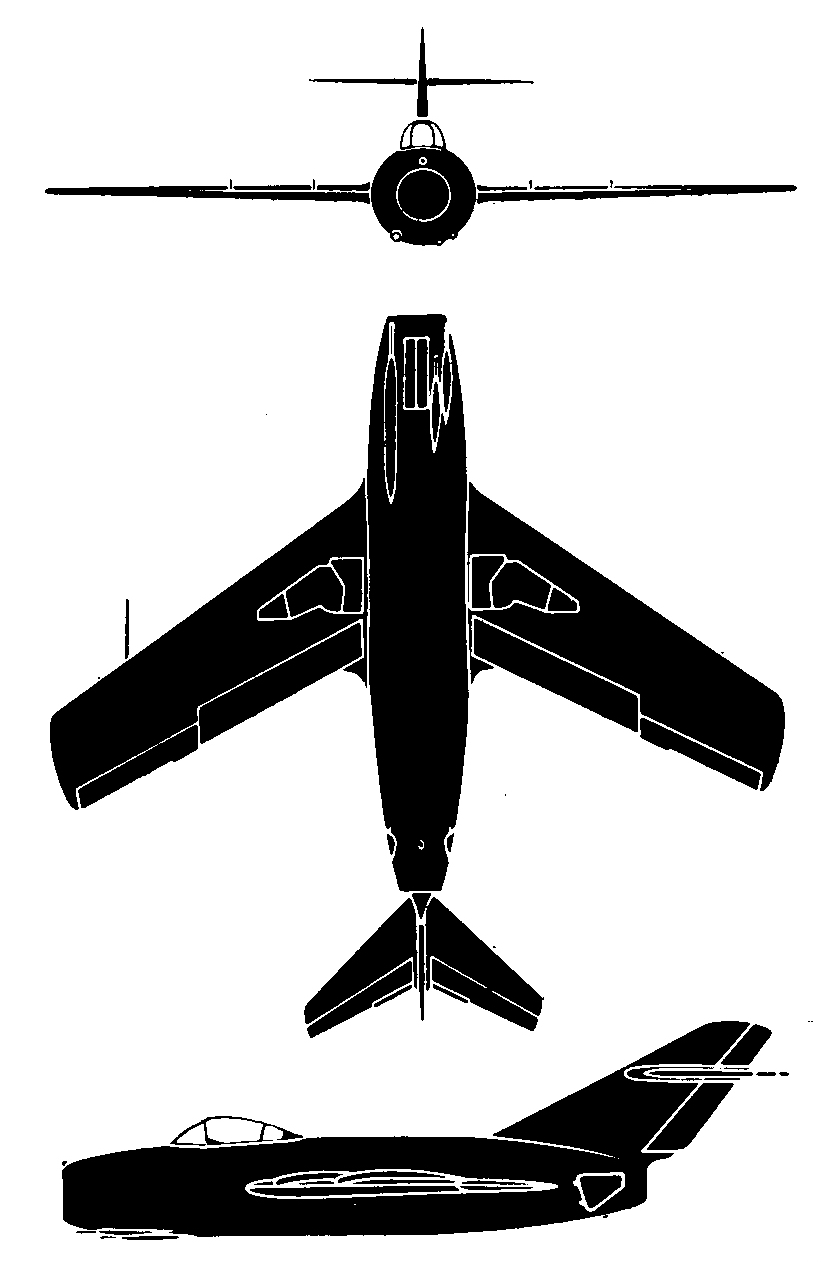
_-_1956_r.jpg)
History
Starting point: the USSR arrives late to the jet age
The Soviet Union ended the Second World War behind the West in jet propulsion. Experiments with "mixed power" aircraft, combining a piston engine and a jet, led nowhere: Artem Mikoyan's OKB-155, with his deputy Mikhail Gurevich, built about sixteen I-250s — also designated MiG-13 — in which a piston engine drove a propeller in the nose and a compressor in the rear fuselage, and flew two I-270 rocket-fighter prototypes. Both were dead ends. What did prove useful was German loot: the Junkers Jumo 004 and BMW 003 turbojets, put into Soviet production as the RD-10 and RD-20, and German swept-wing research.
Answering a February 1945 state requirement for a pure jet fighter, the Mikoyan OKB designed the twin-engine, straight-winged I-300. The first of three prototypes flew on 24 April 1946 with Alexei N. Grinchik at the controls: it was the first Soviet pure jet aircraft to fly, beating the Yakovlev Yak-15 into the air by barely an hour. Its layout — two engines low in the fuselage exhausting under a tail boom shielded by a steel laminate heatshield — also came from German work. Grinchik was killed on 11 July 1946 when he crashed during a demonstration to VVS and government brass. Mounting the cannon in the lip of the intake caused engine stalls through gun-gas ingestion; the worst faults were patched in a crash programme so that ten aircraft could overfly Red Square in November 1946. Now designated MiG-9, the type entered service in 1948 and 610 were built. NATO would call it "Fargo".
The MiG-9 was broadly comparable to the Lockheed P-80 Shooting Star, but its front-line life was short. It never saw combat, and its only export customer was China, which received a number in 1950 as advanced trainers. Its real value lay elsewhere: it gave the Mikoyan OKB the design and industrial experience with which to tackle the next aircraft.
The engine Britain sold
The next step demanded a better engine. The German units were axial-flow — the architecture of the future, but hard to get right and starved of the materials that would make it reliable. The British had backed the centrifugal-flow engine, whose compressor used an impeller like a water pump: less promising in the long run, far more mature and much easier to build.
In 1946 aviation minister Mikhail Khrunichev and designer Alexander Yakovlev suggested to Stalin that the USSR buy engines from the British. The anecdote repeated by the sources has Stalin answering acidly, "What fool will sell us his secrets?" He let the exercise proceed anyway, and the Soviet delegation — which included Mikoyan and engine designer Vladimir Klimov — found the British perfectly willing to sell. The context explains part of it: Winston Churchill had been replaced by Clement Attlee, far less suspicious of Moscow; the USSR had been an ally against Hitler; and the technology was not classified. There were, even so, loud protests from the RAF and the Defence Ministry.
The figures are precise. Rolls-Royce was given permission in September 1946 to sell ten Nenes to the USSR and in March 1947 a further fifteen — twenty-five in all, with Stafford Cripps's agreement and an express reservation that they not be used for military purposes; the total of jet engines sold to the Soviets in 1947 came to 55, including the smaller Derwent 5. Seventeen Soviet engineers trained that same year at the Rolls-Royce works in Derby to maintain and repair them. The delegation also came home with a licence and technical data. The Soviets reneged on the civil-use reservation: the Nene went into production as the RD-45 and RD-45F, the Derwent 5 as the RD-500. Early production units were unreliable — having the drawings is not the same as being able to make the parts to the required quality — and sorting them out took time.
The I-310 and the contest with Lavochkin
In the spring of 1947, while the bugs were still being worked out of the Nene copies, the Mikoyan OKB was tasked with building a fighter around it, drawing on swept-wing research by TsAGI, the Central Aerodynamics and Hydrodynamics Institute. The project was designated I-310. The first prototype, powered by a British-built Nene, flew on 30 December 1947 with Viktor N. Yuganov at the controls.
The date was no accident: there was a deadline. The account in the sources is less heroic than one might expect — the weather was poor and there was no real obstacle to postponing the flight, but Yuganov stood to collect a 10,000-rouble bonus if he flew the prototype, and he needed the money. He made two circuits of the airfield under the cloud base and landed. Mikoyan was not there; he telephoned the pilot to congratulate him. Months later the type would receive the service designation MiG-15.
The contest was not settled. Lavochkin came from a line of its own — the La-150, La-152 and the La-160, the first Soviet fighter with swept wings, flown in June 1947 — and fielded two candidates: the La-168, with a Nene and a T-tail, and "Aircraft 174" with a Derwent, conceived as a fallback in case the British failed to deliver afterburning Nenes (they did fail). The first 174 prototype flew on 8 January 1948, nine days after the I-310. It was lost on 11 May 1948 to structural vibration, and testing continued with the improved 174D, which went through State Acceptance Tests from August to 25 September 1948. Against the Nene-powered MiG-15 it had almost the same top speed and better manoeuvrability, with a somewhat lower rate of climb. It was ordered into production in September 1948 and given the designation La-15 in April 1949.
Both aircraft therefore reached production. But the La-15 was a complex design that demanded complicated and expensive tooling; only 235 were built, they served until 1953, and the Soviet authorities eventually decided to build a single fighter: the MiG-15bis. Surviving La-15s were disarmed in 1953, their engines reused on the KS-1 missile and the airframes expended as targets at nuclear tests. Ease of manufacture and cost, not across-the-board technical superiority, decided the competition.
From prototype to production line, 1948-1949
A second I-310 prototype flew on 27 May 1948 and a third on 17 July; trials led to production authorisation that summer. The changes were many. The third prototype received hydraulically actuated airbrakes on the rear fuselage, because the aircraft became hard to control in a fast dive: the main cause was the difficulty of building it perfectly symmetrical, so that each airframe tended to roll to one side. Trim tabs adjustable by the ground crew were fitted and nicknamed "knives" (nozhi); when build quality improved and the asymmetry ceased to matter, the knives were kept anyway. VVS pilots complained that the aircraft bounced on landing; trials concluded that the problem was pilot technique in the face of unprecedented performance, and specific training procedures were developed.
The first production MiG-15 flew on 31 December 1948. It incorporated changes to the control surfaces, a redesigned cockpit layout, a new gunsight and, above all, a fuel supply system that reduced high-altitude flameouts. The type entered VVS service in early 1949, and the USSR announced its existence to the West on 1 May of that year with 45 MiG-15s over Moscow in the May Day parade. NATO assigned the reporting name "Fagot", meaning a bundle of firewood. By 1950 the VVS was flying it in its first jet display team, the "Red Five", painted red on the upper surfaces with a smoke generator under each wing. Before the year was out it would be in combat.
The MiG-15bis
The Klimov OKB kept refining the RD-45 into the VK-1 — Vladimir Klimov's own initials — of 26.5 kN (2,700 kgp / 5,950 lbf). The new engine produced the MiG-15bis, first flown on 2 July 1949; "bis" means "again", and the designation might be rendered "MiG-15 Plus". The VK-1 had a slightly different form factor from the RD-45F and required fuselage changes; the bis also brought aerodynamic and systems refinements and, most significantly, hydraulically boosted ailerons that improved roll rate. The MiG-15's slipper tank gave way to a 400-litre teardrop tank on a pylon, not "handed" — it could hang under either wing — with later production tanks gaining twin fins to improve separation on release.
The MiG-15bis entered VVS service in late 1950 and became the main production variant; NATO called it "Fagot-B", retroactively making the original the "Fagot-A". More improvements followed during production: NR-23 cannon replacing the NS-23, with 50% higher rate of fire; a canopy with a better field of view; pressurisation bleed for a g-suit; larger dive brakes; more cockpit armour; the Sirena-2 radar warning receiver; and electric self-starting, which did away with the ground cart. A few carried a brake parachute and antiskid braking, never standard kit.
The MiG-15bis figures: 10.06 m span, 20.6 m² wing area, 11.05 m length and 3.4 m height; 3,680 kg empty and 6,125 kg maximum take-off weight; 1,075 km/h maximum speed at altitude, a 15,515 m service ceiling and 1,625 km combat range.
Specialised variants followed. The MiG-15bisS escort fighter carried a 600-litre slipper tank under each wing — which required wing modification — plus a larger oxygen supply and other tweaks; it nearly doubled endurance, and 49 were built from 1951. The MiG-15bisR reconnaissance version replaced one 23 mm cannon with a vertical camera and usually flew with the big tanks: 364 were built. In the late 1950s many MiG-15bis were pressed into the fighter-bomber role with an extra pylon under each wing for a bomb or rocket pod, often wearing disruptive camouflage. These were makeshift conversions: no armour for close support, minimal warload and no aiming equipment beyond the standard gunsight. Rocket pods were the preferred store, since they could be aimed with the sight after registering the target with cannon fire, and cluster munitions worked because they did not need precision.
The MiG-15UTI "Midget"
An aircraft of unprecedented performance demanded a two-seat trainer. An April 1949 state requirement specified one; a new-build prototype based on the early-production "Fagot-A" flew before the summer, and production began in the autumn of 1950 as the UTI MiG-15, or MiG-15UTI. NATO named it "Midget".
The tandem cockpit had two canopies, the front hinging to the right and the rear sliding back. The second seat was paid for out of internal fuel; contrary to some sources the UTI was not stretched, as photographs make plain — it was exactly as long as the single-seater. It was powered by the RD-45F and carried reduced armament: initially one 23 mm NR-23 cannon and a 12.7 mm machine gun, the cannon soon dropped from the line.
It was built in very large numbers, became the standard advanced trainer of the USSR, its satellites and its client states, and stayed in first-line service well into the 1970s, long after the fighter itself was obsolete. It received a stream of small upgrades to keep it relevant to the aircraft cadets would graduate onto. It had its handling quirks but was fun to fly, sturdy and reliable, and was called "Babushka" (granny) and "Matushka" (nice old lady); also "sparka", though that simply meant "twin" and applied to two-seat trainers in general. Besides the VVS it served with DOSAAF, the paramilitary body that gave flight training to civilians, and with the cosmonaut corps.
Korea: November 1950
When the Korean War broke out on 25 June 1950, the North Korean air arm flew Soviet-supplied piston aircraft: 93 Il-10s and 79 Yak-9Ps, plus forty or fifty assorted transport, liaison and training machines. The USAF swept that inventory from the sky as soon as it was organised. In November 1950 it ran into something else.
On 11 October 1950 Stalin agreed to send VVS MiG-15s to cover the Chinese People's Volunteer Army units then moving into North Korea. The task was to protect the Yalu bridges and hydroelectric plants, North Korean facilities and the Chinese rear area, and to train Chinese and North Korean pilots. On 1 November Soviet MiG-15s began defensive patrols over the Yalu. That same day the 50th Fighter Aviation Division entered the war, noses painted red and in North Korean markings: eight MiG-15s intercepted about fifteen USAF F-51D Mustangs and First Lieutenant Fyodor V. Chizh shot down and killed Aaron Abercrombie.
Here the sources disagree, and the disagreement remains unresolved. The Soviet account places the **first jet-versus-jet combat in history** on that same 1 November 1950, when three MiG-15s of the 50th IAD intercepted ten F-80 Shooting Stars. The American account dates it to 8 November 1950 and credits First Lieutenant Russell J. Brown of the 16th Fighter Interceptor Squadron, 51st Fighter Interceptor Wing, with shooting down a MiG-15 while flying an F-80C. Both dates circulate in sources of comparable standing, and this sheet records them without arbitrating between them.
The 64th Fighter Aviation Corps
The 64th Fighter Aviation Corps (64th IAK) was established on 14 November 1950 as the parent formation of the Soviet interceptor units based in northeastern Manchuria, initially comprising the 28th, 50th and 151st Guards Fighter Aviation Divisions under Major General Ivan Belov. In February 1951 the original divisions were replaced by the 303rd (Smolensk) and the 324th (Svir), the latter commanded by Colonel Ivan Kozhedub, the highest-scoring Allied fighter ace of the Second World War. Its composition changed constantly: twelve fighter aviation divisions, two independent night-fighter regiments, two naval aviation fighter wings and four antiaircraft artillery divisions passed through the corps. It counted 26,000 personnel in 1952, and on 1 November of that year had 321 aircraft in its combat units.
Soviet participation was kept secret. The aircraft wore PLAAF markings, the pilots were issued Chinese documents and uniforms, and they were forbidden to approach the front line or fly over the sea. At first they were required not to speak Russian on missions and to learn Korean phrases; the requirement was dropped after the first engagements because it was impossible to comply with. UN pilots were aware of the Soviet presence despite the secrecy, but the details were published in the USSR only during the 1970s and 1980s.
The constraints were tactical too. Soviet fighters operated close to their bases, limited by the aircraft's range, and were vectored by good ground control that placed them advantageously; they were not allowed to cross an imaginary line drawn from Wonsan to Pyongyang. Large MiG formations waited on the Chinese side of the border and swooped from high altitude on UN aircraft entering "MiG Alley", running back over the border if things went badly. The basic formation was a six-aircraft group split into three pairs.
The B-29s and Black Thursday
The MiG-15 had been conceived to intercept bombers like the B-29 — it was even flown in mock combat against a captured B-29 and against its Soviet copy, the Tupolev Tu-4 — and its armament says everything: two 23 mm cannon with 80 rounds per gun and one 37 mm with 40, enough to tear a heavy bomber apart at the cost of a low rate of fire. That mission, not duelling with the Sabre, was the primary one, and it was given to the VVS elite: in April 1951 to Kozhedub's 324th IAD and, from June, to General Georgy A. Lobov's 303rd IAD.
On 12 April 1951, 44 MiG-15s attacked a formation of 48 B-29 Superfortresses escorted by 18 F-86 Sabres, 54 F-84 Thunderjets and 24 F-80 Shooting Stars heading for the Yalu bridge at Uiju. The Soviets shot down or damaged beyond repair ten B-29As, one F-86A and three F-80Cs for the loss of a single MiG. That day, on which 25% of the Far East Air Force's B-29 bombing force was destroyed or damaged, is known in American writing as "Black Thursday".
October repeated the lesson. The strategic bombers returned between 22 and 27 October 1951 to neutralise the North Korean airfields at Namsi, Taechon and Saamchan, and took further losses. On 23 October 1951, 56 MiG-15bis intercepted nine B-29s escorted by 34 F-86s and 55 F-84Es: despite being outnumbered they shot down or damaged beyond repair eight B-29As and two F-84Es for one MiG. After that week, daylight B-29 bombing over the north was no longer sustainable as before.
Against the F-86 Sabre
It is hard to imagine two more evenly matched opponents. They even resembled each other in silhouette, to the point where friendly fire was a constant nuisance throughout the conflict. Some in the West suspected the MiG-15 was a Sabre built from stolen blueprints, which is nonsense: both designs had roots in German engineering, were developed in parallel and were entirely different in detail. The MiG-15 was substantially smaller than the F-86, at about 80% of its empty weight, though it looked bigger because of its plump fuselage, dictated by the centrifugal-flow VK-1.
The differences followed each programme's aims. The MiG-15 was designed as a bomber interceptor: it climbed faster and performed better at altitude, though the late F-86F would end up with a performance edge over the MiG-15bis. The F-86 was designed for air superiority: it had a slight edge in general manoeuvrability and behaved better at low level. The armament followed the same logic — heavy cannon to kill bombers against six fast-firing 12.7 mm Brownings to score hits in a turning fight — and the comparison is still argued: the MiG's powerful but slow-firing guns favoured the pilot who shot well, the Sabre's lighter, faster guns the one who did not. The Americans conceded that the Brownings lacked punch; some Soviet pilots contemptuously called them "pea-shooters".
The Sabre had the edge in sophistication, above all its radar gunsight, and its high-set cockpit gave a superb field of view, while the MiG's low seating gave the pilot more protection. The MiG had unpleasant details: the ejection lever was on one side only, so an injured pilot might have to reach across his body with his good arm to eject; some sources place the introduction of a twin-lever seat in 1952. Soviet pilots envied the Sabre's survival kit — examples were sent back to the USSR for the engineers to study — and had nothing to compare with American search and rescue, though they rarely flew over hostile territory. In exchange, they regarded the MiG-15 as far sturdier than the F-86 and called it fondly "samolyot-soldat", the soldier aircraft.
The kill claims are irreconcilable. The Americans claimed an 8:1 ratio against the MiG-15; Russian sources consider that exaggerated and their pilots claim a comparable ratio the other way. The 64th IAK's official totals — which the sources themselves call inflated — give 1,250 UN aircraft shot down, 1,100 by MiGs and 150 by antiaircraft artillery, against 335 aircraft lost, 120 pilots killed and 68 antiaircraft gunners; and an overall ratio of 3.4:1 in Soviet favour, with 1,097 enemy aircraft of all types destroyed, in 64,000 sorties and 1,872 air battles. What that same Soviet reckoning does show is a declining curve: the ratio was 7.9:1 between November 1950 and January 1952, fell to 2.2:1 in 1952 and to 1.9:1 in 1953, as more advanced fighters arrived on the UN side and American tactics improved.
There is a non-technical explanation for the imbalance as well. The Soviets withdrew their best pilots early, and many of the Sabre's victims were flown by very inexperienced Chinese and North Korean pilots. Russian pilots later admitted that the Americans often had the edge in skill, because they accumulated more training hours and because Soviet squadrons rotated through the theatre on a rigid, short bureaucratic cycle that prevented pilots from building combat experience and passing it to newcomers.
Operation Moolah and No Kum-Sok's defection
The Americans wanted an intact MiG-15. On the night of 26 April 1953, two B-29s dropped 1.2 million leaflets over Communist bases in the Yalu basin, written in Russian, Chinese and Korean, offering 100,000 dollars to any pilot who defected with one. The operation was codenamed Moolah, from the old American slang for big money — one Russian source, understandably baffled, translated it as "Operation Mullah". On 10 May the B-29s returned by night with a further 40,000 leaflets over the Sinuiju and Uiju airfields, and on 18 May with 90,000 more. The leaflets carried a photograph of Franciszek Jarecki, the Polish pilot who in March 1953 had flown his Lim-2 — the Polish version of the MiG-15bis — to Denmark to claim asylum.
The effect UN command observed was indirect: after the 26 April drop, allied aircraft made no visual contact with any MiG for eight days, and in the ninety days that followed Communist pilots flew fewer sorties than in the ninety before; over that period UN pilots claimed 155 MiG-15s downed for the loss of only three F-86s. Whether the cause was propaganda, weather or the state of enemy training is open to argument.
The MiG did arrive, but late and for other reasons. On the morning of 21 September 1953 — two months after the 27 July ceasefire — Lieutenant No Kum-Sok took off from Sunan air base outside Pyongyang in a MiG-15bis of the 2nd Regiment, Korean People's Air Force, bort number "Red 2057", and landed at Kimpo Air Base in South Korea before ten in the morning. The flight lasted seventeen minutes, with the MiG reaching 1,000 km/h; he was neither pursued nor intercepted. By No's own account the reward would not have moved any North Korean pilot: the offer went out in April 1953 through leaflets dropped on Yalu bases, but by then all Russian, Chinese and North Korean MiG-15s were stationed in Manchuria, so it was unlikely that any MiG-15 pilot had seen them. He collected the 100,000-dollar cheque all the same. No spoke fluent English, Japanese, Korean and Russian; he lived in Daytona Beach, Florida, and died on 26 December 2022 at the age of ninety, never having second-guessed his decision.
The aircraft was taken to Okinawa, given USAF markings and test-flown by Captain H. E. Collins and Major Chuck Yeager. It was then shipped to Wright-Patterson Air Force Base after a US offer to return it to its rightful owner went unanswered; it is on display today at the National Museum of the United States Air Force in Dayton, Ohio. Yeager made contested claims about the aircraft in his memoirs, in particular that it was extremely dangerous in a dive and that Soviet pilots he later spoke with agreed; when those pilots learned of the attribution they rejected it flatly.
The licences: Czechoslovakia, Poland and China
The MiG-15 was produced extensively outside the USSR, and the first to do so were not the Czechs but the Poles. After assembling a batch of Soviet-supplied knockdown kits, the WSK factory at Mielec began building the MiG-15 in 1952 as the Lim-1, with about 227 completed, and rolled production over to the MiG-15bis in late 1953 as the Lim-2, with 500. The RD-45F and VK-1 engines were licence-built at WSK Rzeszów as the Lis-1 and Lis-2. There were Lim-2s in reconnaissance configuration (Lim-2R), Lim-1s upgraded with late MiG-15bis avionics and unofficially known as the "Lim-1.5", and a few Lim-1s and Lim-2s used as target tugs by the simple expedient of a hook behind the nose gear door. The Poles did not build the MiG-15UTI, but factory-converted a number of Lim-1s and Lim-2s to two-seat configuration as the SBLim-1 and SBLim-2; some, with camera controls replacing the flight controls in the rear seat, went to battlefield reconnaissance and artillery spotting as the SBLim-1Art and SBLim-2Art. Some sources mention minor exports of Lim-2s and perhaps Lim-1s to East Germany; otherwise only Polish forces flew them. The Polish state railway went so far as to mount MiG-15 fuselages on flatcars, using the downward-angled jet exhaust to clear the tracks.
Czechoslovakia was the most enthusiastic foreign manufacturer. From 1953, again after assembling Soviet kits, the Aero plant at Vodochody produced the MiG-15 as the S-102, with 821 built; the MiG-15UTI as the CS-102, with 2,013; and the MiG-15bis as the S-103, with 620. The RD-45F and VK-1 engines were built in Czechoslovakia by Motorlet. In the late 1950s the Czech designations were dropped and the aircraft reverted to their Soviet ones. Czech-built MiG-15s were used in the USSR itself and exported worldwide, and were reckoned the best-built of all, in keeping with a long Czech tradition of precision manufacturing. They received numerous modifications: the PPZ-1 blind landing system, with a small antenna dome on the intake splitter; MiG-15T and MiG-15bisT target tugs, disarmed and fitted with a winch; MiG-15SB fighter-bombers with three pylons under each wing, a brake parachute and provision for two rocket-assisted take-off boosters — the only MiG-15s with RATO capability — and their MiG-15bis-SB equivalent without the RATO gear; photo-reconnaissance versions; a single MiG-15UTIP trainer with Izumrud radar; ejection-seat testbeds; and radio-controlled target drones. One MiG-15bis-SB was modified to carry the K-13 air-to-air missile, a combination never used operationally. The Czechs also mounted the nose and engine of a MiG-15 on a 6x6 truck as a runway deicer.
China is the most widely misunderstood case. The Soviets worked with the Chinese on licence production of the MiG-15bis, but by the time Chinese industry was ready the type had been superseded by the MiG-17: China never built the MiG-15 or the MiG-15bis. What it did receive were large numbers of Soviet-supplied MiG-15bis, designated J-2 — "J" for the Chinese word for fighter — some of which were passed on to Chinese client states. The two-seater was built there: the MiG-15UTI was produced as the JJ-2, served with the PLAAF into the 1970s and was exported as the FT-2.
Spread, other theatres and the operational end
The MiG-15 was the standard Soviet fighter of the early 1950s and was supplied in large numbers to Warsaw Pact countries and to almost every Soviet client state in Africa and Asia. The MiG-15UTI went on being exported long after the fighter was obsolete; Finland, with its characteristic mix of Western and Eastern equipment, obtained four.
Soviet MiG-15s stayed in action after the armistice, meeting Western spy planes that strayed into Soviet airspace and attacking reconnaissance aircraft in international airspace after overflights or other provocations. There were documented kills: on 16 December 1950 a USAF RB-29 was downed over Primorye, in the Sea of Japan, by Captain Stepan A. Bajaev and Lieutenant N. Kotov; on 13 June 1952 two naval MiG-15s flown by Captain Oleg P. Fedotov and Lieutenant Ivan P. Proskurin shot down an RB-29A near Valentin Bay, with all twelve crew lost; on 7 August 1952 Lieutenants Zeryakov and Lesnov downed another RB-29 over the Kuril Islands, killing all nine aboard. There were also encounters with Western reconnaissance balloons — hundreds sent over during a few months of 1955 and three improved ones in 1958 — a murky episode that proved ineffectual and was abandoned amid loud Soviet complaints.
Chinese MiG-15s had occasional encounters with Taiwanese F-86s and other Taiwanese aircraft in the early 1950s, with both sides claiming kills. Egypt and Syria received MiG-15 "Fagot-A" and MiG-15bis "Fagot-B" fighters from the mid-1950s and used them in the Arab-Israeli wars of 1956 and 1967: they claimed some kills in 1956, but in 1967 most were destroyed on the ground in the opening blitz. A few Egyptian MiG-15s flew ground-attack sorties in 1967, suicidal missions for an aircraft by then hopelessly obsolete and no match for Israeli fighters.
The last military operator was Albania, which flew a handful of MiG-15bis and MiG-15UTI into late 2005. The MiG-15 also remains on the books of the Korean People's Army Air Force as an advanced trainer.
The two-seater's long epilogue: Gagarin
The Soviet cosmonaut corps used the MiG-15UTI to keep flying proficiency and, presumably, as a hack for getting around a very large country. On 27 March 1968, on a routine training flight from Chkalovsky air base, Yuri Gagarin — the first human being to fly in space, aboard Vostok 1 on 12 April 1961 — and his flight instructor Vladimir Seryogin were killed when their MiG-15UTI crashed near the town of Kirzhach. Their bodies were cremated and the ashes interred in the Kremlin wall. The investigation was wrapped in secrecy: on 12 April 2007 the Kremlin vetoed a fresh inquiry, saying it saw no reason for one, and in April 2011 documents from the 1968 commission set up by the Communist Party Central Committee were declassified. Competing accounts of the accident persist.
That the aircraft involved was a MiG-15UTI eighteen years after the type entered service says a good deal about its role: long after the fighter had passed into history, the two-seater was still the instrument on which Eastern Bloc pilots were trained and kept current.
Production and balance
The production figures are enormous and only partly broken down: 13,130 built in the USSR and at least 4,180 under licence, which places the MiG-15 among the most-produced jet aircraft in history, with more than 13,000 of the Soviet total alone. Abundance and ruggedness explain its afterlife: so many were built, and they are so sturdy and reliable, that a good number survive in private hands, flying as display aircraft.
Declared gaps
- No fully cross-checked production breakdown by factory and country has been located that reconciles with the global figures; the Czech and Polish licence subtotals come from a single general-interest source and could not be checked against industrial documentation. - The USAF's technical evaluation of No Kum-Sok's MiG-15bis is recorded here only from general-interest sources and a museum record; no test report has been consulted. - No material has been gathered on any use of the MiG-15 in Vietnam, nor on airworthy civilian examples (warbirds), beyond the generic mention of their survival in private hands. - The first jet-versus-jet combat in history is left unarbitrated: 1 November 1950 according to the Soviet account, 8 November 1950 according to the American one.
Variants
| I-310 | I-312 | MiG-15 | MiG-15bis | MiG-15bisF | MiG-15bisP | MiG-15bisR | MiG-15bisS | MiG-15ISh | MiG-15LL | MiG-15M | MiG-15PB | MiG-15S | MiG-15SV | MiG-15U | UTI MiG-15 | UTI MiG-15P | |
|---|---|---|---|---|---|---|---|---|---|---|---|---|---|---|---|---|---|
| First flight | December 30, 1947 | — | — | — | — | — | — | — | — | — | — | — | — | — | — | — | — |
| Aircraft type | Fighter prototype (project «S») | — | Single-seat jet fighter, first production series | Single-seat jet fighter | — | — | — | — | — | — | — | — | — | — | — | Two-seat conversion trainer | — |
| Powerplant | One British-supplied Rolls-Royce Nene turbojet, later replaced in production by its Soviet copy, the RD-45. | — | One Klimov RD-45F turbojet (a Soviet copy of the Rolls-Royce Nene) rated at 22.3 kN of thrust. | One Klimov VK-1 centrifugal-flow turbojet rated at 26.5 kN of thrust, mounted in the rear fuselage. | — | — | — | — | — | — | — | — | — | — | — | One Klimov RD-45F (or RD-45FA; VK-1 on late airframes) turbojet. | — |
| Powerplant | 1 × Rolls-Royce Nene | 1 × turbojet | 1 × Klimov RD-45F | 1 × Klimov VK-1 | 1 × turbojet | 1 × turbojet | 1 × turbojet | 1 × turbojet | 1 × turbojet | 1 × turbojet | 1 × turbojet | 1 × turbojet | 1 × turbojet | 1 × turbojet | 1 × turbojet | 1 × Klimov RD-45F | 1 × turbojet |
| Thrust per engine | — | — | 22.3 kN | 26.5 kN Best value in this row | — | — | — | — | — | — | — | — | — | — | — | — | — |
| Length | — | — | — | 10.1 m Best value in this row | — | — | — | — | — | — | — | — | — | — | — | 10.1 m Best value in this row | — |
| Wingspan | — | — | — | 10.1 m Best value in this row | — | — | — | — | — | — | — | — | — | — | — | 10.1 m | — |
| Height | — | — | — | 3.7 m Best value in this row | — | — | — | — | — | — | — | — | — | — | — | 3.7 m Best value in this row | — |
| Wing area | — | — | 20.6 m² Best value in this row | 20.6 m² Best value in this row | — | — | — | — | — | — | — | — | — | — | — | 20.6 m² Best value in this row | — |
| Empty weight | — | — | — | 3,681 kg | — | — | — | — | — | — | — | — | — | — | — | 3,404 kg Best value in this row | — |
| MTOW | — | — | — | 6,106 kg | — | — | — | — | — | — | — | — | — | — | — | — | — |
| Top speed | — | — | — | 1,076 km/h Best value in this row | — | — | — | — | — | — | — | — | — | — | — | 1,015 km/h | — |
| Max speed altitude | — | — | — | 0 m | — | — | — | — | — | — | — | — | — | — | — | 0 m | — |
| Cruise speed | — | — | — | 850 km/h Best value in this row | — | — | — | — | — | — | — | — | — | — | — | 820 km/h | — |
| Service ceiling | — | — | — | 15,500 m Best value in this row | — | — | — | — | — | — | — | — | — | — | — | 14,825 m | — |
| Initial climb rate | — | — | — | 51.2 m/s Best value in this row | — | — | — | — | — | — | — | — | — | — | — | 38.5 m/s | — |
| Range | — | — | — | 1,200 km Best value in this row | — | — | — | — | — | — | — | — | — | — | — | 950 km | — |
| Ferry range | — | — | — | 2,520 km | — | — | — | — | — | — | — | — | — | — | — | — | — |
| Range conditions | — | — | — | Range of 1200 km on internal fuel (1420 litres) and 1975 km with drop tanks; in ferry configuration with two 600-litre tanks it reaches 2520 km. | — | — | — | — | — | — | — | — | — | — | — | — | — |
| Armament | — | — | One 37 mm Nudelman N-37 with 40 rounds and two 23 mm Nudelman-Suranov NS-23 with 80 rounds per gun; two hardpoints for 50 or 100 kg bombs. | Two 23 mm Nudelman-Rikhter NR-23 autocannon in the lower left fuselage (80 rounds per gun) and one 37 mm Nudelman N-37 in the lower right fuselage (40 rounds), carried on a lowerable gun tray; two underwing hardpoints for 100 kg bombs, unguided rockets or drop tanks. | — | — | — | — | — | — | — | — | — | — | — | One 23 mm Nudelman-Rikhter NR-23 with 80 rounds or one 12.7 mm machine gun (Afanasyev A-12.7 or Berezin UBK-E) with 150 rounds. | — |
| Max weapons load | — | — | 200 kg Best value in this row | 200 kg Best value in this row | — | — | — | — | — | — | — | — | — | — | — | — | — |
| Payload | — | — | 0 kg Best value in this row | 0 kg Best value in this row | — | — | — | — | — | — | — | — | — | — | — | 0 kg Best value in this row | — |
| Cargo capacity | — | — | — | No cargo or passenger capacity: a single-seat fighter whose two underwing hardpoints take 200 kg of stores or drop tanks. | — | — | — | — | — | — | — | — | — | — | — | — | — |
| Crew | 1 Best value in this row | — | 1 Best value in this row | 1 Best value in this row | — | — | — | — | — | — | — | — | — | — | — | 2 | — |
| Passengers | 0 Best value in this row | — | 0 Best value in this row | 0 Best value in this row | — | — | — | — | — | — | — | — | — | — | — | 0 Best value in this row | — |
Images