Lockheed Martin F-35 Lightning II variant
Lockheed Martin F-35 Lightning II F-35I "Adir"
The F-35I "Adir" ("Mighty One") is the Israeli version of the Lightning II: an F-35A with nationally built electronic warfare systems, sensors and countermeasures layered over the original avionics, and with locally manufactured wings. The United States initially refused to allow such changes before permitting them, a unique case within the programme. Israel received its first aircraft in late 2016 and was the first country in the world to use the F-35 in combat, a fact its air force confirmed in May 2018.
Lockheed Martin F-35 Lightning II sheet

- 48
- Units built
- 2,800 km
- Range
History
The F-35I is the only variant in the family with substantially authorised national modifications. Israel demanded from the outset that it be allowed to integrate its own electronic warfare, and the United States initially refused before eventually agreeing: the Israeli systems are layered over the standard avionics rather than replacing them, and add data gathering and processing capability.
The reason the Israeli Air Force gave publicly is one of time horizon. A senior officer noted that the F-35’s stealth might be partly overcome within a decade, while the aircraft’s service life is counted in thirty to forty years; hence the insistence on controlling the electronic means of survival with indigenous technology that can be updated without depending on anyone else.
The aircraft has a bespoke helmet, with a projector for each eye that feeds information directly to the pilot and tracks head movement, and a main computer with plug-and-play provision for add-on systems. Proposals have included an external jamming pod and the integration of Israeli air-to-air missiles and guided bombs in the internal bays. Because of component requirements, the F-35I’s wings are manufactured in Israel.
Israel Aerospace Industries studied a two-seat F-35 concept in 2010 — an executive noted there was "known demand for two seats not only from Israel" — which never materialised, and in 2008 planned conformal fuel tanks as well as stealthy external tanks; the latter were reportedly used in the June 2025 Israeli strikes against Iran.
The Israeli Air Force received its first Adirs in late 2016 and in May 2018 its commander, Amikam Norkin, stated publicly that the aircraft had taken part in real strikes: the first confirmation of F-35 combat use by any operator. As of January 2026, 48 aircraft had been delivered out of 75 ordered, including a testbed designated AS-15 for Israeli-developed weapons, electronics and structural upgrades.
It is widely speculated that the F-35I could serve as a delivery vehicle for Israeli nuclear weapons, being derived from the nuclear-capable F-35A; there is no official confirmation.
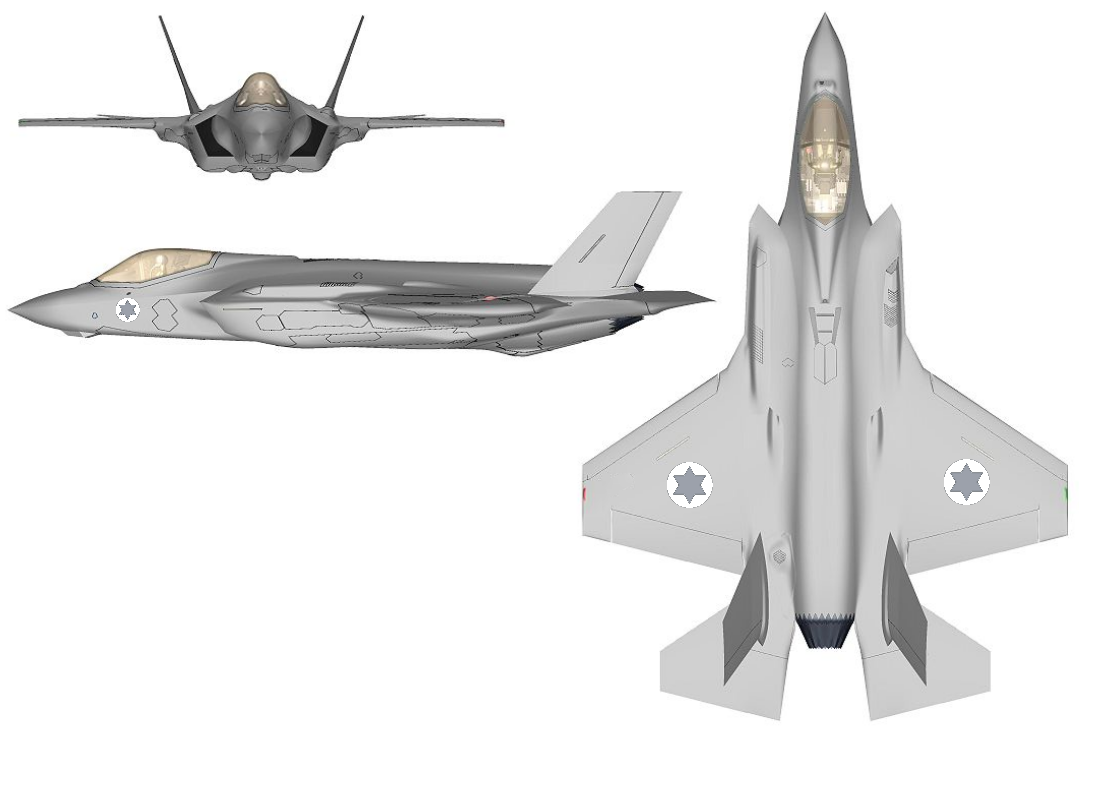
Three-view drawing
Multimedia


Elsewhere
Videos
Photos
- Flickr — Israeli Air ForceÁlbum oficial de la llegada de los F-35I «Adir» a Israel ↗
- Flickr — Israeli Air Force«The 3 Pillars»: tres F-35I Adir en formación ↗
- Flickr — Israeli Air Force«Better Together»: pareja de F-35I Adir ↗
- Flickr — Israeli Air Force«The Silence before Landing»: F-35I Adir en aproximación ↗
- Flickr — Israeli Air Force«First Step»: primer piloto israelí en el F-35I Adir ↗
- Flickr — Israeli Air Force«Two is a Company»: F-35I Adir sobre Israel ↗