Transport · Military · United States
Lockheed C-130 Hercules
- August 23, 1954
- First flight
- In service
- Status


-1600.webp)
-1600.webp)

-800.webp)
-1600.webp)


_(cropped)-1600.webp)

-1600.webp)
.jpg)


-1600.webp)


-1600.webp)

-1600.webp)


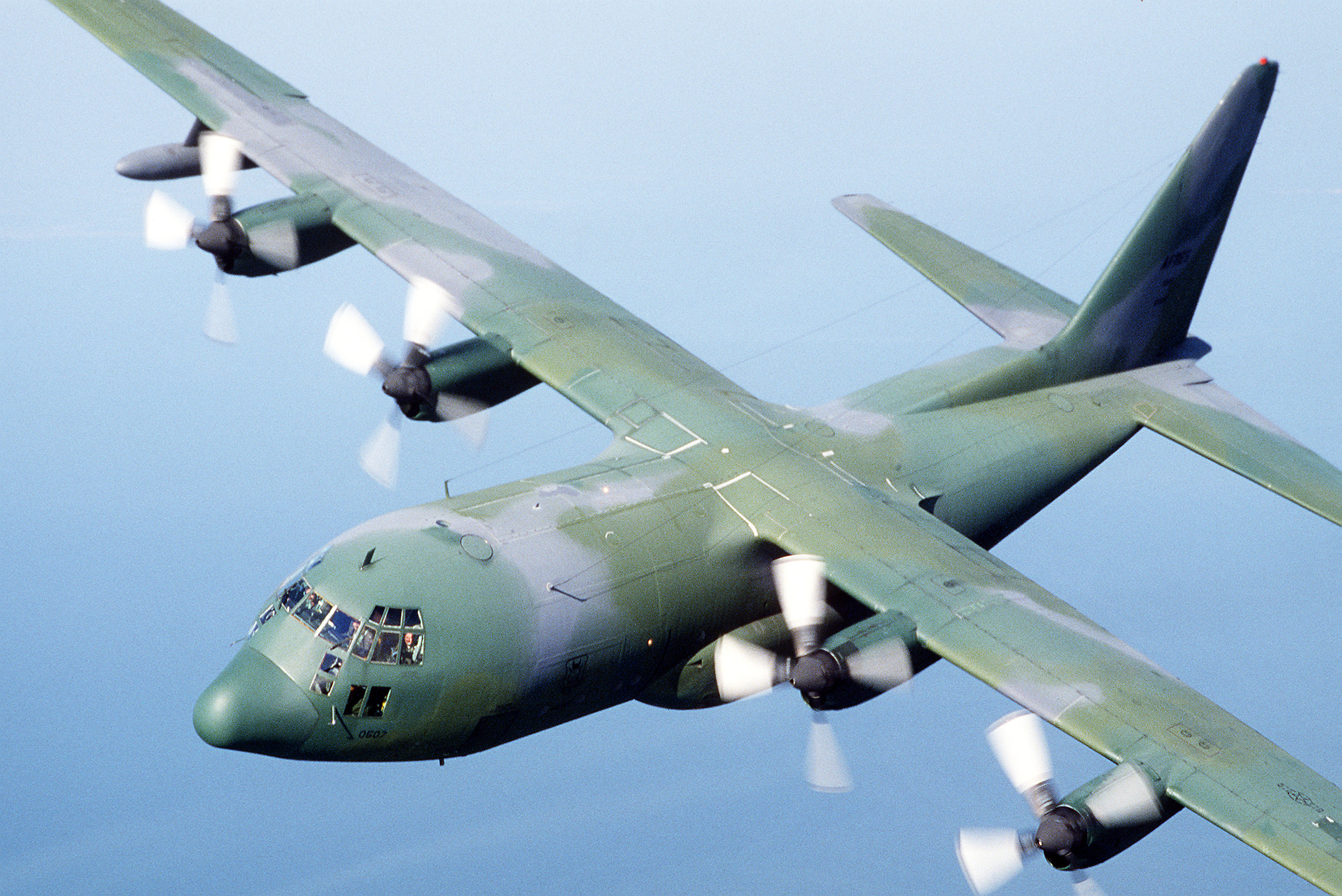
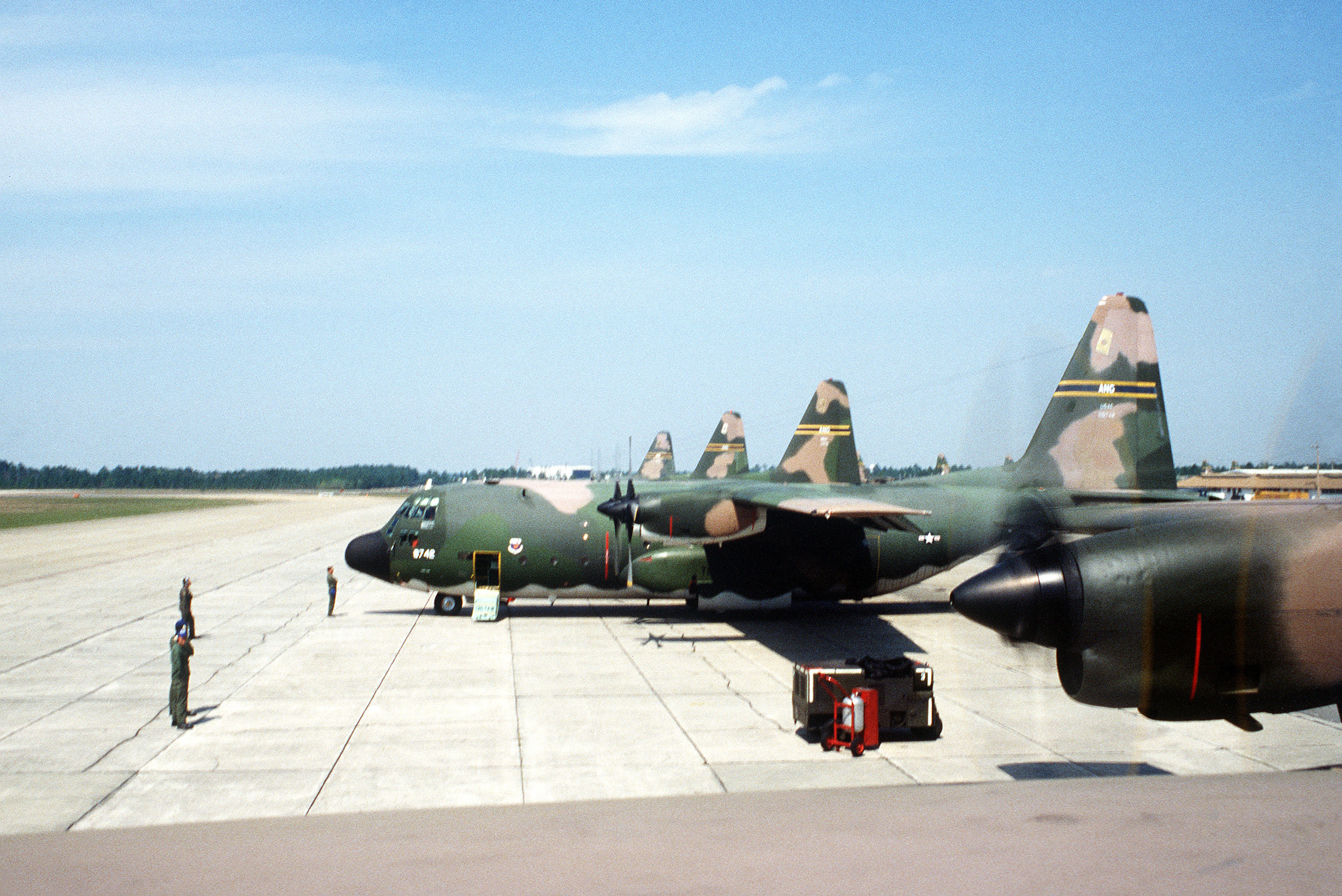
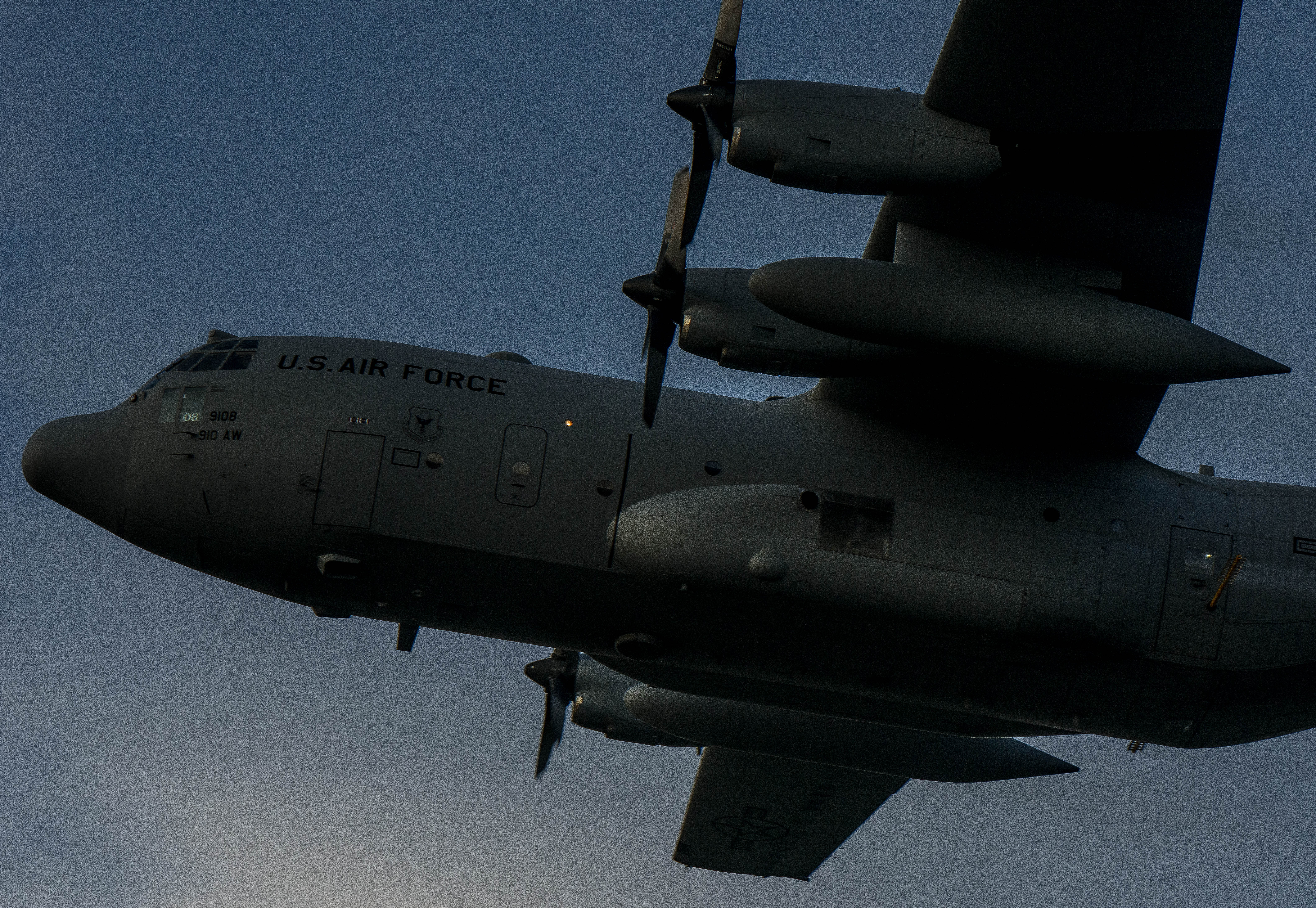
The Lockheed C-130 Hercules is an American four-engined turboprop military transport aircraft, designed and built by Lockheed (now Lockheed Martin), with a high wing and a rear loading ramp. Conceived to carry troops, cargo and casualties out of unprepared strips, it is the main tactical airlifter of many armed forces and the longest continuously produced military aircraft in the United States: in 2024 it reached seventy years of uninterrupted manufacture since 1954, with more than 2,700 examples built as of June that year. More than forty variants, including the civil versions marketed as the Lockheed L-100, operate in more than sixty nations. It was also the fifth aircraft to complete fifty years of continuous service with its original primary customer, the United States Air Force (USAF), on a date the consulted sources place either in December 2006 or in 2007. Its origin lies in the Korean War, which exposed the inadequacy of the piston-engined transports inherited from the Second World War (Fairchild C-119, Douglas C-47, Curtiss C-46). On 2 February 1951 the USAF issued a General Operating Requirement to nine manufacturers: it called for capacity for 92 passengers, 72 combat-equipped troops or 64 paratroopers and, unlike transports derived from airliners, an aircraft conceived from the outset as a combat transport loading through a hinged ramp at the rear of the fuselage. The greatest innovation was the powerplant: the Allison T56 turboprop, developed specifically for the aircraft, which offered far more power for its weight than a piston engine and greater range than a turbojet. Lockheed, with a design team led by Willis Hawkins, won the contract for the Model 82 on 2 July 1951. The YC-130 prototype flew on 23 August 1954 from Burbank, California, and series production moved to Marietta, Georgia, where over 2,300 aircraft had been built through 2009. The configuration has barely changed since — high wing, high-flotation landing gear for dirt strips, a rear ramp equally useful for driving vehicles aboard and for airdropping cargo — and the evolution played out in engines and avionics. The initial C-130A (deliveries from December 1956) was followed by the C-130B of 1959, with auxiliary tanks in the centre wing section and four-bladed propellers; the longer-legged C-130E of 1962, with external tanks; the C-130H, with T56-A-15 engines and a redesigned outer wing, in production until 1996 and still the most widespread model; and the C-130J Super Hercules, launched by a Royal Air Force order of December 1994 and the only version in production today, with new engines, six-bladed propellers and digital avionics: 500 delivered to 26 operators in 22 countries as of March 2022. The family of specialised versions has no equivalent. The AC-130 gunship, born in Vietnam for close air support; the EC-130 for electronic warfare, airborne command and psychological operations (Commando Solo, Compass Call); the MC-130 for special operations, infiltrating, exfiltrating and refuelling special-operations helicopters in flight; the HC-130 long-range search and rescue aircraft of the USAF and the Coast Guard; the KC-130 tanker of the Marine Corps; the WC-130 weather reconnaissance version, with which the 53rd Squadron's Hurricane Hunters fly into tropical cyclones; the ski-equipped LC-130, the largest aircraft in the world able to land on snow and ice and the mainstay of Operation Deep Freeze in Antarctica; and the firefighting role through the Modular Airborne Firefighting System, which temporarily turns a Hercules into a 3,000-gallon airtanker. On the civil side, the L-100 — a C-130E without military equipment — flew in 1964 and was delivered in 114 examples up to 1992, with the LM-100J succeeding it from 2017. Its service record covers almost everything: forward air control over Laos and North Vietnam; the 1976 Entebbe raid, in which four Israeli Hercules flew more than 2,200 nautical miles almost entirely below 100 ft; the failed Operation Eagle Claw in Iran in 1980; and the 21 unarrested landings made by a KC-130F aboard the carrier Forrestal in 1963, still the record for the largest and heaviest aircraft to operate from an aircraft carrier. Australia was the first foreign user, in 1958. That mix of ruggedness, reconfigurability and longevity explains why the Hercules — the "Herk" of military slang — remains the yardstick by which tactical airlift is measured.
Three-view drawing
_del_Lockheed_C-130_Hercules.png)
History
The Korean War, which broke out in June 1950, served as an involuntary proving ground for the transport fleet the United States had inherited from the Second World War, and the verdict was unambiguous: the piston-engined cargo aircraft of the previous generation were no longer adequate for the war actually being fought. The Douglas C-47 Skytrain, the Curtiss C-46 Commando and the Fairchild C-119 Flying Boxcar had all been excellent in their day — the first two were, in fact, military adaptations of 1930s civil designs — but Korea exposed their limits in a way that left no room for argument. They lacked payload, they lacked range, they lacked reliability from improvised strips and, above all, they lacked a design conceived around military use rather than adapted to it. An aeroplane laid out to carry passengers and later converted into a troop transport carries with it decisions that prove expensive in combat: the cargo floor sits too high above the ground, freight goes in through side doors sized for suitcases rather than vehicles, and a circular pressurised fuselage wastes useful volume exactly where it is most needed.
On 2 February 1951 the United States Air Force issued a General Operating Requirement for a new transport aircraft and circulated it among nine manufacturers: Boeing, Douglas, Fairchild, Lockheed, Martin, Chase Aircraft, North American, Northrop and Airlifts Inc. The document did not describe a better aeroplane; it described a different one. It called for a capacity of 92 passengers, 72 combat-equipped troops or 64 paratroopers, housed in a cargo compartment roughly 41 ft (12 m) long, 9 ft (2.7 m) high and 10 ft (3.0 m) wide. It called for loading and unloading through a hinged ramp at the rear of the fuselage rather than through side doors. It called for the ability to operate from unprepared runways, with Tactical Air Command — the command that would have to use it close to the front — squarely in mind. And it called for a payload of 11,340 kg. In writing, this was the definition of a combat transport designed as such from the first line of the drawing, not derived from anything else.
The rear ramp itself was not a new idea. German prototypes of the Second World War — the Junkers Ju 252 and the Ju 352, the latter named, aptly enough, Herkules — had pioneered its use on a military cargo aircraft, and within the American inventory the Boeing C-97 Stratofreighter already had rear ramps that made it possible to drive vehicles aboard, something also achievable through the forward ramp of the Douglas C-124. What was new was not the ramp but the combination: an integral rear ramp, a cargo floor at the height of a truck bed, and an unobstructed hold, free of structural intrusions, in an aircraft conceived from scratch around those three features. To that was added a second function that would eventually matter as much as the first: the future Hercules's ramp would serve not only for loading on the ground but for airdropping cargo in flight, including the low-altitude parachute-extraction system used to deliver Sheridan light tanks, and in due course large improvised "daisy cutter" bombs.
The other great leap in the requirement lay in propulsion. For a large aircraft, the adoption of a turboprop powerplant was a notable advance, and the engine chosen was the Allison T56, developed specifically for the C-130. The reasoning was twofold. Against a turbojet, the turboprop burned less fuel and therefore offered greater range, a decisive factor in an aircraft whose entire purpose is to carry things a long way. Against a piston engine, the turboprop delivered far more power for its weight, with corresponding gains in payload and take-off performance. The trade-off was a new and serious hazard: the turboprop configuration chosen for the T56, with the propeller connected to the compressor, had the potential to cause structural failure of the aircraft if an engine failed, because a windmilling propeller generates enormous and asymmetric drag. Safety devices had to be incorporated expressly to reduce that drag, and the requirement shaped the design from the outset.
Four of the nine manufacturers invited declined to take part: Fairchild, North American, Martin and Northrop stayed out of the competition of their own accord. The remaining five companies submitted ten design proposals — Lockheed two, Boeing one, Chase three, Douglas three and Airlifts Inc. one. The contest ultimately narrowed to a close race between the lighter of Lockheed's two submissions, the preliminary project designated L-206, and a four-turboprop design offered by Douglas. The detail is worth underlining because it explains a good deal of what followed: at that moment the USAF's transports were built by Fairchild, Boeing and Douglas — the houses with proven credentials in the field — and it was the least obvious bidder whose proposal prevailed.
Lockheed's design team was led by Willis Hawkins, and its starting point was a 130-page proposal for the Lockheed L-206. Hall Hibbard, Lockheed's vice president and chief engineer, read it and passed it to Kelly Johnson, the engineer behind the P-38 Lightning and the Constellation who would later direct the U-2 and SR-71 programmes. Johnson, whose professional instinct pointed invariably towards the fast and the sleek, did not care for the low-speed, unarmed aircraft, and left behind a remark that aviation history has taken care to repeat ever since: "If you sign that letter, you will destroy the Lockheed Company." Hibbard and Johnson signed the proposal anyway, and the company won the contract for the design now designated Model 82 on 2 July 1951. Johnson's judgement turned out to be one of the most celebrated misreadings in the industry: the aircraft he regarded as a commercial liability became the longest-running production line in the military business and a revenue stream that outlived nearly every fighter and reconnaissance programme he himself signed off.
In configuration, the Hercules bears a visible family resemblance to a larger, four-engined version of the Fairchild C-123 Provider, with a similar wing and cargo-ramp layout; the C-123 had in turn evolved from the Chase XCG-20 Avitruc glider, first flown in 1950. The architectural decisions behind Lockheed's new freighter followed one from another with a logic that looks obvious today and was not obvious then. The high wing freed the entire volume of the hold and left the cargo floor low, at truck-bed height, so a vehicle could be driven up the ramp without auxiliary platforms or cranes. That same high wing forced the main landing gear outside the fuselage, into lateral fairings, which in exchange kept the cargo section clear of wheel wells. The gear, soft in its travel, was sized to absorb the irregularities of unprepared strips. The hold was fully pressurised — unusual at the time in a tactical cargo aircraft — so that passengers, litters or troops could be carried without altitude restrictions and so that the aircraft could be reconfigured quickly between those roles. It was given large integral fuel tanks to extend range, a flight deck with excellent visibility for the crew, and the turboprop engines already described. The whole yielded an aircraft with a range of 1,100 nmi (1,270 mi; 2,040 km), able to operate from short and unprepared strips, and with performance that, combined with its short take-off and landing behaviour, placed it on a par in speed with the fighters of the Second World War. The basic structure was built in high-strength aluminium alloy, with some titanium components.
The first flight of the YC-130 prototype took place on 23 August 1954 from the Lockheed plant in Burbank, California. The flight lasted 61 minutes and ended at Edwards Air Force Base; Stanley Beltz and Roy Wimmer were at the controls, with Jack Real and Dick Stanton as flight engineers, and Kelly Johnson — the same man who had prophesied the company's ruin — flew chase in a Lockheed P2V Neptune. On the exact identity of the aircraft the sources disagree, and the disagreement is worth stating plainly: the English-language material gives serial number 53-3397, the second prototype built but the first of the two to fly, while the Spanish-language material describes it as "the first of the two YC-130 prototypes" and assigns it the number 53-3396; the same divergence affects the co-pilot's name, cited as Roy Wimmer in one source and Ray Wimmer in the other. What neither disputes is the date, the place and the impression the aircraft made: for the first time a transport aircraft combined in a single airframe a low floor at truck-bed height, soft landing gear for rough strips, a pressurised hold, large integral tanks, excellent cockpit visibility, turboprop engines and short-field performance of a kind not previously seen in an aircraft of that size.
Once the two prototypes were complete, production moved to Marietta, Georgia, where over 2,300 C-130s were built through 2009. The choice of Marietta had its own industrial genealogy: it was Government Plant No. 6, erected during the Second World War to build B-29 bombers and reopened afterwards by Lockheed to repair B-29s and to build the B-47 Stratojet. Lockheed Martin marked the Marietta site's 75th anniversary as a U.S. Center for Manufacturing Excellence in June 2026, placing the start of the facility under its stewardship in 1951, the same year as the Model 82 contract. The first production C-130A, serial 53-3129 and company designation Model 182, rolled out of Marietta on 7 April 1955.
The move from prototype to series brought a good many changes with it. The fuselage and tail were modified, the rear section given a squarer shape; radar was installed in the nose; provision was made for JATO/RATO rocket-assisted take-off; and more powerful T56-9 engines were fitted. On the designation of the radar carried by those early production aircraft the materials do not agree: one cites the APS-59 when describing the production changes, while another mentions an AN/APN-59 navigation radar in the nose of the H model, so the point is recorded here with the discrepancy declared and without choosing between the two forms. What is certain is the visible effect of the nose's evolution: the early production A model at first retained the blunt nose of the prototypes and later adopted the elongated radar profile known as the "Roman nose", now all but extinct — C-130A serial 54-1632, the twenty-first airframe built and privately owned, stored at Tucson, Arizona, near Davis-Monthan AFB, is said to be the only survivor still carrying that early nose.
The initial production model, the C-130A, was powered by Allison T56-A-9 turboprops driving three-bladed Aero Products propellers; the official USAF fact sheet gives the designation as T56-A-11 or -9, without the materials clarifying the exact split between sub-variants. A total of 219 were ordered and deliveries began in December 1956, continuing until the C-130B appeared in 1959. The first production batch of C-130As went from 1956 to the 463d Troop Carrier Wing at Ardmore Air Force Base, Oklahoma, and the 314th Troop Carrier Wing at Sewart AFB, Tennessee. Six further squadrons were assigned to the 322d Air Division in Europe and the 315th Air Division in the Far East. Additional aircraft were modified for electronic intelligence work and posted to Rhein-Main Air Base in Germany, while modified RC-130As went to the photo-mapping division of the Military Air Transport Service. The C-130A's entry into USAF service is dated December 1956.
The aircraft's first serious limitation did not take long to appear. As the C-130A became operational with Tactical Air Command, its lack of range became apparent, and the fix was to add fuel capacity by means of wing pylon-mounted tanks outboard of the engines: 6,000 lb (2,700 kg) of additional fuel, for a total capacity of 40,000 lb (18,000 kg). Some A models were fitted with skis and redesignated C-130D, opening a line of work that deserves detail. In January 1957 Lockheed made the first flight of a C-130A — serial 55-0021 — modified with a ski-wheel configuration able to operate both from conventional runways and from snow- or ice-covered surfaces. In February, Task Force Slide began at Bemidji, Minnesota, to develop, test and validate the procedures for what would become the C-130D; the flights were conducted on the frozen surfaces of nearby lakes and included rocket-assisted take-offs. Task Force Slide continued into 1958, and by the end of that year twelve modified C-130As, now designated C-130D, had been delivered to the 61st Troop Carrier Squadron to support construction of two DEW Line radar sites on the Greenland ice cap. The C-130B was developed to complement the A models already delivered, and it brought substantial novelties. The chief one was increased fuel capacity in the form of auxiliary tanks built into the centre wing section, accompanied by an AC electrical system. Four-bladed Hamilton Standard propellers replaced the three-bladed Aero Products units that had distinguished the earlier A models, and those four blades remained standard until the arrival of the J model decades later. The ailerons were now operated by hydraulic pressure raised from 2,050 to 3,000 psi (14.1 to 20.7 MPa), and the engines were uprated: the official USAF fact sheet identifies the B's powerplant as the Allison T56-A-7. A total of 134 were ordered and the model entered USAF service in May 1959.
The B came close to introducing a technology that would have changed the aircraft's profile. It was originally intended to have "blown controls", a system that blows high-pressure air over the control surfaces to improve their effectiveness in slow flight. It was tested on an NC-130B prototype fitted with a pair of T-56 turbines supplying high-pressure air through a duct system to the control surfaces and flaps during landing. The results were spectacular on one half of the problem: landing speed dropped to just 63 knots and landing distance was cut in half. The system never entered service because it did not improve take-off performance by the same margin, and extraordinary landing performance is operationally pointless if the aircraft cannot then take off again from where it has just come to rest. That line of work also left behind the C-130B BLC, a one-off conversion of airframe 58-0712 fitted with a double Allison YT56 gas-generator pod under each outer wing to supply bleed air to all the control surfaces and flaps.
The C-130B also yielded an electronic-reconnaissance variant designated C-130B-II, of which thirteen aircraft were converted. It was distinguished by false external wing fuel tanks that were in fact disguised signals-intelligence receiver antennas; those pods were slightly larger than the standard wing tanks found on other C-130Bs. Most also carried a swept-blade antenna on the upper fuselage, plus extra wire antennas between the vertical fin and the upper fuselage found on no other C-130. The radio call numbers painted on these aircraft's tails were changed regularly to confuse observers and disguise their true mission. It is a minor episode in the type's history, but an early and revealing one: barely four years after the A entered service, the Hercules airframe was already being used for work that had nothing to do with carrying freight.
The extended-range C-130E entered service in 1962 — the official USAF fact sheet specifies August 1962 — having been developed as an interim long-range transport for the Military Air Transport Service. It was essentially a B model, and the new designation reflected the installation of external fuel tanks under the midsection of each wing and more powerful Allison turboprops. Here the materials disagree on two points that are better declared than silently resolved: on the capacity of those tanks, one source gives 1,360 U.S. gallons (5,100 litres) each and another 1,290 U.S. gallons (4,900 L; 1,070 imp gal); and on the engine, one source specifies the Allison T56-A-7A while the USAF fact sheet maintains that the E used the same T56-A-7 as the B. What is not disputed is the effect of the added weight in mid-span: the hydraulic boost pressure to the ailerons had to be reduced back to the 2,050 psi (14.1 MPa) of the A model. The E further incorporated structural improvements, avionics upgrades and a higher gross weight. A total of 389 were ordered. Australia took delivery of twelve C-130Es during 1966–67 to supplement the twelve C-130As already in service with the Royal Australian Air Force. Sweden and Spain fly the TP-84T version of the C-130E, fitted for aerial refuelling.
Alongside the pure transport series, the tanker branch opened up. The KC-130s, originally procured as C-130Fs for the U.S. Marine Corps in 1958 under the designation GV-1, are equipped with a removable 3,600 U.S. gallon (14,000 L) stainless steel fuel tank carried inside the cargo compartment. The two wing-mounted hose-and-drogue refuelling pods each transfer up to 300 U.S. gallons per minute (1,100 L/min) and allow two aircraft to be refuelled simultaneously, which translates into rapid cycle times even with large formations: a typical tanker formation of four aircraft can be refuelled in under thirty minutes. The Navy's C-130G, for its part, received increased structural strength for higher-gross-weight operation.
The model that defined the Hercules for decades was the C-130H. It carried updated Allison T56-A-15 turboprops, a redesigned outer wing, updated avionics and other minor improvements. Later H models incorporated a new centre wing with improved fatigue life, subsequently retrofitted to many earlier H airframes; for structural reasons some aircraft are required to land with reduced fuel when carrying heavy cargo, which cuts usable range. On the H's introduction dates the materials offer two readings, both set out here: the encyclopaedic text places initial deliveries in 1964, with the Royal New Zealand Air Force as the launch customer, and its own variant index dates the introduction to June 1964, whereas the official U.S. Air Force fact sheet dates to June 1974 the arrival of the first of the 308 C-130Hs ordered by the USAF. The two figures may refer to different things — the model's entry into service as against its entry into the American inventory — but since the materials do not say so, the discrepancy is declared rather than resolved.
The H remained in production until 1996, and that longevity explains its status as the type's workhorse. An aircraft built without interruption for more than thirty years accumulates an enormous fleet, a mature logistics base, a settled employment doctrine and a body of aircrew trained on it; to which must be added that the H combined, already in its baseline definition, the power of the T56-A-15 with a revised wing and modern avionics — precisely the set of improvements that the A and the B had been demanding through operational experience. The C-130Hs produced between 1992 and 1996 were designated C-130H3 by the USAF, the "3" denoting the third design variation of the H series; their improvements included ring laser gyros for the inertial navigation system. The equivalent model for export to the United Kingdom is the C-130K, known in Royal Air Force service as the Hercules C.1; the stretched version, the C-130H-30, is the Hercules C.3 in British service. These cross-cutting designations, which would multiply over the years, are a symptom of what was happening: the Hercules had ceased to be a USAF aeroplane and had become the standard tactical transport of much of the Western world, each operator applying its own nomenclature to it.
It is worth setting out in detail what the aircraft was like in its most widespread form, the C-130H, because the figures explain better than any adjective why a design from 1951 remained competitive forty years later. The basic crew is five: two pilots, a navigator or combat systems officer, a flight engineer and a loadmaster. Allowable payload reaches 42,000 lb (19,000 kg). The hold of the C-130E, H and J measures 40 ft (12.19 m) long, 9 ft 11 in (3.02 m) wide and 9 ft (2.74 m) high, with a rear ramp 123 in (3.12 m) long and 119 in (3.02 m) wide — the USAF fact sheet gives a hold length of 41 ft and the Spanish-language material 12.50 m long by 3.14 m wide and 2.74 m high at its lowest point, differences of about half a metre that probably reflect different measuring conventions and are recorded here as they stand. Into that volume fit 92 passengers, or 64 paratroopers, or 74 litter patients with five medical crew, or six pallets, or two to three Humvees, or two M113 armoured personnel carriers, or one CAESAR self-propelled howitzer.
The C-130H's external dimensions are 97 ft 9 in (29.79 m) long, 132 ft 7 in (40.41 m) in span and 38 ft 3 in (11.66 m) high, with a wing area of 1,745 sq ft (162.1 m²); the aerofoil is a NACA 64A318 at the root and a NACA 64A412 at the tip. Empty weight is 75,800 lb (34,382 kg) and maximum take-off weight 155,000 lb (70,307 kg). The powerplant consists of four Allison T56-A-15 turboprops of 4,590 shaft horsepower (3,420 kW) each according to the encyclopaedic data, a figure the official USAF fact sheet rounds to 4,591 and the Spanish-language material raises to 4,910 CV, a discrepancy noted here. The propellers are four-bladed Hamilton Standard 54H60 units, constant-speed, fully feathering and reversible, 13 ft 6 in (4.11 m) in diameter; reverse pitch is one of the elements behind the aircraft's landing distances.
In performance, the C-130H reaches a maximum speed of 320 kn (370 mph, 590 km/h) at 20,000 ft (6,100 m) and cruises at 292 kn (336 mph, 541 km/h); the USAF fact sheet puts the H's speed at 366 mph, 318 ktas, Mach 0.52 at 20,000 ft, against 345 mph and 300 ktas for the E. Range is 2,050 nmi (2,360 mi, 3,800 km), and ferry range reaches 3,995 nmi (4,597 mi, 7,399 km). Service ceiling is 33,000 ft (10,000 m) empty and 23,000 ft (7,000 m) with a 42,000 lb (19,000 kg) payload, against the C-130E's 19,000 ft with that same load: the 4,000 ft difference between E and H at identical weight is the cleanest measure of what the T56-A-15 contributed. Rate of climb is 1,830 ft/min (9.3 m/s). The avionics of later airframes include the Westinghouse Electronic Systems AN/APN-241 weather and navigational radar.
The runway figures are the ones that explain the aircraft's tactical role and that justify, in retrospect, every decision taken in 1951. The C-130H's take-off distance is 3,586 ft (1,093 m) at the maximum gross weight of 155,000 lb (70,307 kg), but falls to 1,400 ft (427 m) at a gross weight of 80,000 lb (36,287 kg). Translated into the real mission, a C-130H can carry up to 19,686 kg of cargo over 2,298 km; with a 45-minute fuel reserve and landing fully loaded in 1,300 m, a 900 kg load allows the landing distance to be reduced to 850 m. The USAF fact sheet adds the breakdown by model: at maximum normal payload — 36,500 lb (16,590 kg) for both the E and the H — range is 1,000 nautical miles for the E and 1,050 for the H; with a 35,000 lb payload, 1,250 and 1,300 nautical miles respectively. And the cost figures give the other measure of the programme: 11.9 million dollars for the C-130E and 30.1 million for the C-130H, in then-year fiscal 2017 dollars.
The result of all of the above is an aircraft the Air Force describes, without exaggeration, as rapidly reconfigurable for widely differing cargo types — palletised equipment, floor-loaded material, airdrop platforms, container delivery system bundles, vehicles and personnel, or aeromedical evacuation — and one originally conceived as a troop, cargo and medical evacuation transport. That this versatile airframe would go on to serve as well for close air support, airborne assault, search and rescue, scientific research support, weather reconnaissance, aerial refuelling, maritime patrol and aerial firefighting was not in the 1951 requirement, but it follows from it: a wide-section pressurised fuselage with a rear ramp, an unobstructed high wing and the ability to operate where there is no airport is, above all, a flying container into which almost anything can be put.
The Air Force issued the original design specification in 1951, and the aircraft was still in production seventy-five years later. In 2007 the C-130 became the fifth aircraft in history to mark fifty years of continuous service with its original primary customer, which in its case is the United States Air Force, and in 2024 it reached seventy years of continuous production, a record that makes it the longest continuously produced military aircraft. More than forty variants of the Hercules, including the civil versions marketed as the Lockheed L-100, operate in more than sixty nations, and the Marietta line that began in 1955 with 53-3129 had delivered more than 2,300 airframes by 2009 alone. When the C-130A entered service in December 1956 none of that was written, and it was certainly not what Lockheed's own chief engineering talent expected. What was written was the requirement of February 1951, and the aircraft's subsequent career is, in large measure, the story of a specification that got it right.
Deliveries of the first production batch of C-130A began in 1956, going to the 463d Troop Carrier Wing at Ardmore Air Force Base, Oklahoma, and the 314th Troop Carrier Wing at Sewart AFB, Tennessee. Six further squadrons were assigned to the 322d Air Division in Europe and the 315th Air Division in the Far East, additional aircraft were modified for electronic intelligence work and based at Rhein-Main Air Base in Germany, and modified RC-130As went to the photo-mapping division of the Military Air Transport Service. The type formally entered USAF service in December 1956. That initial distribution already described the life the aircraft would lead: a tactical transport spread across every theatre and, at the same time, the airframe reached for whenever a mission needed something large, rugged and comparatively cheap. The cost of that ubiquity arrived early. In 1958 a reconnaissance C-130A-II of the 7406th Support Squadron was shot down over Armenia by four Soviet MiG-17s while flying a routine mission along the Turkish-Armenian border. Australia became the first non-American operator, with twelve aircraft delivered from late 1958, and the Royal Canadian Air Force followed with four B-models — Canadian designation CC-130 Mk I — in October and November 1960.
In 1963 the Hercules set a record it still holds: largest and heaviest aircraft ever to land on an aircraft carrier. During October and November of that year a US Marine Corps KC-130F (BuNo 149798), lent to the US Naval Air Test Center, made twenty-nine touch-and-go landings, twenty-one unarrested full-stop landings and twenty-one unassisted takeoffs aboard USS Forrestal at a range of different weights. The pilot, Lieutenant — later Rear Admiral — James H. Flatley III, was awarded the Distinguished Flying Cross for the trials. They were highly successful, yet the aircraft was never deployed that way. Flatley denied that the C-130 had been tested for carrier onboard delivery or for delivering nuclear weapons; the intention, he said, was to support the Lockheed U-2, which was also being trialled from carriers. The aircraft flew on with Marine Aerial Refueler Squadron 352 until 2005 and now belongs to the collection of the National Museum of Naval Aviation at NAS Pensacola, Florida. The sources disagree on the detail: the English-language material places the trials across October and November 1963 and distinguishes twenty-nine touch-and-go passes from twenty-one full-stop landings, while the Spanish-language material dates the selection of the carrier to 3 October 1963, places the ship some 500 miles off the Atlantic coast near Boston, describes a pitching deck and 40-knot winds, and simply credits Flatley with twenty-nine full-stop landings and takeoffs.
Vietnam turned the Hercules into the backbone of intra-theatre tactical airlift. It carried troops, ammunition, fuel and supplies between the main bases of Southeast Asia and the dirt strips inland, and with it the delivery techniques that avoided landing on a field under fire became routine: parachute drops of troops, the low-altitude parachute extraction system for heavy loads — the aircraft skimming the strip while a drogue chute pulled the pallet off the ramp — and conventional container drops. The material consulted records C-130B crews performing a LAPES delivery in Vietnam in 1967 but does not describe specific resupply operations to besieged garrisons, so none are attributed here. What the record does show is the sheer wear: the A-models of the four squadrons at Naha Air Base, Okinawa, and of the squadron at Tachikawa Air Base, Japan, carried the campaign from beginning to end.
From 1964, C-130 crews of the 6315th Operations Group at Naha began forward air control missions — known as FAC or Flare — over the Ho Chi Minh Trail in Laos in support of USAF strike aircraft. In April 1965 the mission was extended to North Vietnam, where C-130 crews led formations of Martin B-57 Canberra bombers on night reconnaissance and strike missions against the communist supply routes running south. In early 1966 Project Blind Bat/Lamplighter was established at Ubon Royal Thai Air Force Base in Thailand; after the move to Ubon the task became a four-engined forward air control mission in which the Hercules crew hunted for targets, marked them with flares and called in the strike aircraft. Less well known was Operation Commando Scarf, also called Commando Lava, flown by the Naha-based crews: it delivered chemicals onto stretches of the Ho Chi Minh Trail in Laos, intended to produce mud and landslides and make the truck routes impassable. The same A-models flew the Fact Sheet leaflet mission over Laos and North Vietnam and highly classified special-operations sorties.
In October 1968, C-130Bs of the 463rd Tactical Airlift Wing dropped a pair of M-121 bombs of 10,000 pounds (4,500 kg), weapons developed for the enormous Convair B-36 Peacemaker that had never been used. The US Army and the Air Force revived them as a means of clearing helicopter landing zones out of the jungle, and in early 1969 the 463rd began flying Commando Vault missions. Although the stated purpose was to open landing zones, the M-121s were also used against enemy base camps and other targets. It is the first chapter in a lasting relationship between the Hercules and very large bombs rolled off a ramp — a task no fighter could take on, and one that made a transport into a weapons carrier.
The Hercules also appeared in episodes far from Southeast Asia that shaped its reputation. In November 1964, C-130Es of the 464th Troop Carrier Wing on loan to the 322d Air Division in France took part in Operation Dragon Rouge in the former Belgian Congo. After communist Simba rebels seized the white residents of Stanleyville as hostages, the United States and Belgium mounted a joint rescue in which the C-130s dropped, airlanded and airlifted a force of Belgian paratroopers. Two missions were flown, one over Stanleyville and another over Paulis, during Thanksgiving week, and the result was the first award of the MacKay Trophy to C-130 crews. In the Indo-Pakistani War of 1965, No. 6 Transport Squadron of the Pakistan Air Force modified its C-130Bs as bombers carrying up to 20,000 pounds (9,100 kg) of palletized bombs rolled out of the cargo bay; the improvised bombers struck Indian bridges, heavy artillery positions, tank formations and troop concentrations, though with little success overall.
Late in the decade, American anxiety about the Chinese nuclear programme produced one of the strangest missions in the type's history. After the Black Cat Squadron failed to plant sensor pods near the Lop Nur nuclear test base using a U-2, the CIA devised a plan called Heavy Tea to deliver two battery-powered sensor pallets near the site. A Black Bat Squadron crew was trained in the United States to fly the Hercules, and on 17 May 1969 twelve men led by Colonel Sun Pei Zhen took off from Takhli Royal Thai Air Force Base in an unmarked USAF C-130E. After six and a half hours of low-altitude flight in darkness they reached the target and parachuted the pallets near Anxi in Gansu province; another six and a half hours at low level brought them back to Takhli. The sensors worked, uploading data to a US intelligence satellite for six months until their batteries failed, and during that period China conducted two nuclear tests, on 22 and 29 September 1969. A follow-up mission, Operation Golden Whip, was planned and then cancelled in 1970. The aircraft used was most probably C-130E serial 64-0506 or 64-0507, both delivered to Air America in 1964 and returned to the USAF later, at which point they were given the serials of two C-130Es destroyed in accidents — 62-1843, lost in Vietnam on 20 December 1965, and 63-7785, lost on 17 June 1966 — to disguise their classified origins.
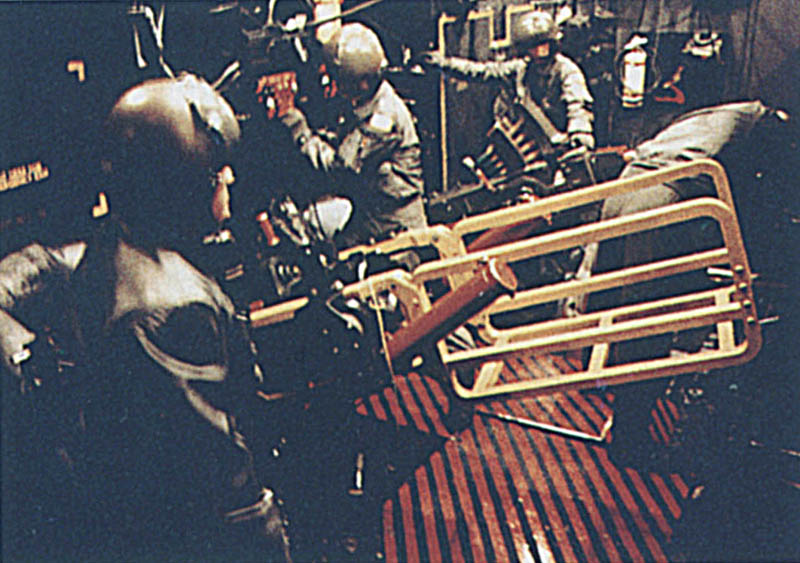
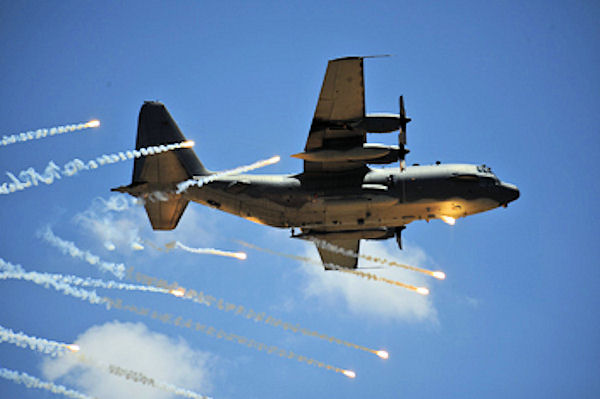
The most influential Vietnam chapter, however, was the birth of the gunship. During the war the C-130 was selected to replace the Douglas AC-47 Spooky — Project Gunship I — in order to improve mission endurance and increase the capacity for munitions. The AC-47 had proved that a transport that could fly faster than a helicopter, higher, and loiter far longer could use the pylon turn to place continuous, accurate fire on a single point of ground. In 1967 the JC-130A serial 54-1626 was chosen for conversion into the AC-130A prototype, Project Gunship II. The work was done at Wright-Patterson AFB by the Aeronautical Systems Division: a direct-view night-vision telescope was installed in the forward door, an early forward-looking infrared set in the front of the left wheel well, and Miniguns and rotary cannon were fixed to fire downward and aft along the left side. The prototype fire-control computer was hand-built by Wing Commander Tom Pinkerton at the USAF Avionics Laboratory. Flight testing took place largely at Eglin AFB, and in September 1967 the aircraft was certified ready for combat testing and flown to Nha Trang Air Base in South Vietnam for a ninety-day programme. The AC-130 was later supplemented by the AC-119 Shadow, Gunship III, which proved underpowered.
The gunship arrived in South Vietnam on 21 September 1967 and began combat operations over Laos and South Vietnam that year. In June 1968, AC-130s deployed to Tan Son Nhut Air Base outside Saigon in response to the Tet Offensive. On 18 August 1968 a gunship flying an armed reconnaissance mission in III Corps was diverted in support of the Katum Special Forces Camp; the ground commander, having watched the accuracy of the weapon, eventually called for fire onto his own perimeter as the Viet Cong tried to breach the wire on the western side. By 30 October 1968 there were enough Gunship IIs in the theatre to form a squadron, the 16th Special Operations Squadron, assigned to the 8th Tactical Fighter Wing at Ubon Royal Thai Air Force Base; it was then that the C-130A gunship formally became the AC-130A. By December 1968 most AC-130s flew escorted by F-4 Phantom IIs of the 497th Tactical Fighter Squadron, typically three fighters per gunship, against an increasingly dense air-defence environment. The first Spectre lost to enemy fire went down on 24 May 1969.
Technical development was continuous and always aimed at the same problem: finding trucks under jungle canopy at night. In late 1969 aircraft 56-0490 arrived in theatre under the name Surprise Package, carrying solid-state laser-illuminated low-light-level television with an associated YAG laser designator, improved forward-looking infrared, video recording for both television and infrared, an inertial navigation system and a prototype digital fire-control computer. The rest of the fleet received similar improved equipment in the summer of 1970 before returning to Ubon. Seven airframes had been converted in 1968 to the original "Plain Jane" configuration; ten more AC-130As were acquired in 1970 under Project Pave Pronto, and the Surprise Package aircraft were brought up to Pave Pronto standard in the summer of 1971 under the new nickname "Thor". Conversion of C-130Es into AC-130Es gave rise to Project Pave Spectre, and the first "Cadillac" AC-130E reached Vietnam on 25 October 1971. Among the Pave Pronto modifications the most distinctive was Black Crow, designated AN/ASD-5: a highly sensitive magnetic anomaly detector with a phased-array antenna housed in a radome on the left front of the nose, originally conceived for finding submerged submarines and here slaved to the AC-130A/E/H targeting computers, able to pick up the unshielded ignition coils of North Vietnamese trucks hidden under the foliage and even the emissions from the hand-held transmitters of ground controllers. The armament reached its peak on 17 February 1972 with the arrival of the first 105 mm cannon, installed on Gunship 570 and used from mid-February until the aircraft took battle damage to its right flap; the gun was then moved to Gunship 571 and remained in use until that aircraft was shot down on 30 March.
The Vietnam peace accord of 28 January 1973 ended Spectre operations in the country but not in the region: the gunships continued to support operations in Laos and Cambodia, and from 22 February 1973, when US offensive operations in Laos ceased, they were devoted entirely to the Cambodian conflict. On 12 April 1975, with the Khmer Rouge closing on Phnom Penh, AC-130s supported Operation Eagle Pull, the final evacuation of American and allied officials from the capital; on 30 April they were over Saigon covering the final evacuation in Operation Frequent Wind; and on 15 May they were called out again when the Khmer Rouge seized the merchant ship USS Mayaguez at sea. The war cost the gunship force six AC-130s and fifty-two aircrew; against that, the type is credited with destroying more than ten thousand trucks and with a very large number of critical close air support missions. In parallel, the A-model served to the end of the conflict and was handed to the Republic of Vietnam Air Force under the Vietnamization programme, equipping three squadrons based at Tan Son Nhut. As the war wound down, the B-models of the 463rd and the A-models of the 374th Tactical Airlift Wing went home to the United States, most of them to Air Force Reserve and Air National Guard units.
The second great line of specialization also grew out of the war: the clandestine penetration aircraft. The Combat Talon was developed between December 1964 and January 1967 by Lockheed Air Services at Ontario, California, following a study by Big Safari, the USAF programme office that modifies and sustains special-mission aircraft. Two highly classified testbeds — originally serials 64-0506 and 64-0507, with all numbers sanitized from the airframes — were assigned to Project Thin Slice to develop a low-level clandestine penetration aircraft for special forces operations in Southeast Asia; the order to adapt the C-130E came in 1964 after six C-123B Providers modified for unconventional warfare under Project Duck Hook proved inadequate for the newly created MACV-SOG. The modifications under Thin Slice and its August 1966 successor Heavy Chain were code-named Rivet Yard, and the four C-130Es involved became known as "Yards". Meanwhile, fourteen C-130Es were bought for SOG in 1965 for similar modification: they left the Marietta line as standard production aircraft, received the Fulton surface-to-air recovery system at a rate of three a month, were ferried to Greenville, Texas, for painting by Ling-Temco-Vought Electrosystems with a low-radar-reflective finish that added 168 kg (370 lb) to their weight — the velvet black-and-green scheme earning them the nickname "Blackbirds" — and returned to Ontario for the electronics package code-named Rivet Clamp, whence the aircraft became known as "Clamps". The whole family was given the designation Combat Talon in 1967.
The electronics defined the aircraft as much as the paint. The Rivet Clamps, originally designated C-130E(I)sp, carried an electronic and infrared countermeasures suite and the SPR2, later the AN/APQ-115 multimode radar, adapted from the Texas Instruments AN/APQ-99 of the RF-4C photo-reconnaissance Phantom, with terrain-following, terrain-avoidance and mapping modes that allowed the aircraft to work at low level, at night and in any weather while avoiding known enemy radars and antiaircraft concentrations. From 1970, Texas Instruments and Lockheed Air Service adapted the AN/APQ-122 of the Adverse Weather Aerial Delivery System with terrain-following modes to replace the AN/APQ-115, whose mean time between failures was unacceptable throughout its life; coupled to the Litton LN-15J inertial navigation system and known as MOD-70, the new radar was fitted to all twelve operational Combat Talons and the four Heavy Chain testbeds between 1971 and 1973, and remained in service until the late 1980s. After MOD-70 the fleet was split into three designations: C-130E(CT) for the Clamps, C-130E(Y) for the Yanks — formerly Yards — and C-130E(S) for the Swaps. In 1977 Headquarters Air Force consolidated all three as the MC-130E, and in 1984, with the authorization to modify twenty-four C-130Hs to Combat Talon II standard, the original aircraft became the Combat Talon I.
Nothing did more for the Talon's legend than the Fulton surface-to-air recovery system, used to extract people and material without landing. A large helium balloon lifted a nylon line into the air, where it was snagged by a large scissors-shaped yoke mounted on the aircraft's nose; the yoke caught the line, released the balloon and pulled the attached load off the ground with a shock less than that of an opening parachute. A sky anchor secured the line, and wires stretched from the nose to both wing leading edges protected the propellers on missed snag attempts. The crew hooked the line as it trailed behind the aircraft, attached it to the hydraulic winch and drew the person or cargo in through the rear cargo door. After a death on 26 April 1982 at CFB Lahr in Germany, the Fulton system on the Clamp aircraft was subjected to intense maintenance scrutiny and live pickups were suspended; a major upgrade effort, Project 46, ran from 1986 to 1989, but at its conclusion the suspension of live extractions remained in force, and in 1998 the Fulton equipment was removed from every Combat Talon.
The aircraft earmarked for Combat Talon modification were assigned in July 1965 to the 464th Troop Carrier Wing at Pope Air Force Base, North Carolina, though a shortage of ramp space caused by the build-up for South Vietnam meant they were temporarily housed at Sewart AFB, Tennessee. The wing's 779th Troop Carrier Squadron was designated the training squadron for the modified C-130E(I)s under Project Skyhook, alongside its normal airlift role, and six crews were prepared for deployment to Vietnam under Project Stray Goose. The Combat Talon I first saw action on 1 September 1966, when the six Stray Goose crews deployed to Ching Chuan Kang Air Base in Taiwan and forward to Nha Trang Air Base in South Vietnam. That deployment, known as Combat Spear, preceded the European (Combat Arrow) and American (Combat Knife) deployments. Administratively it was Detachment 1, 314th Troop Carrier Wing, but it answered operationally to MACV-SOG; on 9 October 2009 the detachment received the Presidential Unit Citation for its support of SOG activities, the culmination of a six-year campaign by a former Stray Goose member after the unit had been left out of an earlier citation. The detachment was redesignated the 15th Air Commando Squadron on 15 March 1968 and the 15th Special Operations Squadron on 1 August of that year, within the 14th Special Operations Wing. In Vietnam the aircraft dropped leaflets over North Vietnamese positions and inserted and resupplied special forces and indigenous units across Southeast Asia, flying unescorted, at night and at low altitude. By 1970 twelve Combat Talons were operational in three four-aircraft units: the 7th Special Operations Squadron at Ramstein Air Base in Germany, the 15th at Nha Trang, and Detachment 2 of the 1st Special Operations Wing at Pope, redesignated 318th SOS in 1971 and 8th SOS in 1974. The 15th SOS became the 90th SOS on 23 October 1970, moved to Cam Ranh Bay and then in April 1972 to Kadena Air Base, Okinawa, as part of the American drawdown, and was redesignated the 1st SOS on 15 December 1972.
The Son Tay raid of 21 November 1970 was the purest demonstration of what the aircraft existed for. Two Combat Talons served as navigation escorts and airborne control during Operation Kingpin, the operational phase of the attempted rescue of prisoners of war from the Son Tay camp in North Vietnam: 64-0523, drawn from the 15th SOS at Nha Trang, and 64-0558 from Detachment 2 of the 1st SOW at Pope. Both were modified at Lockheed Air Services in Ontario with FL-2B forward-looking infrared sets borrowed from the Heavy Chain project, to compensate for the terrain-following difficulties created by the slow speeds imposed by a mixed force of helicopters and fixed-wing aircraft. Twenty-four primary and five backup crew members, all Stray Goose and Combat Spear veterans detached from the 7th SOS and the 1st SOW, worked out helicopter and fixed-wing formation procedures for low-level night missions and trained jointly with selected special forces volunteers at Eglin AFB. Between the end of August and 28 September 1970, Talon, helicopter and A-1 Skyraider crews supervised by the Combat Talon programme manager, Lieutenant Colonel Benjamin N. Kraljev, rehearsed the flight profile in terrain-following missions over southern Alabama, flying 368 sorties totalling more than a thousand hours, followed by a month of intensive joint training at a full-scale replica of the prison camp. In early November the task force deployed to Takhli Royal Thai Air Force Base. The mission was flown by a 7th SOS crew under Major Irl L. "Leon" Franklin, call sign Cherry 01, and a 1st SOW crew commanded by Lieutenant Colonel Albert P. "Friday" Blosch, Cherry 02. It was executed without the loss of a single man, and it failed: the prison held no prisoners.
The end of the war nearly killed the programme. In 1974, as the Air Force sought to reverse the special-operations emphasis inherited from Vietnam, the Combat Talon was close to being dismantled: the 1st Special Operations Wing was redesignated the 834th Tactical Composite Wing and the 8th SOS Talons became a Tactical Air Command asset. What revived interest was the use of 1st SOS "Yank" Talons for sea surveillance off North Korea in 1975 and, above all, the Israeli hostage rescue at Entebbe. That same year a Combat Talon of the 1st Special Operations Wing supported US Marines on Koh Tang island during the Mayaguez incident, dropping a single BLU-82 bomb of 6,800 kg (15,000 lb) to enable their extraction. Here the sources differ: the general C-130 material states that the MC-130 Combat Talon delivered the first BLU-82 "Daisy Cutter" bombs during Desert Storm in 1991, used mainly to clear landing zones and eliminate minefields, while the MC-130 material documents that BLU-82 drop at Koh Tang in 1975. Even so, as late as 1978 and 1979 many staff planners still regarded Air Force Special Operations Forces as a drain on resources rather than an enabler and wanted the whole Talon fleet handed to the Air National Guard. In early 1977 the aircraft was redesignated MC-130E across all three variants, and by November 1979 the force of fourteen MC-130Es was divided among the 1st SOS at Kadena (four Yanks), the 7th SOS at Ramstein (four Clamps) and the 8th SOS at Hurlburt Field, Florida (six Clamps), the last essentially the force training squadron.
Another branch of the family proved decisive for special operations: the helicopter tanker. The series that would eventually be called MC-130P entered service in 1965, during the Vietnam War, as the HC-130H CROWN — airborne controllers that located downed aircrew and directed combat search and rescue operations over North Vietnam. After tanker equipment was added to eleven HC-130Hs, they entered service in November 1966 as HC-130P rescue command-and-control and helicopter air-refuelling aircraft. That capability — a four-engined turboprop able to fly slowly, low and at night, trailing drogues for a helicopter to plug into — solved the structural weakness of the rescue and special-operations helicopter, which is range, and has been associated with the Hercules ever since. The Combat Shadows have belonged to Air Force special operations forces since 1986, and in February 1996 the twenty-eight-aircraft tanker fleet of the special operations command was redesignated MC-130P to bring it into line with the other M-series mission aircraft.
On 4 July 1976 the Hercules carried out the operation that has done most for its fame outside military circles: the rescue of the hostages from a hijacked airliner diverted to Entebbe airport in Uganda. The raid turned on a logistical problem. Israel could not refuel four to six aircraft in flight that far from its own airspace, and no East African country, however sympathetic, wished to invite the wrath of Idi Amin or of the Palestinians by allowing Israeli aircraft to land. The operation was impossible without the help of at least one government in the region, and the Israeli government obtained Kenyan permission to overfly the country and refuel at what is now Jomo Kenyatta International Airport in Nairobi. Kenya's agriculture minister Bruce MacKenzie persuaded President Jomo Kenyatta to let Mossad gather advance intelligence and to allow the Israeli Air Force the use of Nairobi; MacKenzie acted after Sir Maurice Oldfield, then head of Britain's MI6, put his Mossad contacts in touch with him. The ground task force numbered roughly a hundred personnel.
The route ran from Sharm el-Sheikh along the international air corridor over the Red Sea, mostly at no more than thirty metres (a hundred feet) to avoid detection by Egyptian, Sudanese and Saudi radar. Near the southern exit of the Red Sea the Hercules turned south into Ethiopian airspace, passed west of Djibouti, reached a point northeast of Nairobi and turned west across the Rift Valley and Lake Victoria. Two Boeing 707s followed the transports: the first, fitted as a field hospital, landed at Nairobi, while the second, carrying the operation's commander General Yekutiel Adam, orbited over Entebbe during the raid. The Israelis landed at Entebbe on 3 July at 23:00 Israeli time with the cargo doors already open; the exact layout of the airport was unknown, and the first aircraft nearly taxied into a ditch. A black Mercedes resembling Amin's and several Land Rovers of the kind that usually escorted him had been brought along in the hope of passing the checkpoints, but two Ugandan sentries, aware that Amin had recently acquired a white Mercedes, ordered the convoy to stop and were shot with silenced pistols against orders; a commando in one of the Land Rovers then opened fire with an unsuppressed rifle, forcing the assault team to race for the terminal.
The assault was decided inside the main hall of the building, next to the runway. The commandos shouted through megaphones in Hebrew and English for everyone to get down, that they were Israeli soldiers; in the confusion two hostages were killed by friendly fire, Jean-Jacques Maimoni, a nineteen-year-old French immigrant to Israel, and fifty-two-year-old Pasco Cohen, while a third, fifty-six-year-old Ida Borochovitch, was killed by a hijacker in the crossfire. According to the hostage Ilan Hartuv, the hijacker Wilfried Böse had ordered the hostages into an adjoining room and fired only at the soldiers. Meanwhile the other three Hercules had landed and unloaded armoured personnel carriers to hold the perimeter through the hour of refuelling that was expected to be needed, and the Ugandan fighters were destroyed on the ground to prevent pursuit. As the hostages were being loaded, Ugandan soldiers opened fire from the control tower; the commander of the Israeli unit, Yonatan Netanyahu, was killed and at least five commandos were wounded before light machine guns and a grenade launcher silenced the tower. The whole operation lasted fifty-three minutes, of which the assault took thirty. All seven hijackers present and forty-five Ugandan soldiers were killed, and eleven Soviet-built MiG-17 and MiG-21 fighters were destroyed on the ground. The sources disagree on the hostage figures: the material specific to the raid records 106 hostages, of whom three were killed, one — seventy-four-year-old Dora Bloch — was left behind in Uganda and about ten were wounded, with 102 rescued and flown to Israel via Nairobi, while the general C-130 material speaks of 103 passengers rescued and of a force of two hundred soldiers flown by four Israeli Air Force Hercules over more than 2,200 nautical miles (4,074 km) almost entirely below a hundred feet without midair refuelling, refuelling at Nairobi only on the way home.
Four years later the same kind of mission ended in disaster. After the seizure of the US embassy in Tehran on 4 November 1979, Talon crews at Kadena began training for the rescue of the fifty-three hostages as early as 7 November, and the Hurlburt crews on 26 November. Only seven Combat Talons then had the in-flight refuelling capability the mission required, since it had to be mounted out of Egypt or Diego Garcia — Masirah Island did not become available as a base until April 1980 — and all seven were assigned to Eagle Claw, a complex two-night plan. Using night vision goggles, the crews practised blacked-out landings to insert Delta Force operators and US Army Rangers deep inside Iran, and developed several methods of delivering extra fuel to the US Navy RH-53D Sea Stallion helicopters chosen to carry the hostages out. Four transcontinental, all-component, two-night rehearsals were held between December 1979 and March 1980, including a full-scale rehearsal on 25 and 26 March that involved every element of the plan except the three EC-130s that were to fly in the helicopter fuel. A forward area refuelling point capability was also developed, using two palletized 6,800-litre Benson tanks mounted on rails inside the Talon and tied into the aircraft's own pressurized fuel dumping pumps, requiring no further equipment; only one system could be installed before the mission was flown.
The four Talons of the 1st SOS, one of them a spare, staged to Masirah Island off the coast of Oman on 19 April 1980 to lead the Night One infiltration phase, while the three of the 8th SOS deployed to Wadi Qena in Egypt on 21 April to lead the Night Two exfiltration. To establish a "normal" C-130 presence in Egypt, Talons of the 7th SOS — none of which had aerial refuelling capability — flew regular Military Airlift Command call-sign flights in and out of Wadi Qena between 2 January and 8 April 1980, using the deception to pre-position equipment discreetly at the staging base, including ammunition for the AC-130 gunships. Talon crews also manned three borrowed EC-130E ABCCC aircraft configured to carry 68,100 litres (18,000 US gallons) of jet fuel in six collapsible bladders. The first phase began on the evening of 24 April, led by Lieutenant Colonel Robert L. Brenci of the 8th SOS in Talon 64-0565, call sign Dragon 1. The 1st SOS Talons successfully secured the forward operating location known as Desert One in the Iranian desert, but the helicopter portion ended in catastrophe: the failure cost eight lives, seven helicopters and an EC-130E destroyed in a ground accident, even though the MC-130s performed nearly flawlessly. Planning for a second attempt, under the project name Honey Badger, began two weeks later and ran through November; the Combat Talon contribution amounted largely to tactics development, but the electronic countermeasures improvements that came out of it — chaff and flare dispensers and new ALR-69 threat receivers — left the aircraft far better defended than before Eagle Claw. The investigation of the failure and its recommendations led, among other things, to the creation of the United States Special Operations Command.
That second attempt also produced the most extravagant episode in the aircraft's career. One of the measures considered was a "super STOL" aeroplane, to be flown by Combat Talon crews, that would use a football stadium near the US embassy in Tehran as an improvised landing field. The project, called Credible Sport, took three C-130H transports from an airlift unit in late August 1980 — one as a testbed and two for the mission — and modified them at speed. Designated XFC-130H, they carried thirty manoeuvring rockets in five sets: eight firing forward to stop the aircraft, eight downward to slow its descent, eight rearward for takeoff assist, four on the wings to steady them during the takeoff transition, and two at the rear of the tail to keep it from striking the ground on over-rotation. Other features included a dorsal and two ventral fins on the rear fuselage, double-slotted flaps and extended ailerons, a new radome, a tailhook for landing aboard a carrier, and Combat Talon avionics comprising terrain-following radar, a defensive countermeasures suite and a Doppler radar and GPS tie-in to the inertial navigation system. Of the three aircraft only one received the full modification. The programme ended abruptly when that aircraft crashed during testing on 29 October 1980, and international events soon made another rescue attempt moot.
In the South Atlantic, the Falklands War of 1982 put the Hercules on both sides of the front. The Argentine Air Force had acquired the type in 1968, taking three C-130E first — TC-61, TC-62 and TC-63 — followed by the C-130Hs registered TC-64 to TC-68 delivered between 1971 and 1975, the KC-130H tankers TC-69 and TC-70 in 1979, the L-100-30 TC-100 in 1982 and, finally, five C-130Bs registered TC-56 to TC-60. Nicknamed "Chancha" by its crews, the aircraft had already shown what it could do in extreme conditions: on 11 April 1970 TC-61, commanded by Comodoro Athos Arturo Gandolfi, landed on its own wheels on the dirt strip at Marambio Base in Antarctica after three attempts frustrated by weather on 5, 9 and 10 April. It took off from Río Gallegos at 10:00, landed using an assault technique at 13:25, departed at 15:20 and was back at Río Gallegos at 19:54, putting an end to the myth of nine months of winter isolation on the continent. During the conflict the Argentine C-130s flew dangerous night resupply missions to the garrison on the islands, running the British naval blockade, and daylight maritime survey flights as well. The two KC-130s were equally critical: TC-69 had performed the Argentine Air Force's first in-flight refuelling, with A-4C Skyhawks, on 12 June 1979, and in 1982 it refuelled the Navy's Super Étendards; a KC-130 also saved the pilot Guillermo Dellepiane, whose A-4B fuel tanks had been punctured by British fire and who, having never trained for the manoeuvre, managed to plug in at the last moment and reach base while losing part of the fuel the tanker was giving him.
On 1 June 1982 the war claimed the best-known Hercules of the conflict. TC-63, an Argentine Air Force C-130H built in 1968, took off from Comodoro Rivadavia at 08:53 on a reconnaissance flight towards the islands. Almost two hours later, near Pebble Island, it was detected by the radar of the British frigate HMS Minerva, which sent two patrolling Sea Harriers to intercept. One of them, XZ451, fired two AIM-9L Sidewinder missiles: the first missed and the second struck the left wing, after which the pilot continued with his 30 mm cannon until the Hercules lost control and crashed into the sea at 10:50. All seven on board were killed. Beyond transport and reconnaissance, the Argentine Air Force modified and certified at least one C-130 as a bomber with underwing bomb racks, and with it attacked the very large crude carrier Hercules, which was severely damaged and eventually sank near Florianópolis in Brazil. On the British side, the Royal Air Force used its own C-130s to support the logistic chain that sustained the task force. As a measure of the intensity of the Argentine effort, it has been recorded that the only Hercules not active during the war was TC-67, under repair after breaking its nose gear while landing at Marambio Base on 23 November 1981.
The opposite climatic extreme produced the family's most singular variant. The LC-130 began as a prototype in 1956, a C-130A modified with skis; in January 1957 Lockheed flew a C-130A (serial 55-0021) in a ski-wheel configuration able to operate both from conventional runways and from snow- or ice-covered surfaces. In February, Task Force Slide began at Bemidji, Minnesota, to develop, test and validate the procedures for what would become the C-130D; the flights were made on the frozen surface of nearby lakes and included rocket-assisted takeoffs. Task Force Slide continued into 1958, and by the end of that year twelve C-130As modified with skis and hydraulics, now designated C-130D, had been delivered to the 61st Troop Carrier Squadron to support the construction of two DEW Line radar sites on the Greenland ice cap. With the capability proven, in 1959 Headquarters USAF tasked seven of those aircraft to support Project Deep Freeze 60 in Antarctica, and in the same year the first four factory-built ski Hercules appeared under the Navy designation UV-1L, in fact USAF C-130B airframes. The primary mission of the LC-130 is supporting the scientific community in Antarctica, carrying cargo and personnel from McMurdo Station to field stations and camps including the Amundsen-Scott South Pole Station. The skis are retractable, and the aircraft can carry rocket-assisted takeoff bottles, four on each side, fitted for operations from rough, unprepared or sticky snow or when a shorter takeoff run is needed; the spent bottles were originally jettisonable, but after several accidents caused by a bottle detaching during takeoff the mountings were changed so that they could not be released in the air.
The LC-130s were originally operated by the US Navy's Antarctic Development Squadron Six — first designated VX-6 and, from 1969, VXE-6 — based initially at Naval Air Station Quonset Point, Rhode Island, and later at Point Mugu, California. There were two crashes in Antarctica. The first occurred in 1971 at an ice runway 860 miles (1,380 km) from McMurdo Station when two JATO bottles ejected improperly and struck a propeller of aircraft 148321; the second destroyed a similar aircraft, 159131, while it was delivering replacement parts for the first, killing two and injuring nine. The damaged aircraft was dug out of the snow, given temporary repairs and flown to McMurdo in 1987 at a cost of ten million dollars, and from there to Christchurch, New Zealand; it re-entered service, flew several more Antarctic seasons and was retired to Davis-Monthan sometime after 1998. When the Navy ended its participation in the Antarctic programme, operation of the aircraft was transferred in 1999 to the 109th Airlift Wing of the New York Air National Guard, and VXE-6 was decommissioned after forty-four years of science and cargo support for Operation Deep Freeze. The LC-130H remains the largest aircraft in the world capable of landing on snow and ice using skis.
In the second half of the 1970s, with Vietnam closed, the AC-130H remained the only gunship in the regular air force, based at Hurlburt Field, Florida, while the AC-130A fleet passed to the 919th Tactical Airlift Group of the Air Force Reserve at Duke Field, Eglin Auxiliary Field No. 3, a unit redesignated the 919th Special Operations Group with the arrival of the gunship. Late in the decade, as the AC-130H fleet began to receive air refuelling capability, a demonstration mission was planned and flown nonstop from Hurlburt to two hours of live fire over the Empire Firing Range in Panama and back: thirteen hours in the air with two refuellings from KC-135s, proving the concept of striking distant targets from the home base and returning without intermediate stops. In July 1979, AC-130H crews deployed to Howard Air Force Base in Panama as a precaution against hostile action towards American personnel during the Nicaraguan Revolution. Shortly afterwards a two-ship formation of 16th SOS AC-130Hs set new endurance and nonstop distance records, taking off from Hurlburt on 13 November 1979 and landing on 15 November at Andersen Air Force Base, Guam, after 7,200 nautical miles (13,300 km) and twenty-nine hours and forty-three minutes in the air, with four aerial refuellings provided by the 305th Air Refueling Wing. That deployment of four gunships to Guam was a response to the Tehran hostage crisis and was directed from the office of the Chairman of the Joint Chiefs of Staff, out of fear that Iranian militants would begin executing the embassy personnel seized on 4 November; among the options weighed were retaliatory AC-130H strikes deep inside Iran. In Guam the crews worked out by trial and error the radio-silent, lights-out refuelling procedures that later became standard. On their return in March 1980 the four aircraft found themselves deployed to Egypt in support of the failed rescue attempt.
The invasion of Grenada in October 1983 was the first large operation after Vietnam and tested both specialities again. Five Combat Talons of the 8th Special Operations Squadron took part in Operation Urgent Fury between 25 and 31 October; unlike earlier operations prepared over months, the squadron had less than seventy-two hours from the alert. Its task was to insert Rangers of the 1st and 2nd Ranger Battalions by night to seize Point Salines International Airport, defended by Cuban and Grenadan troops, in the opening moments of the operation. The five Talons split into three elements, two of them leading formations of Special Operations Low Level-equipped C-130 transports. In cloud at 500 feet (150 m) above the sea and 20 miles (32 km) west of the objective, the lead Talon, 64-0562, suffered a complete failure of its APQ-122 radar; reorganizing the formations delayed the operation by thirty minutes, during which the Marines made their amphibious landing. Compounding the loss of surprise, the State Department, in what appears to have been a well-meant but inept diplomatic gesture, contacted the Cuban authorities and compromised the mission, further alerting defences that included a dozen ZU-23-2 antiaircraft guns. An AC-130 Spectre, directed to watch the main runway for obstructions, reported it blocked with construction equipment and barricades, and the loadmasters aboard the inbound Talons reconfigured their aircraft for a parachute drop in under thirty minutes. Talon 64-0568, flying as Foxtrot 35 with 8th SOS commander Lieutenant Colonel James L. Hobson at the controls and the commander of Twenty-Third Air Force, Major General William J. Mall Jr., aboard as a passenger, combat-dropped the runway clearing teams while caught in a searchlight and under heavy antiaircraft fire. Two Spectres suppressed the guns so the other Talons and the SOLL C-130s could complete the drop, and the only damage was three small-arms hits on 64-0572. Hobson was awarded the MacKay Trophy for 1984, and the AC-130 crews the Lieutenant General William H. Tunner award.
The 1980s confirmed the gunship as a routine instrument of American policy in Central America. AC-130Hs of the 16th Special Operations Squadron maintained a standing rotation at Howard Air Base in Panama, watching events in El Salvador and other points of interest in the region under rules of engagement that eventually permitted attacks on FMLN targets; that commitment of crews and maintainers began in 1983 and lasted until 1990, with undercover missions flown from Honduras against guerrilla camps and concentrations, and it is credited with helping to hasten the end of the Salvadoran civil war. The American invasion of Panama in December 1989, Operation Just Cause, employed every branch of the family at once: AC-130s destroyed the Panama Defense Force headquarters and numerous command-and-control facilities and provided close air support to ground troops, their crews earning the Mackay Trophy for the most meritorious flight of the year and the Tunner award; Combat Talons took part from December 1989 and through the subsequent Operation Promote Liberty; and Combat Shadows refuelled Army and Air Force helicopters in flight. The AC-130s of the 4th and 16th Special Operations Squadrons have been deployed, officially or otherwise, to almost every conflict in which the United States has been involved since the end of the Vietnam War.
While the specialized variants took the headlines, the bulk of the fleet went on doing what it had always done, and there lies the deeper reason for its worldwide spread. The Hercules became the Western standard tactical transport of the Cold War because it combined four things no competitor offered together: the ability to work from unprepared strips, a rear ramp with a cargo floor at truck-bed height, the range to cross whole theatres, and a production line at Marietta that never stopped delivering. Australia and Canada opened the list of foreign customers in the late 1950s and early 1960s; Pakistan and Argentina took the type in 1965 and 1968; Colombia received it in 1968 as well, buying three second-hand C-130Bs from the Royal Canadian Air Force — two of them later lost in accidents and replaced by two C-130Hs in 1983 — and has flown them on transport, communications, aeromedical evacuation, search and rescue, firefighting, aerial refuelling, Antarctic exploration and weather reconnaissance missions, a list that captures the elasticity of the design better than any adjective. In the United States, the Marine Corps replaced its C-119s with Hercules initially designated GV-1 and adopted the KC-130 tanker, fitted with a removable 3,600 US gallon (14,000 litre) stainless steel tank in the cargo compartment; the Navy bought ski-equipped B-models designated LC-130 after the USAF C-130Ds proved the type's usefulness in Antarctica; and C-130B-II electronic reconnaissance aircraft operated under the SUN VALLEY programme name, chiefly from Yokota Air Base in Japan, all of them reverting to standard cargo configuration once other aircraft took over the reconnaissance role. The longevity of those early airframes was extraordinary: the last operator of the A-model anywhere in the world was the Honduran Air Force, still flying one of its five aircraft, FAH 558, as of October 2009.
The modernisation that produced the C-130J Super Hercules did not begin with an American military requirement. It began with an industrial decision by Lockheed and a European order. On 16 December 1994 the company received the launch order for the J model from the British Royal Air Force, after several months of governmental deadlock in the United Kingdom over whether to buy new transports in Europe or in the United States. The compromise reached had direct consequences for the size of the contract: the Lockheed order was paired with a British commitment to acquire between forty and fifty examples of the projected European Future Large Aircraft, the machine that would later be designated A400M. That commitment reduced the number of Hercules ordered, and it was intended both to secure a twenty per cent British workshare in the FLA programme and to prevent German industry from threatening British Aerospace's position as wing manufacturer for the FLA and for future Airbus commercial projects. The RAF ordered twenty-five aircraft at a total fixed price of 1.6 billion dollars, with the first deliveries initially scheduled for November 1996. That schedule allowed the British Ministry of Defence to meet its 1996 deadline for replacing half of its ageing Hercules fleet, while the FLA was not expected to be available before 2003.
The commercial origin of the initiative shows most clearly in the decision to pursue civil certification from the Federal Aviation Administration before a single aircraft had been delivered. That certification was not a regulatory requirement and was not needed at all for the RAF launch order; it was sought in order to accelerate sales of both the military and the commercial versions of the aircraft. The gamble turned out to be more than a marketing argument: civil certification was subsequently written into the contracts Lockheed Martin signed with several later customers, including the United States Air Force itself and the Royal Australian Air Force.
Externally the J model closely resembles the classic Hercules, but beneath that resemblance the technology has been almost entirely renewed. The essential differences are the Rolls-Royce AE 2100 D3 turboprops; the Dowty R391 six-bladed composite scimitar propellers, whose tips are swept thirty-five degrees; the digital avionics, which include head-up displays for each of the two pilots; and the reduction in the crew required. Together these translate into measurable performance gains over the C-130E and C-130H aircraft the type replaces: forty per cent greater range, a twenty-one per cent higher maximum speed and a forty-one per cent shorter take-off distance. In the airlift role the C-130J is flown by two pilots and a loadmaster, with no navigator and no flight engineer, while the specialised USAF variants — AC-130J, EC-130J, MC-130J, HC-130J and WC-130J — carry larger crews including combat systems officers or navigators and additional specialist personnel; the Marine Corps KC-130J also carries a crew chief for expeditionary operations. The cargo hold measures roughly 12.5 metres long, 2.74 metres high and 3.05 metres wide, and cargo is loaded through the rear of the fuselage. The aircraft can be fitted with what Lockheed calls the enhanced cargo handling system, consisting of a computerised loadmaster station from which the under-floor winch is operated remotely and the dual-rail cargo delivery system is reconfigured between palletised rollers and flat floor, permitting rapid role changes and increasing the time the aircraft is available to perform missions. The model is offered in standard length or in the stretched C-130J-30, with fifteen feet — 4.6 metres — of additional fuselage.
Development, however, proved considerably rougher than expected, and criticism dogged the programme for years. The first problems were software integration glitches, which added three months to the schedule. Then came a nine-month delay caused by previously undetected stall characteristics that forced modifications to the aircraft: the more powerful engines and the change from four propeller blades to six had altered the aerodynamics to the point where the aircraft showed an increased tendency to stall and to roll at low speed. Lockheed Martin spent five months on twenty unsuccessful aerodynamic attempts at a fix; the stall problems were so varied that each remedy worked only under particular conditions — sometimes only with engines at idle, sometimes only at full power. The company ended by introducing a stick pusher into the cockpit, a device that takes control and automatically lowers the nose if the pilot fails to respond to stall warnings, conceived as a temporary addition until an aerodynamic solution could be found for all the new conditions.
In late 1997 a second problem appeared, with an equally paradoxical root. It was discovered that ice build-up could cause directional problems, because the AE 2100 engines, being more powerful and more fuel-efficient than the Allison T56 units they replaced, no longer produced enough bleed air to warm the tail continuously. The situation had been anticipated, but the cyclic system that had replaced the older anti-icing arrangement proved inadequate when the C-130J flew in extreme conditions. The de-icing system had to be extended higher and lower on the vertical stabiliser to prevent ice formation, at a cost of a further five months of delay. From this comes one of the few visual differences between the J model and earlier Hercules: the black rubber de-icing boot at the base of the fin. The financial cost was heavy. Lockheed Martin exceeded its initial development budget of three hundred million dollars: by May 1998 it had spent more than nine hundred million, and by the end of that year it owed the RAF some fifty million dollars in penalties for late delivery. FAA type certification came in September 1998, after four thousand hours of flight testing, and deliveries began in 1999 under the British designations Hercules C4 for the C-130J-30 and Hercules C5 for the standard C-130J. The first flight had taken place on 5 April 1996. The flyaway cost of the standard C-130J stood at sixty-two million dollars in 2008.
The criticism eventually crystallised into a formal attempt at cancellation. On 23 December 2004 United States Deputy Secretary of Defense Paul Wolfowitz approved a programme budget decision that ended C-130J procurement for the Air Force and completed the remainder of the Marine Corps KC-130J order in 2006, with an estimated saving of five billion dollars in the Pentagon budget. The deficiencies cited in justification made a severe catalogue: an inability to airdrop heavy equipment, an inability to conduct combat search and rescue missions, cold-weather performance problems, the risk of paratroopers striking the fuselage on exit, significant cost increases, and radar inadequate for flying into hurricanes. Secretary of Defense Donald Rumsfeld reversed the decision on 10 May 2005, after members of Congress pointed out that cancelling the existing orders for sixty-two aircraft for the Air Force over the following five years would cost the government some two billion dollars in termination charges, a figure that would have exceeded the cost of simply buying the aeroplanes.
From that point the programme stabilised and began absorbing the specialised roles until then performed by older airframes. In mid-June 2008 the Air Force awarded Lockheed Martin a four hundred and seventy million dollar contract for six modified KC-130J aircraft intended for the Air Force itself and for Special Operations Command, a contract that gave rise to the C-130J variants destined to replace the ageing HC-130 and MC-130 fleets. The HC-130J Combat King II, dedicated to personnel recovery, completed developmental testing on 14 March 2011; the final test point was aerial refuelling, and it constituted the first boom refuelling of a C-130 in which the receiving receptacle had been installed in production rather than retrofitted. The same test procedure was applied to the MC-130J Combat Shadow II then being produced for Air Force Special Operations Command. In 2010 Elbit Systems received a contract to supply its J-MUSIC directed infrared countermeasures system and integrate it into the Italian Air Force's C-130J fleet; the J-MUSIC, part of the MUSIC family, uses fibre-laser technology and a high-speed thermal imaging system to protect against heat-seeking guided missiles including shoulder-launched man-portable weapons, appreciably improving the aircraft's self-protection in high-threat environments.
Operational service of the Super Hercules has concentrated on the conflicts that followed 2001. The United States Air Force and Marine Corps have employed it extensively in Iraq and Afghanistan, and Canada also deployed its CC-130J aircraft to Afghanistan. In 2011, during the Libyan civil war, C-130J aircraft from several countries took part in support of the American Operation Odyssey Dawn and NATO's Operation Unified Protector. Between the first flight on 5 April 1996 and 30 April 2013, two hundred and ninety Super Hercules operated by thirteen nations exceeded one million cumulative flight hours. Not all the news was good: in January 2013 it was reported that some Canadian CC-130J aircraft carried counterfeit Chinese microchips in their cockpit displays, supplied by L3 Communications, an American Lockheed contractor; such parts are more failure-prone and can black out instrument displays in flight. A fourteen-month investigation by the United States Senate Armed Services Committee concluded that counterfeit parts present in the Hercules and in other American-built military equipment tend to fail with potentially catastrophic consequences. According to the congressional investigation, the fake microchips in the Hercules had originally been manufactured by the Korean giant Samsung in the 1990s and, more than a decade later, a different supplier based in China had recycled, reconditioned and remarked them so that they would pass as genuine; Samsung later stated that it was not possible to project the reliability of parts altered in that way. The problem came to light in 2010, when the instrument panel of an active-duty United States Air Force aircraft failed. On the record side, on 20 August 2013 the Indian Air Force performed the highest landing ever made by a C-130J at the Daulat Beg Oldi airstrip in Ladakh, at 5,064 metres above sea level. On 5 August 2024, following the protests in Bangladesh, former prime minister Sheikh Hasina flew to Delhi aboard a Bangladesh Air Force C-130J to seek asylum. And in August 2025 the Indian Air Force deployed five Mi-17 helicopters, a Chinook and a C-130J from its northern sector for relief operations after the flash floods in Uttarakhand and Kishtwar district: the C-130J, carrying a National Disaster Response Force team, reached Jammu with rescue equipment, supplies and trained personnel, and more than seven hundred and fifty kilograms of relief material were airdropped over Pathankot.
The commercial milestone that summarises the programme was reached in March 2022: five hundred C-130J aircraft delivered to twenty-six operators in twenty-two countries. The largest user of the model is the United States Air Force, including Air Force Reserve Command and the Air National Guard, which has ordered it in growing numbers; it is followed by the Marine Corps — for which the KC-130J is the fourth Hercules tanker variant after the KC-130F, KC-130R and KC-130T — the Coast Guard, the Indian Air Force, the Royal Canadian Air Force, the Royal Australian Air Force, the Royal Danish Air Force, the Royal Norwegian Air Force, the Israeli Air Force and the Italian Air Force. The C-130J is, moreover, the only version of the Hercules still in production.
On that common airframe a family of variants as extensive as that of the classic Hercules has been built. Beyond the C-130J tactical transport and the stretched C-130J-30 — briefly designated CC-130J by the USAF after 2002 and then renamed C-130J again, with the result that two distinct variants share a designation — there are the C-130J-SOF, fitted with expanded intelligence, surveillance and reconnaissance equipment for special forces and unveiled in June 2017; the Canadian CC-130J Hercules, which is the C-130J-30; the AC-130J Ghostrider gunship; the E-130J for the Navy's strategic communications mission; the EC-130J Commando Solo III psychological warfare aircraft, operated by the Pennsylvania Air National Guard and retired in September 2024; the HC-130J, which exists in two very different forms; the Marine Corps KC-130J tanker; the MC-130J Commando II special operations aircraft, originally named Combat Shadow II, with a proposed amphibious twin-float modification whose flight testing has been repeatedly delayed; the WC-130J weather reconnaissance aircraft; the British Hercules C4 and C5 designations; the civil LM-100J; and the proposed SC-130J Sea Hercules maritime patrol aircraft, conceived for coastal surveillance and anti-submarine warfare.
Two developments deserve separate mention for what they reveal about the elasticity of the design. The first is Harvest HAWK — the Hercules Airborne Weapons Kit — a Marine Corps ISR and weapons mission kit that turns the KC-130J tanker into an armed surveillance aircraft capable of providing ground fire support with Hellfire or Griffin missiles, precision-guided bombs and, in a later upgrade, 30 mm Mk44 Bushmaster II cannon fire. The capability is intended for scenarios where extreme precision is not a requirement, such as area denial; the aircraft retains its refuelling and transport functions intact, and the kit can be removed within a day if needed. The second is the return of the Hercules to the TACAMO mission — Take Charge And Move Out — the survivable strategic communications link with the ballistic missile submarine force. The United States Navy studied replacing its E-6B Mercury fleet with C-130J-30 aircraft; Naval Air Systems Command issued a solicitation on 18 December 2020 for aircraft for fatigue testing, intending to award Lockheed Martin a contract for three stretched Hercules in fiscal years 2022 and 2023 for testing and analysis. In October 2024 the Navy announced that the new TACAMO aircraft, based on the C-130J-30, would be designated E-130J. It is a full-circle return: the Navy operated the EC-130Q in that very role from 1963 to 1993, before moving to the Boeing 707-based E-6 Mercury.
The electronic warfare and information operations branch is among the oldest and most ramified of the Hercules family. The EC-130E Airborne Battlefield Command and Control Center, built on a basic C-130E airframe, gave air and ground commanders a tactical airborne command post in low-air-threat environments; it was retired in 2002 and its mission migrated to the E-8 JSTARS and E-3 AWACS fleets. The EC-130E Commando Solo, the earlier version of the Air Force and Air National Guard psychological operations aircraft, also used a C-130E airframe but carried the mission electronics of the retired EC-121S Coronet Solo. That aircraft served in the first Gulf War, in Operation Uphold Democracy, in the second Gulf War and in Operation Enduring Freedom, and was eventually replaced by the EC-130J Commando Solo and retired in 2006. The EC-130H Compass Call, on a C-130H airframe, is a communications jamming platform operated by the 55th Electronic Combat Group of Air Combat Command at Davis-Monthan Air Force Base in Tucson, Arizona: its role is to disrupt enemy command and control and to limit the coordination essential to the management of adversary forces, through offensive counter-information and electronic attack capabilities in support of American and allied air, surface and special operations forces. It was used extensively in the Gulf War and in Operation Iraqi Freedom, jamming Iraqi communications at both strategic and tactical levels, and also in Enduring Freedom in Afghanistan and in Inherent Resolve against the Islamic State. The EC-130J Commando Solo, for its part, is a modified C-130J flown for psychological operations and civil affairs broadcast missions in the standard AM, FM, shortwave, television and military communications bands; it flies at the highest possible altitudes to obtain the best propagation patterns, operates equally well by day and by night, is air-refuellable, and executes its mission with a single aircraft orbiting offset from the target audience, which may be military or civilian. It is flown exclusively by the Air National Guard, specifically the 193rd Special Operations Wing of Pennsylvania, based at Harrisburg.
The Commando Solo record illustrates an employment that is not about firepower. Shortly after receiving its EC-130 aircraft, the then 193rd Special Operations Group took part in the rescue of American citizens during Operation Urgent Fury, acting as an airborne radio station to inform the population of Grenada of the military action. In 1989 the Commando Solo was decisive in the coordinated psychological operations of Operation Just Cause, broadcasting continuously during the initial phases to help bring about the end of Manuel Noriega's regime. In 1990 the EC-130E was integrated into the newly created Air Force Special Operations Command and received the Commando Solo designation without any change of mission. In 1994 it was used to broadcast radio and television messages to the citizens and leaders of Haiti during Operation Uphold Democracy; the aircraft deployed early in the operation, and President Aristide's broadcast addresses contributed significantly to an orderly transition from military rule to democracy. The same aircraft deployed after the 2010 Haiti earthquake to broadcast a recording by Raymond Joseph, the Haitian ambassador to the United States, warning the population not to attempt to flee by sea to the United States, along with announcements about where to obtain food and aid, Voice of America news and hygiene instructions to prevent disease. On the second day of Operation Odyssey Dawn an EC-130J warned Libyan shipping with an unencrypted message in Arabic, French and English — "Libyan ships or vessels, do not leave port; the forces of the Gaddafi regime are violating a United Nations resolution ordering the end of hostilities in your country; if you attempt to leave port you will be attacked and destroyed immediately" — which was recorded by a radio amateur in the Netherlands. More recently the EC-130 has flown operations against the Islamic State in Iraq to jam its communications.
Long-range rescue produced the HC-130, a designation that in fact covers two distinct aircraft in the hands of two different services. The United States Coast Guard's HC-130J Super Hercules performs search and rescue and maritime reconnaissance duties. The Air Force's HC-130P Combat King and HC-130J Combat King II versions are dedicated to long-range search and rescue and combat rescue: they exercise on-scene rescue command and control, airdrop pararescue forces and equipment, and are capable of air-refuelling suitably equipped helicopters of the Air Force, Army, Navy, Marine Corps and allied NATO nations, a role through which they extend the reach and endurance of combat rescue helicopters. The Air Force HC-130J is nearly identical to the MC-130J, differing only in a few additional electronic systems carried by the latter; it can also be refuelled in flight by KC-46 and KC-135 tankers and can itself refuel the CV-22, MV-22 and CMV-22 tiltrotors. In July 2015 it was announced that the United States Forest Service would receive some of the Coast Guard's HC-130H aircraft for use as retardant-dropping firefighting tankers, as the Coast Guard replaced them with HC-130J aircraft and with HC-27J Spartans transferred from the Air National Guard following the Air Force's decision to retire the C-27.
Tactical aerial refuelling has been a Hercules mission from very early on. The KC-130F made its first test flight in January 1960 under the earlier naval designation GV-1 and entered service in 1962, conceived to refuel Marine Corps aircraft. The KC-130J, the current version, shares fifty-five per cent of its airframe with preceding models but brings significant increases in operational capability and performance margins over the legacy KC-130F, R and T aircraft, and reduces cost of ownership through system reliability and fewer maintenance hours per flight hour. As of 31 December 2023, seventy-four of the eighty-three ordered had been delivered. The Marine Corps reserve squadron VMGR-452 operated twelve KC-130T aircraft until May 2021: it was the last reserve unit flying the classic tankers, and its transition completed the Corps's move to the Super Hercules.
Weather reconnaissance produced one of the type's most singular specialisations. The Air Force's Air Weather Service received its first C-130 in 1962 for air sampling missions after the Soviet Union resumed atmospheric nuclear weapons testing in September 1961. The Air Force was then replacing its WB-50 weather reconnaissance fleet with WB-47E jets, but in 1965 the Air Weather Service concluded that the WC-130 would serve it better in the manned role. That decision came out of an earlier crisis: in 1954 the WB-50D had replaced the WB-29 in seven squadrons, but between 1956 and 1960 six WB-50 crashes cost the lives of entire crews — sixty-six aircrew in all — and metal fatigue together with other structural problems finished the type in 1965. The C-130 was the desired replacement, but budget constraints prevented the purchase of new aircraft for the mission, at a time when Air Force headquarters regarded aerial weather reconnaissance as a luxury to be dispensed with when cuts were needed or expensive programmes had to be funded; the desire to field a large intercontinental ballistic missile deterrent force closed two squadrons in 1958 and three more in March 1960, and the fuel leaks that grounded all sixty-six WB-50 aircraft in May 1960 accelerated the process. Since 1965 the Air Force and Air Force Reserve Command have operated a total of fifty WC-130 aircraft in five variants. The WC-130J Weatherbird is today the data collection platform of the 53rd Weather Reconnaissance Squadron, the celebrated Hurricane Hunters: high-wing, medium-range aircraft configured with specialised weather instrumentation including a dropsonde launch and receive system, and carrying a meteorologist among the crew, intended to penetrate tropical cyclones and winter storms to obtain data on movement, size and intensity. Only one WC-130 has been lost on an operational mission: the H model serial 65-0965, on 12 October 1974, flying inside Typhoon Bess north-east of the Philippines. Another former weather reconnaissance aircraft, H model 65-0968, was lost on 2 May 2018 while serving with the Puerto Rico Air National Guard on its final ferry flight to retirement; two WC-130B aircraft were lost in accidents after being sold to international customers, and another operational WC-130B was destroyed on the ground by a hurricane.
At the opposite end of the planet works the LC-130, the ski-equipped version used in the Arctic and Antarctic, of which ten remain in service with the 109th Airlift Wing of the New York Air National Guard. The lineage begins in 1956 with a prototype obtained by fitting skis to a C-130A; in January 1957 Lockheed first flew a C-130A — serial 55-0021 — in a combined ski and wheel configuration capable of operating from conventional runways and from snow- or ice-covered surfaces alike. In February, Task Force Slide began at Bemidji, Minnesota, to develop, test and validate the procedures for what would become the C-130D; the flights were made on the frozen surface of nearby lakes and included rocket-assisted take-offs. Task Force Slide continued through 1958 and, by the end of that year, twelve C-130A aircraft had been fitted with skis and hydraulics; redesignated C-130D, they were delivered to the 61st Troop Carrier Squadron to support the construction of two DEW Line radar stations on the Greenland ice cap. With the capability proven, in 1959 Air Force headquarters tasked seven of those aircraft to support Project Deep Freeze 60 in Antarctica. That same year the first four factory-built ski Hercules were produced under the naval designation UV-1L, though they were in fact Air Force C-130B aircraft; the designation then changed to C-130BL and, in 1962, with the Department of Defense's standardisation of nomenclature across the services, to LC-130F. The Navy bought those four aircraft for its ongoing Antarctic expedition, adding an LC-130R in 1968. The second batch was acquired by the National Science Foundation as replacement aircraft, after its Office of Polar Programs had assumed management of the Antarctic programme in the early 1970s: designated LC-130R, they were delivered in two lots, three in 1974 and two in 1976. The LC-130's primary mission is to sustain the scientific community in Antarctica by carrying cargo and personnel from McMurdo Station to field stations and camps, including the Amundsen-Scott South Pole Station. The aircraft carry retractable skis allowing them to land on snow and ice as well as on conventional runways, and they have mounting points for rocket-assisted take-off bottles, four on each side, installed and used when operating from rough or unprepared snow surfaces, in sticky snow, or when shorter take-off runs are required. Originally the spent rocket canisters could be jettisoned in flight, but several accidents caused by a canister detaching during take-off led to modification of the mounts so that they can no longer be released in the air.
Special operations gave rise to the MC-130, the basic designation of a family of special mission aircraft operated by Air Force Special Operations Command, by a wing of Air Education and Training Command and by an Air Force Reserve Command wing assigned to the former. Their roles are the infiltration, exfiltration and resupply of special operations forces and the aerial refuelling of, principally, special operations helicopters and tiltrotors. The first variant, the MC-130E, was developed to support clandestine special operations missions during the Vietnam War: eighteen were created by modifying C-130E transports, four were lost to attrition and the remainder served for more than four decades after their initial modification. An update, the MC-130H Combat Talon II, was developed in the 1980s from the C-130H and entered service in the 1990s; four of the twenty-four original H-series aircraft have been lost in operations. The Combat Shadow aircraft were built during the Vietnam War for search and rescue operations and were reconfigured in the 1980s as Special Operations Command tankers; the last of the twenty-four was retired in 2015. The Combat Spear was developed in 2006 as an economical version of the Combat Talon II, but was reconfigured and redesignated AC-130W Stinger II in 2012. The MC-130J, operational since 2011, is the new-production variant now replacing all the other special operations MC-130 aircraft: as of 2023 the Air Force had received fifty-seven, and the last MC-130J produced was delivered in January 2025.
Of all the branches of the family tree, the gunship has passed through the most generations. The AC-130 is a long-endurance, heavily armed ground-attack variant with an assortment of weapons integrated with sensors, navigation and fire-control systems; its large profile and low operating altitudes, around two thousand one hundred metres, make it an easy target, so its close air support missions are habitually flown at night. The airframe is built by Lockheed Martin while Boeing handles the gunship conversion and sustainment; its sole operator has been the United States Air Force. The cabin is unpressurised and the weapons are mounted to fire from the port side: during an attack the aircraft performs a pylon turn, flying a wide circle around the target, which allows it to engage for far longer than a conventional strafing pass permits. The AC-130H Spectre was armed with two 20 mm M61 Vulcan cannon, a 40 mm Bofors L/60 and a 105 mm M137 gun using the M37 recoil mechanism of the M102 howitzer; the 20 mm cannon were removed after 1994. The AC-130U Spooky II, the third gunship generation, replaced the two 20 mm guns with a 25 mm GAU-12 Equalizer, improved the fire-control system and increased ammunition capacity. The AC-130W Stinger II is a C-130H modified with a precision strike package, and the AC-130J is based on the MC-130J Commando II special operations tanker.
The gunship's armament evolution includes as many abandoned paths as successful ones. In 2007 Special Operations Command began a programme to replace the AC-130U's 25 mm GAU-12 and 40 mm Bofors with two 30 mm Mk44 Bushmaster II cannon, and modified four aircraft as testbeds, known as AC-130U Plus 4. The command cancelled the plans: Brigadier General Bradley A. Heithold stated on 11 August 2008 that the effort was being dropped because of accuracy problems with the Bushmaster "at the altitude we were employing it from", as well as for schedule reasons; the new weapons were removed, the original 40 mm and 25 mm guns reinstalled, and the aircraft returned to combat service. Replacing the 105 mm M102 howitzer with a breech-loading variant of the 120 mm M120 mortar was also studied, a concept offering greater ammunition flexibility, increased lethality, precision strike capability, reduced collateral damage and fewer casualties in danger-close situations: one hundred rounds weigh 1,900 kilograms for the 105 mm howitzer against 1,500 for the 120 mm mortar; the recoil load is 48,000 newtons against 25,000; the recoiling weight of the weapon is 665 kilograms against 596; and the muzzle pressure is 24.5 megapascals against 11.2. In 2010 the Air Force awarded L-3 Communications a sixty-one million dollar contract to add precision strike packages to eight MC-130W Combat Spear aircraft and give them gunship capability; so equipped they were called Dragon Spear, and the aim was to relieve the extremely high operational demand on the AC-130 fleet until the AC-130J entered service. The package comprises a 30 mm cannon and several precision-guided munitions, with rails on the outboard wing pylon of each wing for four Hellfire missiles, Small Diameter Bombs or SDB II, and ten common launch tubes mounted on the rear ramp to fire Griffin A missiles, with additional missiles stored aboard that can be reloaded in flight; those tubes, fifteen centimetres in diameter and 1.2 metres long, can accommodate other small munitions. The MC-130W Dragon Spear was renamed AC-130W Stinger II in 2011.
The AC-130J Ghostrider grew out of a 2011 initiative to acquire sixteen new gunships from newly built MC-130J Commando II airframes fitted with a precision strike package, with a request for 1.6 billion dollars across fiscal years 2011 to 2015. The gunship fleet would thus grow to thirty-three aircraft, a net increase of eight after the planned retirement of eight ageing AC-130H; the first aircraft would be bought in fiscal year 2012, two in 2013, five in 2014 and the last eight in 2015. The decision to stay with the C-130 followed the elimination of funding for sixteen C-27J aircraft from the 2010 budget. On 9 January 2013 the Air Force began converting the first MC-130J into an AC-130J; the first example was delivered to Special Operations Command on 29 July 2015 and initial operational capability was declared on 30 September 2017 with six gunships delivered, with full operational capability planned for 2023 at thirty-seven aircraft. The aircraft has two planned increments: the Block 10 configuration includes an internal 30 mm cannon, Small Diameter Bombs and laser-guided missiles launched from the rear cargo door; Block 20 adds a 105 mm gun — the Air Force decided to incorporate it because shells are more accurate and cheaper than dropping SDBs — large aircraft infrared countermeasures, wing-mounted Hellfire missiles and radio-frequency countermeasures. The J model is lighter and more fuel-efficient than its predecessors, flies at 669 kilometres per hour, has a range of 4,800 kilometres and a service ceiling of 8,500 metres; thirty-two aircraft had been procured as of 2014 to replace the AC-130H, and by 2018 the first Ghostrider squadron, the 73rd Special Operations Squadron, was operating from Hurlburt Field in Florida.
Not every armament plan bore fruit. Special Operations Command sought to install a directed-energy weapon on the AC-130J by 2022, in the line of the earlier Advanced Tactical Laser programme: a beam of up to 120 kilowatts, perhaps 180 to 200, weighing around 2,300 kilograms, capable of defensively destroying anti-aircraft missiles and offensively engaging communications towers, boats, vehicles and aircraft, mounted on the side in place of the 30 mm cannon and intended for only a few aircraft. The command abandoned the idea in 2024, after years of delays, on determining that placing a laser firing out of the side of the airframe would generate so much air turbulence that the beam itself would be disrupted. A new munition, by contrast, did prosper: in June 2016 Special Operations Command awarded Dynetics the integration of its tactical munition onto the AC-130. Designated GBU-69/B Small Glide Munition, it weighs twenty-seven kilograms and carries a sixteen-kilogram blast-fragmentation warhead that can be detonated on direct impact or at a selected height; being unpowered, and despite its smaller size, its warhead is heavier than those of the Hellfire and Griffin A missiles, at nine and 5.9 kilograms respectively. Guidance combines a GPS receiver with anti-spoofing software and four distributed-aperture semi-active laser seeker apertures adapted from the APKWS guided rocket. Fielding approval came in early 2017, an initial lot of seventy units was contracted in June of that year with plans to buy up to a thousand, and its range is thirty-two kilometres. Potential additions also included an active denial system for airborne crowd control and small unmanned aerial vehicles launched from the common tubes to provide remote video and coordinates to the weapons operators through cloud cover: called Tactical Off-board Sensors, they would be expendable and would fly a programmed orbit to verify targets the aircraft cannot see because of bad weather or because it is standing off from air defences. The Air Force was also interested in a glide bomb launchable from those tubes and capable of hitting ground vehicles travelling at 120 kilometres per hour from more than three thousand metres of altitude.
In combat, the gunship has been present in every major American operation since Vietnam except Operation El Dorado Canyon, the 1986 strike on Libya. During the 1990-1991 Gulf War, in Operations Desert Shield and Desert Storm, AC-130 aircraft of the regular Air Force and the Reserve provided close air support, force protection — air base defence — and battlefield interdiction; the principal interdiction targets were the early warning and ground-controlled intercept sites along Iraq's southern border. At its usual altitude of 3,700 metres the aircraft had demonstrated the ability to engage moving ground targets. The first gunship into the battle of Khafji helped stop an Iraqi armoured column advancing south on 29 January 1991, and the following day three more supported the Marines involved in the operation, attacking Iraqi positions and columns moving south to reinforce their positions north of the town. Despite the surface-to-air missile threat and the increasing visibility in the early morning hours of 31 January 1991, one AC-130H — serial number 69-6567, call sign Spirit 03 — elected to remain on station to continue protecting the Marines. A lone Iraqi with a man-portable Strela-2 missile shot it down, and all fourteen crew were killed. The loss of Spirit 03 had a far-reaching technical consequence: it led the United States Department of Defense to join the development of the AN/AAQ-24 directed infrared countermeasures system that, in its current laser-based form, is standard equipment on large American military aircraft today.
Then came the humanitarian and stabilisation operations of the 1990s. Gunships were used in Somalia during Operations Restore Hope and United Shield between 1992 and 1993, and in Operation Uphold Democracy in Haiti in 1994. They took part in Operation Assured Response in Liberia in 1996 and in Operation Silver Wake in 1997, the evacuation of American non-combatants from Albania, and they participated in NATO's missions in Bosnia-Herzegovina and Kosovo throughout the decade. On 22 and 23 October 1997 two AC-130U aircraft set a sustained flight record for any C-130 by flying thirty-six hours non-stop from Hurlburt Field to Taegu Air Base in South Korea, taking on 186,000 kilograms of fuel in seven aerial refuellings from KC-135 tankers, a mark that exceeded the previous record by more than ten hours. It should be noted that the sources disagree on the exact date: the article devoted to the AC-130 dates the flight to 22 and 23 October 1997, while the general C-130 article places it between 22 and 24 October. In 1998 gunships formed part of the American force build-up intended to compel Iraq to admit UNSCOM weapons inspectors.
The war on terror multiplied their employment. In Afghanistan, the day after their arrival, AC-130 aircraft attacked Taliban and al-Qaeda forces near the city of Kunduz and were directly responsible for their surrender the following day; on 26 November 2001 they were called in to suppress a revolt at the Qala-i-Jangi fortress prison. The 16th Special Operations Squadron flew missions over Mazar-i-Sharif, Kunduz, Kandahar, Shkin, Asadabad, Bagram, Baghran, Tora Bora and virtually every other part of the country. In March 2002 three Spectres provided thirty-nine decisive combat sorties in support of Operation Anaconda, during which they fired more than one thousand three hundred 40 mm rounds and one thousand two hundred 105 mm rounds. In Iraq close air support was the primary mission: night after night at least one AC-130 was airborne to answer one or more air support requests, and a typical sortie meant covering a brigade's requests, refuelling in flight and spending another two hours with another brigade or a special forces team. The use of AC-130 aircraft in places such as Fallujah, urban environments where insurgents mixed with dense civilian populations, was criticised by human rights organisations. Gunships were also used for intelligence gathering with their video, infrared and long-range radar sensors, and in 2007 American special operations forces employed them against suspected al-Qaeda militants in Somalia. In July 2010 there were eight AC-130H and seventeen AC-130U aircraft in active service, and in March 2011 the Air Force deployed two AC-130U in Operation Odyssey Dawn over Libya. On 15 November 2015, two days after the Paris attacks, AC-130 gunships and A-10 Thunderbolt II attack aircraft destroyed a convoy of more than one hundred oil tanker trucks operated by the Islamic State in Syria, as part of Operation Tidal Wave II, aimed at cutting off crude oil smuggling as a source of funding for the group. Shortly before, on 3 October 2015, an AC-130 mistakenly attacked the Médecins Sans Frontières hospital in Kunduz, Afghanistan, in five successive passes: forty-two people were killed and more than thirty injured. The building had been wrongly identified as the source of attacks on coalition members; the subsequent investigations led to the punishment of sixteen service members and identified "human error" as the root cause. On 21 November 2023 the Air Force reported that an AC-130J had carried out a retaliatory strike against an Iranian-backed militia group in central Iraq near Al-Asad Air Base, after militants launched a ballistic missile at the base.
Retirements mark the succession of generations. Nineteen AC-130A conversions from C-130A airframes were completed, transferred to the Air Force Reserve in 1975 and retired in 1995. Eleven AC-130E Spectre conversions from C-130E airframes were completed, ten of which were upgraded to AC-130H configuration. Of the eight AC-130H aircraft completed, the last was retired in 2015: it was 69-6569 "Excalibur", retired on 26 May 2015 at Cannon Air Force Base in New Mexico. The AC-130U Spooky II returned from its final combat deployment on 8 July 2019 and was retired in June 2020. The AC-130W Stinger II was retired in July 2022; here the sources disagree on how many were converted: the variant listing states that twelve MC-130W aircraft were turned into gunships, while the operational narrative indicates that fourteen had been converted by September 2013. Special Operations Command began receiving AC-130J aircraft in the spring of 2019 and the type began deploying to Afghanistan that summer. As for the future, as of 2026 AC-130 gunships have been providing close air support to special operators for fifty-nine years; although constant upgrades to weapons, sensors and countermeasures have kept them relevant, they are not expected to be survivable in the non-permissive environments of the future because of their high signature and low speed. Military analysts such as the Center for Strategic and Budgetary Assessments have suggested that Special Operations Command invest in more advanced technologies for the role, with a mix of low-cost expendable unmanned aircraft and stealthy attack aeroplanes. The command itself is studying changes to the AC-130J including removing the 105 mm gun and fitting small cruise missiles, AESA radar and adaptive mission networking improvements; in 2025 it was announced that the aircraft had conducted launch tests of the Black Arrow, also known as the Small Cruise Missile, from its Ramp Launch Tubes.
Outside the military sphere, the Hercules found its most visible civil role in fighting forest fires. In the early 1970s the United States Congress authorised the Modular Airborne Firefighting System, a joint operation of the Forest Service and the Department of Defense. It is a roll-on, roll-off device allowing a C-130 to be converted temporarily into a three-thousand-gallon airtanker to fight forest fires when demand exceeds the supply of contracted private tankers and available public assets; in this way the Forest Service can use Air National Guard and Air Force Reserve Command military aircraft as an emergency back-up resource to the civilian fleet. The latest generation, MAFFS II, was first used on a fire in July 2010, aboard a C-130J Super Hercules; the 146th Airlift Wing was the first unit to transition to the MAFFS II system in 2008 and remains the only unit flying it on the C-130J. The story also has a tragic chapter. In the late 1980s twenty-two C-130A aircraft retired from the Air Force were taken out of storage and transferred to the Forest Service, which in turn passed them to six private companies to be converted into tankers. One of them crashed in June 2002 while operating near Walker, California; the accident was attributed to wing separation caused by fatigue stress cracking and contributed to the grounding of the entire large airtanker fleet. After a thorough review, the Forest Service and the Bureau of Land Management declined to renew the leases on nine C-130A aircraft out of concern over the age of machines in service since the 1950s and their ability to withstand the stresses generated by aerial firefighting. More recently, Coulson Aviation USA developed an updated retardant aerial delivery system known as RADS XL, consisting of a C-130H or Q fitted with an in-floor discharge system combined with a removable 3,500- or 4,000-gallon water tank, the whole assembly certified by the FAA. On 23 January 2020 Coulson's Tanker 134, an EC-130Q registered N134CG, crashed during firefighting operations in New South Wales, Australia, killing its three crew members; the aircraft had taken off from RAAF Base Richmond and was supporting efforts against the fires of the 2019-20 Australian season.
The classic fleet, meanwhile, never stopped being modernised. In 2000 Boeing received a 1.4 billion dollar contract to develop a C-130 Avionics Modernization Program kit; the programme was burdened by delays and cost overruns until its restructuring in 2007. In September 2009 it was reported that the upgrade would be dropped to free funds for the F-35, the CV-22 and tanker replacement programmes, but in June 2010 the Department of Defense approved funding for the initial production of the kits and authorised Boeing to begin low-rate production; a total of one hundred and ninety-eight aircraft were expected to be equipped, at a per-aircraft cost of fourteen million dollars that Boeing expected to reduce to seven million from the sixty-ninth aircraft onward. During the 2000s Lockheed Martin and the Air Force also began fitting and refitting C-130 aircraft with eight-bladed NP2000 propellers from UTC Aerospace Systems, and an engine enhancement programme was approved that saves fuel and reduces temperatures in the T56, with which the Air Force expects to save two billion dollars and extend the life of the fleet. In 2021 the Air Force Research Laboratory demonstrated the Rapid Dragon system, which turns the C-130 into a strike platform capable of launching twelve JASSM-ER missiles with five-hundred-kilogram warheads from a standoff distance of 925 kilometres; planned future improvements include support for JDAM-ER, mine laying, drone dispersal and greater launch range once the 1,900-kilometre JASSM-XR becomes available.
The strictly civil branch of the Hercules had a far more modest career, and its history explains well why the aircraft has always been, above all, a military machine. The L-100 is the civil variant of the C-130, equivalent to the E model without pylon tanks, without the side and forward windows below the main windshield and without the military equipment; that absence of windows below the windshield is precisely what allows an L-100 or LM-100J to be distinguished at a glance from a C-130 or C-130J. The background goes back to 1959, when Pan American World Airways ordered twelve Lockheed GL-207 Super Hercules for delivery in 1962, powered by four Allison T56 engines of six thousand equivalent shaft horsepower; Pan Am never received them. Slick Airways was to receive six aircraft of the type somewhat later, in 1962. The Super Hercules would have been 7.11 metres longer than the C-130B, and variants powered by 6,445-equivalent-horsepower Rolls-Royce Tyne engines and by four Pratt & Whitney JT3D-11 turbofans were also studied. In 1960 Zantop Air Transport won an Air Force Logair domestic cargo contract for outsize freight by undertaking to buy five C-130B transports that Lockheed would certify commercially, but the deal foundered when Zantop and Lockheed failed to agree on financing terms.
The L-100 prototype, registered N1130E, first flew on 20 April 1964 in a flight of twenty-five hours and one minute: the longest first flight of a commercial aircraft to that date. The type certificate was granted on 16 February 1965. Twenty-one production aircraft were built, and the first was delivered to Continental Air Services, a wholly owned subsidiary of Continental Airlines, on 30 September 1965. The stretched L-100-20 was certified in 1968 with a new 1.5-metre section forward of the wing and a 1.02-metre section aft; the still longer L-100-30 was certified in October 1970 with an additional 2.03-metre section, and Lockheed rebuilt some L-100-20 aircraft as L-100-30s. There was also a military conversion, the L-100M-30, with the same 2.03-metre stretch, and one design that stayed on paper: the L-400 Twin Hercules, a twin-engined variant announced with "more than ninety per cent parts commonality" with the standard C-130, which was shelved in the mid-1980s with none built.
The civil users of the L-100 draw a very specific map: places the military aircraft did not reach and no other freighter could serve. One of the most prominent was Interior Airways, an Alaskan bush operator, and its corporate successor Alaska International Air, which used the type to fly into short gravel, snow and ice strips in Alaska's far north. In the 1970s Alaska International Air was a pure L-100 operator — not only within Alaska but worldwide — and for regulatory reasons it enjoyed an effective monopoly on the use of the type for almost any task supporting the construction of the Alaska pipeline in the mid- and late 1970s. When construction was unexpectedly delayed, a local competitor set up for that work, Red Dodge Aviation, went bankrupt, and the civil L-100 pioneer, Alaska Airlines, left the business in the early 1970s. In 1974 Alaska International Air crashed an L-100 on Fletcher's Ice Island, a huge iceberg drifting in the Arctic Ocean that hosted a Navy station complete with a runway; the aircraft was written off, but a team of company mechanics rebuilt it on site under extremely harsh conditions in the open air, including the installation of an entirely new wing, over six months, and the aircraft returned to Alaska in stages and went back into service after further work.
The bulk of the market, however, was always tied to military domestic cargo contracts. In the 1970s and 1980s the major L-100 users were the civilian contractors of the American military domestic air cargo networks, the Air Force's Logair and the Navy's Quicktrans, among them Airlift International, Saturn Airways, Trans International Airlines and Southern Air Transport. During the 1970s Quicktrans converted entirely to the L-100 and kept it as its sole type until the programme ended in 1994; within Logair the L-100 was one of the types employed from the late 1960s until the programme closed in 1992. The largest L-100 operator in the world was frequently, quite simply, whichever airline held the Logair or Quicktrans contract share at the time. There was purely commercial employment — several L-100-20 aircraft flew scheduled freight for Delta Air Lines between 1968 and 1973 — but it never reached volume. Deliveries totalled one hundred and fourteen aircraft and production ended in 1992. The comparison with the more than two thousand seven hundred military airframes built says by itself which of the two branches took hold.
The attempt to repeat the exercise with the J model has so far produced a similar outcome. An updated civil version of the C-130J-30 was under development, but the programme was put on hold indefinitely in 2000 to concentrate resources on military development and production. On 3 February 2014 Lockheed Martin formally relaunched the LM-100J programme, saying it expected to sell seventy-five aircraft and seeing in it the ideal replacement for existing civil L-100 fleets. The first flight took place at Marietta, Georgia, on 25 May 2017, and series production began in 2019. The launch operator was Pallas Aviation, which from 2019 would operate two aircraft out of Fort Worth Alliance Airport in the United States. By early March 2022 the four LM-100J aircraft Pallas then owned — registrations N96MG, N71KM, N67AU and N139RB — had begun flying numerous rotations, at least five hundred and twenty-two by 16 May 2024, between Ramstein Air Base and secondary military air facilities at Nowe Miasto nad Pilicą in Poland, Boboc in Romania, Sliač in Slovakia, Lielvārde in Latvia and Aalborg in Denmark. A fifth and final aircraft, N91BU, was delivered to Pallas in August 2023. In early June 2024 Larry Gallogly, Lockheed's director of customer requirements for air mobility and maritime missions, summed up the situation bluntly: "We haven't seen robust demand for the commercial variant of the [LM-100]J, so we haven't had any follow-on customers."
The accident record of the civil branch is long and reflects the kind of work it did. On 30 April 1968 an L-100 operated by the Pakistan Air Force, 64145, broke up in turbulence near Chaklala Air Base in Islamabad while carrying supplies: all twenty-two occupants were killed. On 24 December 1968 the L-100-10 N760AL failed to execute a go-around despite poor visibility and crashed on approach to Brit-Puk No. 1, an airstrip at an oil drilling site near Prudhoe Bay, Alaska; of the four aboard, the flight engineer and the co-pilot died. On 10 October 1970 Saturn Airways' L-100-20 N9248R became disoriented on approach to McGuire Air Force Base in fog and glare and struck trees just over a kilometre and a half from the threshold, killing its three crew. On 23 May 1974 Saturn Airways' L-100-30 N14ST was flying from Alameda, California, to Indianapolis when the left wing failed through metal fatigue and the aircraft crashed near Springfield, Illinois: three crew and a Navy courier were killed. On 4 October 1986 Southern Air Transport's L-100-30 N15ST crashed at Kelly Air Force Base in Texas because a device intended to raise the elevator had not been retracted, and the crew could not control the aircraft; all three aboard died. On 8 April 1987 the same company's L-100-30 N517SJ crashed after losing power in two engines during a go-around attempt at Travis Air Force Base in California, with five killed. On 2 September 1991 the L-100-20 N521SJ was destroyed when it struck a landmine while taxiing at Wau airport; its five occupants survived with minor injuries. On 23 September 1994 an L-100 freighter of Heavylift Cargo Airlines leased to Indonesia's Pelita Air Service plunged into Kowloon Bay after taking off from Kai Tak International Airport; six of the twelve aboard were killed, and the investigation determined that the number four engine had entered beta mode owing to a wiring system failure and that the crew mishandled the corrective procedure. On 25 August 2008 L-100-20 serial 4593 of the 220th Airlift Wing of the Philippine Air Force crashed into the sea shortly after take-off at Davao, killing eleven. On 20 May 2009 L-100-30 A-1325 of the Indonesian Air Force's 31st Squadron crashed into four houses on final approach to Madiun-Iswahyudi airport: ninety-eight of the one hundred and twelve people aboard were killed along with two on the ground, and the wreckage was scattered across a rice field near Magetan in East Java. On 23 June 2021 L-100-30 construction number 5022 of the Ethiopian Air Force was destroyed in a crash near Gijet, Ethiopia; it may have been shot down by the Tigray Defense Forces.
The C-130J has suffered notable losses of its own. On 12 February 2007 the British Hercules C.4 ZH876, a C-130J-30 built in 1998, was badly damaged landing on a desert dirt strip sown with improvised explosive devices in Maysan province near Basra, Iraq; there were no casualties among crew or passengers, but the airframe was damaged beyond repair and was destroyed with explosives at the crash site to prevent it falling into enemy hands. On 15 March 2012 the Norwegian C-130J-30 10-5630 "SIW", the newest of the Royal Norwegian Air Force's four aircraft, was flying from Evenes Air Station to Kiruna in Sweden when it struck the slope of Mount Kebnekaise at fifteen hundred metres in bad weather, having disappeared from radar, and disintegrated; all five crew were killed, and persistent bad weather prevented a Lockheed P-3C Orion surveillance aircraft from locating the wreckage until the 17th. The aircraft was to have picked up soldiers and returned to its Norwegian base for NATO's Cold Response exercise. On 28 March 2014 the Indian C-130J-30 KC-3803, one of six operated by 77 Squadron "Veiled Vipers", crashed near Gwalior less than ten minutes after take-off, killing all five aboard: the aircraft was conducting low-level penetration training at around ninety metres, following a second C-130J, and stalled during a climb to three hundred metres on encountering the wake turbulence of the lead aircraft in the formation. On 2 October 2015 an American C-130J registered 08-3174, originally of the 317th Airlift Group at Dyess Air Force Base and assigned to the 774th Expeditionary Airlift Squadron of the 455th Air Expeditionary Wing, crashed some twenty-eight seconds after taking off from Jalalabad Airport in Afghanistan: all eleven occupants — six American airmen and five civilian contractors — were killed, along with three Afghan soldiers in a ground guard tower. The pilot had earlier propped up the control yoke with a night-vision goggle case and forgot to remove it before the next take-off.
The programme's balance sheet, seven decades after it began, has no equivalent. By June 2024 more than two thousand seven hundred Hercules had been built, and the type had become the longest continuously produced military aircraft in history, reaching seventy years of uninterrupted production that same year. More than forty variants of the Hercules, including the civilian versions marketed as the Lockheed L-100, operate in more than sixty nations, and the aircraft is the main tactical transport of many of the world's armed forces. As for the half-century of continuous service with its original customer, the United States Air Force, the sources disagree: the material consulted places in 2007 the moment when the Hercules became the fifth aircraft to reach fifty years of continuous service with its original primary customer — after the English Electric Canberra, the B-52 Stratofortress, the Tupolev Tu-95 and the KC-135 Stratotanker — while other references date the milestone to December 2006, counting from the start of C-130A deliveries in December 1956; the discrepancy arises from whether one counts from the first delivery or from the official commemoration of the anniversary.
The reason for that longevity is not sentimental. The design solved from the outset a problem that has not changed — carrying heavy loads into short, unprepared strips far from any infrastructure — and it did so with an airframe with enough margin to absorb roles its authors had never imagined: gunship, rescue aircraft, tactical tanker, electronic warfare and psychological operations platform, hurricane hunter, ski-equipped polar transport, firefighting airtanker, special operations aircraft and, now, launcher of palletised cruise missiles. Every attempt to replace it has in practice ended up complementing it: the European A400M, whose procurement commitment cut back the British launch order, did not remove the Hercules from the RAF, and the avionics, propeller and engine modernisation programmes have gone on extending the life of the classic models while the Marietta line kept delivering J models. The C-130J is today the only version in production, and to it all the type's historical specialisations have been redirected one after another — AC-130J, MC-130J, HC-130J, KC-130J, WC-130J, EC-130J, E-130J — so that the entire family is being renewed on a common airframe without changing the formula. Its acknowledged vulnerability in high-threat scenarios, openly discussed by Special Operations Command itself in the gunship's case, marks the limit of what a large, slow turboprop can do in a conflict between peer powers; but as long as there are short strips, natural disasters, scientific camps on the ice, forest fires and armies that need to put cargo on the ground where there is no airport, the problem the Hercules solved in 1954 will keep existing, and with it the reason why the assembly line remains open.
Variants
| YC-130 | L-100 | HC-130 | LM-100J | AC-130A/E/H/J/U/W | B.L.8 | B.L.8A | C-130A | C-130A-II Dreamboat | C-130B | C-130B BLC | C-130D/D-6 | C-130E | C-130(EM/BM) Erciyes | C-130F/G | C-130H | C-130HE | C-130J-30 | C-130J Super Hercules | C-130K | C-130M | C-130T | CC-130E/H/J Hercules | DC-130A/E/H | E-130J | EC-130 | GC-130 | JC-130 | KC-130F/R/T/J | L-100-20 | L-100-30 | LC-130F/H/R | MC-130 | NC-130 | PC-130/C-130-MP | RC-130A/S | SC-130J Sea Herc | TC-130 | TP 84 | VC-130H | WC-130A/B/E/H/J | |
|---|---|---|---|---|---|---|---|---|---|---|---|---|---|---|---|---|---|---|---|---|---|---|---|---|---|---|---|---|---|---|---|---|---|---|---|---|---|---|---|---|---|
| First flight | August 23, 1954 | April 20, 1964 | December 8, 1964 | May 25, 2017 | — | — | — | — | — | — | — | — | — | — | — | — | — | — | — | — | — | — | — | — | — | — | — | — | — | — | — | — | — | — | — | — | — | — | — | — | — |
| Aircraft type | — | — | — | — | — | — | — | — | — | — | — | — | — | — | — | Tactical and logistics airlifter, turboprop-powered | — | — | — | — | — | — | — | — | — | — | — | — | — | — | — | — | — | — | — | — | — | — | — | — | — |
| Powerplant | — | — | — | — | — | — | — | — | — | — | — | — | — | — | — | Four Allison T56-A-15 turboprops rated at 3,423 kW (4,590 shp) each, driving four-bladed Hamilton Standard 54H60 constant-speed, fully feathering, reversible propellers 4.11 m in diameter. Compared with the C-130E's T56-A-7A, the -A15 delivers greater unit power with no major changes to the rest of the airframe. | — | — | — | — | — | — | — | — | — | — | — | — | — | — | — | — | — | — | — | — | — | — | — | — | — |
| Powerplant | 4 × turboprop | 4 × turboprop | 4 × turboprop | 4 × turboprop | 4 × turboprop | 4 × turboprop | 4 × turboprop | 4 × Allison T56-A-9 | 4 × turboprop | 4 × Allison T56-A-7 | 4 × turboprop | 4 × turboprop | 4 × Allison T56-A-7 | 4 × turboprop | 4 × turboprop | 4 × Allison T56-A-15 | 4 × turboprop | 4 × turboprop | 4 × Rolls-Royce AE 2100 | 4 × turboprop | 4 × turboprop | 4 × turboprop | 4 × turboprop | 4 × turboprop | 4 × turboprop | 4 × turboprop | 4 × turboprop | 4 × turboprop | 4 × turboprop | 4 × turboprop | 4 × turboprop | 4 × turboprop | 4 × turboprop | 4 × turboprop | 4 × turboprop | 4 × turboprop | 4 × turboprop | 4 × turboprop | 4 × turboprop | 4 × turboprop | 4 × turboprop |
| Power per engine | — | — | — | — | — | — | — | — | — | — | — | — | — | — | — | 4,590 hp | — | — | — | — | — | — | — | — | — | — | — | — | — | — | — | — | — | — | — | — | — | — | — | — | — |
| Length | — | — | — | — | — | — | — | — | — | — | — | — | — | — | — | 29.8 m | — | — | — | — | — | — | — | — | — | — | — | — | — | — | — | — | — | — | — | — | — | — | — | — | — |
| Wingspan | — | — | — | — | — | — | — | — | — | — | — | — | — | — | — | 40.4 m | — | — | — | — | — | — | — | — | — | — | — | — | — | — | — | — | — | — | — | — | — | — | — | — | — |
| Height | — | — | — | — | — | — | — | — | — | — | — | — | — | — | — | 11.7 m | — | — | — | — | — | — | — | — | — | — | — | — | — | — | — | — | — | — | — | — | — | — | — | — | — |
| Wing area | — | — | — | — | — | — | — | — | — | — | — | — | — | — | — | 162 m² | — | — | — | — | — | — | — | — | — | — | — | — | — | — | — | — | — | — | — | — | — | — | — | — | — |
| Empty weight | — | — | — | — | — | — | — | — | — | — | — | — | — | — | — | 34,382 kg | — | — | — | — | — | — | — | — | — | — | — | — | — | — | — | — | — | — | — | — | — | — | — | — | — |
| MTOW | — | — | — | — | — | — | — | — | — | — | — | — | — | — | — | 70,307 kg | — | — | — | — | — | — | — | — | — | — | — | — | — | — | — | — | — | — | — | — | — | — | — | — | — |
| Top speed | — | — | — | — | — | — | — | — | — | — | — | — | — | — | — | 593 km/h | — | — | — | — | — | — | — | — | — | — | — | — | — | — | — | — | — | — | — | — | — | — | — | — | — |
| Max speed altitude | — | — | — | — | — | — | — | — | — | — | — | — | — | — | — | 6,096 m | — | — | — | — | — | — | — | — | — | — | — | — | — | — | — | — | — | — | — | — | — | — | — | — | — |
| Cruise speed | — | — | — | — | — | — | — | — | — | — | — | — | — | — | — | 541 km/h | — | — | — | — | — | — | — | — | — | — | — | — | — | — | — | — | — | — | — | — | — | — | — | — | — |
| Cruise altitude | — | — | — | — | — | — | — | — | — | — | — | — | — | — | — | 6,096 m | — | — | — | — | — | — | — | — | — | — | — | — | — | — | — | — | — | — | — | — | — | — | — | — | — |
| Service ceiling | — | — | — | — | — | — | — | — | — | — | — | — | — | — | — | 10,058 m | — | — | — | — | — | — | — | — | — | — | — | — | — | — | — | — | — | — | — | — | — | — | — | — | — |
| Initial climb rate | — | — | — | — | — | — | — | — | — | — | — | — | — | — | — | 9.3 m/s | — | — | — | — | — | — | — | — | — | — | — | — | — | — | — | — | — | — | — | — | — | — | — | — | — |
| Range | — | — | — | — | — | — | — | — | — | — | — | — | — | — | — | 3,797 km | — | — | — | — | — | — | — | — | — | — | — | — | — | — | — | — | — | — | — | — | — | — | — | — | — |
| Ferry range | — | — | — | — | — | — | — | — | — | — | — | — | — | — | — | 7,399 km | — | — | — | — | — | — | — | — | — | — | — | — | — | — | — | — | — | — | — | — | — | — | — | — | — |
| Combat radius | — | — | — | — | — | — | — | — | — | — | — | — | — | — | — | 0 km | — | — | — | — | — | — | — | — | — | — | — | — | — | — | — | — | — | — | — | — | — | — | — | — | — |
| Endurance | — | — | — | — | — | — | — | — | — | — | — | — | — | — | — | 660 min | — | — | — | — | — | — | — | — | — | — | — | — | — | — | — | — | — | — | — | — | — | — | — | — | — |
| Range conditions | — | — | — | — | — | — | — | — | — | — | — | — | — | — | — | The headline range (3,797 km) and unloaded ferry range (7,399 km) come from the Wikipedia specifications table without a stated payload condition. The official USAF fact sheet gives different figures by condition: 1,945 km at maximum normal payload (16,556 kg) and 2,408 km at 15,876 kg of payload; both sources are declared given the differing methodology, rather than silently picking one. Combat radius (combatRadiusKm) is recorded as 0: the C-130H is a transport with no strike mission or ordnance load against which to define a combat radius — a concept specific to fighters and attack aircraft. | — | — | — | — | — | — | — | — | — | — | — | — | — | — | — | — | — | — | — | — | — | — | — | — | — |
| Armament | — | — | — | — | — | — | — | — | — | — | — | — | — | — | — | Unarmed transport variant; warloadKg is recorded as 0 (not applicable). The C-130 family includes armed gunship derivatives — the AC-130A/E/H/J/U/W, fitted with side-firing cannon — but these are separate variants in the census, not the transport C-130H described here. | — | — | — | — | — | — | — | — | — | — | — | — | — | — | — | — | — | — | — | — | — | — | — | — | — |
| Max weapons load | — | — | — | — | — | — | — | — | — | — | — | — | — | — | — | 0 kg | — | — | — | — | — | — | — | — | — | — | — | — | — | — | — | — | — | — | — | — | — | — | — | — | — |
| Payload | — | — | — | — | — | — | — | — | — | — | — | — | — | — | — | 19,051 kg | — | — | — | — | — | — | — | — | — | — | — | — | — | — | — | — | — | — | — | — | — | — | — | — | — |
| Cargo capacity | — | — | — | — | — | — | — | — | — | — | — | — | — | — | — | Cargo hold 12.19 m long, 3.02 m wide and 2.74 m high, with a 3.12 m rear ramp. Maximum authorized payload of 19,051 kg (42,000 lb); can carry 92 passengers, 64 paratroopers, 74 litter patients with 5 medical attendants, 6 pallets, 2-3 Humvees, 2 M113 armored personnel carriers, or one CAESAR self-propelled howitzer. Service ceiling drops from 10,058 m empty to 7,010 m at the maximum 19,051 kg payload. | — | — | — | — | — | — | — | — | — | — | — | — | — | — | — | — | — | — | — | — | — | — | — | — | — |
| Crew | — | — | — | — | — | — | — | — | — | — | — | — | — | — | — | 5 | — | — | — | — | — | — | — | — | — | — | — | — | — | — | — | — | — | — | — | — | — | — | — | — | — |
| Passengers | — | — | — | — | — | — | — | — | — | — | — | — | — | — | — | 92 | — | — | — | — | — | — | — | — | — | — | — | — | — | — | — | — | — | — | — | — | — | — | — | — | — |
| Units built | 2 | 114 Best value in this row | — | — | — | — | — | — | — | — | 1 | 12 | — | — | — | — | — | — | — | — | — | — | — | — | — | — | — | — | — | — | — | — | — | — | — | — | — | — | — | — | 50 |
Images
Elsewhere
- DVIDSC-130 Hercules ↗
- DVIDSC-130 Hercules ↗
- DVIDSC-130 Hercules ↗
- DVIDSArctic Edge 24: Inside a C-130 Hercules ↗
- DVIDSLoadmaster looks out the back end of a C-130 Hercules ↗
- DVIDSC-130 Hercules Passenger Transport ↗
- DVIDSC-130 Hercules Passenger and Cargo Transport ↗
- National Museum of the U.S. Air ForceLockheed C-130E Hercules ↗
- National Museum of the U.S. Air ForceLockheed AC-130A Hercules ↗
- National Museum of the U.S. Air ForceLockheed C-130E Hercules ↗
- Imperial War MuseumsLockheed C-130 Hercules ↗
- Imperial War MuseumsLockheed C-130 Hercules ↗
Show the 8 more
- Imperial War MuseumsIn-Flight Check, Hercules, RAF Lyneham ↗
- Smithsonian National Air and Space MuseumLockheed C-130 Hercules Family ↗
- Smithsonian National Air and Space MuseumModel, Static, Lockheed AC-130 Hercules ↗
- Smithsonian National Air and Space MuseumLockheed C-130A-45-LM Hercules ↗
- Smithsonian National Air and Space MuseumLockheed C-130A-45-LM Hercules ↗
- National Warplane MuseumLockheed C-130A Hercules ↗
- Naval History and Heritage CommandC-130 Hercules ↗
- Flickr / FlightGlobalDespiece (cutaway) del Lockheed C-130J Hercules ↗