Fokker F28 Fellowship variant
Fokker F28 Fellowship F.28 Mk 2000
First stretched version of the Fokker F28 Fellowship: a fuselage 2.21 m longer than the Mk 1000's, the same wing and Spey engines, and up to 79 passengers. It flew in 1971, was launched by Nigeria Airways and only 10 were built.

- April 28, 1971
- First flight
- 10
- Units built
- 1,705 km
- Range
- 79
- Passengers
History
The F.28 Mk 2000 was the first stretched version of the Fokker F28 Fellowship and the Dutch manufacturer's answer to operators who wanted more seats without giving up the simplicity of the original regional twinjet. The approach was deliberately conservative: Fokker took the Mk 1000, the baseline short-fuselage version, and inserted two fuselage plugs, one of 57 inches (about 1.4 m) ahead of the wing and another of 30 inches (0.76 m) behind it, lengthening the cabin by 2.21 m in total. Everything else stayed the same: the same 23.6 m wing, the same two rear-mounted Rolls-Royce Spey Mk 555-15 turbofans and the same basic systems. With an overall length of 29.6 m, maximum capacity rose from 65 to 79 passengers, fourteen more seats than the version it was derived from.
To save time and money, Fokker did not build a new prototype: it converted the F28-1000 prototype to the stretched standard. In that configuration it first flew on 28 April 1971, a little over two years after the Mk 1000 had opened revenue service with Braathens on 28 March 1969. The new version's Certificate of Airworthiness followed on 30 August 1972, according to the English-language Wikipedia and the Fokker Heritage archive. The price barely changed compared with the short version: the Spanish-language Wikipedia gives about US$3 million in 1970 dollars for a Mk 2000, against US$2.9 million for a Mk 1000.
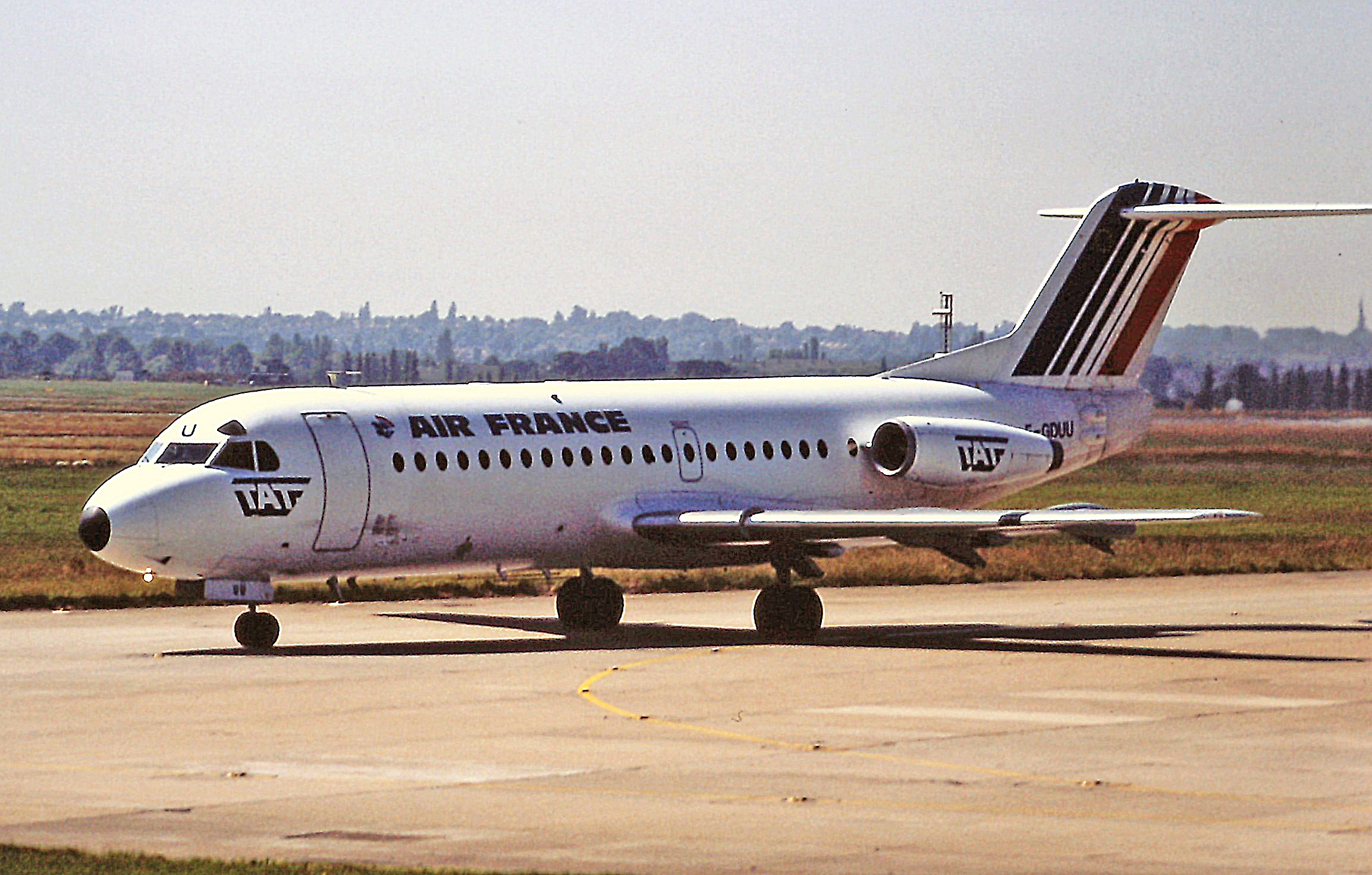
The launch customer was Nigeria Airways, which according to the English-language Wikipedia put the type into revenue service in October 1971; the source does not explain the gap with the certification date. The Nigerian flag carrier used it on its domestic network. In West Africa it was also flown by Ghana Airways: the Fokker Heritage archive records that the airline's aircraft registered 9G-ACA was the stretched Mark 2000 version.
Commercially, the Mk 2000 met with very limited demand. Of the 241 F28s of all versions built between 1967 and 1987, only 10 were Mk 2000s, one of the lowest totals in the family. The sources do not spell out why, but they do show that the stretch was made without changing the wing or the engines, and that maximum take-off weight remained around 29 t, the same as the Mk 1000's according to the comparison tables published by readyfortakeoffbook. Fokker corrected the formula a few years later with the Mk 4000, which reused the long fuselage of the Mk 2000 but added a wing extended by 1.5 m, two overwing emergency exits on each side, quieter Spey 555-15H engines and room for 85 passengers; it was that combination that became a commercial success.
The Mk 2000 fuselage also served as the basis for other developments. The Mk 5000 and Mk 6000 were modifications of the Mk 2000 with a larger wing and leading-edge slats. Neither succeeded: only two Mk 6000s were built and no Mk 5000 at all. After a period of use by Fokker, the two Mk 6000s were converted to Mk 2000 standard before being sold to Air Mauritanie; Fokker Heritage notes that the airline's 5T-CLF was once again fitted with the fixed leading-edge section of the wing.
The main documented accident involving the version struck the Nigeria Airways fleet. On 28 November 1983 the Mk 2000 registered 5N-ANF, operating Flight 250 from Ikeja to Enugu, crashed into a cassava field 3.3 km short of the runway during a VOR approach flown in visibility well below the required minima. The aircraft, which had first flown on 10 February 1975, was carrying 72 people: 53 were killed and 19 survived. The probable cause was the flight crew's decision to continue the approach in below-minima weather conditions until the aircraft struck the ground.
%2C_Paris-CDG.jpg)
With only ten aircraft built, the Mk 2000 holds a modest place in the Fellowship story, but it was the intermediate step that allowed Fokker to introduce the long fuselage on which the family's best-selling version would later be built.
Multimedia

%2C_Paris-CDG-800.webp)


