Fairchild Republic A-10 Thunderbolt II: The Tank Killer | MILITARY TIPS by LT EP32
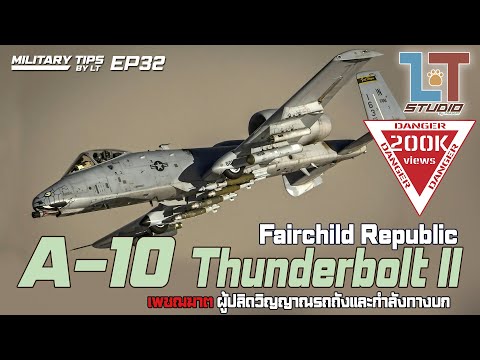
Video from the channel LT STUDIO about Fairchild Republic A-10 Thunderbolt II, linked on its Above Ten Thousand entry. Duration: 22:36. Video type: Documentary.
What it's about
This 32nd episode of the Thai series "Military Tips by LT" covers the Fairchild Republic A-10 Thunderbolt II. It is a single-seat, subsonic, twin-turbofan attack aircraft, in service with the United States Air Force since 1976 for close air support. It is presented as the last pure attack aircraft still active in that force. The video covers its origins, design, armament and combat record.
Historical background
After World War II, the USAF set aside the conventional attack aircraft in favor of fast, nuclear-capable tactical aircraft such as the F-101 Voodoo and the F-105. In Vietnam, the main attack aircraft was the Douglas A-1 Skyraider: it carried a heavy load and could loiter over the target for a long time, but it was slow and vulnerable to anti-aircraft artillery.
On 7 June 1961, Secretary of Defense Robert McNamara ordered two tactical aircraft, giving rise to the TFX program (F-111) and the F-4 Phantom II family. The Phantom performed poorly at low speed, couldn't loiter long over the target and was expensive. At the same time, the Army was converting the UH-1 into a gunship and developing the AH-1 Cobra with BGM-71 TOW missiles and the AH-56 Cheyenne. This competition led the USAF to study its close air support capability in 1966. It concluded that it needed a cheap attack aircraft, equal to or better than the A-1.
On 22 December 1966, the requirements for the A-X program were drafted and sent to 21 companies. In May 1970 the request for proposals was updated in light of improved Soviet armor: it called for a 30 mm rotary cannon, a takeoff run of about 1,200 m, 16,000 pounds of payload and a 460 km radius. Northrop's YA-9A and Fairchild Republic's YA-10A competed, along with General Electric and Philco-Ford for the cannon. On 18 January 1973 the YA-10A won, and in June General Electric secured the GAU-8 contract.
Notable facts
The first production A-10 flew in October 1975. Full-rate production began on 10 February 1976 and the first delivery was on 30 March of that year. The two-seat night and bad-weather version received no orders. In 1984 production reached 13 aircraft a month, and 716 were built in total. Service life was extended from 6,000 to 8,000 flight hours. In 1978 the Pave Penny laser receiver was added, and in 1987 Grumman took over program support. After cracks were found in the structure and wings, Boeing built new wings for about 1.7 billion dollars. The first aircraft with them flew in 2011, with service planned until 2035. The nickname "Warthog" follows the tradition of Republic's "Hogs": the F-84, the "Super Hog" F-84F Thunderstreak and the "Ultra Hog" F-105 Thunderchief.
A 540 kg titanium bathtub protects the cockpit against rounds of up to 23 mm. It is powered by two General Electric TF34 engines, with a cruise speed of 300 knots and a maximum speed of 381 knots at sea level. The seven-barrel GAU-8 cannon carries 1,174 rounds, and the aircraft has 11 hardpoints for 16,000 pounds: AIM-9, AGM-65 Maverick, rockets, Mk 82 and Mk 84 bombs, GBU-12, JDAM and Sniper XR or Litening pods.
Its first base was Davis-Monthan, in Arizona, in 1976. In the 1991 Gulf War it was credited with more than 900 tanks, 2,000 vehicles and 1,200 artillery pieces in about 8,100 sorties, with 5 aircraft lost. That result led to the abandonment of plans to replace it with the F-16. It later saw combat in Bosnia, in Kosovo (Allied Force, where it covered the rescue of an F-117 pilot), in Afghanistan from Bagram, and in Iraq in 2003. There it fired more than 300,000 30 mm rounds with 85% availability. Since 2005, 356 aircraft have been upgraded to the A-10C standard. According to the video, 141 remain in the USAF and another 86 in reserve units.