Fairchild Metroliner variant
Fairchild Metroliner Fairchild C-26A
US military designation of the SA227-AC Metro III. The Air Force bought eleven, two of them for Venezuela; from 1989 they served the Air National Guard as operational support transports, and one became the Naval Test Pilot School's flying classroom in 2018.
-1600.webp)
- 11
- Units built
- 3,750 km
- Range
- 22
- Passengers
History
A Metro III with a military designation
The C-26A is the designation given by the US armed forces to the Fairchild SA227-AC Metro III, the pressurised twin-turboprop regional transport. The armed forces never gave it an official name: it is unofficially known by the same nickname as its civil counterpart, Metroliner. The US Air Force bought eleven C-26As based on the SA227-AC, and two of them were supplied to the Venezuelan Air Force. It was the first step of a military family that later grew with the C-26B, the RC-26B surveillance aircraft, the UC-26C and the C-26D and C-26E, each with its own civil basis.
What the type certificate says
The Federal Aviation Administration (FAA) type certificate data sheet A8SW lists the model as "SA227-AC (C-26A)", approved on 8 May 1981 in the normal category under Special Federal Aviation Regulation SFAR 41. Its note 18 defines the aircraft precisely: the C-26A is an SA227-AC modified in accordance with engineering change proposal ECP 567, or an SA227-BC modified per ECP 592, and must be operated with the FAA-approved flight manual supplement for that configuration. The same sheet includes an "SA227-BC (Military C-26A)" approved on 25 September 1989, and allows an SA227-AC to be converted into an SA227-BC by incorporating ECP 563. This is a nuance the online encyclopaedia misses, as it calls the three military SA227-BCs C-26Bs.
.jpeg)
The powerplant is a pair of Garrett (AiResearch) TPE331-11U-601G or -611G turboprops with Dowty Rotol propellers, or TPE331-11U-602G or -612G with McCauley propellers, in both cases 106 inches (269 cm) in diameter. The sheet sets take-off power at 1,000 shaft horsepower (746 kW) dry and 1,100 (820 kW) wet, with 1,000 at maximum continuous rating.
Support transport for the Guard
The first C-26s were delivered in 1989 and assigned to selected Air National Guard flying wings for operational support airlift. They had quick-change passenger, medevac or cargo interiors, with seats for a pilot, a co-pilot and nineteen passengers, or a mix of passengers and cargo. Their role was that of an on-call, rapid-response modern air transport for high-priority resupply and for moving key personnel to remote, unserviced or feeder sites: repair parts, equipment, technical teams and crash and accident investigation teams. They also covered range clearance, medical evacuation, administrative movement of personnel, transportation connections and courier flights.
Published figures
The C-26A entry in the online encyclopaedia gives two crew, 22- or 14-passenger layouts, a height of 5.13 m, a maximum take-off weight of 6,400 kg, 2,370 litres of fuel, a maximum speed of 533 km/h, a range of 3,750 km and a ceiling of 9,500 m. The Federation of American Scientists table, compiled from the A8SW sheet itself, agrees on 22 passengers, two crew seats, take-off weight and maximum range with IFR reserves, and adds a maximum operating speed of 248 knots true airspeed (about 459 km/h).
Other users
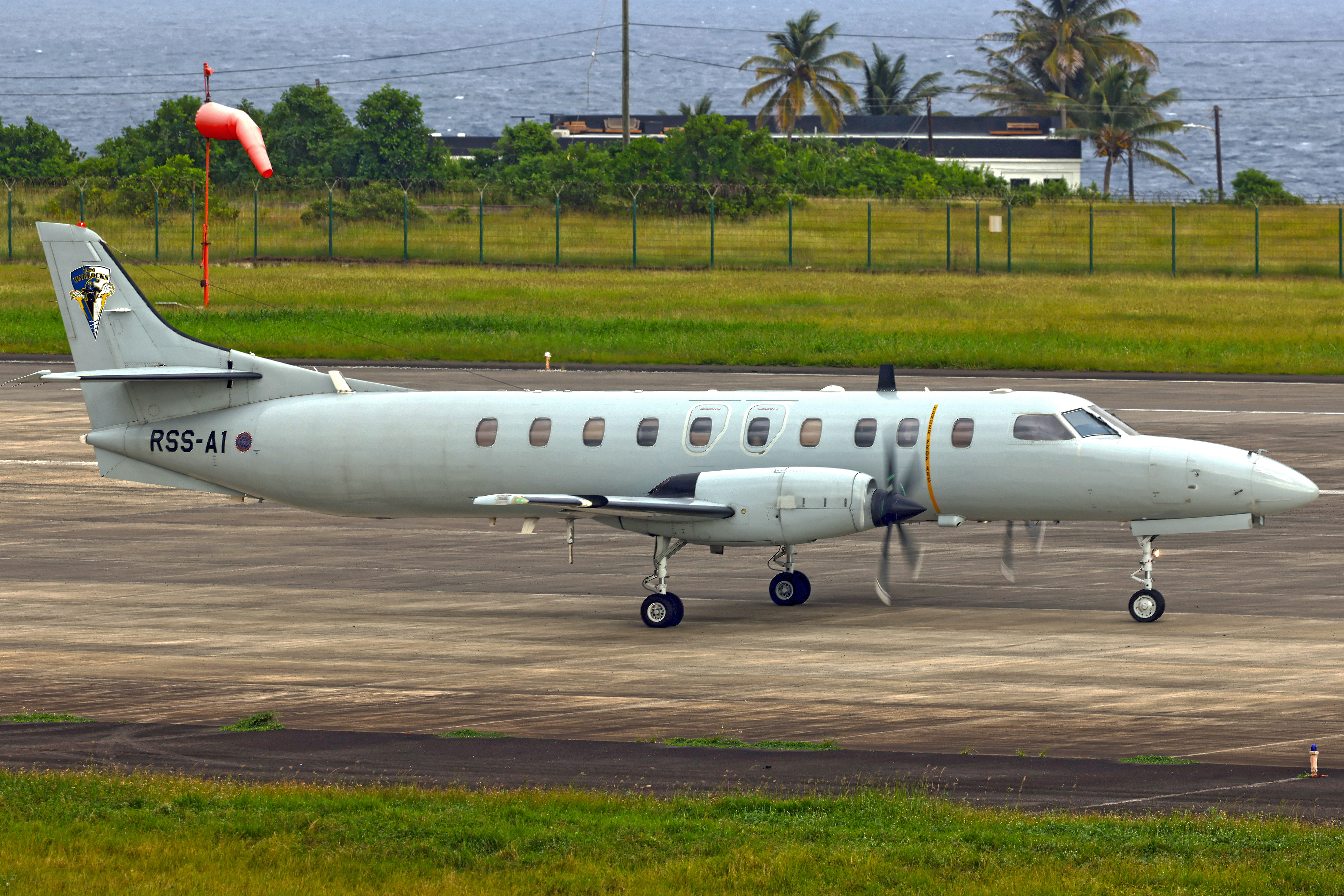
Besides the two Venezuelan aircraft, the same operator list credits two C-26As to the Barbados Air Wing, part of the Regional Security System. The US Navy, for its part, has used the C-26A as a trainer for its test pilots.
A second life as a flying classroom
The best documented airframe is former Air Force 86-0456. After retiring from counter-narcotics missions along the Mexican border, it was handed by the US Government to the US Naval Test Pilot School (USNTPS) in autumn 2015. It arrived with minimal documentation and maintenance records, which called for extensive work to meet FAA standards as well as modifications specific to a flying classroom. The rebuild took place in San Antonio, Texas, with the school, the AIRWorks systems integration office, the PMA-207 support aircraft programme office and M7 Aerospace, a subsidiary of Elbit Systems of America. Converted into ASTARS III, the school's third-generation flying classroom after a retired P-3 and a leased Saab 340, it was delivered at Patuxent River in June 2018 as Navy Bureau Number 860456, together with a simulation lab whose crew stations match the aircraft. Its first flight as ASTARS III took place on 21 August 2018, and Class 155 was the first to use it for all of its systems flight test events.
Multimedia
-1600.webp)

_RSS-A1%2C_Regional_Security_System_Barbados%2C_Bridgetown%2C_20_Nov_2025-1600.webp)
_RSS-A2%2C_ex-USN_86-0456%2C_Regional_Security_System_Barbados%2C_18_Oct_2024_(2)-1600.webp)
_RSS-A2%2C_ex-USN_86-0456%2C_Regional_Security_System_Barbados%2C_18_Oct_2024_(1)-1600.webp)