Embraer EMB 110 Bandeirante variant
Embraer EMB 110 Bandeirante EMB 110 (C-95)
First production version of the Bandeirante: a twelve-seat military transport with two 680 shp PT6A-27s, designated C-95 by the Força Aérea Brasileira. It was the aircraft with which Embraer began series production in 1973 and the trunk from which every later military version grew.
Embraer EMB 110 Bandeirante sheet

- August 9, 1972
- First flight
- 60
- Units built
- 12
- Passengers
History
The production EMB 110, designated C-95 by the Força Aérea Brasileira, is the version with which the Bandeirante stopped being a prototype and became the first aircraft Embraer ever built on a production line. Its origins lie in project IPD-6504 of the Centro Técnico Aeroespacial, launched from 1965 under the French engineer Max Holste with Ozires Silva as its driving force. The three YC-95 prototypes (EMB 100 to the company), with 550 shp PT6A-20 engines and oval windows, flew from October 1968 onwards; the production aircraft that emerged from the 1968-1969 test programme was already a different machine, with the fuselage stretched to 13.74 m, a redesigned cabin, fin and engine nacelles, rectangular windows, a landing gear fully housed in the new nacelles and two Pratt & Whitney Canada PT6A-27 turboprops of 680 shp. Series production began in May 1971 and the first EMB 110 flew on 9 August 1972, with a maximum take-off weight of 5,300 kg.
The first delivery to the Força Aérea Brasileira took place on 9 February 1973, two months before Transbrasil put the civil EMB 110C into commercial service. The Ministério da Aeronáutica had ordered eighty aircraft under the C-95 designation, but according to Brazilian air force historiography only fifty-five were delivered as such between 1973 and 1976, with serials FAB 2132 to 2175 and 2179 to 2189; English-language sources give sixty EMB 110s built in total. In its basic configuration the C-95 was a twelve-seat transport for passengers and light cargo, without a rear cargo door, designed for the network of short unpaved strips in the Brazilian interior over which the FAB operated the Correio Aéreo Nacional. It was spread across the regional air transport squadrons and the base aviation groups, and period photographs show it with units as varied as the 1º/15º Grupo de Aviação, the 1º/7º Grupo de Aviação and the 3º and 5º Esquadrão de Transporte Aéreo.
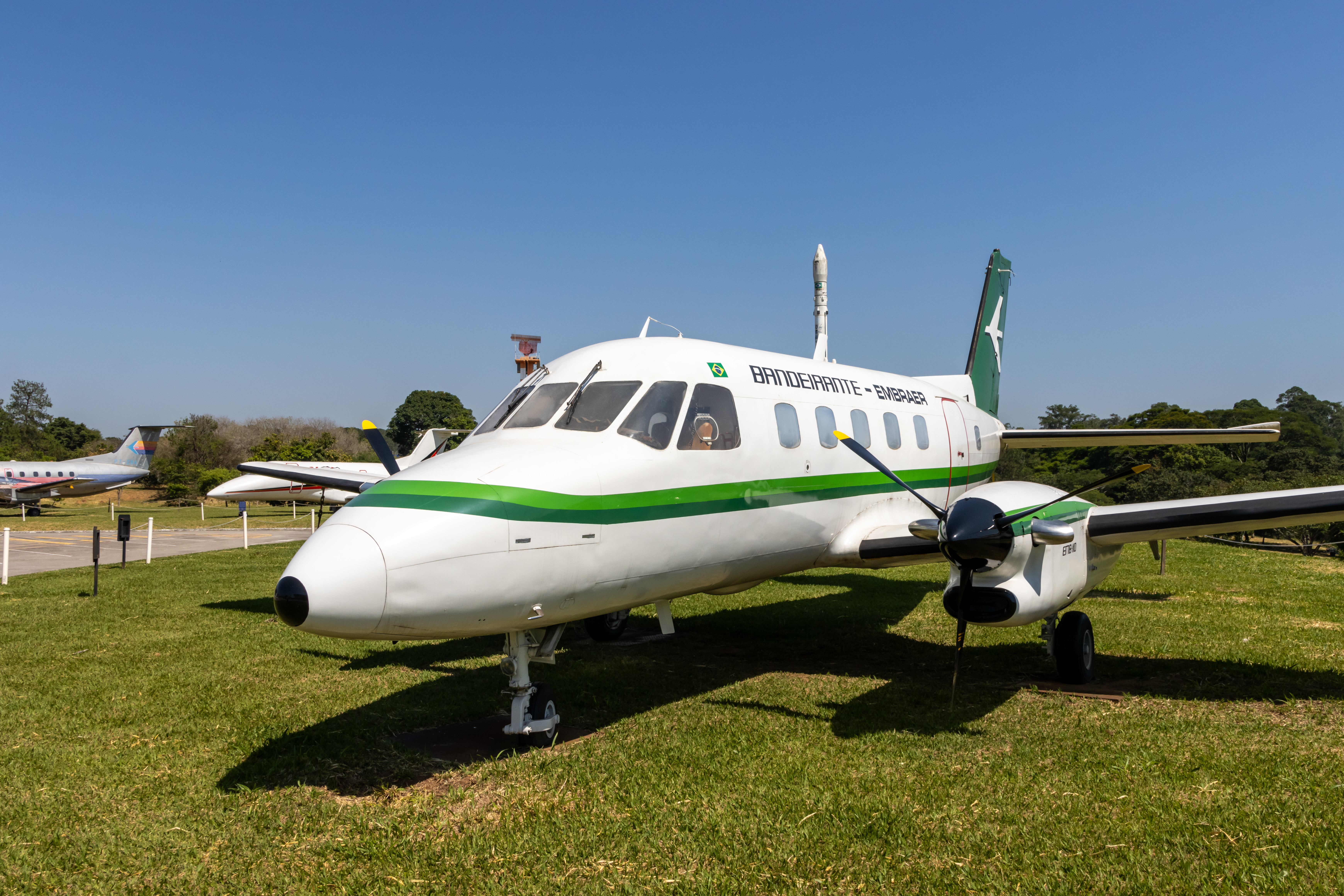
The C-95 was the trunk from which every later military version grew: the EMB 110A navaid-calibration aircraft (EC-95), the EMB 110B aerial-survey aircraft (R-95), the EMB 110K1 freighter with rear cargo door (C-95A), the EMB 110P1K (C-95B), the EMB 110P1K SAR (SC-95B) and the EMB 110P1A (C-95C), together with the EC-95B and EC-95C conversions for the Grupo Especial de Inspeção em Voo and the XC-95B rain-research aircraft of the Centro Técnico Aeroespacial. Even the original EC-95s returned to plain C-95 transport standard in 2000-2001 when they lost their calibration equipment. The civil EMB 110C, seating fifteen or sixteen, was a direct derivative of the C-95 and gave Embraer the experience with which it later tackled the international market.
The first-generation C-95s gradually gave way to the C-95A, B and C, more powerful thanks to the 750 shp PT6A-34, and were not included in the avionics modernisation the FAB decided upon in 2008, which covered only the P1, P1SAR and P1A versions. Even so, the C-95 family as a whole remained the workhorse of Brazilian light transport for decades: in December 2010, when the first modernised aircraft flew, the FAB still had 96 EMB 110s in service, a figure that fell to 48 by 2017, and in 2020 C-95AM 2291 of the 1º/5º Grupo de Aviação received a commemorative scheme marking 100,000 flying hours accumulated by the fleet. In February 2023 the FAB celebrated fifty years of the Bandeirante in service, half a century after that first delivery.
Multimedia


%2C_For%C3%A7a_A%C3%A9rea_Brasileira%2C_en_tierra-800.webp)
%2C_For%C3%A7a_A%C3%A9rea_Brasileira%2C_en_Expo_Aero_Brasil_2005-800.webp)
