Airliner · Civil · United States
Douglas DC-7
- May 18, 1953
- First flight
- 1953
- Introduced
- 2020
- Retired
- 338
- Units built



_at_Smithsonian_NASM_Udvar-Hazy_Center_in_Chantilly%2C_VA_(cropped)-800.webp)
-1600.webp)


-800.webp)

-1600.webp)


-1600.webp)


-1600.webp)
-800.webp)
-1600.webp)

-1600.webp)


-800.webp)
The Douglas DC-7 was the last large piston-engined airliner built by the Douglas Aircraft Company, produced between 1953 and 1958 as a direct derivative of the DC-6. It answered a very specific request from American Airlines: an aircraft able to cross the United States coast to coast without a stop in roughly eight hours, the ceiling that civil regulations then placed on a domestic crew's flight time. Douglas was reluctant to build it until the airline's president, C. R. Smith, ordered twenty-five aircraft for forty million dollars and so covered the development bill. That stretched airframe went on to spawn the longer-legged DC-7B and, above all, the DC-7C «Seven Seas», which from the summer of 1956 made the non-stop Atlantic routine in both directions, including the westbound leg against the prevailing wind that had rarely been economic before. Its engine, the eighteen-cylinder Wright R-3350 Turbo-Compound, gave the aeroplane the performance that defined it and, at the same time, the reputation for fragility that cut its airline career short. A total of 338 aircraft of the series were built. The arrival of the Boeing 707 and the Douglas DC-8 made the type obsolete in barely five years — some carriers withdrew their DC-7s after little more than five years of service — yet it survived for decades converted into a freighter and an aerial firefighting tanker: the last airworthy example was not retired until October 2020.
Related events
Related sheets
Category
Three-view drawing
History
An order to win the transcontinental race
The DC-7 designation was used twice. The first time was in 1945, when Pan American World Airways asked Douglas for a civil version of the C-74 Globemaster military transport; the order was cancelled almost at once and that project bears no relation to the aircraft that eventually carried the name. The designation was revived when American Airlines set out a different and far more precise requirement: an aeroplane able to fly coast to coast across the United States without a stop in about eight hours. The figure was not arbitrary. Civil Air Regulations then capped a domestic flight crew at eight hours of flying in any twenty-four-hour period, so a through transcontinental service was only workable if the aircraft fitted inside that margin.
Douglas had no appetite for the development. The reluctance was overcome commercially: C. R. Smith, president of American Airlines, ordered twenty-five aircraft for a total of forty million dollars, a sum that covered the cost of getting the design into the air before it flew. The competitive aim was plain enough — to take the most prestigious route in the American market away from TWA's Lockheed Super Constellations.
From the DC-6B to the DC-7
What emerged was not a new design but a measured evolution of a family that already worked. The wing came from that of the DC-4 and DC-6, with the same span, and the fuselage was stretched forty inches (about 100 cm) over the DC-6B by inserting a plug behind the wing. The real difference sat in the nacelles: four eighteen-cylinder Wright R-3350 Duplex-Cyclone Turbo-Compound engines in place of the DC-6's Pratt & Whitneys.
The prototype flew in May 1953 and American took delivery of its first aircraft that November, opening the country's first non-stop east-coast to west-coast service. The schedule was set unrealistically, just inside the eight-hour limit for a single crew, and TWA was pushed into matching it with its Super Constellations. Both types suffered frequent in-flight engine failures that forced many services to divert. Some blamed the schedule pressure itself: meeting the advertised times meant holding high power settings, which overheated the engines and destroyed their power-recovery turbines.
The DC-7B and the reach across the Atlantic
The original DC-7 was followed by the DC-7B, with slightly more power and optional fuel tanks carried above the wing in the rear of enlarged engine nacelles, each holding 220 US gallons (833 litres). Only Pan American and South African Airways specified them. The South African carrier used the variant to link Johannesburg with London with a single stop.
Pan American's DC-7Bs began flying the Atlantic in the summer of 1955, scheduled one hour and forty-five minutes faster than the Super Stratocruiser from New York to London or Paris. Even so, the range gain over the original DC-7 was modest, and European operators saw no reason to buy on the strength of it: the early DC-7s were purchased by United States carriers alone.
The DC-7C Seven Seas
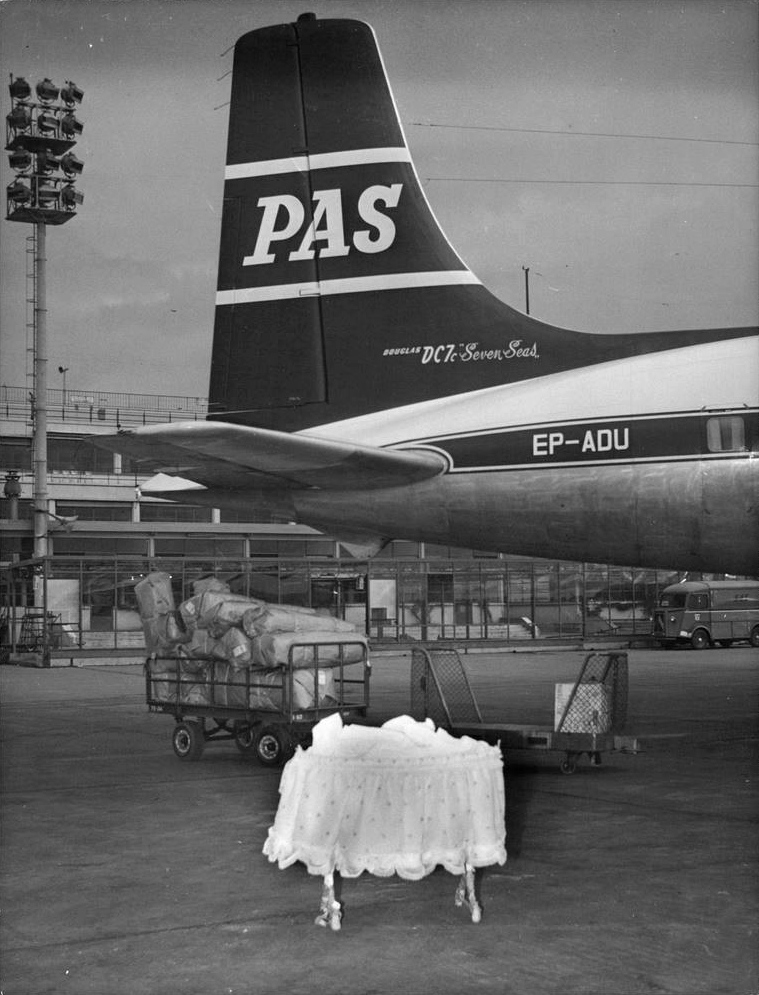
Douglas answered that European indifference with the DC-7C, released in 1956 and named Seven Seas. Its defining feature was a pair of five-foot (1.5 m) inserts at the wing root, a solution that dealt with three problems at once: it increased fuel capacity, cut interference drag and moved the engines further outboard, which made the cabin appreciably quieter. The nacelle tanks that had been optional on the DC-7B became standard. The fuselage grew again with a second forty-inch plug, this time ahead of the wing, bringing the overall length to 34.21 metres; span was 38.86 metres and wing area 152.1 square metres.
The numbers describe the aircraft well: up to 105 passengers, a maximum take-off weight of 64,864 kilograms, 29,620 litres of fuel in eight wing tanks, a maximum speed of 653 km/h and a recommended cruise of 557 km/h at 6,600 metres, essentially its service ceiling, with a maximum-fuel range of 9,069 kilometres. Carrying maximum payload the range fell to 7,459 kilometres. Power came from four turbo-compound R-3350s rated at 3,400 horsepower for take-off at sea level, driving four-bladed reversible Hamilton Standard Hydromatic propellers.
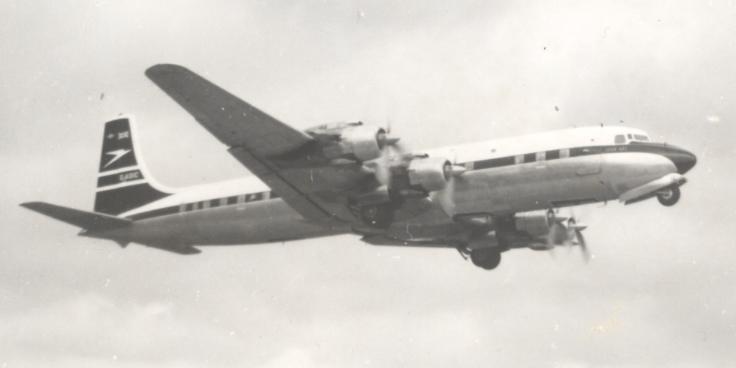
Since the late 1940s Pan American and others had scheduled a handful of non-stop flights between New York and Europe, but the westbound leg, into the prevailing wind, was seldom possible with an economic payload. The Super Constellation and the DC-7B that appeared in 1955 managed it occasionally; it was Pan American's DC-7C that, in the summer of 1956, began doing it with some reliability. BOAC was forced to buy DC-7Cs rather than wait for delivery of its Bristol Britannias, and the type found its way into several overseas fleets, among them SAS, which flew it on polar routes to North America and Asia. The DC-7C outsold its direct rival, the Lockheed L-1649A Starliner, which entered service a year later.
The R-3350 Turbo-Compound: the virtue and the weak point
Everything the DC-7 was rests on its engine, and it is worth understanding why Douglas chose it. The DC-6, and the DC-6B in particular, had earned a firm reputation for straightforward, reliable engineering with Pratt & Whitney Double Wasps. But Pratt & Whitney offered no genuinely effective larger engine apart from the Wasp Major, whose reputation for poor reliability ruled it out. Douglas therefore turned to Wright Aeronautical.
The R-3350's turbo-compound system was an elegant post-war idea aimed at fuel economy. Three power-recovery turbines were mounted around the rear of the engine, one for each bank of six cylinders, using the velocity energy of the exhaust gas rather than its expansion and feeding power back to the crankshaft through reduction gearing and fluid couplings. Against an equivalent R-3350 without turbo-compounding, the system added roughly 550 horsepower at take-off and around 240 at cruise settings, burning fuel at much the same rate as the older R-2800 while delivering more useful power.
The price of that sophistication was reliability. The Duplex-Cyclone carried problems of its own that fed straight into the DC-7's service record. Operator experience makes the point by contrast: Morten Beyer, an executive at Riddle Airlines — later Airlift International — recounted that his company grew comfortable buying second-hand DC-7s, known engine troubles and all, after seeing the success of carriers such as Swissair that made a point of babying the Wright. In Beyer's account, many passenger airlines competed on speed and ran the engine at its limits, which is exactly where it tended to break; Riddle operated it reliably by treating it with the same care.
The Grand Canyon collision
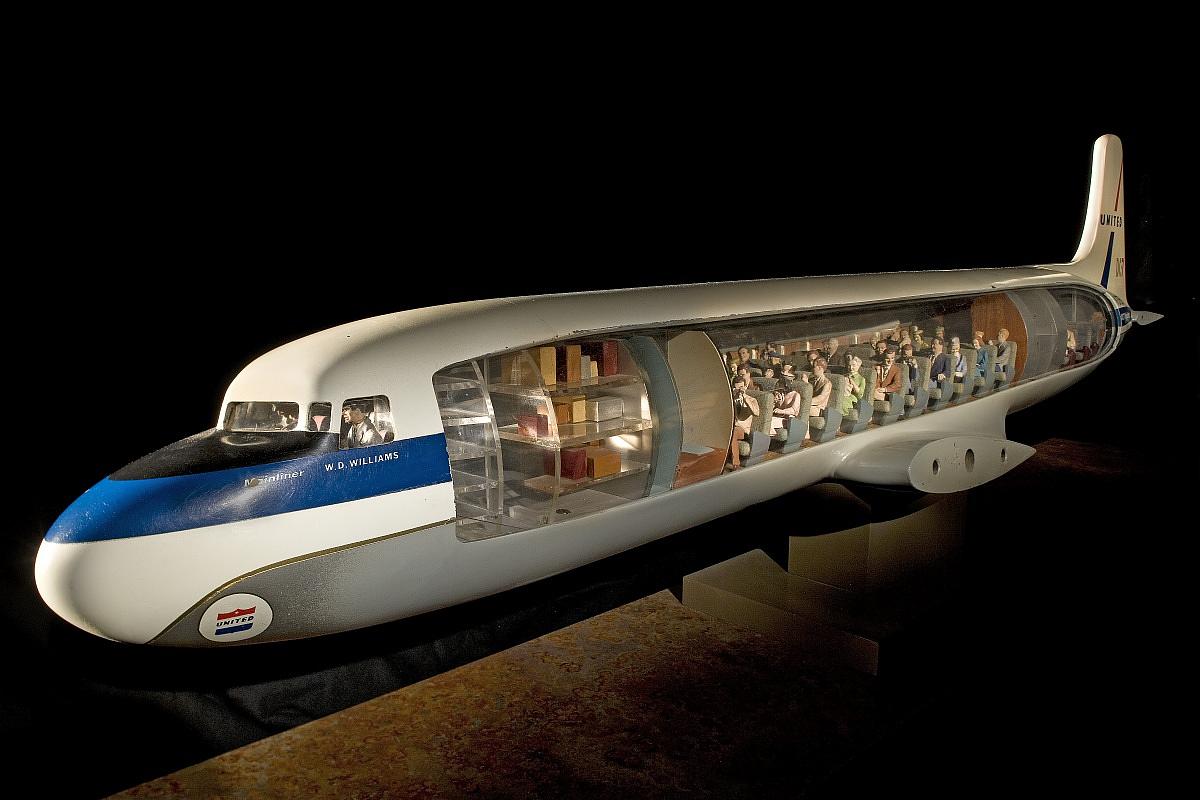
On 30 June 1956 a United Air Lines DC-7 named Mainliner Vancouver, operating Flight 718, collided in mid-air with the Lockheed L-1049A Super Constellation Star of the Seine, TWA Flight 2, over Grand Canyon National Park in Arizona. Both had left Los Angeles minutes apart, bound for Chicago and Kansas City respectively. All 128 people aboard the two aircraft died, making it the first commercial aviation accident to exceed one hundred fatalities.
The collision happened in uncontrolled airspace, where separation was the pilots' own responsibility under the principle then called see and be seen. The Constellation's captain had asked to climb to avoid building thunderheads and, refused because no separation could be guaranteed, was instead cleared to fly a thousand feet on top, above the cloud in visual conditions, taking responsibility for his own separation. Both aircraft ended up at the same altitude, some 6,400 metres, at similar speeds, most likely manoeuvring around the same towering clouds. They struck at 10:32 at an angle of roughly twenty-five degrees: the DC-7's left wing caught the Constellation's vertical stabiliser, while the propeller of its number one engine cut a series of gashes into the other aircraft's belly. The Constellation lost its tail assembly and fell in a near-vertical dive; the DC-7, its left wing wrecked and its outboard engine ruined, spiralled down into the cliff face of Chuar Butte.
The accident laid bare the state of American air traffic control: there was no radar coverage over the canyon, no homing beacons and neither aircraft carried a cockpit voice or flight data recorder. The regulatory consequences came in two stages. In 1957, after often contentious congressional hearings, funding was increased to modernise air traffic control, to hire and train more controllers and to buy radar — initially military surplus equipment. But authority over American airspace remained split between the military and the Civil Aeronautics Administration, which had no jurisdiction over military flights, and collisions and near-misses continued. The deeper fix was the Federal Aviation Act of 1958, which dissolved the CAA and created the Federal Aviation Agency — renamed the Federal Aviation Administration in 1966 — with total authority over American airspace, military activity included.
Five years and the jet
The DC-7's airline career was remarkably short. It was developed shortly after the de Havilland Comet, the first jet airliner, entered service, and only a few years before Douglas's own DC-8 first flew in 1958. Once Boeing 707s and DC-8s started reaching the fleets from 1958 onwards, DC-7C sales stopped dead.
The telling detail is the order in which airlines disposed of their piston aircraft. Carriers operating both DC-6s and DC-7s retired the DC-7s first, even though they were the newer machines. Some were withdrawn after little more than five years of service, while most DC-6s lasted longer and sold far more readily second-hand. The reason was not the airframe, which was sound, but the cost and reliability of the turbo-compound engine.
A second life: freighter and tanker
From 1959 Douglas began converting DC-7s and DC-7Cs into DC-7F freighters to extend their working lives. The conversion fitted large forward and rear freight doors and removed some of the cabin windows; the Speedfreighter conversion cost around 166,112 dollars per aircraft. FAA-approved cargo conversions were also carried out under the DC-7B Cargo and DC-7C cargo configurations, with a large main-deck door and cargo floors, and certain aircraft were further modified to meet Class E main-cabin cargo compartment requirements.
Once the freight years were over, part of the fleet found a third trade: aerial firefighting. Converted DC-7 tankers went on working for decades, well into the twenty-first century. The end came in October 2020, when Erickson Aero Tanker's DC-7B N838D, known as Tanker 60, completed its final season and was retired at the end of its Oregon contract; on 14 October it flew from Medford to Madras, in the same state, in what is regarded as probably the last flight of any DC-7. It was the last airworthy aircraft of the family.
Survivors remain on static display or in storage: the forward fuselage of a DC-7 at the National Air and Space Museum in Washington, a DC-7B at the Pima Air & Space Museum in Tucson, another at the Delta Flight Museum in Atlanta and a third at the Sullenberger Aviation Museum in Charlotte, several former Erickson airframes stored at Madras, and a DC-7C displayed at San Bartolomé de Tirajana, in Las Palmas.
The record, safety and the DC-7D that never was
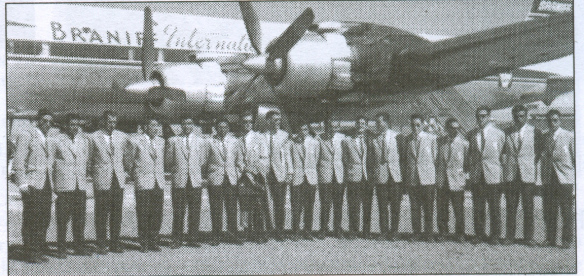
Total production of the series came to 338 aircraft: 105 DC-7s, 112 DC-7Bs and 121 DC-7Cs. American Airlines was the launch customer. The list of commercial operators takes in Alitalia, BOAC, Braniff, Delta, Eastern, Flying Tigers, Japan Airlines, KLM, Mexicana, National, Northwest Orient, Panair do Brasil, Pan American, Sabena, SAS, South African Airways, Swissair, Turkish Airlines, TAI and United among others; a number of airframes later passed into military hands in Colombia, France, Mexico and Rhodesia.
On safety, the Aviation Safety Network database lists 97 accidents and incidents involving the type between 1955 and 1993, with 728 fatalities when only the DC-7 side of mid-air collision entries is counted.
One variant was left behind: the DC-7D, a proposed turboprop development powered by four Rolls-Royce RB.109 engines that BOAC considered in 1954. No order was placed and the aircraft was never built, so the DC-7 family closed as the end of the line for Douglas's large piston airliners, precisely as the jet was rewriting the rules of air transport.
Variants
| DC-7 | DC-7C Seven Seas | DC-7B | DC-7B Cargo | DC-7BF | DC-7CF | DC-7D (proyecto) | DC-7F «Speedfreighter» | |
|---|---|---|---|---|---|---|---|---|
| First flight | May 18, 1953 | December 20, 1955 | — | — | — | — | — | — |
| Aircraft type | Long-haul airliner | Long-haul airliner | Long-haul airliner | Long-haul cargo airliner | Long-haul cargo airliner | Long-haul cargo airliner | Long-haul airliner (project) | Long-haul cargo airliner |
| Powerplant | 4 × Wright R-3350-972TC18DA2/DA4 Turbo-Compound 18-cylinder radial piston engines, 2,423.5 kW (3,250 hp) each for take-off | 4 × Wright R-3350-988TC18EA1/EA4 Turbo-Compound 18-cylinder air-cooled radial piston engines, 2,535.4 kW (3,400 hp) each for take-off, with three power-recovery turbines geared back to the crankshaft and four-blade reversible Hamilton Standard Hydromatic propellers. | 4 × Wright R-3350-972TC18DA4/988TC18EA1/988TC18EA4 Turbo-Compound 18-cylinder radial piston engines, 2,423.5 kW (3,250 hp) each for take-off | 4 × Wright R-3350-972TC18DA4/988TC18EA1/988TC18EA4 Turbo-Compound 18-cylinder radial piston engines, 2,423.5 kW (3,250 hp) each for take-off | 4 × Wright R-3350-972TC18DA4/988TC18EA1/988TC18EA4 Turbo-Compound 18-cylinder radial piston engines, 2,423.5 kW (3,250 hp) each for take-off | 4 × Wright R-3350-988TC18EA1/EA4 Turbo-Compound 18-cylinder radial piston engines, 2,535.4 kW (3,400 hp) each for take-off | 4 × Rolls-Royce RB.109 (Tyne) turboprops; a proposal studied by BOAC in 1954 that never left the drawing board | 4 × Wright R-3350 Turbo-Compound 18-cylinder radial piston engines; the exact sub-model (972TC18DA4, 988TC18EA1 or 988TC18EA4) depends on the airframe converted |
| Powerplant | 4 × Wright R-3350-972TC18DA2 / 972TC18DA4 Turbo-Compound | 4 × Wright R-3350-988TC18EA1 / 988TC18EA4 Turbo-Compound | 4 × Wright R-3350-972TC18DA4 / 988TC18EA1 / 988TC18EA4 Turbo-Compound | 4 × Wright R-3350-972TC18DA4 / 988TC18EA1 / 988TC18EA4 Turbo-Compound | 4 × Wright R-3350-972TC18DA4 / 988TC18EA1 / 988TC18EA4 Turbo-Compound | 4 × Wright R-3350-988TC18EA1 / 988TC18EA4 Turbo-Compound | 4 × Rolls-Royce RB.109 (Tyne) | 4 × Wright R-3350-972TC18DA4 / 988TC18EA1 / 988TC18EA4 Turbo-Compound |
| Power per engine | 3,250 hp | 3,400 hp Best value in this row | 3,250 hp | 3,250 hp | 3,250 hp | 3,400 hp Best value in this row | — | — |
| Length | 33.2 m | 34.2 m Best value in this row | 33.2 m | 33.2 m | 33.2 m | 34.2 m Best value in this row | 34.2 m Best value in this row | 34.2 m Best value in this row |
| Wingspan | 35.8 m | 38.9 m | 35.8 m | 35.8 m | 35.8 m | 38.9 m | 38.9 m Best value in this row | 38.9 m Best value in this row |
| Height | — | 9.7 m | — | — | — | — | — | — |
| Wing area | 136 m² | 152 m² Best value in this row | 136 m² | 136 m² | 136 m² | 152 m² Best value in this row | — | — |
| Empty weight | — | 33,005 kg | — | — | — | — | — | — |
| MTOW | 55,429 kg | 64,864 kg | 57,152 kg | 57,152 kg | 57,152 kg | 65,657 kg Best value in this row | — | — |
| Top speed | — | 653 km/h | — | — | — | — | — | — |
| Max speed altitude | — | 6,919 m | — | — | — | — | — | — |
| Cruise speed | 578 km/h Best value in this row | 557 km/h | 578 km/h Best value in this row | — | — | — | — | — |
| Cruise altitude | — | 6,584 m | — | — | — | — | — | — |
| Service ceiling | 7,620 m Best value in this row | 6,614 m | 7,620 m Best value in this row | — | — | — | — | — |
| Initial climb rate | — | 5.3 m/s | — | — | — | — | — | — |
| Range | 7,593 km | 9,069 km | 9,171 km Best value in this row | — | — | — | — | — |
| Ferry range | — | 10,400 km | — | — | — | — | — | — |
| Combat radius | 0 km Best value in this row | 0 km Best value in this row | 0 km Best value in this row | 0 km Best value in this row | 0 km Best value in this row | 0 km Best value in this row | 0 km Best value in this row | 0 km Best value in this row |
| Range conditions | Published range of 7,593 km with full tanks plus diversion and 30-minute hold allowances: enough to cross the United States non-stop, but not the North Atlantic in both directions. | Range of 9,069 km with maximum fuel and a 6,940 kg payload and no allowances, or 7,459 km with maximum payload: the first Douglas able to link New York and Europe non-stop in both directions on a regular basis. | Range of 9,171 km with maximum fuel and diversion plus hold allowances; the saddle tanks in the engine nacelles made westbound non-stop North Atlantic crossings possible, though not reliably. | — | — | — | — | — |
| Armament | None | None | None | None | None | None | None | None |
| Max weapons load | 0 kg Best value in this row | 0 kg Best value in this row | 0 kg Best value in this row | 0 kg Best value in this row | 0 kg Best value in this row | 0 kg Best value in this row | 0 kg Best value in this row | 0 kg Best value in this row |
| Payload | — | 8,364 kg | — | — | — | — | — | — |
| Cargo capacity | Standard 2+2 cabin for 74 passengers, up to 107 in a five-abreast high-density layout. | Cabin seating 62 in first class (2+2) or up to 105 in tourist class (3+2), plus 8,364 kg of cargo and baggage in the lower holds. | Standard 2+2 cabin for 74 passengers, up to 109 in a high-density layout. | Approved DC-7B cargo configuration: clear main deck with a large freight door and a reinforced floor. Maximum zero-fuel weight rises to 44,452 kg (98,000 lb) and maximum landing weight to 47,174 kg (104,000 lb). Some production DC-7s were converted to this standard and re-plated. | Designation of the DC-7B freighter conversion, with main-deck freight doors; it corresponds to the DC-7B Cargo configuration of specification 4A10. | DC-7C cargo configuration: eligible airframes are cleared to 65,657 kg (144,750 lb) maximum take-off weight, against 64,864 kg for the passenger version. | Never built: no order was placed and the design never reached prototype stage. | Douglas marketing name for the DC-7B and DC-7C freighter conversions undertaken from 1959: large forward and rear freight doors and the removal of part of the cabin windows. |
| Crew | 4 Best value in this row | 5 | 4 Best value in this row | 4 Best value in this row | 4 Best value in this row | 4 Best value in this row | — | 4 Best value in this row |
| Passengers | 105 Best value in this row | 105 Best value in this row | 105 Best value in this row | — | — | — | — | — |
| Units built | 105 | 121 Best value in this row | 112 | — | — | — | — | — |
Images
Elsewhere
- Airliners.netDouglas DC-7 — Butler Aircraft (tanker) ↗
- Airliners.netDouglas DC-7 — Delta Air Lines ↗
- Airliners.netDouglas DC-7 — Delta Air Lines (2) ↗
- Airliners.netDouglas DC-7 — National Airlines ↗
- Airliners.netDouglas DC-7 — United Airlines ↗
- Airliners.netDouglas DC-7 — American Airlines ↗
- Airliners.netDouglas DC-7 — Erickson Aero Tanker (tanker) ↗
- JetPhotosDouglas DC-7 N334AA American Airlines ↗
- JetPhotosDouglas DC-7 N334AA American Airlines (2) ↗
- JetPhotosDouglas DC-7 N334AA American Airlines (3) ↗
- JetPhotosDouglas DC-7 N6353C Erickson Aero Tanker ↗
- JetPhotosDouglas DC-7 N401US Erickson Aero Tanker ↗
Show the 12 more
- Delta Flight MuseumDC-7B Ship 717 — Delta Flight Museum ↗
- Delta Flight MuseumDouglas DC-7 1954-1968 — Delta Flight Museum ↗
- Air-and-Space.comDouglas DC-6 and DC-7 Tankers ↗
- ShutterSpeedAeroDouglas DC-7 Air Tanker ↗
- Smithsonian NASMDouglas DC-7, America by Air ↗
- Smithsonian NASMModelo de Douglas DC-7 Mainliner, United Air Lines ↗
- Smithsonian NASMDouglas DC-7 — American Airlines ↗
- Smithsonian NASMDouglas DC-7 — panorámica de cabina ↗
- Northwest Airlines History CenterDouglas DC-7C — Northwest Airlines History Center ↗
- FlightAwareDouglas DC-7B Delta Air Lines en KATL ↗
- FlightAwareDouglas DC-7B N838D — tanker ↗
- AerialFire MagazineCommercial Veterans, Firefighting Giants — DC-7 tankers ↗