Airliner · Civil · Germany
Dornier 328
- December 6, 1991
- First flight
- 1993
- Introduced
- In service
- Status
- 107
- Units built

_(2)-1600.webp)

-800.webp)
_(2)-1600.webp)
-1600.webp)

-800.webp)
-800.webp)
-800.webp)

_(2)-1600.webp)


-1600.webp)
-800.webp)

_at_Edmonton_International_Airport-1600.webp)
_%40_MAN%2C_June_2016-1600.webp)
_(2)-1600.webp)
_(2)-1600.webp)
_(2)-1600.webp)
-1600.webp)
_(2)-1600.webp)

-1600.webp)
-1600.webp)
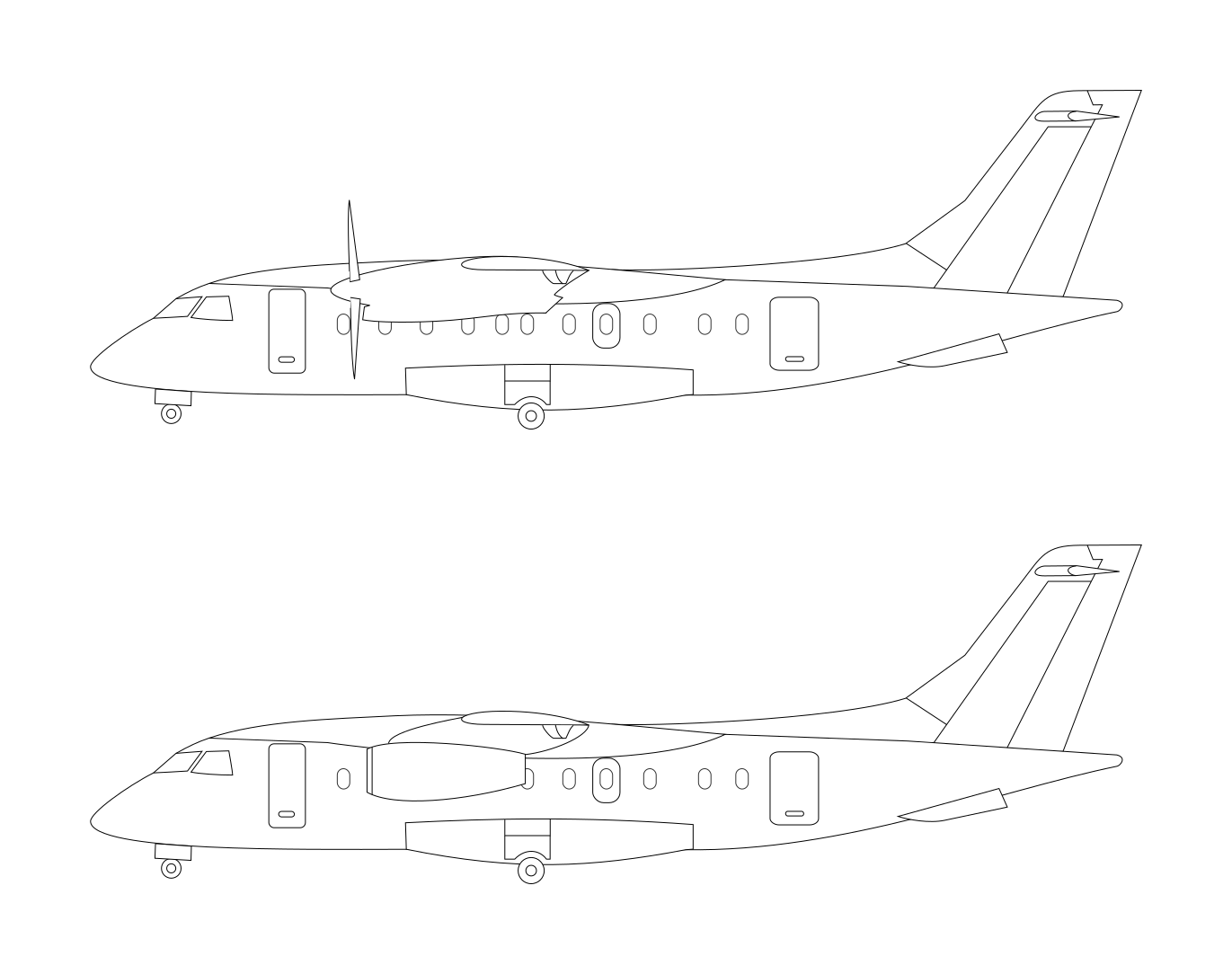
The Dornier 328 is a twin-turboprop regional airliner conceived by Dornier Luftfahrt GmbH at Oberpfaffenhofen, near Munich, for a very specific niche: around thirty seats, three-abreast, and performance close enough to a jet that the aircraft could slot into big-airport traffic without disruption. The 1984 market study behind the programme called for a fast, quiet and easy-to-maintain commuter airliner; the project was relaunched in December 1988 after an agreement between the Dornier family and Daimler-Benz, first flew on 6 December 1991 and entered commercial service on 13 October 1993. A supercritical wing inherited from the Dornier 228, a pressurised fuselage shaped for high cruise speed, six-bladed Hartzell propellers and a Honeywell Primus 2000 glass cockpit made it one of the fastest and quietest regional turboprops of its generation. Technical merit did not translate into commercial success. Launched just as regional jets were taking over, and into a recession, the 328 never approached the four hundred units originally projected. In June 1996 Deutsche Aerospace sold most of Dornier Luftfahrt to America's Fairchild Aircraft, creating Fairchild Dornier, which re-engined the aircraft with Pratt & Whitney Canada PW306/9 turbofans —the 328JET, first flown on 20 January 1998— and planned a whole family (428JET, 728, 928) that the April 2002 bankruptcy left on paper. A total of 107 turboprops and 110 jets were built, and the last airframe was the final commercial aircraft designed and manufactured entirely in Germany. After the collapse the type certificate passed through AvCraft Aviation, M7 Aerospace and, from June 2006, 328 Support Services GmbH, bought in February 2015 by Sierra Nevada Corporation. The design found a second military life as the C-146A Wolfhound of US Air Force Special Operations Command, and an industrial one as Deutsche Aircraft's D328eco, a stretched version seating up to forty passengers, assembled at Leipzig/Halle, whose first prototype was rolled out at Oberpfaffenhofen in May 2025.
Related sheets
Category
History
A gap in the market: the 1984 study
The Dornier 328 programme began while the Friedrichshafen firm was still part of Deutsche Aerospace. Market research carried out in 1984 identified demand that no manufacturer was properly serving: a roughly thirty-seat commuter airliner that was fast, quiet and easy to maintain. Internal projections spoke of a market of at least 400 units. The desired profile included a high cruising speed —345 kn, about 639 km/h— plus a higher cruising altitude and greater range than the competition, so that the aircraft would be almost as fast as a jetliner while burning considerably less fuel. A broader trend worked in its favour: regional traffic was starting to move away from the hub-and-spoke model towards point-to-point links between secondary cities, and that kind of route called for exactly the aeroplane Dornier had in mind.
The December 1988 relaunch
The project was formally relaunched in December 1988, when shareholders gave their approval after negotiations between the Dornier family and Daimler-Benz. A six-month evaluation narrowed the powerplant choice to three candidates: the General Electric CT7-9D, the Garrett TPE-341-21 and the Pratt & Whitney Canada PW119A. Deutsche Aerospace regarded the Garrett engine as technically superior, but Pratt & Whitney Canada's was further advanced in development and was chosen. The decision immediately pulled the propeller with it: Dornier selected a six-bladed composite unit from Hartzell, whose bid was reportedly substantially lighter than those from Dowty and Hamilton Standard. For the instrument panel, after weighing electromechanical against digital solutions, the company settled on a digital glass cockpit and awarded it to Honeywell, having considered offers from Saab, Rockwell Collins and Smiths Aerospace.
A turboprop designed to jet standards
The 328 is a twin-turboprop regional aircraft aimed at short-haul operators, which Deutsche Aerospace liked to promote as a "third-generation airliner". Its fuselage adopts an unusually streamlined shape optimised for high cruising speeds; the aircraft can sustain higher cruise and approach speeds than most turboprops, which lets controllers slot it in among jetliners on approach without hurting airport throughput. According to the manufacturer, the 328 offered the "lowest noise level, widest cabin, highest standing room, widest cabin floor, and widest seats in the three-abreast class". It could also work from semi-prepared airstrips and rough runways, with retractable landing gear on high-flotation tyres, steerable nose gear and a gravel guard.
The production powerplant was a pair of Pratt & Whitney Canada PW119C turboprops driving fully reversible Hartzell HD-E6C-3B propellers. The blades generate markedly less noise than contemporary designs thanks to a lower rotational speed, propeller synchrophasing and the six-blade configuration itself; the system is variable-pitch to hold engine speed constant. In the early nineties the manufacturer claimed that its combined noise-reduction measures kept cabin noise "below that of even some modern jet aircraft".
Cabin, materials and systems
The fuselage allows a comfortable airline-style three-abreast layout and, in a dense arrangement, four abreast, with a maximum of 27 in that reference configuration and a total of six cabin layouts offered for passenger and cargo work. These included a flexible combi arrangement with a movable wall separating passengers from freight and a medical evacuation fit with biofloors and positions for four litters and their attendants. The 328 was the first Dornier-built aircraft to be pressurised, a decision taken to bring the passenger experience closer to that of much larger aeroplanes; a full-sized galley, toilet and washbasin could be installed.
The wing is the same supercritical design originally developed for the Dornier 228, giving the aircraft both good cruise and good climb performance. The 228's straightforward construction techniques were also reused, though with far greater use of composites in areas such as the rear fuselage and empennage: at launch the 328 used more composite material than any of its direct competitors, and Kevlar-carbon fibre composites are claimed to have cut weight by around 20 per cent. Elsewhere an aluminium alloy is used for the pressure fuselage and much of the wingbox, a titanium alloy for the tail cone, and glass fibre-reinforced plastic for the radome and the leading edge of the vertical stabiliser. Noise-absorbent material lines the fuselage, and the cabin wall hangs from isolator brackets to cut vibration and noise transmission.
The two-crew glass cockpit carries a Honeywell Primus 2000 avionics suite, with an electronic flight instrument system of five 20 × 17.5 cm cathode-ray tube displays. The central tube serves as the engine-indicating and crew-alerting system, the two inner ones as multifunction displays and the two outer ones as primary flight displays. The fit is completed by a dual integrated avionics computer, a digital databus derived commercially from MIL-STD-1553, dual Primus II integrated radios, an automatic flight control system, dual digital air data reference units, Primus 650 weather radar, dual mode-S transponders, an enhanced ground proximity warning system and a traffic collision avoidance system.
From rollout to certificate: 1991-1993
In May 1991 the US carrier Horizon Air placed an order for 35 aircraft, the largest yet for the 328 and larger than any other order placed that year for the type or its competitors. The first prototype was formally rolled out in October 1991 and made its maiden flight on 6 December 1991; a second prototype flew on 4 June 1992. On 13 October 1993 the 328 formally entered commercial service.
The near-disaster of December 1992
On 14 December 1992 one of the prototypes suffered a near-catastrophic in-flight propeller failure: all six blades on one engine detached and punctured the fuselage. The resulting temporary loss of control rolled the aircraft through 280° and cost it 5,000 feet (1,500 m) before the crew regained control. The episode did not stop the programme, but it remains one of the most severe test incidents suffered by a regional turboprop of the period.
Entering service in a hostile market
The 328 reached the market at the worst possible moment. It faced a crowded field of established turboprops —ATR 42, DHC-8, EMB 120 Brasilia, Jetstream 41, Saab 340— and, at the same time, the newly launched regional jets that were rapidly gaining favour in the early nineties. The aircraft was quieter and faster than many rivals, but that was not enough. The second half of the programme also coincided with a recession that suppressed demand for new aircraft. Both the 328 and Deutsche Aerospace's wider Dornier division were losing money, and the parent began to waver over its commitment to the regional market, repeatedly deferring a decision on a stretched 48-seat model that had already been unveiled in 1991.
From Deutsche Aerospace to Fairchild Dornier
In the early nineties Deutsche Aerospace and Fokker explored a commercial relationship to attack the regional market together, culminating in the German company buying a 40 per cent stake in Fokker in 1993. In June 1995 there were reports of talks between Deutsche Aerospace and Daewoo Heavy Industries about a second 328 assembly line in South Korea for the Asian market. That same year, however, both Fokker and Deutsche Aerospace ran into severe financial trouble, ending German ambitions to dominate European regional aviation. In June 1996 Deutsche Aerospace sold the majority of Dornier Luftfahrt GmbH to the American manufacturer Fairchild Aircraft, creating Fairchild Dornier GmbH: the third-largest regional aircraft manufacturer in the world, which saw the 328 both as a key product and as the basis of a future family. Production stayed at Oberpfaffenhofen, sales were centred on San Antonio, Texas, and product support was provided from both sites.
The 328JET: the same aeroplane with turbofans
Some prospective customers reported a negative perception of turboprop noise and reliability, which pushed Dornier to study a turbofan variant, initially designated 328-300. The idea had been examined early in the 328's development but rejected by then-parent Daimler-Benz Aerospace; the turboprop's conservative structural design made the conversion far easier, requiring relatively few modifications. By November 1996 the feasibility study was complete and the engine choice was close, between the General Electric CFE738, the Pratt & Whitney Canada PW306 and the LF507-1F, plus a de-rated LF507-2. Any of them promised a cruising speed of 375 to 390 kn (694 to 722 km/h) at 22,000 ft (6,700 m), well above the turboprop's 335 kn at the same altitude, at the cost of roughly 30 per cent higher fuel burn. The final choice was the Pratt & Whitney Canada PW306/9, and the programme was formally launched in early February 1997.
In June 1997 the first sales were announced: French regional operator Proteus Airlines became launch customer with a $70 million order for six aircraft. By the end of the year Dornier claimed 17 firm orders and 15 options, and said it was negotiating two major deals for up to 180 aircraft; the company believed in a viable market for as many as 600. The prototype rolled out at Oberpfaffenhofen on 6 December 1997 and flew on 20 January 1998, piloted by Meinhardt Feuersenger —until then chief test pilot of the turboprop— and Peter Weger; the maiden flight over the Bavarian Alps reached 25,000 ft (7,600 m) and lasted almost two hours. Four prototypes took part in the flight test programme. Certification slipped four months to resolve undercarriage problems, specifically brakes and shock absorbers, and was granted in July 1999 by the European Joint Aviation Authorities, with matching FAA approval within weeks.
The family that never came: 428JET, 728 and 928
Fairchild Dornier did not intend to stop at the 328. A stretched version, first called the 328-700, was already being considered early in the jet programme; in 1998 the company opted to develop the 44-seat 428JET, to be built jointly with Israel Aircraft Industries, and several customers signed letters of intent. A comprehensive upgrade of the existing model was also planned, involving an avionics overhaul and a possible new swept wing around the turn of the decade, along with a corporate version branded Envoy 3. Above all this sat the larger Fairchild Dornier 728 family, with 928 derivatives and Envoy 3 and Envoy 7 business versions. The scheme drew support from the German government, which guaranteed $350 million in loans. The 428JET was cancelled in the summer of 2000 despite holding firm orders, and through the late nineties the company exhausted itself looking for capital and strategic partners.
April 2002: the collapse
Fairchild Dornier entered bankruptcy in April 2002. The 328JET was the last commercial aircraft produced by the old Dornier business and, at serial number 221 of the 224 built across all versions, the last transport aircraft designed and manufactured entirely in Germany; that airframe was still unfinished and formed part of the insolvency estate. Turboprop production had run from 1991 to 2000 for 107 aircraft, and jet production from 1996 to 2002, with 110 examples delivered by 2008 counting those completed after the line closed.
The break-up: AvCraft, M7 Aerospace and 328 Support Services
After the bankruptcy, AvCraft Aviation of Virginia acquired the 328 and 328JET rights in March 2003, including 18 jets at various stages of assembly and the 428JET development work. AvCraft delivered its first 328JET in 2004, but filed for bankruptcy itself in 2005 and was bought by private equity investors who reformed it as M7 Aerospace. In June 2006 328 Support Services GmbH acquired the type certificate for both the 328 and the 328JET. That company never resumed manufacture; it concentrated on maintenance, repair and overhaul for the in-service fleet. By 2018 it supported around 200 turboprops and jets of the type, and offered conversion of existing airframes for civil transport, military operations, medical evacuation, freight or utility missions for $7-9 million, zero-time engines included.
Sierra Nevada, Ankara and the TR328 project
In February 2015 the US engineering firm Sierra Nevada Corporation bought 328 Support Services GmbH. Shortly afterwards its owner, Turkish-American engineer Fatih Ozmen, established Özjet Havacılık Teknolojileri A.Ş. at the Technopark of Bilkent University in Ankara and signed a memorandum of understanding with the Turkish transport ministry to manufacture the 328 there. In June 2015 the Turkish government launched the TR328 and TRJ328 regional aircraft project, modernised turboprop and jet versions for civil and military use, with the prospect of a larger TR628/TRJ-628 family and break-even estimated at several hundred units per type. First flight was anticipated for 2019, but Turkey abandoned the programme in October 2017 in the face of rising costs and waning confidence in the demand forecasts. Sierra Nevada and 328 Support Services then looked for other routes to revive the aircraft, convinced that demand below 40 seats still existed.
The C-146A Wolfhound
The 328's most visible second life has been military. Twenty converted aircraft serve with US Air Force Special Operations Command as the C-146A Wolfhound, assigned to the 524th Special Operations Squadron at Cannon Air Force Base for infiltration, exfiltration, cargo resupply and airlift from prepared and semi-prepared airfields worldwide. The type began USAF operations in June 2011 and entered service with US Africa Command that October. Sierra Nevada Corporation was contracted to provide design, modification, integration, modernisation, test and certification for the conversion of 17 Dornier 328s for military use, and Germany's 328 Group won a four-year contract worth more than $200 million in 2009 for spare parts and logistics support. On 24 February 2026 a US C-146A landed for the first time on a bypass road at Laoac, Pangasinan, in the Philippines, during a joint exercise between the Armed Forces of the Philippines and US Special Tactics teams to practise using highways as emergency runways; it was the first time a US C-146 had actually landed on a Philippine public highway.
Maritime patrol: AeroRescue and Australia's AMSA
In 2005 the Australian Maritime Safety Authority awarded AeroRescue a contract for long-range search and rescue capability around Australia. Five 328-100s were progressively commissioned from April 2006 to February 2007 and stationed around the Australian coastline to provide a 24-hour capability with a thirty-minute response time. The aircraft were fitted out by Aerodata AG in Germany with a comprehensive sensor suite: Israel Aerospace Industries ELTA EL/M 2022A radar, an FSI Star SAFire III forward-looking infrared turret, a direction finder and an ARGON ST infrared/ultraviolet scanner. They also carried an Aeronautical Engineers Australia dispatch system allowing rescue stores to be dropped through a chute in the underwing emergency exit, later upgraded with an in-flight-opening cargo door to dispatch larger items such as 20-person life rafts and boat-dewatering pumps. The fleet was eventually replaced by CL604 jets under contract to AMSA.
Civil operators
In July 2018 24 aircraft remained in airline service, with Private Wings (9) and DANA (4) the major operators and seven other airlines flying smaller numbers. By August 2019 58 turboprops and 50 jets were in service, the largest operators being the US Air Force (20), Denmark's Sun-Air (12), Germany's Private Wings (10) and America's Ultimate Jetcharters (8), while 19 turboprops and nine jets sat in storage and 79 had been retired. In December 2019 33 328JETs were still in airline service, chiefly with Sun-Air of Scandinavia (14) and Key Lime Air and Ultimate Jetcharters (14 between them). In the United States the turboprop flew scheduled passenger service with Atlantic Coast Jet, Air Wisconsin, Horizon Air, Lone Star Airlines, PSA Airlines, US Airways Express and Mountain Air Express, plus feeder services branded United Express and US Airways Express; the jet was operated by Skyway Airlines (twelve), Great Plains Airlines (four) and Atlantic Coast Airlines, which flew over thirty as Delta Connection between 2000 and 2005. Outside North America the type has served with Central Mountain Air in Canada, Rhein-Neckar Air and Private Wings in Germany, Eagle Air in Iceland, Medavia in Malta, Dornier Aviation Nigeria, South East Asian Airlines in the Philippines, Avex Air Transport in South Africa, Paspaley Aviation in Australia and the Botswana Defence Force Air Wing. Pratt & Whitney Canada keeps one 328JET, registration C-GCPW, as an employee shuttle between Toronto and Montreal.
Accidents and incidents
On 25 February 1999 Alitalia Flight 1553, operated by Minerva Airlines from Cagliari-Elmas to Genoa, ran off the end of runway 29 on landing and crashed into the sea; four of the 31 people on board died. On 11 June 2006 the British Air Accidents Investigation Branch recommended a safety audit of City Star Airlines after a serious incident in which a Dornier 328 crew flew close to cliffs and failed to respond correctly to terrain warnings on approach to Sumburgh from Aberdeen; the aircraft landed safely, but the captain was suspended and asked to resign. On 3 June 2006 a Private Air Charters 328JET overran runway 34R at Manassas Regional Airport and stopped on a nearby road, with substantial damage to the aircraft and no injuries among the eight people aboard.
Variants and designations
The turboprop family comprises four sub-variants: the initial 328-100; the 328-110, the standard aircraft with greater range and weights; the 328-120, with improved short-field performance; and the 328-130, with progressive rudder authority reduction at higher airspeeds. To these are added the 328JET, the turbofan version formerly known as the 328-300; the American C-146A Wolfhound; the projected 44-seat 428JET; the Lockheed Martin X-55 Advanced Composite Cargo Aircraft demonstrator, a 328J with its mid and aft fuselage and empennage replaced by composite structure for the Air Force Research Laboratory; and Deutsche Aircraft's D328eco, new production announced in August 2019.
Reference specifications
For the Dornier 328-110, per Jane's All the World's Aircraft 1999-2000: crew of three (two pilots and a flight attendant) and capacity for 30 to 33 passengers; length 21.28 m, wingspan 20.98 m, height 7.24 m, wing area 40.00 m² and aspect ratio 11.0:1, with a Do A-5 aerofoil; empty weight 8,920 kg and maximum take-off weight 13,990 kg; fuel capacity 4,268 L; two Pratt & Whitney Canada PW119B turboprops of 1,625 kW (2,179 hp) each driving six-bladed Hartzell propellers of 3.60 m diameter; cruise speed 620 km/h (330 kn) at 6,100 m; range 1,852 km (1,000 nmi) at 9,450 m with reserves for a 190 km diversion and forty-five minutes of holding; service ceiling 9,492 m; Honeywell Primus 2000 avionics.
For the 328-300JET: 30 to 33 passengers with a maximum payload of 3,266 kg; length 21.11 m, wingspan 20.98 m, height 7.24 m and wing area 40.0 m²; empty weight 9,420 kg and maximum take-off weight 15,660 kg; two Pratt & Whitney Canada PW306B turbofans of 26.9 kN (6,000 lbf) each; maximum speed 750 km/h (400 kn); range 2,740 km with the optional long-range tank; service ceiling 11,000 m.
The D328eco and the return to Leipzig
On 21 August 2019 328 Support Services announced the formation of DRA GmbH to establish a final assembly line for a new version, then called the 328NEU, at Leipzig/Halle Airport, creating up to 250 new jobs there and over 100 at Oberpfaffenhofen. The company signed memoranda with German federal authorities and with ministries of the Free State of Saxony; Sierra Nevada undertook to invest €80 million ($88.75 million) in DRA and Saxony pledged €6.5 million. On 29 April 2020 the new version was rebranded the D328eco, because the Dornier trademark belongs to Airbus and is used by its Dornier Consulting subsidiary; DRA GmbH therefore created the Deutsche Aircraft brand.
The redesigned aircraft is stretched by 2 m to 23.3 m, allowing up to 40 passengers, 20 per cent more than the original 328. Garmin G5000 avionics may permit single-pilot operations in some circumstances. Power comes from the Pratt & Whitney Canada PW127XT-S, raising output from 2,180 to 2,750 hp (1,630 to 2,050 kW) with 2-3 per cent better brake specific fuel consumption, while maximum take-off weight rises by 1.7 tonnes to 15.6 t, similar to the 328JET. The declared targets are 600 km/h (320 kn), an altitude of 9,144 m, operations from 1,000 m runways and fuel consumption of 2.6 L per 100 km per passenger with 40 seats filled; final length would be 23.31 m and wingspan 20.98 m. The manufacturer's technical material quotes a maximum cruise speed of 324 kn true and cruise profiles of long-range cruise at 30,000 ft and maximum cruise at 28,000 ft.
In January 2021 first flight was reported to be scheduled for 2024, with supplemental type certification and service entry both planned for 2025; the plant was sized for up to 48 aircraft a year. In May 2023 the ground-breaking ceremony for the final assembly line took place at Leipzig/Halle, with a commissioning hangar and logistics centre, and in June of that year the company announced that fabrication of the first prototype had begun. Suppliers include Liebherr-Aerospace Toulouse, Aciturri and Heggemann, and Private Wings is launch customer with an initial five aircraft. In early May 2025 the rear fuselage assembly line was inaugurated at Dynamatic Technologies in Bengaluru, India, and Deutsche Aircraft was preparing to roll out its first prototype at Oberpfaffenhofen on 28 May, assembled from the centre section of one Dornier 328 airframe and the nose and empennage of another, with the intention of flying it later that year.
Assessment
The Dornier 328 is one of those aircraft whose technical quality never found its market moment. It was the fastest and among the quietest regional turboprops of its class, with a cabin better than its rivals' and the ability to work from indifferent runways, but it arrived just as regional aviation switched en masse to jets and as the economic cycle punished fleet purchases. Its 217 airframes across the two versions, out of 224 built of all types, fall far short of the original expectations. Its legacy, by contrast, has proved unusually durable: the fuselage served as a composite-structure testbed for the US Air Force as the X-55, it remains in front-line service as the AFSOC C-146A more than thirty years after the first flight, and it has become the basis on which Germany has tried to restart commercial aircraft manufacture with the D328eco. Few failed programmes have been given so many second chances.
Variants
| 328-100 | 328JET | Lockheed Martin X-55 ACCA | 328-110 | 328-120 | 328-130 | C-146A Wolfhound | D328eco | |
|---|---|---|---|---|---|---|---|---|
| First flight | December 6, 1991 | January 20, 1998 | June 2, 2009 | — | — | — | — | — |
| Aircraft type | Regional turboprop airliner | Regional jet airliner | Jet technology demonstrator | Regional turboprop airliner | Regional turboprop airliner | Regional turboprop airliner | Military turboprop transport | Regional turboprop airliner |
| Powerplant | 2 × Pratt & Whitney Canada PW119B turboprops of 1,625 kW (2,180 shp) each, driving six-blade Hartzell composite propellers (Mod 00 configuration of TCDS EASA.A.096). | 2 × Pratt & Whitney Canada PW306B turbofans of 26.9 kN each, replacing the propellers while keeping the turboprop's wing. | 2 × Pratt & Whitney Canada PW306B turbofans of 26.9 kN each, carried over unchanged from the 328JET airframe it was built from. | 2 × Pratt & Whitney Canada PW119B turboprops of 1,625 kW (2,180 shp) each, flat-rated to ISA+5 and driving 3.60 m six-blade Hartzell propellers. | 2 × Pratt & Whitney Canada PW119C turboprops of 1,625 kW (2,180 shp) each, flat-rated to ISA+22 for better hot-and-high performance. | 2 × Pratt & Whitney Canada PW119C turboprops of 1,625 kW (2,180 shp) each (Mod 30 configuration of TCDS EASA.A.096). | 2 × Pratt & Whitney Canada PW119C turboprops of 1,625 kW (2,180 shp) each, with six-blade propellers and electronic engine control. | 2 × Pratt & Whitney Canada PW127XT-S turboprops rated at 2,475 shp for take-off, with up to 2,750 shp available on one engine. |
| Powerplant | 2 × Pratt & Whitney Canada PW119B | 2 × Pratt & Whitney Canada PW306B | 2 × Pratt & Whitney Canada PW306B | 2 × Pratt & Whitney Canada PW119B | 2 × Pratt & Whitney Canada PW119C | 2 × Pratt & Whitney Canada PW119C | 2 × Pratt & Whitney Canada PW119C | 2 × Pratt & Whitney Canada PW127XT-S |
| Power per engine | 2,179 hp Best value in this row | — | — | 2,179 hp Best value in this row | 2,179 hp Best value in this row | 2,179 hp Best value in this row | 2,179 hp Best value in this row | — |
| Thrust per engine | — | 26.9 kN Best value in this row | 26.9 kN Best value in this row | — | — | — | — | — |
| Length | 21.3 m | 21.3 m | — | 21.3 m | 21.3 m | 21.3 m | 21.3 m | 23.3 m Best value in this row |
| Wingspan | 21 m Best value in this row | 21 m Best value in this row | — | 21 m Best value in this row | 21 m Best value in this row | 21 m Best value in this row | 21 m Best value in this row | 21 m Best value in this row |
| Height | 7.2 m Best value in this row | 7.2 m Best value in this row | — | 7.2 m Best value in this row | 7.2 m Best value in this row | 7.2 m Best value in this row | 7.2 m Best value in this row | 7.2 m Best value in this row |
| Wing area | 40 m² Best value in this row | 40 m² Best value in this row | — | 40 m² Best value in this row | 40 m² Best value in this row | 40 m² Best value in this row | 40 m² Best value in this row | — |
| Empty weight | — | 9,420 kg | — | 8,920 kg | 8,810 kg Best value in this row | — | — | 10,150 kg |
| MTOW | — | 15,660 kg Best value in this row | — | 13,990 kg | 13,990 kg | 13,990 kg | 13,990 kg | 15,660 kg Best value in this row |
| Top speed | — | 750 km/h Best value in this row | — | 620 km/h | 620 km/h | — | 620 km/h | 600 km/h |
| Max speed altitude | — | — | — | 6,100 m | — | — | — | — |
| Cruise speed | — | — | — | 620 km/h | — | — | — | — |
| Cruise altitude | — | — | — | 6,100 m | — | — | — | — |
| Service ceiling | 9,449 m | 11,000 m Best value in this row | — | 9,492 m | 9,449 m | 9,449 m | 9,449 m | 9,144 m |
| Initial climb rate | — | — | — | 10.5 m/s | 10.5 m/s | — | — | 12 m/s Best value in this row |
| Range | — | 2,740 km Best value in this row | — | 1,852 km | 1,852 km | 1,852 km | — | — |
| Combat radius | 0 km Best value in this row | 0 km Best value in this row | 0 km Best value in this row | 0 km Best value in this row | 0 km Best value in this row | 0 km Best value in this row | 0 km Best value in this row | 0 km Best value in this row |
| Range conditions | Published range figures apply to the Mod 10 and later series: 1,852 km (1,000 NM). Every delivered Mod 00 airframe was later converted to Mod 10 or Mod 20. | 2,740 km with the optional long-range tank; the certified aircraft may operate up to 10,668 m under the extended-altitude approval. | No published range figures: the aircraft is a one-off demonstrator and the programme expected 15 to 20 test flights. | 1,852 km (1,000 NM) flown at 9,450 m, with reserves for a 190 km diversion and a 45-minute hold. | 1,852 km (1,000 NM) with diversion reserves and a 45-minute hold; the ISA+22 flat rating preserves take-off power on short strips and in hot weather. | 1,852 km (1,000 NM) with diversion reserves and a 45-minute hold; this series progressively reduces rudder authority as airspeed rises. | 1,800 NM with a 2,000 lb cargo load and a 31,000 ft operating ceiling, per the published aircraft data. | Maximum cruise of 600 km/h (324 KTAS) and long-range cruise of 543 km/h, both quoted at 9,144 m; the manufacturer states 635 kg of block fuel on a 300 NM stage with 40 passengers. |
| Armament | None | None | None | None | None | None | None | None |
| Max weapons load | 0 kg Best value in this row | 0 kg Best value in this row | 0 kg Best value in this row | 0 kg Best value in this row | 0 kg Best value in this row | 0 kg Best value in this row | 0 kg Best value in this row | 0 kg Best value in this row |
| Payload | — | 3,266 kg | — | — | — | — | — | 4,200 kg Best value in this row |
| Cargo capacity | Cabin seating 30 to 33 three-abreast; rear class D hold of 6.49 m³ rated at 750 kg plus overhead bins of 0.98 m³ rated at 157 kg. | Cabin seating 30 to 33 three-abreast; maximum payload of 3,266 kg plus a rear class D hold of 6.49 m³ rated at 750 kg. | Composite rear fuselage, wider than the original and fitted with a rear loading ramp; it takes two standard military pallets. | Cabin seating 30 to 33 three-abreast; rear class D hold of 6.49 m³ rated at 750 kg plus overhead bins of 0.98 m³ rated at 157 kg. Combi and four-litter medevac layouts are available. | Cabin seating 30 to 33 three-abreast; rear class D hold of 6.49 m³ rated at 750 kg plus overhead bins of 0.98 m³ rated at 157 kg. | Cabin seating 30 to 33 three-abreast; rear class D hold of 6.49 m³ rated at 750 kg plus overhead bins of 0.98 m³ rated at 157 kg. | Up to 27 passengers, or four litter patients on casualty evacuation, plus the pressurised rear class D hold rated at 750 kg; flight deck and cabin are configured for night-vision goggles. | Cabin seating 40 at 30-inch pitch or 30 at 36-inch pitch; maximum payload of 4,200 kg over the typical operating empty weight. |
| Crew | 3 Best value in this row | 3 Best value in this row | — | 3 Best value in this row | 3 Best value in this row | 3 Best value in this row | 3 Best value in this row | — |
| Passengers | 33 | 33 | — | 33 | 33 | 33 | 27 | 40 Best value in this row |
| Units built | — | — | 1 | — | — | — | 20 Best value in this row | — |
Images
Elsewhere
- FlightGlobalDespiece numerado (cutaway) del Dornier 328, lámina del archivo de Flight International ↗
- FlightGlobalDespiece numerado (cutaway) del Dornier 328-110, lámina del archivo de Flight International ↗
- JetPhotosDornier Do-328-310 Jet D-BADA, ADAC Luftrettung ↗
- JetPhotosDornier Do-328-300 Jet N328WW, Ultimate Jetcharters ↗
- JetPhotosDornier Do-328-110 PK-RAW, Trigana Air Service ↗
- Planespotters.netDornier Do-328-110 9H-AET, Medavia ↗
- Planespotters.netDornier Do-328-120 N355EF, Sierra Nevada Corporation ↗
- Planespotters.netDornier Do-328-110 N430JS, US Airways Express ↗
- Planespotters.netDornier Do-328-110 OE-LKC, Air Alps ↗
- AirHistory.netFairchild Dornier 328-310 328JET D-BIRD, Private Wings ↗
- AirHistory.netDornier 328-100 D-CATI, Horizon Air c/s, ILA Berlin 1992 ↗
- AirHistory.netDornier 328-100 PH-EAB, EASP Air ↗
Show the 7 more
- AirHistory.netDornier 328-100 D-CITI, Daimler-Benz Aerospace, Paris Air Show 1995 ↗
- Airliners.netDornier C-146A Wolfhound (328), USAF ↗
- Airliners.netDornier (Lockheed Martin) X-55A (328-300) ↗
- Airliners.netDornier 328-300 328JET, cabina de vuelo ↗
- Airliners.netDornier 328-100, Horizon Air ↗
- Airliners.netDornier 328-100, DLR (banco de pruebas de hidrógeno) ↗
- FlightAwareFairchild Dornier 328-300, Albertville Regional Airport ↗