Fighter · Military · France
Dassault Mirage III
- November 17, 1956
- First flight
- 1961
- Introduced
- In service
- Status
- 1,422
- Units built

-1600.webp)


_en_vuelo%2C_1992-1600.webp)

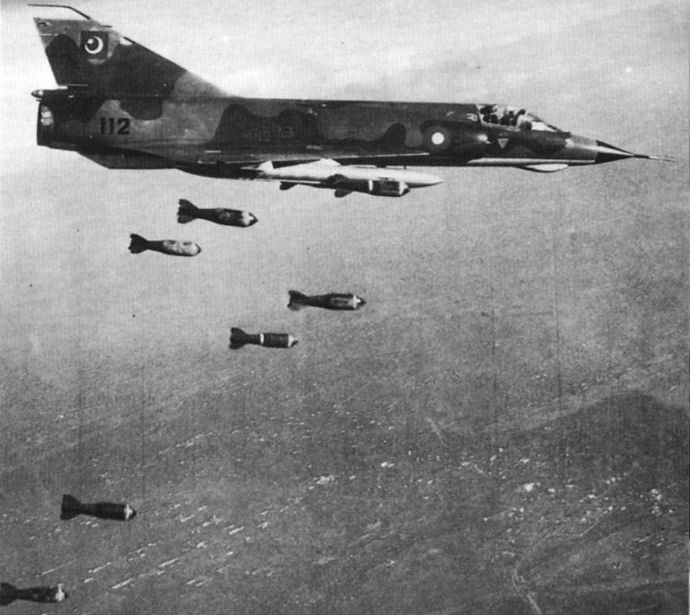

The Dassault Mirage III is a family of single-engine French fighters, built in single- and two-seat form by Dassault Aviation. On 24 October 1958 it became the first Western European combat aircraft to exceed Mach 2 in level flight. Its tailless delta silhouette defined, for two decades, the very idea of an exportable supersonic fighter: affordable, adaptable to almost any mission and, above all, combat-proven. The programme grew out of studies begun by the French Defence Ministry in 1952 and a specification for a lightweight all-weather interceptor able to reach Mach 1.3 in level flight. Dassault's answer, the MD.550 Mystère Delta, first flew on 25 June 1955 and, renamed Mirage I after a redesign, reached Mach 1.6 with an auxiliary SEPR rocket, but proved too small to carry useful armament. Having dropped the interim Mirage II, the company committed to a design some 30 per cent heavier built around the new Snecma Atar turbojet, itself of German ancestry. The Mirage III prototype flew on 17 November 1956; ten longer, larger-winged pre-production Mirage IIIAs followed, and one of them set the Mach 2.2 record. The tailless delta layout, with 60° of sweep and a 5 per cent thickness ratio, is both its virtue and its limit: with no horizontal stabiliser there is no room for conventional flaps, hence the long take-off runs and high landing speeds; in exchange it is simple, rugged and very fast in a straight line. The fuselage applied the area rule, source of its wasp-waisted profile. The Mirage IIIE is 15.03 m long with an 8.22 m span and a maximum take-off weight of 13,700 kg; its Atar 09C gives 60.8 kN in afterburner and 2,350 km/h (Mach 2.2) at 12,000 m, with a 17,000 m ceiling, two 30 mm DEFA 552 cannon and up to 4,000 kg of stores on five hardpoints. After the pre-production IIIA came the IIIC, the first production model and a pure interceptor, which flew in October 1960; the Armée de l'Air took 95 from July 1961 and kept them in service until 1988. The two-seat IIIB trainer was developed alongside it, stretched by about a metre and stripped of cannon and radar, with 63 ordered by France. The multirole, strike-capable IIIE flew on 5 April 1961 with a longer forward fuselage, Cyrano II air-to-air/air-to-ground radar and the Atar 09C: 192 went to the Armée de l'Air and by 1971 it was the most widely exported version. From it came the two-seat IIID and the IIIR reconnaissance aircraft, whose nose carried up to five OMERA cameras in place of radar. The Mirage III's reputation was made in combat. In the Six-Day War of June 1967, with a dozen aircraft held back for air defence and the rest attacking Arab air bases, 48 of the 58 air-to-air kills claimed by Israel were credited to Mirage pilots. In the 1973 Yom Kippur War the fleet flew air-to-air missions exclusively, and the figures conflict: ACIG.org holds that at least 26 Mirages and Neshers were lost in aerial combat, while official Israeli sources acknowledge only five aircraft downed in dogfights; Israel in turn claimed 106 Syrian and Egyptian aircraft shot down by Mirage IIICJs and a further 140 by Neshers. In the South African Border War the type formed the bulk of the fighter force, criticised for its short range but used for reconnaissance over Angola; Pakistan took it to the 1971 war and as late as Operation Swift Retort in 2019; and Argentina deployed its IIIEAs in the Falklands, where the lack of aerial refuelling left them barely five minutes over the combat area. Its international spread was vast. Australia built the Mirage IIIO under licence at the Government Aircraft Factories and Switzerland the IIIS at F+W Emmen, whose cost overruns led to the political scandal known as the "Mirage affair" and cut the run to 36 IIIS and 18 IIIRS. The same root produced the Mirage 5 attack aircraft, the Israeli Nesher born of the 1969 French embargo and later sold to Argentina as the Dagger, the Kfir, South Africa's Atlas Cheetah — a deep upgrade using Kfir technology, retired in 2008 — and Pakistan's Project ROSE, which renewed the avionics of second-hand airframes. Published production figures do not agree: the type's data panel gives 1,422 airframes, while the text puts at 1,403 the Mirage III/5/50s of all models built by Dassault, licence production aside. Australia withdrew the type in 1988 and sold fifty aircraft to Pakistan, and Switzerland followed in 1999; Pakistan remains today the only active military operator, with 49 aircraft listed.
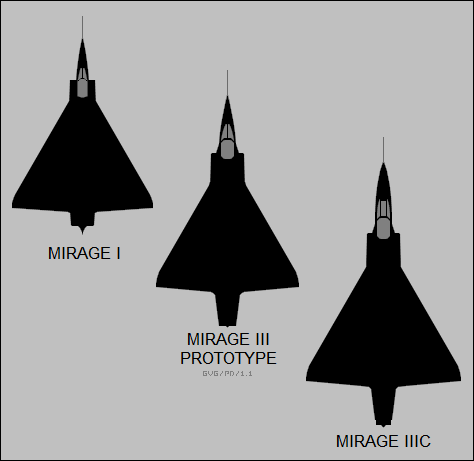
Three-view drawing
_del_Dassault_Mirage_III.png)
History
The story of the Mirage III begins before the aircraft itself, in the effort with which France rebuilt its jet engine industry after 1945. The turbojet that would eventually push the fighter through Mach 2, the SNECMA Atar, did not originate in a French drawing office but in the deliberate absorption of a German design team. Hermann Oestrich's group, responsible for developing the BMW 003, had moved in February 1945 to Stassfurt, near Magdeburg, where C. G. Rheinhardt was setting up an underground engine factory in a salt mine — the same mine known historically for having stored uranium compounds for the Nazi atomic bomb programme — in a desperate attempt to keep production going under the Allied bombing campaign. Stassfurt surrendered to US forces on 12 April 1945; Oestrich had hidden much of the technical data in a local cemetery and handed it over the next day to a ten-man team made up primarily of Pratt & Whitney engineers. Production briefly restarted for American use, and US forces cleared out the factory while they waited to turn the area over to the Soviets.
Oestrich was moved to Munich for further interrogation and from there to England at the request of the British engine designer Roy Fedden, who set him to work on a turboprop for a proposed four-engine transport of the C-54 Skymaster class. It was during that work that French DGER agents secretly approached him with an offer to continue development of the 003 in France: French forces had found a number of BMW 003 turbojets in their occupation zone and were interested in setting up a production line. The discussions had not progressed far when he was allowed to return to Munich; he was brought back to England in late August, then returned to Munich again, where the Americans offered him and a hand-picked team jobs in the United States, but without their families. Oestrich accepted the French invitation instead, and by September he had been installed in the former Dornier factories at Rickenbach, in the French Zone close to the northern border of Switzerland. Other former BMW engineers joined him, along with men from several other German firms, bringing the team to about two hundred. The group was named the Atelier Technique Aéronautique Rickenbach — ATAR — and that acronym gave the engine its name. By October they had re-engineered the 003 design as the ATAR 101 (model R.101) and were granted a production contract on the proviso that manufacture would actually be carried out in France; in January a five-year contract was offered to the entire team, with protected wages, provisions for their families, few travel restrictions and the possibility of French citizenship. It was signed on 25 April 1946, and the ATAR 101 drawings went to SNECMA for production. One discrepancy in the sources must be flagged: the lead of the material devoted to the Atar derives the engine from the German BMW 018 design, whereas the historical narrative within that same material and the Mirage III article both derive it from the BMW 003, and the Atar text itself describes the re-engineering of the 003 as the ATAR 101.
The trigger for the programme was a lesson from the Korean War. The Soviet-built MiG-15 had drawn considerable international attention, and several nations became interested in the prospects of a light fighter — a relatively uncomplicated, heavily armed, swept-wing jet — spurred by the speed of Soviet advances in aircraft capability. France was among the quickest governments to encourage the development of such an aircraft, alongside the United Kingdom (which produced the Folland Gnat), the United States (the Douglas A-4 Skyhawk) and Italy (the Fiat G.91). On the date and exact content of the specification the sources disagree: the English-language material places both the start of the French Defence Ministry studies and the issue of the specification in 1952, and describes a lightweight all-weather interceptor able to climb to 18,000 metres (59,100 ft) in six minutes and to reach Mach 1.3 in level flight; the French-language material places the Armée de l'Air requirement at the beginning of 1953 and describes a light fighter of four tonnes empty, able to climb to 15,000 metres in four minutes and likewise to reach Mach 1.3 in level flight. They also differ on the number of respondents: the English source names three manufacturers — Dassault with the MD.550 Mystère-Delta, Sud-Est with the SE.212 Durandal and Sud-Ouest with the SO.9000 Trident — while the French source says seven manufacturers replied, Dassault among them.
Dassault's submission was a small twin-engined delta. The contract for the study, construction and development of two twin-jet, rocket-boosted MD 550 prototypes was notified on 22 March 1953, and the aircraft were ordered in March 1954, intended to be powered by two Turbomeca Gabizo turbojets of 1,090 kgp (1,510 kgp with afterburning) plus a SEPR.66 rocket. When the Gabizo proved not to be ready, Dassault fell back on two Armstrong Siddeley Vipers of 795 kgp, licence-built under the designation MD 30R, and fitted the SEPR 66 rocket to provide supplementary acceleration in the climb. The thrust figures do not fully agree across sources: the English material credits each afterburning MD30R Viper with 9.61 kN (2,160 lbf), a figure consistent with the 1,000 kg per engine that the French material gives once afterburner nozzles were fitted, but it assigns the SEPR 66 a boost thrust of only 4.7 kN (1,100 lbf) against the 1,500 kgp declared by the French material; the discrepancy is recorded here and not resolved. The layout was a tailless delta with a 5 per cent thickness ratio and 60° of sweep, topped by a large vertical stabilizer and rudder. The pilot sat in a raised position with an unobstructed view, thanks to the air intakes being set well back, and the tapered nose was designed to house a radar.
The MD 550-01 made its maiden flight on 25 June 1955 at 8:50 from Melun-Villaroche, with Roland Glavany at the controls; the flight lasted twenty minutes and the aircraft climbed to 3,000 feet, and a second flight was made the same day. On those first flights it had neither afterburners nor rocket, and in that configuration the English source credits it with a maximum speed of Mach 1.15, while the French source records Mach 0.95 in a dive on the fourth flight, on 24 July. Testing ran for six months, during which the prototype received a number of modifications and reached Mach 1.3 in level flight and Mach 1.6 with the SEPR 66 liquid-propellant rocket motor. An internal inconsistency in the English material must be declared here: it dates the unassisted Mach 1.3 in level flight to "late 1954" and places the whole test campaign in which Mach 1.6 was reached over the course of 1954 — both of which precede the aircraft's own first flight, which the same text dates to 25 June 1955. The French material, which is internally consistent, places those marks within the six months of testing that followed June 1955.
In February 1956 the aircraft was given the new designation Mirage. By early May of that year the modifications were complete: it carried a new swept fin (the so-called "F fin") and modified elevon servo controls, the MD 30R engines had received afterburner nozzles that raised unit thrust to 1,000 kg, and the air intakes had been redesigned with a smaller cross-section to suit high Mach numbers and the afterburning Viper. The changes added 400 kg, bringing empty weight to 3,610 kg, and the aircraft flew again on 5 May 1956 using afterburner for the first time. The sources also differ on the fin: the English material describes the redesign as a reduction in size of a vertical stabilizer that had been unusually large on the first prototype, whereas the French material describes a new swept fin. It was at this point that the MD 550-01 became the Mirage I and the MD 550-02 the Mirage II.
The Mirage I went nowhere as a fighter, and the reasons illustrate exactly what the light fighter formula could and could not deliver. According to the aviation author John F. Brindley, testing of the Mirage I and of the rival Trident and Durandal designs had demonstrated the limitations of the light fighter concept on two fronts: endurance and equipment/payload capacity. The Mirage I's small size restricted its armament to a single air-to-air missile, and it was decided during flight trials that the aircraft was simply too small to carry a useful armament. The French account adds the institutional move: in July 1956 the Armée de l'Air amended its tender and abandoned prototype development, because the appearance of supersonic bombers was shifting the effort towards a more complex but higher-performing aircraft. On the prototype's ultimate fate the sources again disagree: the English material says that once flying trials were complete the Mirage I was eventually scrapped, while the French material says its flight testing was maintained until May 1957 as a supporting effort for the Mirage IV bomber project, after which the aircraft was ferried to Brétigny for storage. They agree on the verdict: the Mirage I programme had served to evaluate the delta formula.
Dassault wanted a successor. An enlarged version, the Mirage II, was considered, which according to the English material would have been fitted with a pair of Turbomeca Gabizo turbojets — the very engines originally intended for the MD 550 and not ready in time — and the MD 610 Cavalier was also studied in three versions; but the Mirage II remained unbuilt, bypassed for an even more ambitious design, 30 per cent heavier than the original Mirage I and powered by a single newly developed SNECMA Atar afterburning turbojet capable of up to 43.2 kN (9,700 lbf). The French account describes the same fork from the hardware side: the MD 550-02 was left unfinished, but Dassault funded from its own resources an MD 550-03 that reused the 02's wing on a fuselage shaped to the area rule and reduced the powerplant to a single SNECMA Atar 101-G of 4,400 kgp. That MD 550-03 was designated Mirage III. In parallel an even larger heavy fighter was drafted, referred to as the Mirage IV. The decisive factor was the interest of the French military itself, which made its preference for the Mirage III proposal known to the company.
The Mirage III incorporated a number of new design principles, notably the transonic area rule, whereby changes in an aircraft's cross-section are made as gradual as possible — the origin of the famous "wasp waist" of so many supersonic fighters. Like its predecessor, it retained provision for a booster rocket engine. The Mirage III 001 prototype made its first flight on 17 November 1956, and on its tenth flight it momentarily reached Mach 1.52, an upper limit imposed by the shape of the air intakes. In July 1957 the intakes were fitted with a pair of manually operated half-cone shock diffusers — the celebrated souris, or "mice" — which could be moved forward as Mach number increased, ensuring that the fuselage oblique shock remained outside the intake lip and thereby reducing inlet pressure losses. Their addition allowed Mach 1.65 to be reached in level flight on 19 September 1957, a figure raised to Mach 1.8 with the supplementary SEPR 66 rocket, the same unit that had equipped the Mirage I.
The prototype's success translated into an order for ten pre-production aircraft, placed as early as May 1957 and designated Mirage IIIA. They were appreciably larger in order to house all the necessary equipment: the French material specifies a fuselage stretch of 1.40 metres and a span increase of 0.64 metres, while the English material sums it up by saying the IIIA was almost two metres longer than the Mirage III prototype. The wing grew by 17.3 per cent in area and its chord thickness was reduced to 4.5 per cent, and the engine became an Atar 09B capable of 58.9 kN (13,200 lbf) with afterburning. The rocket motor was retained, now the SEPR 841. The IIIA also received a Thomson-CSF Cyrano Ibis air intercept radar, operational-standard avionics and a drag chute to shorten its landing roll. The first pre-production aircraft, A 001, flew on 12 May 1958 with Roland Glavany at the controls, and on 24 October of that same year, with the same pilot, it reached Mach 2. On that figure the sources qualify things differently: the English material says the aircraft achieved a top speed of Mach 2.2 during that October flight, while the French material says it reached Mach 2 that day and that Mach 2.2 was finally attained later in the test campaign using the SEPR acceleration rocket. What is not in dispute is the consequence: the Mirage IIIA became the first Western European combat aircraft to exceed Mach 2 in level flight, and the record of the Musée de l'Air et de l'Espace, which preserves the aircraft in its Hall des prototypes, describes it as the first French aircraft to pass Mach 2 under official supervision.
The pre-production campaign divided the labour: each of the ten aircraft took part in a specific phase of the programme in order to accelerate development. In June 1959 Mirage IIIA number 3 set a new closed-circuit speed record over 100 km; in October 1960 an accident cost the loss of number 5. In December 1959 the tenth and final IIIA was rolled out, and the last six aircraft of the batch were largely representative of the subsequent initial production standard. The test regime covered evaluation of the newer SEPR 841 rocket motor, various underwing drop tanks and other major systems. One Mirage IIIA was powered by a Rolls-Royce Avon 67 of 71.1 kN (16,000 lbf) to serve as a test aircraft for the Australian evaluation, and was given the Mirage IIIO designation; it flew in February 1961, but the Avon powerplant was ultimately not adopted on production aircraft.
The decision that defines the aeroplane deserves its own examination: the tailless delta wing. The formula offered clear advantages for what was being asked of it. It is a simple design, easy to construct and relatively robust; it provides generous internal volume within the wing for fuel; and it is capable of achieving high speeds when flown in a straight line. In exchange, it imposed a catalogue of limitations that would follow the Mirage III throughout its operational life. The absence of a horizontal stabilizer meant conventional flaps could not be used, which resulted in a relatively long takeoff run and a high landing speed. The delta wing also limits manoeuvrability and suffers from buffeting at low altitude because of its large wing area and the resulting low wing loading. Hence the aircraft was born with compensating measures built in: provision for the SEPR rocket motor, which supplied the supplementary acceleration that the turbojet alone could not provide in the climb and in high-altitude interception, and the IIIA's drag chute to shorten the landing roll. The later modernisations, with canards and strakes, belong to a much later stage in the type's history.
There was also external confirmation that the delta bet was sound. The British aviation author Derek Wood observed that there was "a striking resemblance" between the MD.550 Delta and the British Fairey Delta 2, an experimental aircraft that first flew on 6 October 1954 and set a new world speed record on 1 March 1956. During the later stages of Fairey Delta 2 testing, in October and November 1956, the FD2 performed 47 low-level supersonic test flights from Cazaux Air Base near Bordeaux, in France. Dassault engineers observed those trials and obtained additional data on the performance and flight characteristics of delta-winged aircraft. The Delta 2 confirmed Dassault's theories and provided further supporting evidence for the viability of the Mirage III development.
The first major production model was the Mirage IIIC, a single-seat interceptor that first flew in October 1960 — the French material specifies 9 October. It was largely similar to the IIIA, less than half a metre longer, but with a full operational fit: a Cyrano I bis fire-control radar, an Atar 09B engine of 6,000 kgp with an eyelid-type variable exhaust, and twin 30 mm DEFA 552 cannon mounted in the belly with the gun ports under the air intakes, with 125 rounds each, enough for six or seven seconds of continuous fire; the French material adds that a one-second burst meant 250 metres covered by the aircraft and some 40 rounds of 240 to 300 grams each containing 50 to 70 grams of explosive, at ranges beyond 1,000 metres. Early production IIICs had three stores pylons, one under the fuselage and one under each wing; another outboard pylon was soon added to each wing for a total of five, excluding a sleek supersonic tank which also had bomb-carrying capacity. The outboard pylon was intended to carry an AIM-9B Sidewinder air-to-air missile, later replaced by the Matra R.550 Magic, while the centreline pylon carried the radar-guided Matra R.530. The repertoire was rounded out by the AS-30L air-to-surface missile, 400 kg bombs, two JL100 rocket pods with 18 SNEB 68 mm rockets apiece, and the ability to carry a tactical nuclear bomb — American by default, since the French nuclear arsenal had not yet been built.
IIIC deliveries began in July 1961 and the first squadron was declared operational in January 1962. The aircraft carried a number of teething troubles, notably a somewhat fragile undercarriage that led to several temporary groundings. The French Air Force took 95 Mirage IIICs and kept them in service until 1988; of those 95, 55 were destroyed or written off as a result of accidents over roughly twenty-five years, a figure that gives the measure of what it actually cost to operate a tailless delta of that generation.
Alongside the interceptor, the Armée de l'Air ordered a two-seat operational trainer, the Mirage IIIB, whose first flight the sources date to either 21 October 1959 (English material) or 20 October 1959 (French material). The fuselage was stretched to accommodate the second seat, and here too the figures diverge: about 58 cm according to the French source, about a metre (3 ft 3.5 in) according to the English one. Both cannon and the radar were removed, and provision for the SEPR rocket was deleted as well, although the aircraft could carry external stores if desired. The Armée de l'Air ordered 63 Mirage IIIBs including the prototype, among them five IIIB-1 trials aircraft, ten IIIB-2(RV) inflight refuelling trainers with dummy nose probes used to train Mirage IVA bomber crews, and twenty IIIBEs with the engine and some other features of the multi-role Mirage IIIE; the IIIBE carried a navigation radar but still had no fire-control radar, and was recognisable by its tapered nose. One IIIB was fitted with a fly-by-wire flight control system in the mid-1970s and redesignated Mirage IIIB-SV (Stabilité Variable), serving as a testbed for the system later used in the Mirage 2000.
While the IIIC was heading towards quantity production, Dassault turned its attention to a multirole/strike variant, which materialised as the single-seat Mirage IIIE; the two-seat trainer derived from it for export received the Mirage IIID designation. The first of a batch of three prototypes flew on 5 April 1961. The IIIE differed considerably from the IIIC interceptor: it had a 300 mm (12 in) forward fuselage extension to increase the size of the avionics bay directly behind the cockpit, a stretch that also allowed fuel capacity to be expanded — deemed necessary after several pilots had criticised the IIIC for being quite limited in range. Many IIIEs were fitted with a British-built Marconi continuous-wave Doppler navigation radar radome on the underside of the fuselage beneath the cockpit, something no Mirage IIIC ever carried; the French source specifies that this Doppler radar was coupled to a navigation computer and a TACAN receiver. An equally inconsistent variation was the presence or absence of a high-frequency antenna fitted as a forward extension to the vertical tailplane: on some Mirages the leading edge of the fin was a straight line, while on those with the HF antenna it had a sloping forward extension. The extension appears to have been generally standard on production Mirage IIIAs and IIICs, but appeared only on some of the Mirage IIIE's export versions. The IIIE carried the Thomson-CSF Cyrano II dual-mode air/ground radar, a radar warning receiver with its antennas mounted in the vertical tailplane, and an Atar 09C engine of 6,200 kgp with a petal-style variable exhaust. The first production Mirage IIIE was delivered to the Armée de l'Air on 14 January 1964, and over time 192 aircraft were delivered to that service. In 1973 the French IIIE gained the ability to carry the French AN-52 tactical nuclear weapon, and in 1976 the Matra R550 Magic short-range air-to-air missile. By 1971 the IIIE had become the most widely exported version of the aircraft.
The reconnaissance branch was grouped under the general designation Mirage IIIR. These aircraft used the stretched Mirage IIIE airframe but were furnished with the avionics of the Mirage IIIC, and replaced the radar — for which there was no room in the nose — with a purpose-developed camera nose accommodating up to five OMERA cameras usable by day or by night. On the cannon there is a nuance the sources do not tell the same way: the English material states that the IIIR retained the twin DEFA guns and all compatibility with external stores, while the French material says the guns were not normally fitted but could be installed if required. An improved variant, the Mirage IIIRD, was developed later: essentially a IIIR with an extra panoramic camera in the most forward nose position, the Doppler radar and other avionics of the IIIE, and provision for carrying an infrared linescan or a side-looking airborne radar in an under-fuselage pod. In response to Armée de l'Air interest in a reconnaissance model, Dassault proceeded with a pair of prototypes: the first flew on 31 October 1961, and the first production-standard aircraft followed on 1 February 1963. The service opted for 50 production Mirage IIIRs and later ordered a further 20 IIIRDs. One point of sequence is worth retaining: the Mirage IIIR preceded the Mirage IIIE in operational introduction.
Series production was organised around four principal versions and reached a rate of up to twenty aircraft per month. The work was shared between Dassault GAMD as prime contractor and a number of partners and subcontractors, among them SNCAN, SNECMA, Avions Louis Breguet and Hispano-Suiza. The RAND Corporation estimated that as many as 32,000 people were involved in the programme, of whom 5,000 were Dassault employees — roughly a third of the personnel of the entire French aerospace industry in the 1960s. On the total number built the sources do not agree, and the discrepancy must be declared: the type record in the Spanish-language material gives 1,422 aircraft in various variants, including derivatives such as the Nesher and the Kfir; the body of the English-language article states that 1,403 Mirage III/5/50 aircraft of all types were built by Dassault; the French material speaks of 1,401 examples built if the versions designated Mirage 5 are taken into account; and the Musée de l'Air et de l'Espace record simply says that more than 1,400 units of the production versions of the Mirage III and V were built. The French source further puts the number exported at close to 950.
Export was, indeed, the defining feature of the programme. The largest customers for French-built Mirage IIICs were Israel, whose principal variant was the Mirage IIICJ, and South Africa, the bulk of whose fleet was the Mirage IIICZ; the material details that Israel received 70 single-seat Mirage IIICJs between April 1962 and July 1964, two Mirage IIIRJ photo-reconnaissance aircraft in March 1964, and four Mirage IIIBJ two-seat combat trainers, three in 1966 and one in 1968, while South Africa received 16 Mirage IIICZs between December 1962 and March 1964. Switzerland bought a single Mirage IIICS in 1962 for evaluation and test purposes. Several customers obtained the Mirage IIIB with designations changed only to carry a country code: IIIDA for Argentina, IIIDBR for Brazil, IIIBJ for Israel, IIIBL for Lebanon (two built), IIIDP for Pakistan, IIIBZ, IIIDZ and IIID2Z for South Africa, IIIDE for Spain and IIIDV for Venezuela. A good number of Mirage IIIEs were built for export as well, purchased in small numbers by Argentina as the Mirage IIIEA, Brazil as the IIIEBR, Lebanon as the IIIEL, Pakistan as the IIIEP, South Africa as the IIIEZ, Spain as the IIIEE and Venezuela as the IIIEV, each with its own list of sub-designations and minor variations in equipment fit. Dassault believed the customer was always right and was happy to accommodate changes in equipment fit as customer needs and budgets required. Reconnaissance versions were exported as the IIIRP and IIIRP2 to Pakistan and as the IIIRZ and IIIR2Z to South Africa — the latter with the Atar 9K-50 engine — and reconnaissance Mirages were purchased by Abu Dhabi, Belgium, Colombia, Egypt, Libya, Pakistan and South Africa, with some export IIIRDs fitted with British Vinten cameras rather than OMERA units and most of the Belgian aircraft built locally. New-build two-seaters under the generic Mirage IIID designation went to Abu Dhabi, Argentina, Brazil, Chile, Colombia, Egypt, Gabon, Libya, Pakistan, Peru, Spain, Venezuela and Zaire, and in some cases the aircraft were literally surplus: two French Air Force Mirage IIIBEs were sold to Brazil as the Mirage IIIBBR and three to Egypt as the Mirage 5SDD.
Behind that commercial success lay a political machine. According to Brindley, a key element of the Mirage III's export success was the extensive support given to Dassault by the French government, to the point that the state would often commence negotiations without involving or informing Dassault at all until a later stage. That same state involvement had its reverse side: France was diplomatically protective of the fighter and frequently forbade purchasing nations from re-exporting their Mirage IIIs to third parties without French consent, under the threat of a prospective embargo. The aircraft attracted attention of another kind as well. During the 1960s the Soviet Union was alleged to have engaged in industrial espionage targeting Dassault and specifically the Mirage III; in one widely reported incident, Soviet agents approached a pilot of the Lebanese Air Force and offered him a bribe to fly one of that country's fourteen Mirage IIIs directly to Soviet territory, an approach the pilot reported to Lebanese counter-intelligence.
Two countries built the Mirage III under licence, and in both cases the aircraft were variants of the Mirage IIIE. Australia first showed official interest in the Mirage III in 1960 as a replacement for its CAC Sabre, and initially considered a version powered by a licence-built Rolls-Royce Avon, the same engine used by the Australian Sabre; an experimental Avon-powered Mirage III was built and flown in trials, but it did not result in the Avon being used on a production variant. The Australian government decided that the Royal Australian Air Force would receive a variant based on the Mirage IIIE and powered by the SNECMA Atar, built under licence by the Government Aircraft Factories (GAF) at Fishermans Bend, Melbourne. Known as the Mirage IIIO or GAF Mirage, the Australian variant differed from the IIIE mainly in its avionics. The other major Australian aircraft manufacturer of the day, the Commonwealth Aircraft Corporation, also based in Melbourne, was involved in the project as well, producing the Atar engine under licence. Dassault initially supplied a pair of pattern aircraft, the first of which flew in March 1963, which were transported to Australia and used to help GAF technicians establish their own assembly line. GAF produced three variants: the Mirage IIIO(F) interceptor, the Mirage IIIO(A) surface attack aircraft and the two-seat Mirage IIIO(D) lead-in fighter trainer, completing 48, 50 and 16 aircraft respectively. Between 1967 and 1979 all surviving Mirage IIIO(F) aircraft were converted to Mirage IIIO(A) standard, reconfiguring them from the interceptor role to ground attack and aerial reconnaissance.
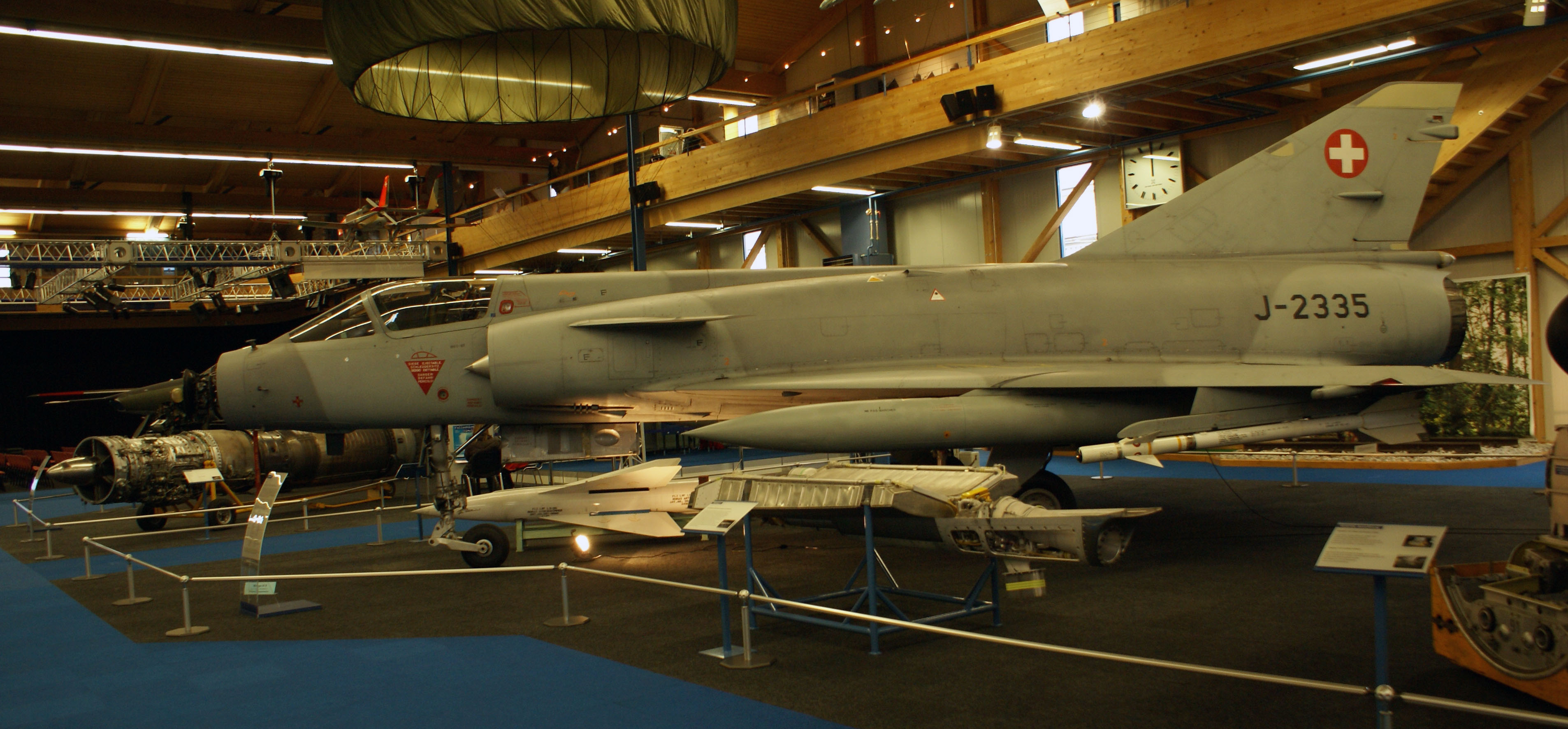
The Swiss case was rougher and left a proper noun behind in the country's politics. In 1961 Switzerland purchased a single Mirage IIIC from France for use as a development aircraft, supporting its intention to produce 100 Mirage III fighters domestically for the Swiss Air Force. The aircraft were manufactured in Switzerland by F+W Emmen — today RUAG, the federal government aircraft factory at Emmen — under the Mirage IIIS designation, conceived to perform the attack, interception and reconnaissance missions in a single model. The venture suffered considerable cost overruns, mainly due to Swiss-mandated customisations and features and compounded by a lack of financial oversight; the controversy over manufacturing cost ultimately culminated in the so-called "Mirage affair" and the resignation of several officials. It also became clear that a single model was not capable of delivering all the desired performance, so F+W Emmen eventually produced only 36 Mirage IIIS interceptors and 18 Mirage IIIRS reconnaissance aircraft, far short of the intended hundred. The scope of the phrase needs to be stated precisely: in the material available, the Swiss "Mirage affair" is a scandal of costs and budgetary control, not of espionage. The industrial-espionage strand usually associated with the name — the case of the Swiss engineer Alfred Frauenknecht — appears in this material only as a bibliographic reference, specifically the Swiss Federal Court appeal verdict in the Frauenknecht case of 3 November 1970, cited as a source in the article on the IAI Nesher; that same article confines itself to saying that, according to official accounts, Israel had already obtained a complete set of drawings and detailed information prior to the embargoes. Without material to develop it further, this text goes no further.
The Swiss Mirage IIIS was far more than a IIIE with different markings. It had considerably strengthened wings, airframe and undercarriage, because the Swiss Air Force required robustness comparable to that of carrier-based aircraft. The reinforced airframes allowed aircraft to be moved by lifting them with a crane — hence the four lifting points, retractable nosecones and lengthened nosewheel legs — because the caverns bored into the mountains that the Swiss Air Force uses as bunkers offer very little room to manoeuvre parked aircraft. Another benefit of the strengthened frames was that they enabled JATO-assisted takeoffs, giving the type a short takeoff and landing capability. The IIIS also carried new American-sourced avionics and a different cockpit design, including a Hughes Aircraft Company TARAN-18 radar, and could be armed with the AIM-4 Falcon air-to-air missile, the Swiss designation of the SAAB licence-built Rb27, which is similar to the Hughes AIM-26 Falcon. It was additionally wired to carry a Swiss- or French-built nuclear bomb; in the event, the Swiss nuclear bomb programme was stopped at the pre-production stage and Switzerland chose not to purchase such weapons from France either. The Mirage IIIRS could carry a centreline pod for photo-reconnaissance as well as an integral fuel tank beneath the aft belly which, carrying a smaller fuel load, allowed a rear-facing film camera to be added; with the reconnaissance pod fitted, supersonic performance was severely diminished. The IIIS could optionally be fitted with a SEPR 844 rocket engine. The Mirage IIIS entered operational service with the Swiss Air Force in 1967, and the Mirage IIIRS followed two years later.
By the mid-1960s, then, the Mirage III was established as the product that would define the French aircraft industry for a generation: a tailless delta of straightforward formula, powered by a turbojet of German lineage re-engineered in France, declined into interceptor, two-seat trainer, all-weather low-level strike aircraft and reconnaissance platform, built at up to twenty aircraft a month with a third of the country's aerospace workforce behind it, sold to well over half a dozen air forces and manufactured under licence on two continents. What it still lacked was the test that would turn a good export product into a commercial phenomenon and a legend: combat. That test would come in June 1967, and its consequences would touch both the aircraft's reputation and the relationship between its manufacturer and one of its principal customers. Rising tensions in the Middle East led French President Charles de Gaulle to embargo the Israeli Mirage 5s on 3 June 1967, two days before the war broke out; the aircraft continued to roll off the production line despite the embargo, and by 1968 the batch was complete and the Israelis had made their final payments. In January 1969, in response to the 1968 Israeli raid on Lebanon, the French government announced that it would impose an arms embargo on Israel; in late 1969 the Israelis, who had pilots in France testing the aircraft, requested that they be released. For many years no official military relations existed between France and Israel, although spare components remained available, and the outcome of those difficulties would be Israel Aircraft Industries' development of the Nesher fighter, based on the Mirage 5.
No other operator worked the Mirage III as hard as Israel, and none did more to build its reputation. The relationship began in 1959, when the Israeli Air Force sent one of its best pilots to fly the Mirage IIIA. His report was enthusiastic, and the aircraft immediately acquired the nickname it would keep throughout its Israeli career: Shahak, "lightning bolt". The enthusiasm came with a doctrinal disagreement that shaped the aircraft's configuration for the rest of its life. Ezer Weizman, then commander-in-chief of the Israeli Air Force, was not looking for a pure interceptor but for a fighter-bomber. Accordingly, Israeli Mirage IIIs dispensed with the SEPR 841 rocket motor that Dassault offered as a climb booster, and the volume freed up in the fuselage went into fitting the two 30 mm cannon and carrying additional fuel. It was a decision taken before a shot had been fired that proved, in hindsight, the single most consequential of the whole programme: the gun would account for more kills than anything else in the type's first decade of service, and the extra fuel was what allowed Israeli Mirages to reach the Egyptian airfields at all.
The figures for the initial order do not agree across the sources consulted. The French documentation records a contract signed in 1960 for 72 Mirage IIICJs, 5 Mirage IIIBs and 2 Mirage IIIRs, delivered between April 1962 and 1968 and equipping five squadrons. The Spanish-language documentation instead records the purchase of 70 Mirage IIICJs and 2 Mirage IIIRJs between 1962 and 1964, plus 4 Mirage IIIBJs between 1966 and 1968. The sources disagree both on the total and on the split between single-seaters, trainers and reconnaissance airframes, and nothing in the captured material allows one series of figures to be preferred over the other. What all versions share is the order of magnitude — around eighty airframes — and the fact that deliveries were spread over six years, so that the force which went to war in 1967 was not yet the complete force.
The type's baptism of fire came early, and in two stages. The Mirage III was first committed to combat on 12 November 1964, in an engagement between the Israeli Air Force and the Syrian army over the Golan Heights. Two days later it fought its first air-to-air engagement proper, and the result was a disappointment: no kill, and the failure was attributed to the missiles. That first frustration is telling, because it anticipates one of the defining features of the aircraft's entire combat career — first-generation guided weapons were far less reliable than their data sheets promised, and the Mirage's real effectiveness would come to rest on the gun and, later, on Israeli-developed infrared missiles. The type's first aerial victory came on 14 July 1965, against a Syrian MiG-21.
The engagement that made the aircraft's name before the war came when a Mirage pilot met two Egyptian MiG-19s attempting to intercept an Israeli Piper J-3 Cub reconnaissance aircraft in Israeli airspace. He shot down both: the first with a radar-guided Matra R.530 fired from less than a mile away — the first aerial kill in the history of that French missile — and the second with cannon fire. Here too the sources disagree on the date: the English-language material places the fight on 29 November 1966, the Spanish-language material on 29 May 1966. The description of the engagement, the aircraft types involved and the sequence of kills match point for point in both versions, so this is one event carried with two irreconcilable dates.
The Six-Day War, fought between 5 and 10 June 1967, was the moment the Mirage III went from being a good fighter to being the fighter that had won a war. The conflict opened with Operation Focus — Moked — the Israeli surprise attack on the Egyptian airfields. At 07:45 Israeli time, with civil defence sirens sounding across the country, the air force launched every operational jet it had but twelve: of nearly two hundred aircraft, all but those twelve went out against the Egyptian bases. The twelve held back were Mirages — four permanently airborne and eight at a high state of readiness on the ground — tasked with defending Israeli skies against attack by hostile bombers. Virtually all the other Mirages were loaded with bombs and sent on strikes against Arab air bases.
The mechanics of the attack explain both why the Mirage's contribution was decisive and why it was so unglamorous in the bombing role. Israeli formations went out over the Mediterranean, flying low to stay below radar cover, before turning toward Egypt; others came in over the Red Sea. The Egyptian defence hobbled itself: much of the air defence system had effectively been shut down out of fear that rebel Egyptian forces might shoot down the aircraft carrying Field Marshal Abdel Hakim Amer and Lt-Gen Sidqi Mahmoud, en route from al Maza to Bir Tamada in Sinai. The precaution made little difference, since the Israeli pilots came in below Egyptian radar cover and well below the lowest altitude at which the SA-2 batteries could engage. The powerful Jordanian radar facility at Ajloun did detect the incoming waves and passed the code word for "war" up the Egyptian chain of command, but Egyptian command and communications problems kept the warning from reaching the targeted airfields. The attack method combined bombing and strafing runs against parked aircraft with runway-disabling tarmac-shredding penetration bombs developed jointly with France, leaving surviving aircraft unable to take off. The runway at al-Arish was deliberately spared, because the Israelis expected to turn it into a military airport for their transports after the war.
The result was devastating. Only four unarmed Egyptian training flights were airborne when the strike began. A total of 338 Egyptian aircraft were destroyed and 100 pilots killed, although the exact Egyptian loss figure is disputed. The losses included all 30 Tu-16 bombers, 27 of 40 Il-28s, 12 Su-7 fighter-bombers, more than 90 MiG-21s, 20 MiG-19s, 25 MiG-17 fighters and around 32 transports and helicopters; Egyptian radars and SAM batteries were also attacked and destroyed. Israel lost 19 aircraft, of which two were destroyed in air-to-air combat and 13 brought down by anti-aircraft artillery. One Israeli aircraft, damaged and unable to break radio silence, was shot down by Israeli Hawk missiles after straying over the Negev Nuclear Research Centre; another was destroyed by an exploding Egyptian bomber. The operation guaranteed Israeli air supremacy for the rest of the war, and attacks on the other Arab air forces followed later the same day as fighting broke out on the remaining fronts.
Within that picture, the verdict on the Mirage III as a bomber was lukewarm. The material records that its performance in that role was modest at best, perhaps because of its limited payload capacity: the aircraft had been conceived as a high-altitude interceptor, and its delta wing, optimised for speed and ceiling, offered neither the external load nor the low-level handling of a purpose-built strike aircraft. As a fighter, the balance was extraordinary. On the first day of combat, six MiGs were claimed shot down by Mirage pilots. Over the following days the Israeli Mirages typically operated as fighters, and out of a claimed total of 58 Arab aircraft shot down in air combat during the conflict, 48 were credited to Mirage pilots. These are Israeli claims, not independently audited tallies, and should be read as such.
The French material preserves an airframe-by-airframe account of Israeli Mirage IIIs lost or damaged over those six days that allows the war to be seen from the other side of the scoreboard. On 5 June a Mirage IIICJ of 101 Squadron was intercepted and shot down near Zagazig, Egypt, by two infrared-guided R-3S missiles fired from an Egyptian MiG-21MF; the pilot ejected and was executed on the ground. The same day, another Mirage IIICJ of 117 Squadron shot down a Syrian MiG-21 and was itself damaged by the explosion and debris of its victim, suffering engine failure on the return flight near Ramat David and forcing the pilot to eject. A third Mirage of 117 Squadron was shot down by anti-aircraft fire during the attack on Damascus air base, killing the pilot; a fourth, also of 117 Squadron, was heavily damaged by flak in the same attack and its pilot ejected over Israel. A fifth was damaged by the explosion of bombs dropped during the attack on the Egyptian air base at Inchas and, escorted by its leader, made it back to Hatzor. On 6 June a Mirage of 119 Squadron was hit by flak while attacking buildings on the Golan Heights, and its wounded pilot managed to land at Ramat David.
On 7 June the fighting shifted to the Iraqi front. Four Israeli Vautours escorted by two Mirages struck the H-3 airfield again, leaving one Hunter crashed on take-off and another Hunter and a MiG-21 damaged in air combat; later the same day, four Vautours escorted by four Mirages attacked H-3 for the third time. One Iraqi Hunter was shot down and its pilot killed, while the Israelis lost two Vautours and one Mirage, with three crewmen dead and two taken prisoner. The French loss list identifies that aircraft as Mirage IIICJ No. 60 of 101 Squadron, downed by a Hawker Hunter near H-3, the pilot ejecting and being captured. Also on 7 June, Mirage IIICJ No. 84 of 101 Squadron was hit and destroyed by an SA-2 over western Sinai while intercepting an Il-28, and No. 29 of 117 Squadron, returning from a search for a pilot downed over H-3, took an R-3S from a Syrian MiG-21 and still made it into Megiddo, where it was repaired. On 8 June a Mirage of 101 Squadron ran out of fuel after an engagement with an Egyptian MiG-21 over northern Sinai and its pilot was rescued, while another was shot down by an SA-2 or by flak during a ground attack, killing the pilot. On 10 June, the last day, a Mirage of 119 Squadron was lost over the Golan to Syrian anti-aircraft fire or to the explosion of the truck it was attacking; the pilot was picked up by an S-58 helicopter.
Reading the two sets of data together is more instructive than either alone. The Israeli pilots' outstanding results coexisted with a list of technical defects the air force itself recorded once the campaign was over: engine reliability problems, radar reliability problems and problems with gun accuracy. Israel introduced local modifications to correct part of these shortcomings, the most significant being the replacement of the Atar 9B by the Atar 9C-3 in the Mirage IIICJ fleet in the early 1970s. Some Mirage IIICJs were also temporarily converted for reconnaissance, receiving a completely redesigned nose to house the necessary equipment. And above all the technical consequences came a political one: France imposed an arms embargo on the region after the 1967 war, forcing Israel to maintain and update its fleet on its own and setting in motion the chain of events that would lead to the indigenous derivatives.
Between the summer of 1967 and August 1970 came the War of Attrition, a low-intensity, high-frequency conflict along the Suez Canal and the Syrian border in which the Israeli Mirage III accumulated more real combat hours than in the two conventional wars combined. The list of aircraft damaged or lost in that period draws a precise picture of how those engagements went. On 15 July 1967, in a fight pitting two Mirages against eight MiG-21s near the Israeli-Syrian border, Mirage IIICJ No. 20 of 119 Squadron was hit by an R-3S and its pilot ejected over Israel. On 3 November 1968 a Mirage IIICJ intercepting MiG-17s escorted by MiG-21s over the Nile delta was damaged by an R-3S and repaired. On 8 March 1969, the first day of the declared phase of the War of Attrition, four MiG-21PFs intercepted two Mirage IIICJs of 101 Squadron on patrol along the Suez Canal: one Mirage was damaged by an R-3S impact but returned to base, and one MiG was shot down in the fight.
On 14 April 1969 two Mirages intercepting an Su-7 were engaged by four MiG-21PFs over Sinai; one Mirage shot down a MiG-21 with an AIM-9B and the other damaged a second MiG-21, also with a Sidewinder, while Mirage IIICJ No. 68 of 119 Squadron took an R-3S and landed damaged at Refidim. On 26 June 1969 a Mirage IIICJ was shot down by an R-3S fired from an Egyptian MiG-21FL in the Suez region. On 20 July 1969 two Mirage IIICJs of 101 Squadron, Nos. 45 and 56, were both lost in combat with Egyptian MiG-21s over Sinai, both to R-3S missiles — the second is sometimes listed as downed by anti-aircraft fire, a discrepancy the material itself notes — and both pilots ejected and were rescued. On 11 September 1969 Mirage IIICJ No. 18 of 119 Squadron went down at Mansoura to an R-3S, again with the missile-or-flak question unresolved, and its pilot was wounded and captured. On 11 December 1969 Mirage IIICJ No. 83 of 119 Squadron shot down a Syrian MiG-17F with cannon over the Golan and was damaged by its victim's debris, reaching Ramat David with the engine out.
The year 1970 was the hardest. On 2 February a Mirage IIICJ of 117 Squadron was hit and destroyed by Syrian flak and its pilot killed. On 9 February No. 57 of 101 Squadron was shot down by an R-3S from Egyptian MiG-21PFs north of Suez and its pilot taken prisoner. On 2 March No. 70 of 117 Squadron was severely damaged by Egyptian flak in the Suez region and its pilot ejected near Refidim. On 26 June No. 31 of 117 Squadron evaded two R-3S missiles fired by two Syrian MiG-21s over the Golan, only for its engine to flame out and the aircraft to enter a spin; the pilot ejected and was captured. And on 30 July 1970, during an ambush mission flown jointly with an F-4E against Soviet MiGs of the 135th Fighter Aviation Regiment, Mirage IIICJ No. 68 of 119 Squadron — the same airframe damaged in April 1969 — was hit by an R-3S in the Suez region, landed at Refidim and was repaired. That last action has particular documentary value: it places the Mirage III fighting not Arab pilots but Soviet crews deployed in Egypt, in one of the few direct clashes between Western hardware and USSR aircrew during the Cold War.
Two patterns run through the whole list and describe how this aircraft was fought better than any general appraisal. The first is that the R-3S — the Soviet infrared Atoll, itself a copy of the Sidewinder — was overwhelmingly the cause of Israeli air-combat losses and damage: it appears in almost every entry. The second is the high proportion of aircraft that were hit and still came home to be repaired. An aircraft that returns with an infrared missile hit in the tail section and lands at a forward Sinai base is an aircraft with structural margin and an engine able to keep running while damaged, and that toughness, together with ease of maintenance in the field, explains much of the availability the Israeli Air Force managed to sustain through three years of continuous attrition. The Yom Kippur War, fought between 6 and 25 October 1973, found the Israeli Mirage III in a different role from the one it had played in 1967. This time the fleet was engaged solely in air-to-air operations: ground attack had passed to the A-4 Skyhawk and the F-4 Phantom, and the Mirage, with its delta wing and its thrust, was reserved for air superiority — precisely what Dassault had designed it to do. One peculiarity of the conflict forced an urgent identification measure. Israeli pilots found themselves facing Mirage 5s in Arab hands — Libya, which had forces stationed in Egypt before the war broke out, contributed an armoured brigade and two squadrons of Mirage V fighters, one of which was to be flown by Egyptian crews — while they themselves flew Mirage IIIs and the indigenous Nesher, of near-identical silhouette. The solution was immediate and crude: orange triangles painted on the wings of Israeli aircraft so that they could be identified instantly and tragic mistakes avoided in the middle of a turning fight.
The figures for this war are the most delicate point in the type's entire combat history, and the captured material requires them to be set out for what they are: competing claims, not established facts. Israel claimed 106 Syrian and Egyptian aircraft shot down by Mirage IIICJs and a further 140 by the Nesher derivative. As to its own losses, formal Israeli sources maintain that only five Israeli Air Force aircraft were shot down in air-to-air combat during the whole war. Against that figure, ACIG.org — the Air Combat Information Group — states that at least 26 Mirages and Neshers were lost in air-to-air combat in the same conflict. The gap between five and twenty-six cannot be reconciled: either the Israeli accounting excludes categories of loss that the other includes, or one of the two series is simply wrong. None of the material consulted resolves the contradiction, and the encyclopaedic record itself flags the ACIG statement with a source-reliability warning. Both are therefore recorded here, attributed to whoever asserts them, without choosing between them.
The French loss register offers a third line of evidence, in the form of a dated list of individual airframes that helps show where the discrepancy might come from. On 8 October 1973 a Nesher of 101 Squadron was shot down over Syria by an R-3S fired from an Egyptian MiG-21MF, its pilot ejecting and being recovered — the same pilot would be shot down and rescued again on 10 October and once more on 6 May 1974. The same day, Mirage IIICJ No. 58 of 101 Squadron was shot down over Syria by an Iraqi Hawker Hunter. On 9 October Mirage IIICJ No. 25 of 117 Squadron fell in Syria to an SA-3 and its pilot was taken prisoner. On 10 October a Nesher of 113 Squadron was downed by Egyptian flak after a fight with a MiG-17, and Mirage IIICJ No. 78 of 117 Squadron by Syrian flak. On 17 October No. 14 of 117 Squadron ran out of fuel after a fight with a Syrian MiG-21 and its pilot ejected over the sea off the Israeli coast. On 18 October a Mirage IIICJ of 101 Squadron was damaged by the explosion and debris of an Egyptian MiG-17 shot down by a Shafrir 2 fired from a Nesher of 113 Squadron, and was repaired. On 20 October Nesher No. 31 of 101 Squadron was intercepted by an Egyptian MiG-21 and destroyed by an R-3S over Sinai. On 21 October Nesher No. 76 of 101 Squadron went down over Sinai to either an SA-6 or flak, and the same day another Nesher was shot down by a Syrian MiG-21MF. On 22 October six Neshers were shot down by Syrian MiG-21MFs, and on 23 October two more. Finally, on 26 October, after the ceasefire, a Mirage IIICJ was shot down by a Syrian MiG-21MF.
That tally alone yields well over a dozen Mirages and Neshers lost in air-to-air combat, far more than the five formally acknowledged and fewer than ACIG's twenty-six, which suggests the official Israeli figure may cover a narrower category — perhaps only certain types, or only kills by fighters rather than by surface-to-air missiles — though the material does not say so. What the list does make clear is the mix of threats the type faced in 1973: fighter-launched infrared missiles, SA-3 and SA-6 surface-to-air missiles, anti-aircraft artillery, and fighters of other Arab states such as the Iraqi Hunters. The Mirage III also routinely fought alongside the Nesher, to the point that the statistics of the two types are merged in almost every source.
The sequence of losses did not end with the ceasefire. Between April and June 1974, during the subsequent fighting on the Syrian front, the Israeli Air Force lost several more Mirages: on 15 April, Mirage IIICJ No. 52 of 101 Squadron, downed by an R-3S from a Syrian MiG-21 over Syria, and another Mirage IIICJ the record notes with a question mark, also against a Syrian MiG-21; on 19 April another Mirage IIICJ to a Syrian MiG-21MF; on 26 April a Mirage IIIRJ reconnaissance aircraft to a Syrian MiG-21F-13; on 6 May Mirage IIICJ No. 99 of 101 Squadron, hit over Syria by a surface-to-air missile, possibly an SA-3, with the pilot rescued; and on 4 June another Mirage IIICJ to a Syrian MiG-21MF. The list also contains an anomalous entry that should be flagged as such: the register logs a Mirage IIICJ shot down on 26 April 1974 by a "Pakistani MiG-21F-13", an attribution that fits nothing else in the material and cannot be taken at face value without further verification.
The overall balance of the type's Israeli career, as the French material sums it up, is that of one of the most successful second-generation fighters in the history of air combat: close to three hundred confirmed victories and around forty unconfirmed credited to Israeli Mirage IIIs, against roughly fifty airframes lost in twenty years to combat and accidents combined. The personal emblem of that career is Giora Epstein, regarded as the ace of aces of the supersonic jet era, who scored all of his victories flying either the Mirage IIICJ or the Nesher; the French record specifies that nine of his seventeen confirmed kills were obtained on the Mirage III. Israel's Mirage IIIs were withdrawn from service in the early 1980s, and their surviving airframes found a second life in South America.
The type's second great combat career was written in Pakistan. The Pakistan Air Force received its first Mirage IIIs in 1968, from an initial order for 18 Mirage IIIEs, 13 Mirage IIIR reconnaissance aircraft and 3 Mirage IIID trainers, to which an order for 64 Mirage 5s in various configurations was added some years later. When the third Indo-Pakistani war broke out, between 3 and 16 December 1971, those aircraft were the most modern items in the Pakistani inventory and were used accordingly. PAF Mirages took part in the pre-emptive strikes that opened the campaign and claimed the first aerial victories of the war on the western front, against Indian Air Force English Electric Canberra bombers and reconnaissance aircraft, as well as against Su-7s and Hawker Hunters. Throughout the war they were frequently employed on airfield interdiction, strike and combat air patrol missions, while close air support and battlefield air interdiction were handled by F-86 Sabres and Shenyang F-6Ps. The French loss register notes a single Pakistani Mirage III EP shot down in the war, on 11 December 1971, by an Indian Folland Gnat F.Mk.1, with the pilot's death recorded with a question mark. The French summary credits Pakistani Mirage IIIs with at least three aerial victories in that conflict.
The Mirage III remained a major frontline type for the Pakistan Air Force through the 1970s and 1980s, and in that capacity took up the early combat air patrols near the Afghan border following the Soviet invasion of Afghanistan. During those missions two MiG-21s of the Afghan air force were claimed by Mirage IIIs of No. 5 Squadron, in actions dated 16 April and 10 May 1986, but neither kill was ever confirmed. The type was also allegedly deployed against the Northern Alliance, and during the war on terror Pakistani Mirage III and Mirage V jets were deployed to Khyber Pakhtunkhwa province after the spillover of militants from Afghanistan in 2001, flying close air support missions throughout the conflict.
The last documented combat action of the type in the material is also one of the most recent of any Mirage III anywhere. In February 2019 the Indian Air Force bombed an alleged terrorist training camp at Balakot after violating Pakistani airspace. In response, then Prime Minister Imran Khan ordered the Pakistan Air Force to carry out retaliatory strikes on Indian military installations in Indian-administered Kashmir. The operation, codenamed Swift Retort, was executed in the early hours of 27 February. Two Mirage 5PAs armed with H-4 SOW glide bombs and two two-seat Mirage IIIDAs of No. 15 Squadron were used for the mission, while JF-17s and F-16s from other squadrons provided escort and combat air patrol. The division of labour is telling about how far the design's service life had been stretched: the Mirage 5PAs released the weapons, and the weapon systems officers in the Mirage IIIDAs guided the bombs onto their targets by data link. An aircraft conceived in the 1950s as a high-altitude interceptor was, sixty years later, executing a precision strike with guided glide munitions.
South Africa is the third major operational chapter, and the most instructive about the type's limits. The South African Air Force inducted its first Mirage IIICZ interceptors between December 1962 and March 1964, taking sixteen, and kept buying: three IIIBZ trainers between 1962 and 1964, and IIIRZ reconnaissance aircraft between 1966 and 1967. Here too the sources disagree on the detail of the inventory. The English-language material credits the force during the Border War with 16 Mirage IIICZ interceptors, 17 Mirage IIIEZ multirole fighter-bombers and 4 Mirage IIIRZ reconnaissance fighters; the French material raises the total to three IIIBZ, sixteen IIICZ, fourteen IIIDZ, seventeen IIIEZ and eight IIIRZ; and the Spanish-language material agrees with the French breakdown and adds that the force received seventy-seven airframes assembled in-country by Atlas Aviation, that the embargo cancelled the delivery of some fifty further examples, and that eleven of the IIIDZs were converted to D2Z standard and four of the IIIRZs to R2Z, both fitted with the Mirage F1's Atar 09K-50 engine. The interceptors formed No. 2 Squadron "Cheetahs" in 1962, whose name would eventually give the later upgrade programme its title.
In the South African Border War the Mirage III carried a structural handicap that no local modification could fix: range. Even while recognised as an exceptional dogfighter, it was repeatedly criticised for lacking the reach to be effective over long distances, as strike operations against People's Liberation Army of Namibia insurgents based in neighbouring Angola demanded. South African pilots also found the high-nosed, delta-winged Mirage III relatively difficult to land on the rudimentary airstrips near the operational area. And the mediocre performance of the aircraft's Cyrano II radar effectively precluded night operations and flying in challenging weather, reducing the interceptor to a fair-weather daylight fighter. The need to avoid prolonged aerial contact was partly dictated by fuel considerations: SADF fighters launched from distant bases in South West Africa and arrived over the combat area with very little margin.
With the arrival of the newer Mirage F1, the Mirage IIIs were progressively reassigned to 2 Squadron and restricted to secondary roles: daytime interception, training exercises and photographic reconnaissance. By the late 1980s the Mirage IIICZ was considered so obsolete that it was used only for base security. The Mirage IIIRZ, by contrast, continued to fly photo-reconnaissance missions over Angolan targets, simply because the SAAF had only one other aircraft equipped for the role, the even more antiquated English Electric Canberra. The profile of those sorties was distinctive: the IIIRZs flew at extremely low altitude, sometimes as low as fifty feet, and shortly before reaching the target entered a rapid climb from which the photographs were taken before turning away. During the Battle of Cuito Cuanavale, Mirage IIIRZ pilots flew mock sorties over enemy positions at Xangongo and Humbe expressly to provoke a response from Cuban or Angolan MiG-21s and MiG-23s, which would then be engaged by the accompanying SAAF Mirage F1AZs. The aircraft that could no longer win the fight was used as bait so that another could.
Accounts of actual combat by South African Mirage IIIs are sparse and not entirely consistent. The Spanish-language material states that, apparently, the only occasion on which they entered combat was the bombing of the Namibian refugee camp at Cassinga, when a Cuban tactical group stationed at Tchamutete which responded immediately was attacked by Mirage IIIs of 2 Squadron, and that Mirage IIICZs were sent several times to intercept MiG-21s and MiG-23s but never actually engaged them. The same material identifies the aircraft's limited armament as the main problem in the Angolan theatre, cutting down its combat options and relegating it to actions close to the border, and adds that from late 1987 the MiG-23MLs had won air superiority. Two losses are documented: Mirage IIIR2Z "856", shot down over Angola in 1979, and a Mirage IIICZ damaged by an SA-7 hit in 1981. The French summary dates the South African commitment of the type to between 1978 and 1982 and specifies that the Mirages there flew strike, air superiority and reconnaissance missions. It was precisely the impossibility of replacing these aircraft, owing to the total UN arms embargo, that led South Africa to task engineers at the local Atlas company with modernising them in the early 1980s.
The last major combat employment of the Mirage III was Argentina's, and it is the case in which the range limitation proved most decisive. Argentina ordered a first batch of ten single-seat Mirage III EAs and two two-seat Mirage III DAs on 14 July 1970, delivered from 21 August 1972. A second batch of seven Mirage III EAs, ordered in 1977 after good results with the first, raised the single-seat total to seventeen; a third Mirage III DA was ordered to replace an accident loss and delivered in December 1979, and a fourth was received in February 1980. No further orders were placed with France. The aircraft carried the local designations III EA and III DA — the "A" for Argentina — and on 21 September 1973 the air force formed the Escuadrón I de Caza-Interceptora with them at Mariano Moreno air base. For the 1982 war, Grupo 8 de Caza deployed to the military air bases at Comodoro Rivadavia and Río Gallegos.
The problem was geometric before it was tactical. Argentina's Mirage IIIs had no aerial refuelling capability, and the Falkland Islands lay some seven hundred kilometres from the nearest mainland airfields. Even fitted with a pair of 2,000-litre drop tanks, the Mirages — and the Israeli-built Daggers — were forced to fly to the absolute limit of their range simply to reach the British fleet from the mainland. Over the islands they could stay between five and ten minutes at most, and always at altitude, before turning for home. The runway at Port Stanley was too short to operate fast jets, so there was neither a forward-basing option nor a realistic emergency divert. The usual armament of the Argentine Mirages was one Matra R530 or a pair of Magic 1 missiles.
On 1 May 1982 the first major Argentine strike force, thirty-six aircraft comprising A-4 Skyhawks, IAI Daggers, English Electric Canberras and Mirage III escorts, was sent out in the belief that the British landing was imminent or had already taken place. Combat broke out between Sea Harrier FRS Mk 1 fighters of No. 801 Naval Air Squadron and Mirage IIIs of Grupo 8, and the episode resolved itself in a way that defines the whole campaign: neither side would fight at the other's best altitude, until two Mirages finally descended to engage. One was shot down by an AIM-9L Sidewinder; the other escaped damaged, without enough fuel to reach its mainland base, made for Port Stanley and was brought down there by friendly fire. The French register specifies that the second aircraft, having jettisoned its tanks in the same fight, was hit by a twin 35 mm Oerlikon GDF-002 anti-aircraft gun of Grupo de Artillería Antiaérea 601, which fired three rounds, and that its pilot was killed. On the fate of the first Mirage's pilot the sources disagree: some record him as having ejected and been recovered, others as killed, and the French register itself notes the uncertainty. On the same day a Dagger of Grupo 6 was intercepted and shot down by an AIM-9L from a Sea Harrier of No. 800 Naval Air Squadron over Lively Island.
The consequence of that first day was a complete doctrinal reorganisation. The Argentine Air Force staff decided to employ the A-4 Skyhawks and Daggers only as strike units, the Canberras only at night, and the Mirage IIIs — with no air refuelling capability and no competitive air-to-air missile — as decoys to lure the British Sea Harriers away. From then on the Mirages were frequently flown on diversion sorties at very high altitude, forcing a response from the patrolling Harriers and so improving the survival and success odds of the real strike force. The Argentine count records 47 cover missions and 7 diversion missions flown by the Mirage III EAs. The decoy tactic would later be extended with the formation of Escuadrón Fénix, a unit of civilian jets flying around the clock to simulate strike aircraft preparing to attack the fleet. A number of Mirages were additionally held at high alert against possible Avro Vulcan raids on mainland targets and as a deterrent against aggressive flights by neighbouring Chile along Argentina's western border.
The effect of the Black Buck raids on Mirage employment needs care, because contradictory versions circulate. The single Vulcan bomb hit that struck the Stanley runway on 1 May reduced the runway's capability to operate fast jets such as the Mirage III, but not smaller jet fighters, the Pucará or the Hercules C-130. Some sources have claimed the raid made the Argentines realise their mainland was vulnerable and prompted fighters to be redeployed north out of the theatre, but later Argentine sources confirm that the Vulcan raids did not influence the decision to move some Mirage IIIs from southern Argentina to the Buenos Aires Defence Zone. Whatever deterrent effect existed was further diluted when British officials made clear there would be no strikes against air bases in Argentina itself.
The weight of the Argentine air campaign therefore fell not on the Mirage IIIs but on the Daggers, the Israeli-built Mirage 5 derivative acquired in two batches totalling thirty-five single-seaters and four two-seaters. It was the Daggers that flew the anti-shipping strikes, using very low approach profiles that exploited the islands' radar ground clutter and a late pop-up over the target, and it was they that paid the price: of the thirteen aircraft of the family lost by the Argentine Air Force between 1 and 29 May 1982, two were Mirage III EAs and eleven were Daggers. In the battle of San Carlos on 21 May, one Dagger fell probably to a Sea Wolf missile from HMS Broadsword near Fanning Head and four more to AIM-9Ls from Sea Harrier combat air patrols of No. 800 and No. 801 Naval Air Squadrons near Teal Inlet and north of Port Howard; on 23 May another was lost returning from a mission; on 24 May three more north of Pebble Island; and on 29 May the last, brought down by a Rapier FS.B2 surface-to-air missile of T Battery, 12 Regiment Royal Artillery. The aircraft itself and its lineage belong to the chapter on the derivatives; what matters here is that the Argentine Mirage III fought directly exactly once, and spent the rest of the war acting as bait so that others could attack.
Peru, in support of Argentina's conflict with the United Kingdom, delivered ten of its Mirage 5Ps on 4 June 1982, which were immediately taken on charge with the serials of the aircraft lost in combat. The war's losses subsequently pushed Argentina to buy second-hand Israeli material again, though the details vary by source: the French register speaks of nineteen single-seat Mirage IIICJs and three IIIBJ two-seaters bought from Israel in 1984, while the Spanish-language material dates the deal to 1982 and puts the figure at twenty-two Mirage IIICJs, noting that the aircraft carried Peruvian markings to keep the purchase secret. Argentina's Mirage III EAs and III DAs were finally retired in November 2015.
Other users brought the Mirage III onto the flight line without ever committing it to combat, or did so only marginally. Lebanon ordered twelve aircraft — ten single-seaters and two two-seaters — received the first in April 1968 and the last in 1969, and assigned them to No. 5 Squadron until 1973 and then to No. 4. The Lebanese Mirages flew a few rare combat missions in the 1970s and were then placed in storage from 1978 as civil war engulfed the country; a single-seater and a two-seater were lost in accidents in the meantime. The remaining ten never flew again in Lebanese colours and were finally sold to Pakistan in 2000, where they returned to service. Spain ordered twenty-four Mirage III EEs and six III DE two-seaters in 1968, received them between 1970 and 1972 and designated them locally C.11 and CE.11; they were never used in combat, although they deployed briefly to the Canary Islands in November 1975 following the Green March organised by Hassan II to claim Western Sahara, then a Spanish possession. Australia operated its Mirage III Os for twenty-three years without committing them to a conflict, losing around forty aircraft in accidents, and sold fifty of the survivors to Pakistan in 1990. Brazil kept its F-103s in the air defence role from 1972 until December 2005, accumulating more than 67,000 flight hours without combat. Venezuela assigned its Mirage III EVs to Escuadrón de Caza 33 and retired them between 2008 and 2009. Switzerland flew its Mirage III S, with Hughes TARAN-18 radar and Falcon missiles, purely in the air defence of a neutral country until 1999.
What combat taught about the aircraft can be reduced to a handful of constants that recur in every theatre. The radar was always the weak point. The Cyrano I bis of the Mirage III C and the dual-mode air/ground Cyrano II of the III E were first-generation sets whose mediocre performance — in the explicit judgement of the South African operators — effectively precluded night and bad-weather operations; in the III R reconnaissance variant the radar was deleted outright for lack of space in the nose. Guided weapons took time to mature: the first Israeli air-to-air engagement of 1964 ended without result because of missile failure, and although the radar-guided Matra R.530 scored the world's first kill for the weapon in Israeli hands against a MiG-19, the practical load-out drifted toward infrared missiles — the AIM-9B Sidewinder, later the Matra R.550 Magic, and in the Israeli case the domestically built Shafrir 2, which appears downing MiG-17s in 1973. The two 30 mm DEFA 552 cannon with 125 rounds per gun, mounted in the belly with the ports under the air intakes, were the weapon Israel refused to give up in 1959 and the one that settled a substantial share of its engagements, including the second MiG-19 of 1966 and the Syrian MiG-17F of December 1969.
The delta wing imposed its own arithmetic. It limits manoeuvrability and suffers from buffeting at low altitude because of the large wing area and the resulting low wing loading, so the Mirage III was an excellent aircraft in the vertical and at high altitude, where its thrust and ceiling gave it the advantage, and a compromised one in a sustained low-level turning fight, where it bled energy quickly. That characteristic explains the stand-off of 1 May 1982 over the Falklands, when neither side would accept combat at the other's favourable altitude, and it also explains why Israeli pilots, who knew the aircraft intimately, systematically fought by entering and leaving an engagement rather than staying in it. The operational Achilles heel was range: insufficient for Angolan distances, insufficient for Falklands distances, and adequate in the Middle East only because the distances there were short and because Israel had given up the SEPR rocket to carry more fuel. Against that, the type proved structurally tough and notably easy to maintain in the field: the Israeli loss list is full of aircraft that come home with missile hits and are repaired, and Pakistan managed to keep close to one hundred and eighty Mirage IIIs and Mirage 5s on strength in five units by the early 2000s, buying airframes and engines for spares from around the world to feed a fleet its industry knew how to sustain without the manufacturer's help.
No French postwar fighter left behind a progeny as large or as tangled as the Mirage III. Dassault itself built 1,403 aircraft of the Mirage III/5/50 family, and that figure does not even include those manufactured outside its control: the airframes assembled under licence in Australia, Switzerland and Belgium are part of the total, but the Israeli aircraft built without a licence are not, and neither are the several hundred machines that other countries rebuilt so thoroughly that they became, in practice, different aeroplanes. The story of the delta's descendants is therefore also the story of what happens when an exporter withdraws: two of the three national fighter industries born out of the Mirage III were created precisely because France stopped selling.
The first descendant was born from a customer's request rather than from an engineer's ambition. Israel had been operating the Mirage IIICJ since 1962 and wanted something simpler and cheaper for ground attack in the clear-weather conditions of the Middle East, where the heavy all-weather interception avionics of the Mirage IIIE were a burden rather than an asset. Dassault responded with the Mirage 5, ordered by Israel in September 1966 in a batch of fifty aircraft and flown for the first time on 19 May 1967. The design change was elegant in its simplicity: the Cyrano radar and much of the electronics were removed from the nose, which allowed the nose itself to be lengthened by roughly half a metre, while the pitot tube was moved from the tip of the nose to a position underneath it. The space and weight thus freed were turned into fuel and into carrying capacity. The aircraft gained two extra hardpoints, for a total of seven, and could carry up to 4,000 kg of ordnance. The SEPR rocket motor installation, a feature of the interceptor versions that had never been popular in service, was deleted; the twin 30 mm DEFA cannon were retained.
The commercial logic of the Mirage 5 was that a simplified aircraft would be cheaper, easier to maintain and easier to sell. That logic survived contact with the export market only briefly. Customers who bought the fair-weather attack fighter promptly began asking for the equipment that had been taken out of it: ranging radars, navigation systems, laser designators, radar warning receivers, refuelling probes. Version by version, the Mirage 5 was re-complicated until many of its subvariants amounted, in practical terms, to a reinvented Mirage IIIE with a different nose. This was not an accident of engineering but a deliberate commercial posture on Dassault's part, and it explains the interminable list of sub-designations that follows: each air force could take the combination of equipment it wanted and could pay for. In total, 582 Mirage 5 were built, a figure that includes the 51 Israeli Nesher single-seaters.
The fifty Israeli aircraft were never delivered, and the circumstances of that non-delivery are the point on which the captured sources disagree. The article on the Mirage 5 states that France imposed an arms embargo on Israel on 3 June 1967, immediately before the Six-Day War, and that the aircraft, already paid for, were impounded. The article on the IAI Nesher gives a different date and a different trigger: it states that the embargo came in January 1969, in response to the Israeli raid on Beirut airport in December 1968, and specifies that by then the first thirty aircraft had already been paid for, with options on twenty more, and that the measure also cut off support and spare parts for the Mirage IIICJ fleet already in service. The sources disagree, and neither can be preferred here without inventing a resolution.
What is consistently reported is what followed. Israel is said to have attempted to secure the aircraft, and an episode in Corsica is mentioned in connection with the affair; suspicion also attached to the long-range fuel tanks that would have allowed the aircraft to be flown out. The order was ultimately cancelled and the money refunded. The airframes, designated Mirage 5J for the Israeli order, were taken into French service instead as the Mirage 5F, and eventually formed the pool from which, decades later, Pakistan would buy its second-hand fleet.
The other conflict in the sources concerns what Israel actually received before or instead of the aircraft. One account holds that crates of components and complete airframe sets reached Israel; another, that what reached Israel were the drawings and manufacturing data. The two versions are not fully reconcilable and are set out here as they stand rather than merged.
Belgium became the first licensed builder of the Mirage 5. In 1968 the Belgian Air Force ordered 106 aircraft, assembled by SABCA at Haren and Gosselies with engines produced by FN Moteurs at Liège: 63 Mirage 5BA attack aircraft, 27 Mirage 5BR reconnaissance aircraft and 16 Mirage 5BD two-seat trainers. In the 1990s Belgium launched MIRSIP, a service-life extension and modernisation programme intended to bring twenty low-flying-hours airframes up to a modern standard; the programme was cancelled and the aircraft were sold to Chile, where they served as the Mirage Elkan. Before that, Belgian Mirage 5 had been deployed to Turkey in 1991 during the Gulf crisis.
Egypt was the largest export operator of the type. It acquired 101 airframes and had 82 of them modernised, in a mix of versions that included the Mirage 5SDE multirole fighter, the 5E2, the 5SDR reconnaissance aircraft and the 5SDD two-seater. Egyptian Mirage 5s remained in front-line service long enough to record one of the type's more unusual claims: on 14 March 1986 an Egyptian Mirage 5 was credited with shooting down a Libyan-operated F-14A.
Libya ordered its Mirage 5 in December 1969, in a large batch whose serial ranges are documented, and initially relied on Egyptian personnel: Libyan pilots and technicians trained in Egypt, and Egyptian instructors staffed the operational conversion units set up at Mitiga and at Nasser air base, while the 69th Squadron formed at Tanta. The arrangement ended abruptly. In 1974 the airframes that had been operating from Egyptian bases were returned, and by July 1977 the two countries were at war. That short conflict produced claims and counterclaims on both sides which the sources report as claims rather than as established facts. Libyan Mirage 5s were also employed in a strafing attack on the Italian vessel ITS Licio Visintini.
The rest of the export list runs across three continents. Gabon, Zaire and Chad operated the type in central Africa, with Zairean aircraft later passing to Venezuela. Abu Dhabi and Colombia were customers, the Colombian aircraft eventually being modernised with canards as the Mirage 5COAM. Peru bought a substantial fleet through a succession of standards designated 5P, 5DP, 5P3, 5P4, 5DP3 and 5DP4, and would later transfer ten of its aircraft to Argentina. Venezuela combined new-build and rebuilt aircraft in a fleet that ended up at Mirage 50 standard.
Pakistan, however, became the type's most persistent operator. Under the Blue Flash II programme it acquired 28 Mirage 5PA fitted with the AIDA II ranging radar, which equipped No. 9 Squadron at Rafiqui from January 1973. During the tenure of Air Chief Marshal Anwar Shamim the fleet was expanded with the Mirage 5PA2 and 5PA3, the latter fitted with the Agave radar and cleared to carry the Exocet anti-ship missile, giving the Pakistan Air Force a maritime strike capability built on a 1950s delta. The type's service record includes episodes that illustrate both its longevity and its limits: on 14 May 1986 a Mirage 5 intercepted an intruding Mi-24 and failed to open fire because of a safety catch and a popped circuit breaker. In February 2019, during the Balakot and Swift Retort exchanges with India, Pakistani Mirage 5s delivered H-4 stand-off weapons datalinked from accompanying Mirage IIIDA two-seaters. In May 2025, during the episode named Marka-e-Haqq, the role attributed to the Pakistani Mirage 5 fleet is reported in terms that contradict each other within the same source: the aircraft are described both as having taken part and as having been withheld, and losses were claimed and denied. The Pakistan Air Force denied any loss, and Professor Cheng Xizhong of the Chinese Charhar Institute stated that there was no evidence that Pakistan had lost any aircraft. The contradiction is recorded here rather than resolved. Israel's answer to the embargo was the IAI Nesher, a Hebrew name for the griffon vulture that is also commonly rendered as "eagle". The need was urgent: the Israeli Air Force had lost more than sixty combat aircraft between the 1967 war and the War of Attrition that followed it until 1970, while Syria and Egypt were receiving progressively more modern Soviet equipment. The co-development programme with Dassault that had produced the Mirage 5 — begun, according to the material, in July 1960 — was meant to fill that gap, and the aircraft was to have been named Raam, "thunder" in Hebrew. When the embargo made that impossible, Israel decided to build the airframes at home under the project names Raam A and B.
How Israel came to be able to do so is the most disputed point in the whole history of the Mirage III, and the captured sources do not agree. The official Israeli version is that the country already held a complete set of drawings and detailed information before the embargo, without ever having obtained a manufacturing licence from Dassault. The author Don McCarthy records the speculation that Mossad was involved in obtaining part of the manufacturing documentation, while others maintain that it was Marcel Dassault himself, the company's founder, who freely made the design information available. The authors Doug Dildy and Pablo Calcaterra go further: they state that Dassault discreetly supplied jigs, tooling and a substantial quantity of airframe components through an industrial consortium formed by Israel Aircraft Industries and the American firm North American Rockwell, to which a manufacturing licence is said to have been sold in January 1968, and that the first bare airframes — without armament, electronics, seat or engine — arrived directly from Dassault in France. According to the same authors, the detailed information on the Atar engine was obtained from the Swiss industrial firm Sulzer, which built it for the Swiss Mirages; with those drawings and with several Atars taken from serving Israeli Mirages for reverse engineering, Israel was able to manufacture its own engines. The bibliography of the material itself includes, tellingly, the appeal judgment of the Swiss Federal Tribunal in the Alfred Frauenknecht case, dated 3 November 1970. None of these versions prevails over the others in the available sources.
The product itself is not in doubt. The Nesher's airframe was identical to that of the Mirage 5, but with a complete refit of Israeli-built avionics, a Martin-Baker zero-zero ejection seat and expanded provision for a wider range of air-to-air missiles, including the Israeli infrared-guided Shafrir. IAI began manufacture in 1969; the first Nesher prototype flew in September of that year, the first Raam A was delivered to the Israeli Air Force in May 1971, and in November 1971 the aircraft was officially named Nesher. Fifty-one single-seat fighters (Nesher S) and ten two-seat trainers (Nesher T) were built, with deliveries running until February 1974. Compared with the Israeli Mirage IIIC, the Nesher had simpler avionics and was reportedly slightly less manoeuvrable, but offered greater combat range and a heavier payload. In 1974 production stopped in favour of a more advanced derivative that had been planned in parallel from the outset and whose essential difference was the replacement of the Atar by an Israeli-built General Electric J79: the IAI Kfir. Withdrawn by the Israeli Air Force during the 1970s — the accelerated fatigue of the airframes under offensive employment counted as much as the arrival of the Kfir — most surviving Neshers were refurbished for export.
The buyer was Argentina. After Israeli service the aircraft were overhauled and exported to the Argentine Air Force in two batches, 26 fighters in 1978 and thirteen more in 1980, together with fifty Rafael Shafrir IV air-to-air missiles: 39 aircraft in all, of which 35 were single-seat Dagger A and four were two-seat Dagger B. In Argentina the type was known by the English word Dagger. In 1978 it equipped the newly formed VI Air Brigade, immediately supported by the VIII Brigade, which operated the Mirage IIIEA, and by the Peruvian Air Force, already a Mirage 5 operator. The urgency of that initial deployment is explained by the Beagle conflict, the territorial dispute and diplomatic crisis with Chile of that same year. Israel also sold Mirage IIIs to Argentina under a similar arrangement.
The Argentine upgrade had been foreseen from the start: in the 1979 contract with IAI the Argentine Air Force stipulated that the Daggers would receive new avionics and head-up displays bringing them to Kfir C.2 standard, and beyond it in some subsystems. The programme, named Finger, was already under way in 1982. The war of that year had a lasting industrial consequence: because part of that equipment was manufactured by Britain's Marconi Electronic Systems, the embargo imposed by the United Kingdom forced its replacement, and that work led to the definitive Finger IIIB standard, which differed from the original Finger chiefly in the substitution of the British equipment, often by French equivalents from Thomson-CSF. As a reinforcement after the losses of 1982, Peru transferred ten of its Mirage 5P to Argentina, renamed Mirage Mara; at least one was lost during the conflict and the remaining nine were subsequently modernised along the same Finger lines. All the Argentine deltas — Dagger, Finger, Mara and Mirage III — were retired in December 2015.
The IAI Kfir closes the Israeli branch and is, properly speaking, a direct descendant of the Mirage III, although the captured material treats it only tangentially and does not permit its history to be reconstructed in the detail it deserves. What is documented is that it arose from the replacement of the Atar by the Israeli-built General Electric J79 — an engine widely used in American combat aviation, already fitted to the Lockheed F-104 Starfighter and the McDonnell Douglas F-4 Phantom II — that its arrival displaced the Nesher on the production line in 1974, and that IAI marketed Mirage IIIB upgrade packages to third parties which extended as far as full conversion to Kfir standard. Its influence is best traced in what it did for others: the Kfir C.2 standard was the reference for the Argentine Finger; the lengthened nose and canards of the Atlas Cheetah were probably inspired by it; the Chilean Pantera was modernised "along Kfir lines" with IAI assistance; and Ecuador eventually replaced with Kfirs the Mirage 50s it had bought. The Kfir's own variants, its avionics and its lease to the United States as an aggressor aircraft are not documented in the available material and are not detailed here.
South Africa reached the same problem by a different road and with less room for manoeuvre. During the 1980s the South African Air Force faced increasingly capable Soviet aircraft — the MiG-23 among them — deployed by Angolan and Cuban forces in the long conflict known as the Border War, while international sanctions made an ageing fleet ever more expensive to maintain. The embargo imposed by United Nations Security Council Resolution 418, adopted in November 1977, barred South Africa from buying new aircraft from practically any country in the world, so upgrading what it already had was the only viable option. The fast-jet fleet then comprised multiple variants of the Mirage III (EZ, CZ, BZ, DZ, D2Z, RZ and R2Z) and of the Mirage F1 (AZ and CZ). The F1 was the more modern type — deliveries had begun in 1977 — and was the mainstay of both air defence and strike, so withdrawing it for a deep modernisation would have opened a gap the command judged unacceptable. In addition, existing solutions from related programmes could be applied to the Mirage III: the Mirage 5/Nesher/Kfir line and the Mirage IIING project, the latter based precisely on the Mirage III. The South African Mirage IIIs were, by elimination and by technical convenience, the aircraft chosen for the programme, initially designated Project Cushion.
The work went to Atlas Aircraft Corporation, later Atlas Aviation and finally Denel Aviation. Atlas was able to hire skilled technicians from Israel after the cancellation of the advanced IAI Lavi fighter, and the co-operation rested on an established relationship: Israel had previously supplied military technology to South Africa under agreements that included Israeli purchases of spares and the presence of Israeli advisers embedded in South African units. According to various aviation publications, IAI took part at least in the initial phases of the upgrade and some components were obtained directly from Israel; IAI itself has acknowledged its involvement in the joint development of related projects, such as an active radar programme. According to ACIG, five Nesher fighters may have been acquired from the Israeli Air Force for Cheetah trials and later absorbed into the fleet — all of them ended up upgraded to Cheetah D standard — and according to the author John W. Golan a potentially large number of Kfirs may have been supplied to South Africa for the programme.
The transformation was radical. The process included a complete rebuild of the airframe to zero-flying-hours condition, for which, according to Atlas statements, approximately 50 % of the original fuselage was replaced. Aerodynamically, fixed canards were fitted just behind the air intakes — the Cheetah D and E carried them 30 % smaller than the Cheetah C and the IAI Kfir — along with two additional wing-root pylons, an air-to-air refuelling probe, new ejection seats, a new main spar with a drooped leading edge and a dogtooth notch in each wing, modern elevons governed by a dual-computer flight control system, and nose strakes to improve behaviour at high angles of attack. The result reportedly allowed three times the Mirage III's ordnance weight to be carried with greater agility; the author Dick Lord qualified this by noting that the Mirage F1 remained superior in fuel consumption, ease of handling and range. Electronically, new avionics, radar, electronic warfare and self-protection equipment were installed; since much of it went in the nose, the nose had to be lengthened. The electronic warfare suite included missile approach warning and radar warning receivers, and the self-protection system combined electronic jammers and automatically activated decoy dispensers. The cockpit received a domestically developed helmet-mounted sight, an oversized head-up display and advanced instrumentation. The radar was a new pulse-Doppler set. The Cheetah D and E retained the Atar 9C; the Cheetah C received the more powerful Atar 9K50.
The first Cheetah D was publicly unveiled on 16 July 1986, although several were already in service with 89 Combat Flying School at Pietersburg air base; it was declared operational in 1987. The second and third aircraft delivered to Atlas were Mirage IIIEZ, and after conversion to Cheetah E configuration they went to 5 Squadron at Louis Trichardt. Early experience showed that air-to-air refuelling the Cheetah was considerably more difficult than with the Mirage F1 fleet. Despite having been developed under the mounting pressure of the Border War, there is no evidence that any Cheetah of any variant carried out offensive operations in the conflict's final years. In 1991, when the Cheetah D and E conversion lines closed, sixteen aircraft of each type were declared in service; that same year production of the Cheetah C began, the first example rolling out in January 1993 and equipping 2 Squadron in its entirety, also at Louis Trichardt.
The Cheetah C was the final development of the series and the only fighter in South African Air Force service until its replacement by the Swedish Saab JAS 39 Gripen in 2008. To the earlier standard it added more sophisticated avionics and navigation, an improved ELTA multimode pulse-Doppler radar, a datalink and updated versions of the helmet-mounted sight, the HUD and the HOTAS controls; on the airframe, a one-piece wraparound windscreen in place of the earlier three-piece unit, a revised refuelling probe with less external plumbing, new landing gear and suspension, deletion of the wing fences, the Atar 9K50 engine and a new nose to house the electronics and radar. It could employ precision-guided munitions — laser-, GPS- and television-guided bombs — and stand-off weapons such as the MUPSOW and the TORGOS, along with a wide range of air-to-air missiles: the radar-guided V4 R-Darter and the infrared V3S Snake (the Rafael Python 3) and U-Darter. The Cheetah D, the only two-seater, served mainly for conversion of pilots to the Cheetah C, with a secondary strike capability including guided munitions; under Project Recipient, ten Cheetah Ds were re-engined with the Atar 09K50C-11 in place of their Atar 09C, and later received an avionics update that brought them to Cheetah C standard along with the one-piece wraparound windscreen. Cheetah D no. 845 was assigned to the Test Flight and Development Centre as a systems trials aircraft and took part in the development of the Denel Dynamics MUPSOW stand-off weapon; Denel used two others, 844 as a systems testbed and 847 for evaluation of the SMR-95 engine, a development of the Soviet Klimov RD-33. The performance increase offered by the Russian engine was substantial, but budget cuts and aircraft centre-of-gravity problems ended the programme. The single-seat Cheetah E was conceived as an interim fighter for the period before the Cheetah C entered service: comparatively simple avionics and radar, the Atar 9C-3 retained, and a typical mission of quick-reaction interception, with a minimum of two aircraft armed with two V3B — later V3C — missiles permanently ready against an attack from the north. There was also a Cheetah R, a feasibility study for a dedicated reconnaissance version: the airframe chosen was a Mirage IIIR2Z with the Atar 9K50 engine, no. 855, which in addition to the rebuild received a new nose design and the same radar as the Cheetah E, lost its two 30 mm DEFA cannon and was the only Cheetah not fitted with a refuelling probe. The Air Force decided not to proceed: 855 passed to the Atlas Advanced Combat Wing as a trials and development aircraft, and instead of a dedicated airframe the Vinten Vicon 18 Series 610 reconnaissance pod was adopted on the Cheetah C.
The Cheetah E was withdrawn in 1992 and the Cheetah C and D in April 2008, with the arrival of the first Saab JAS-39D Gripens. The last Cheetah E, no. 842, was painted in a non-standard camouflage scheme and dedicated to systems trials; it now belongs to the South African Air Force Museum and is preserved at Swartkop air base. The retired Cheetahs were stored rather than scrapped, and from 2003 South Africa began looking for buyers. Chile acquired five stored Cheetah Es that year (numbers 819, 820, 827, 832 and 833) and indicated interest in seven more, subject to a suitable price, to serve as a source of spares for its ENAER Panteras. Ecuador also bought the type, which ended up grounded and finally retired for lack of spares. In December 2017 it was announced that the private company Draken International had concluded an agreement with Denel Aviation to acquire much of the surplus fleet — twelve aircraft — and operate them as aggressors in dissimilar air combat training services for customers in the United States. In South Africa, Denel still retained two Cheetah Ds as systems testbeds at its O. R. Tambo International Airport facilities as of October 2012.
Pakistan mounted the other great national modernisation, and for comparable reasons: in the 1990s the United States imposed an economic and military embargo over the country's nuclear weapons programme which delayed delivery of its F-16s, just as the Indian Air Force was modernising its own fleet. In 1992 the Pakistan Air Force adopted a strategy of self-sufficiency and launched the ROSE — Retrofit Of Strike Element — and Sabre II programmes, funded from 1995. Despite American objections, between 1992 and 2003 Pakistan bought second-hand Mirages from Australia, Belgium, Lebanon, Libya and Spain. In 1996 France's SAGEM and Italy's SELEX were contracted as electronics and avionics consultants, and overhaul facilities and engineering divisions were established at the Pakistan Aeronautical Complex (PAC) at Kamra, where more than 90 % of the aircraft were modernised; a few were upgraded in France. In 1998, after SAGEM and SELEX withdrew, Margalla Electronics, DESTO, GIDS and NIE joined the programme. A project team managed the effort with review meetings in Pakistan and in France; the PAC and its technical staff handled parts manufacture and quality control, and Pakistani test pilots validated the new equipment in flight.
The programme's figures differ between the captured sources and the discrepancy is declared here. On the Australian origin of the first-phase airframes, the Mirage III article states that in 1991 Pakistan acquired fifty Australian-built Mirages retired by the Royal Australian Air Force in 1988 — 42 Mirage IIIO and eight two-seat IIID, plus five incomplete airframes for cannibalisation — of which eight entered service immediately and another 33 were upgraded under ROSE I; the article devoted to Project ROSE says that in 1990 Pakistan bought 43 Mirage IIIO and seven Mirage IIID, that of the fifty received forty were deemed serviceable, twelve were overhauled at the PAC and made operational, and the remaining 28 were selected for upgrading, with 28 aircraft eventually brought to ROSE I standard. As for the total upgraded in the first phase, one source gives about 33 Mirage IIIs and the other 28.
The technical content is consistent. ROSE I modernised the cockpit with a new head-up display, multifunction displays, HOTAS controls and a radar altimeter; it added inertial navigation and GPS, a SAGEM navigation and attack system, a radar warning receiver, an electronic countermeasures suite and chaff and flare dispensers. In a second phase the Italian FIAR — later SELEX Galileo — Grifo M3 multimode radar was installed, developed specifically to fit the Mirage III and in full service on the type from 2001: detection range of some 75 km, X-band, a 47 cm circular antenna, 200 W power consumption, a weight below 91 kg, scan coverage of ±60° in azimuth and elevation, air cooling and a guaranteed mean time between failures in flight of more than 220 hours. It offered over thirty air-to-air, air-to-surface and navigation modes — single and dual target track, track-while-scan, real beam mapping, Doppler beam sharpening, sea modes low and high, ground moving target indication and tracking — with optional formation assessment, non-cooperative target recognition, synthetic aperture radar and precision velocity update, together with adaptive digital pulse compression, a dual-channel receiver, low, medium and high pulse repetition frequencies to reduce ground clutter, extensive electronic counter-countermeasures provisions, built-in test equipment and the possibility of integrating IFF interrogators. The Pakistan Air Force's standard short-range air-to-air missile at the time, the AIM-9L Sidewinder, was integrated with the Grifo M3. In early 1999 problems were reported "in certain parameters and errors in certain modes" during flight testing of the radar on the Mirage III, later resolved; it was stated then that the ROSE I aircraft could remain in service beyond 2010. The ROSE I aircraft were also fitted with South African-sourced air-to-air refuelling probes, presented as a pilot programme to introduce aerial refuelling capability into the Pakistan Air Force.
The second phase was built on French material. In 1996 SAGEM sold Pakistan 44 Mirages surplus to the Armée de l'Air: 35 single-seat Mirage 5F and nine two-seat Mirage IIIBE. Only 34 Mirage 5F and six IIIBE were intended to fly again; the rest would serve as a source of spares. Twenty Mirage 5F were overhauled and modernised in France to ROSE II standard. In total, 29 Mirage 5F and six Mirage IIIBE — designated Mirage 5EF and Mirage IIIDF respectively in Pakistan — were delivered by air between 1999 and 2001, with a further five shipped by sea for overhaul at the PAC; one single-seater crashed on an acceptance flight in France. The ROSE II aircraft were similar to the ROSE I except for carrying a navigation FLIR in an under-nose pod instead of the Grifo M3 radar, a new inertial navigation system and encrypted radio. Fourteen ex-French aircraft that had not passed through ROSE II were brought in Pakistan to ROSE III standard, which added a new head-up display, a new multifunction display and a Chinese-built radar warning receiver; on 19 April 2007 a new unit, No. 27 Tactical Attack Squadron "Zarrar", was formed to operate the ROSE III Mirage 5s and specialise in night attack against surface targets. A ROSE IV based on the ROSE III was also offered, which would have added the Grifo 3 radar, AIM-9L/M capability, the Litening-derived Dart targeting pod, a decoy dispenser and a radar warning receiver, but it was not carried out.
The programme was sustained by the wholesale purchase of scrap airframes. In 2003 Pakistan acquired from Libya some fifty grounded Mirage 5 together with 150 engines still in their sealed crates and an enormous quantity of spares; most of those aircraft went to feed parts to the fleet already in service, and with that purchase Pakistan became the largest operator of Mirage III and 5 in the world. In 1998 it had bought Lebanon's grounded Mirage III fleet — ten aircraft, acquired in 2000 according to another of the captured sources — and modernised them at the PAC. Also in 2003 Spanish Mirages arrived for cannibalisation: one source speaks of thirteen Mirage IIIE and another of fifteen Mirage IIIEE and five Mirage IIIDE; both agree that their condition made returning them to flight highly unlikely and that, unlike the Australian and Lebanese purchases, they were in fact used only for spares. The programme was eventually cancelled because of the rising cost of spares and the poor condition of the second-hand airframes. Among its side effects was a recommendation to buy Mirage 2000s from Qatar, a proposal the Joint Chiefs of Staff dropped when the Indian Air Force took that same type into service. Difficulties in adapting the Mirage 5's naval role were solved by acquiring spares. As of November 2025 around ninety Mirage Vs — of the EF, F and PA types in various ROSE configurations — remained active with the Pakistan Air Force alongside 69 Mirage IIIs in assorted configurations, with no confirmed retirement date documented in the material.
Switzerland followed a path of its own, and an expensive one. In 1961 it bought a single Mirage IIIC from France as a development aircraft to support its intention to build one hundred Mirage III fighters domestically. Production was entrusted to F+W Emmen, the federal aircraft factory — today RUAG — under the designation Mirage IIIS, conceived to cover strike, interception and reconnaissance in a single model. The undertaking proved far more costly than expected, chiefly because of the modifications and performance demanded by Switzerland and a lack of financial control; the controversy over manufacturing costs led to the so-called "Mirage affair" and the resignation of several officials. It also became clear that a single model could not deliver every desired capability, so F+W Emmen built only 36 Mirage IIIS interceptors and 18 Mirage IIIRS reconnaissance aircraft. The Mirage IIIS had considerably strengthened wings, airframe and landing gear, because the Swiss Air Force demanded robustness comparable to that of carrier aircraft: the reinforcement allowed the aircraft to be moved by crane — hence four lifting points, a retractable nose cone and a lengthened nose leg — which was necessary in the mountain caverns Switzerland uses as shelters, where there is barely room to manoeuvre a parked aircraft, and it also permitted JATO rocket-assisted take-offs, giving the type a short take-off and landing capability. The Swiss interceptor carried American-sourced avionics and a different cockpit, with the Hughes TARAN-18 radar and fire-control system, and could be armed with the AIM-4 Falcon — the Swiss designation of the Rb27 built under licence by SAAB, similar to the Hughes AIM-26 Falcon. The Mirage IIIS was also wired to carry a Swiss or French nuclear bomb; the Swiss nuclear programme halted at the pre-production stage and the country did not buy such weapons from France either. The Mirage IIIRS could carry a ventral photographic reconnaissance pod and an integral tank under the rear belly which, with a reduced fuel load, allowed a rearward-facing camera to be installed; with the reconnaissance pod fitted, supersonic performance was severely degraded. The SEPR 844 rocket motor could be installed optionally. The Mirage IIIS entered service in 1967 and the IIIRS two years later. Over their operational lives they received Martin-Baker Mk 6 ejection seats, a radar warning receiver and a TRACOR AN/ALE-40 decoy dispenser under the rear fuselage; and from 1988 canards and strakes designed by FFA and F+W in co-operation with Dassault and manufactured in Switzerland were added. Switzerland withdrew its last Mirage IIIS in 1999 and retired the remaining Mirage IIIRS, BS and DS in 2003.
Australia was the other licensed manufacturer. The country formally took an interest in the Mirage III as a replacement for the CAC Sabre in 1960 and initially considered a variant powered by a locally built version of the Rolls-Royce Avon, the Sabre's own engine. An experimental Avon-powered Mirage III was built and tested — a modified Mirage IIIA with a 71.1 kN Avon 67 that flew in February 1961 under the designation Mirage IIIO — but the Avon was not adopted in any production variant. The Australian government decided that the Royal Australian Air Force would receive a variant based on the Mirage IIIE and powered by the SNECMA Atar, built under licence by Government Aircraft Factories at Fishermans Bend, Melbourne. Known as the Mirage IIIO or GAF Mirage, it differed from the Mirage IIIE chiefly in its avionics; Australia's other major aircraft manufacturer of the period, Commonwealth Aircraft Corporation, also based in Melbourne, produced the Atar engine under licence. Dassault supplied a pair of pattern aircraft, the first of which flew in March 1963, which were shipped to Australia to help GAF technicians set up their own assembly line. GAF built three versions: the Mirage IIIO(F) interceptor, of which it completed 48; the Mirage IIIO(A) ground-attack aircraft, with 50; and the Mirage IIIO(D) advanced two-seat trainer, with 16. Between 1967 and 1979 all surviving IIIO(F) were converted to IIIO(A) standard, moving from interception to ground attack and aerial reconnaissance. The Mirage III was withdrawn from Australian service in 1988 and fifty of the surviving fighters were exported to Pakistan in 1990. Several examples are preserved in museums across Australia and at least one is reported to be under restoration to taxiable condition.
Brazil received an upgrade from another source. After 1989, improvements derived from the Mirage IIING programme were incorporated into the Brazilian Mirage IIIEBR and into four ex-Armée de l'Air Mirage IIIE transferred to Brazil in 1988. In 1989 Dassault additionally offered a similar modernisation of surplus French Mirage IIIE under the designation Mirage IIIEX, with canards, a fixed refuelling probe, a lengthened nose, new avionics and other refinements. That Mirage IIIEX first flew on 8 April 1988 and differed from the Mirage IIING in significant details: it incorporated the complete forward fuselage of the Mirage F1 — radome, cockpit and the whole assembly up to the air intakes — placed the canards further aft, above the intakes, dispensed with the IIING's characteristic wing-root leading-edge extensions and fitted strakes beneath the canopy area instead.
Chile combined both branches of the family. It bought six new-build radar-equipped Mirage 50C, eight French Mirage 5F re-engined as Mirage 50FC and three two-seat Mirage 50DC — two of them with the less powerful Atar 9C-3 — and then modernised thirteen 50C and 50FC plus two 50DC two-seaters at ENAER, with assistance from Israel's IAI, under the name Mirage 50CN Pantera. The Pantera featured fixed canards, a revised Kfir-style nose and new avionics, along with other aerodynamic improvements, an air-to-air refuelling probe, strengthened landing gear and two additional fuselage hardpoints; the lengthened nose housed part of the new systems. Alongside them served the Belgian-sourced Mirage Elkan. The Chilean Air Force retired its last Elkan in 2006 and its last Pantera — with the disbandment of Grupo 4 — in 2007, having bought five South African Cheetah Es in 2003 precisely to keep them flying.
Venezuela followed the same road in the early 1990s, when Dassault modernised a batch of Venezuelan Mirage IIIEV and Mirage 5 to Mirage 50 standard together with some new-build aircraft. The single-seat Mirage 50EV carried canards and an air-to-air refuelling probe, a new Cyrano IVM3 radar, a SAGEM inertial navigation system and head-up display, a Sherloc radar warning receiver, an ALE-40 chaff and flare dispenser and capability for the Exocet anti-ship missile; six new-build and seven rebuilt aircraft were delivered — two Mirage IIIEV, two Mirage 5V and three Mirage 5M from Zaire. The two-seat Mirage 50DV was of similar standard except for the radar and for a probe usable only for training, with no actual fuel transfer: one new-build and two conversions, a Mirage 5V and a Mirage 5DV. This variant also reached the Ecuadorian Air Force, which operated six Mirage 50s before replacing them with IAI Kfirs.
The Mirage 50 itself was, strictly speaking, a commercial failure. It arose in the 1970s from the development and installation of the new Atar 9K50 engine, which with 49.2 kN dry and 70.6 kN with afterburner gave the aircraft better take-off and climb characteristics than its predecessors, and it carried new avionics including the Cyrano IV radar. It was available with or without radar. Despite the improvements it did not succeed on the export market, because the Mirage 5 itself was becoming obsolete: however thoroughly re-engined and re-equipped, the airframe remained that of a fighter conceived in the mid-1950s, and by then Dassault was already offering the Mirage 2000. Chile and Venezuela were its customers, and in both cases the purchase was mixed with the conversion of earlier aircraft.
The Mirage III's experimental branch is the least known and the most revealing, because it was there that much of what would later define the next generation of French fighters was tried out. In 1968 Dassault began work, in co-operation with the Swiss, on a Mirage update called Milan ("kite", the bird). Its distinctive feature was a pair of retractable canard surfaces on the nose which became known as "moustaches", intended to improve take-off performance and low-speed control in the strike role. The three initial prototypes were converted from existing fighters, and one of them was nicknamed "Astérix" after the French comic-book character, a small and pugnacious Gaul with an outsized moustache. A fully equipped prototype, rebuilt from a Mirage IIIR, flew in May 1970 powered by the 70.6 kN afterburning SNECMA Atar 09K-50, an engine whose earlier version had been evaluated on the one-off Mirage IIIC2; the Milan also carried updated avionics with a laser designator and rangefinder in the nose. A second complete prototype was produced for Swiss evaluation as the Milan S. The canards gave significant handling advantages but also drawbacks: they obstructed the pilot's forward view to some degree and generated turbulence in the engine intakes. The Milan concept was abandoned in 1972, although work continued by other routes towards the same objectives with canards.
That other route was the Mirage IIING (Nouvelle Génération), developed after the Mirage 50 and powered, like the Milan and the Mirage 50, by the Atar 9K-50. The prototype, converted from a Mirage IIIR, flew on 21 December 1982. It had a modified delta wing with leading-edge root extensions and a pair of fixed canards above and behind the air intakes; its avionics were completely modernised, drawing on the parallel development of the Mirage 2000. The most important change was the use of a fly-by-wire flight control system allowing a relaxed-stability aircraft to be controlled. It incorporated an improved navigation and attack system with inertial navigation and head-up display, and could accept different radars — Cyrano IV or Agave — optionally complemented by a laser rangefinder. The more powerful engine and the new aerodynamics improved take-off and sustained turn performance. It never entered production, but it served as a demonstrator for technologies subsequently applied to upgrades of in-service Mirage IIIs and Mirage 5s, among them the Brazilian ones. The chain is direct: the Milan's moustaches, the fixed canards of the Mirage 50 and the IIING, and the fly-by-wire and relaxed stability of the IIING led to the Mirage 2000, the tailless delta that Dassault built again twenty years after the Mirage III precisely because it had by then learned to compensate electronically and aerodynamically for the shortcomings that had made the pure delta an aircraft with a long take-off run and a penalised turn. The IIING was not the only testbed for that transition: one of the two-seat Mirage IIIB received a fly-by-wire flight control system in the mid-1970s and was redesignated Mirage IIIB-SV (Stabilité Variable), serving as the testbed for the system that would equip the Mirage 2000.
There was also a Mirage IIIT, a single aircraft converted into a flying engine testbed, fitted first with a subsonic Pratt & Whitney/SNECMA TF104 of 46.7 to 61.8 kN and later with a supersonic TF106 of 51.96 to 74.53 kN. That work served the most ambitious and most eccentric project in the whole family: the vertical take-off and landing Mirage IIIV, whose designation is read "three-vee" and not "three-five".
The Mirage IIIV answered specification NBMR-3 (NATO Basic Military Requirement 3), issued by NATO in August 1961 as an updated revision of its V/STOL strike fighter requirement. It called for a supersonic aircraft with a combat radius of 460 km, a cruising speed of Mach 0.92 and a dash speed of Mach 1.5, capable of clearing a 15 m obstacle with 910 kg of payload after a 150 m take-off run. Winning the competition was regarded as being of the highest importance: it was seen as the first genuinely NATO-wide combat aircraft. Eleven contenders entered, and the Mirage IIIV's principal rival was the Hawker Siddeley P.1154, the supersonic cousin of the future Harrier, presented in January 1962 after evolving from the P.1150 project. The Mirage IIIV enjoyed British backing — the British Aircraft Corporation took part in the programme — and the favour of several members of the British Air Staff, and was credited with greater political acceptability thanks to a development and production plan shared among several nations. The P.1154, however, was judged technically superior for being simpler and more reliable with a single engine, against the French aircraft's nine, and in May 1962 it was the one selected. The victory availed nothing: NATO had no central budget and depended on each nation buying for itself, so the selection was ignored and in 1965 NBMR-3 was quietly wound up. France formally withdrew its participation after the Mirage IIIV's rejection, but Dassault went on building prototypes.
Because the Rolls-Royce RB162 lift engines intended for the Mirage IIIV would not be available before 1963, Dassault modified the first Mirage III prototype as an interim VTOL testbed: the Balzac V, fitted with eight Rolls-Royce RB.108 lift engines and a single non-afterburning Bristol Orpheus BOr 3 as its main engine. According to Flight International, one of the Balzac's key objectives was to validate the autopilot — identical to the one intended for the Mirage IIIV — and the lift and transition system. The Balzac began tethered hovering on 12 October 1962 and achieved its first free hover only six days later; the first accelerating transition from vertical take-off to horizontal flight took place on its seventeenth sortie, on 18 March 1963. It suffered two fatal accidents, one in January 1964 and another in September 1965, and after the second it was not repaired.
The Mirage IIIV proper was considerably larger than contemporary fighters: it shared the general layout of earlier Mirages but with a long, relatively wide fuselage and a larger wing. It carried nine engines: a Pratt & Whitney JTF10 modified by SNECMA and designated TF104, of 61.8 kN, and eight Rolls-Royce RB162-1 of 15.7 kN each, mounted vertically in pairs around the centreline. To improve behaviour in vertical flight it incorporated movable thrust-deflecting doors ahead of the belly nozzles: angled 45° rearward on the ground, they dispersed debris and hot gases away from the aircraft, and when the engines were run up to full power they automatically dropped to 90° for maximum lift thrust. The announced envelope was around Mach 1.15 at low altitude and Mach 2.3 at height. The TF104 was soon replaced by an improved 74.5 kN TF106, with which the first prototype made its initial transition to horizontal flight in March 1966 and subsequently reached Mach 1.32. The second prototype, with an 82.4 kN TF306 turbofan for horizontal thrust, first flew in June 1966 and in September reached Mach 2.04 in level flight, but was lost in an accident on 28 November 1966. The Mirage IIIV never managed to take off vertically and reach supersonic flight on the same sortie. The loss of the second prototype killed the programme and, in effect, any prospect of an operational Mach 2 vertical take-off fighter for decades. The rival P.1154 had been cancelled by the British government in 1965, just as the prototypes were being built; its subsonic cousin, the Hawker Siddeley Kestrel, did fly in tripartite trials with the United Kingdom, the United States and West Germany, and from it came the Harrier. The retrospective verdict is severe but hard to rebut: the Mirage IIIV was never a realistic combat aircraft, because the eight lift engines would have been a maintenance nightmare and their weight imposed a severe penalty on range and payload. The surviving prototype is preserved on public display.
The list of what was never built completes the picture of how far the airframe was stretched. A Mirage IIIK powered by a Rolls-Royce Spey turbofan was offered to Britain's Royal Air Force. A carrier-borne Mirage IIIM, with catapult attachment and arrestor hook, was projected for the French Naval Aviation. And a Mirage IIIW lightweight fighter version was submitted to an American competition in which Dassault partnered with Boeing — the aircraft would have been built by Boeing — a proposal that lost to the Northrop F-5.
Placing the Mirage III within its own genealogy requires looking both backwards and forwards. Backwards, the name Mirage IV appears in the programme's very genesis: when Dassault dropped the twin-engined Mirage II in favour of a design 30 % heavier than the Mirage I and powered by the new Atar — the aircraft that would be called the Mirage III — there was also on the table a sketch for a much larger heavy fighter designated Mirage IV, which would end up as the bomber of the French nuclear deterrent. The operational link between the two took an unglamorous form: of the 63 Mirage IIIB ordered by the Armée de l'Air, ten were Mirage IIIB-2(RV) in-flight refuelling trainers with dummy probes on the nose, used to train the crews of the Mirage IVA bomber. Forwards, the Mirage F1 — with a high-mounted swept wing and a conventional tail — was Dassault's answer to the limitations of the pure delta and came to coexist with the Mirage III in the same air forces: in South Africa, with deliveries from 1977, the F1 was regarded as the fleet's most modern type and relegated the Mirage IIIs to secondary roles, and in Dick Lord's judgement it retained an advantage over the Cheetah in fuel consumption, ease of handling and range. And the tailless delta returned with the Mirage 2000 once canards, fly-by-wire and relaxed stability — tried out on the Milan, the Mirage IIIB-SV and the Mirage IIING — had solved the long take-off, penalised turn and nose-high approach that had accompanied the Mirage III all its life. That almost every national upgrade of the Mirage III and Mirage 5 — Cheetah, Kfir, Pantera, Mirage 50EV, the Belgian MIRSIP, the Swiss Mirage IIIS from 1988, the Colombian Mirage 5COAM — ended up adding canards is no aesthetic coincidence: it is the recognition, repeated in six countries, of where the original design's weakness lay and of the fact that it could be corrected without rebuilding the aeroplane.
The type's end came in stages and unevenly. Australia retired it in 1988 and sold its airframes to Pakistan; Switzerland withdrew the Mirage IIIS in 1999 and the rest of its deltas in 2003; South Africa retired the Cheetah E in 1992 and the Cheetah C and D in April 2008, replaced by the Gripen; Chile closed the chapter with the Elkan in 2006 and the Pantera in 2007; Argentina retired all its Daggers, Fingers, Maras and Mirage IIIs in December 2015; Ecuador ended up grounding its Cheetahs for lack of spares. Pakistan, by contrast, kept flying them: as of November 2025 it maintained in active service some ninety Mirage Vs and 69 Mirage IIIs in assorted ROSE configurations, with no confirmed retirement date documented in the captured material. Survivors are plentiful. In Argentina, Mirage IIICJs are preserved at the Liceo Militar Aeronáutico in Funes, at El Plumerillo military air base in Mendoza, at the Museo Interfuerzas at Estancia San Romana in San Luis and at the Museo Nacional de Aeronáutica in Buenos Aires, which also displays a Mirage IIIDA and a Mirage IIIEA. In Australia, Mirage IIIO(F) are distributed among Fighter World at Williamtown air base, the Classic Jets Fighter Museum at Parafield — nose section only — the Queensland Air Museum at Caloundra, the Australian Aviation Heritage Centre in Darwin and the gate at Wagga; A3-42, held by the Historical Aircraft Restoration Society at Illawarra Regional Airport, is intended to fly again in a condition capable of reaching Mach 1. In South Africa, the last Cheetah E is kept by the Air Force Museum at Swartkop and two Cheetah Ds were still flying as Denel testbeds; and a dozen Cheetahs crossed the Atlantic to work as aggressors in the United States. The surviving Mirage IIIV prototype is on public display.
The balance of the type is measured on three planes. For Dassault, the Mirage III was the aircraft that turned a medium-sized firm into a first-rank manufacturer: 1,403 airframes of the III/5/50 family out of its own workshops, plus those built under licence in Australia, Switzerland and Belgium, plus those built without a licence in Israel, and a commercial philosophy — the customer is always right, and each customer may have whatever combination of equipment it wants and can pay for — that by itself explains the endless list of subvariants, and which Dassault would carry over to the Mirage F1, the Mirage 2000 and the Rafale. For France, it was the instrument that established the country as an arms exporter independent of both blocs, selling simultaneously to Israel and to Libya, to South Africa and to Pakistan, to Switzerland and to Argentina; and it was also the instrument that taught France the limits of that policy, because the two embargoes it imposed — on Israel and on South Africa — stopped nothing: they produced the Nesher, the Kfir and the Cheetah, that is, three national aeronautical industries built out of the aircraft France had stopped selling. And for the air forces that bought it, the Mirage III was a fighter that arrived early, proved considerably more versatile than its configuration promised, and above all allowed itself to be rebuilt again and again: six countries modernised it on their own account, two copied or reinvented it, and in at least one it was still flying seventy years after the prototype first left the ground. Few designs of the first supersonic era can say as much.
Variants
| Mirage I (MD.550 Mystère-Delta) | Mirage III-001 | Mirage IIIA | Mirage IIIB | Mirage IIIC | Mirage IIIE | Mirage IIIR | Mirage IIIO | Milan | Mirage IIIB-1 | Mirage IIIB-2 (RV) | Mirage IIIBE | Mirage IIIBJ | Mirage IIIBL | Mirage IIIBS | Mirage IIIBZ | Mirage IIIC-2 | Mirage IIICJ | Mirage IIICS | Mirage IIICZ | Mirage IIID | Mirage IIIDA | Mirage IIIDBR | Mirage IIIDBR-2 | Mirage IIIDE | Mirage IIIDP | Mirage IIIDS | Mirage IIIDZ | Mirage IIIEA | Mirage IIIEBR | Mirage IIIEBR-2 | Mirage IIIEE | Mirage IIIEL | Mirage IIIEP | Mirage IIIEV | Mirage IIIEZ | Mirage IIING | Mirage IIIRD | Mirage IIIRJ | Mirage III ROSE | Mirage IIIRP | Mirage IIIRS | Mirage IIIRZ | Mirage IIIS | Mirage IIIT | Mirage IIIV | |
|---|---|---|---|---|---|---|---|---|---|---|---|---|---|---|---|---|---|---|---|---|---|---|---|---|---|---|---|---|---|---|---|---|---|---|---|---|---|---|---|---|---|---|---|---|---|---|
| First flight | June 25, 1955 | November 17, 1956 | May 12, 1958 | October 20, 1959 | October 9, 1960 | April 5, 1961 | October 31, 1961 | February 14, 1963 | — | — | — | — | — | — | — | — | — | — | — | — | — | — | — | — | — | — | — | — | — | — | — | — | — | — | — | — | — | — | — | — | — | — | — | — | — | — |
| Aircraft type | — | — | — | — | — | Single-seat, delta-wing all-weather fighter-bomber for low-level strike and interception. | — | — | — | — | — | — | — | — | — | — | — | — | — | — | — | — | — | — | — | — | — | — | — | — | — | — | — | — | — | — | — | — | — | — | — | — | — | — | — | — |
| Powerplant | — | — | — | — | — | One SNECMA Atar 9C turbojet, rated at 41.97 kN dry and 60.8 kN with afterburner; the latter figure is the one recorded as thrust per engine. The IIIE also retained provision for an auxiliary SEPR 841 liquid-fuelled rocket delivering an additional 14.7 kN, intended to improve climb rate and ceiling on high-altitude interception missions; it is not counted in the main engine figures. | — | — | — | — | — | — | — | — | — | — | — | — | — | — | — | — | — | — | — | — | — | — | — | — | — | — | — | — | — | — | — | — | — | — | — | — | — | — | — | — |
| Powerplant | 2 × Armstrong Siddeley Viper (MD 30R, construido bajo licencia) | SNECMA Atar 101G-1/101G-2 | SNECMA Atar 9B (42,8 kN en seco / 58,84 kN con posquemador) | SNECMA Atar 9B/9C (sin cohete auxiliar) | SNECMA Atar 9B-3 | 1 × Atar 9C | SNECMA Atar 9C | SNECMA Atar 9C (evaluado también con Rolls-Royce Avon Mk.67, descartado por coste) | SNECMA Atar 9K-50, con planos canard retráctiles («moustaches») en el morro | — | — | — | — | — | — | — | SNECMA Atar 09K-6 | — | — | — | SNECMA Atar 9C | — | — | — | — | — | — | — | — | — | SNECMA Atar 9C, modernizado con planos canard | — | — | — | — | — | SNECMA M53, con planos canard fijos y mando de vuelo eléctrico (fly-by-wire) | — | — | — | — | — | — | SNECMA Atar 9C, con radar y sistema de tiro Hughes TARAN-18 en sustitución del Cyrano francés | TF106 (versión de desarrollo del SNECMA TF306) en célula de Mirage IIIE | 1 SNECMA TF104B/106 de sustentación + 8 Rolls-Royce RB162 verticales de elevación (prototipo Balzac V, previo, con 8 RB108) |
| Thrust per engine | — | — | — | — | — | 60.8 kN | — | — | — | — | — | — | — | — | — | — | — | — | — | — | — | — | — | — | — | — | — | — | — | — | — | — | — | — | — | — | — | — | — | — | — | — | — | — | — | — |
| Length | — | — | — | — | — | 15 m | — | — | — | — | — | — | — | — | — | — | — | — | — | — | — | — | — | — | — | — | — | — | — | — | — | — | — | — | — | — | — | — | — | — | — | — | — | — | — | — |
| Wingspan | — | — | — | — | — | 8.2 m | — | — | — | — | — | — | — | — | — | — | — | — | — | — | — | — | — | — | — | — | — | — | — | — | — | — | — | — | — | — | — | — | — | — | — | — | — | — | — | — |
| Height | — | — | — | — | — | 4.5 m | — | — | — | — | — | — | — | — | — | — | — | — | — | — | — | — | — | — | — | — | — | — | — | — | — | — | — | — | — | — | — | — | — | — | — | — | — | — | — | — |
| Wing area | — | — | — | — | — | 34.9 m² | — | — | — | — | — | — | — | — | — | — | — | — | — | — | — | — | — | — | — | — | — | — | — | — | — | — | — | — | — | — | — | — | — | — | — | — | — | — | — | — |
| Empty weight | — | — | — | — | — | 7,050 kg | — | — | — | — | — | — | — | — | — | — | — | — | — | — | — | — | — | — | — | — | — | — | — | — | — | — | — | — | — | — | — | — | — | — | — | — | — | — | — | — |
| MTOW | — | — | — | — | — | 13,700 kg | — | — | — | — | — | — | — | — | — | — | — | — | — | — | — | — | — | — | — | — | — | — | — | — | — | — | — | — | — | — | — | — | — | — | — | — | — | — | — | — |
| Top speed | — | — | — | — | — | 2,350 km/h | — | — | — | — | — | — | — | — | — | — | — | — | — | — | — | — | — | — | — | — | — | — | — | — | — | — | — | — | — | — | — | — | — | — | — | — | — | — | — | — |
| Max speed altitude | — | — | — | — | — | 12,000 m | — | — | — | — | — | — | — | — | — | — | — | — | — | — | — | — | — | — | — | — | — | — | — | — | — | — | — | — | — | — | — | — | — | — | — | — | — | — | — | — |
| Service ceiling | — | — | — | — | — | 17,000 m | — | — | — | — | — | — | — | — | — | — | — | — | — | — | — | — | — | — | — | — | — | — | — | — | — | — | — | — | — | — | — | — | — | — | — | — | — | — | — | — |
| Initial climb rate | — | — | — | — | — | 83 m/s | — | — | — | — | — | — | — | — | — | — | — | — | — | — | — | — | — | — | — | — | — | — | — | — | — | — | — | — | — | — | — | — | — | — | — | — | — | — | — | — |
| Range | — | — | — | — | — | 2,400 km | — | — | — | — | — | — | — | — | — | — | — | — | — | — | — | — | — | — | — | — | — | — | — | — | — | — | — | — | — | — | — | — | — | — | — | — | — | — | — | — |
| Ferry range | — | — | — | — | — | 3,335 km | — | — | — | — | — | — | — | — | — | — | — | — | — | — | — | — | — | — | — | — | — | — | — | — | — | — | — | — | — | — | — | — | — | — | — | — | — | — | — | — |
| Combat radius | — | — | — | — | — | 1,200 km | — | — | — | — | — | — | — | — | — | — | — | — | — | — | — | — | — | — | — | — | — | — | — | — | — | — | — | — | — | — | — | — | — | — | — | — | — | — | — | — |
| Range conditions | — | — | — | — | — | The material distinguishes combat radius (1,200 km) and ferry range (3,335 km) with external tanks, but gives no generic range figure or endurance in minutes, so those two fields are left without data from the captured material. | — | — | — | — | — | — | — | — | — | — | — | — | — | — | — | — | — | — | — | — | — | — | — | — | — | — | — | — | — | — | — | — | — | — | — | — | — | — | — | — |
| Armament | — | — | — | — | — | Two 30 mm DEFA 552 cannon with 125 rounds each. The five external hardpoints could carry Matra JL-100 rocket/drop-tank pods (each with 19 SNEB 68 mm rockets and 250 l of fuel), AIM-9B Sidewinder or Matra R.550 Magic air-to-air missiles paired with an R.530, conventional bombs and, until 1991, the French AN-52 tactical nuclear bomb (from 1973). | — | — | — | — | — | — | — | — | — | — | — | — | — | — | — | — | — | — | — | — | — | — | — | — | — | — | — | — | — | — | — | — | — | — | — | — | — | — | — | — |
| Max weapons load | — | — | — | — | — | 4,000 kg | — | — | — | — | — | — | — | — | — | — | — | — | — | — | — | — | — | — | — | — | — | — | — | — | — | — | — | — | — | — | — | — | — | — | — | — | — | — | — | — |
| Payload | — | — | — | — | — | 4,000 kg | — | — | — | — | — | — | — | — | — | — | — | — | — | — | — | — | — | — | — | — | — | — | — | — | — | — | — | — | — | — | — | — | — | — | — | — | — | — | — | — |
| Cargo capacity | — | — | — | — | — | The aircraft has no cargo bay: the 4,000 kg figure given by the material is a single structural limit across the five external hardpoints, shared between weapons, reconnaissance pods and drop tanks, so the same value is recorded for both max weapons load and payload. | — | — | — | — | — | — | — | — | — | — | — | — | — | — | — | — | — | — | — | — | — | — | — | — | — | — | — | — | — | — | — | — | — | — | — | — | — | — | — | — |
| Crew | — | — | — | — | — | 1 | — | — | — | — | — | — | — | — | — | — | — | — | — | — | — | — | — | — | — | — | — | — | — | — | — | — | — | — | — | — | — | — | — | — | — | — | — | — | — | — |
| Passengers | — | — | — | — | — | 0 | — | — | — | — | — | — | — | — | — | — | — | — | — | — | — | — | — | — | — | — | — | — | — | — | — | — | — | — | — | — | — | — | — | — | — | — | — | — | — | — |
| Units built | 1 | 1 | 10 | 27 | 95 | 183 Best value in this row | 52 | 100 | 2 | 5 | 10 | 20 | 5 | 2 | 4 | 3 | 1 | 72 | 1 | 16 | 16 | 4 | 6 | 4 | 7 | 5 | 4 | 3 | 17 | 16 | 4 | 24 | 10 | 18 | 7 | 17 | 1 | 20 | 2 | 0 | 3 | 17 | 4 | 36 | 1 | 2 |
Images