Airliner · Civil · United States
Convair 990 Coronado
- January 24, 1961
- First flight
- 1962
- Introduced
- 1995
- Retired
- 37
- Units built


_HB-ICA-800.webp)
_being_fueled_in_August_of_1963-1600.webp)
-1600.webp)
-1600.webp)
_03-1600.webp)
-1600.webp)

_EC-BTE-800.webp)


-800.webp)
_09-1600.webp)

-1600.webp)
_EC-BJD_(2)-800.webp)
-1600.webp)
-1600.webp)
-1600.webp)

-800.webp)
-800.webp)
_01-1600.webp)
%2C_Spantax_AN0693293-800.webp)
_HB-ICE-800.webp)
_EC-BZO-800.webp)

_EC-BJD-800.webp)
-1600.webp)

-1600.webp)
-1600.webp)
_04-1600.webp)
-1600.webp)
-1600.webp)
-1600.webp)
_02-1600.webp)
-800.webp)
-800.webp)
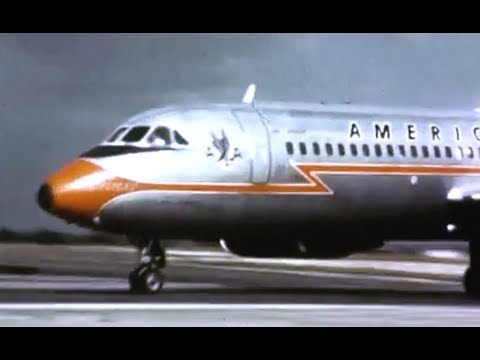
The Convair 990 Coronado was the last jet airliner designed and built by Convair, the San Diego division of General Dynamics, and the fastest four-engined passenger jet of its generation. It grew out of a specific request from American Airlines, which wanted an aircraft able to fly non-stop from New York to Los Angeles against the prevailing wind and to carry more passengers than the Convair 880; Boeing had flatly refused to build one. Convair's answer, known internally as the Model 600 and redesignated 990 in the very month of its first flight, was an 880 stretched by some 3 m, raising capacity from the 88 to 110 seats of its predecessor to between 96 and 121 — fewer than a Boeing 707 (110 to 189) or a Douglas DC-8 (105 to 173), but 25 to 35 mph (40 to 56 km/h) faster than either in cruise. Its unmistakable visual signature was the set of four anti-shock bodies, or "Whitcomb bodies", carried on the wing trailing edge: a literal application of the area rule intended to raise the critical Mach number by cutting transonic drag, and used as additional fuel tankage as well. Power came from four General Electric CJ805-23 engines, turbofans with the fan stage mounted behind the turbine — a solution unique at the time, against the front-fan Pratt & Whitney JT3D of its rivals — civil, non-afterburning derivatives of the J79 turbojet of supersonic fighters, and every bit as smoky. The 990 first flew on 24 January 1961 and entered service in 1962, but it never met its promised figures: real drag far exceeded the predictions, American Airlines cut its order, and not even the reworked 990A delivered the non-stop transcontinental capability that justified the programme. By the time the line closed in 1963 only 37 had been built, and the combined losses of the 880 and 990 rank among the largest in American corporate history. Withdrawn by the major carriers from 1967 onwards, the Coronado enjoyed a long second life on charter work — Spantax was its last big operator — and a third as a NASA flying laboratory, in use until the mid-1990s.
Related events
Related sheets
Category
History
An order Boeing would not take
The story of the Convair 990 begins with a very specific commercial requirement and with a refusal. In the late 1950s American Airlines was looking for a jet able to link the two coasts of the United States non-stop, and in particular to fly from New York to Los Angeles against the prevailing westerly wind — the penalised direction. The airline also wanted more seats than the Convair 880 and its 880M derivative offered, these being the smallest of the first-generation American jet airliners. When it put the requirement to Boeing, the Seattle manufacturer flatly refused to develop such an aircraft.
Convair, the General Dynamics division based in San Diego, took the job on. It came to it from a bitter experience: the 880 was selling badly, and rather than withdraw from the commercial jet business the company chose to double down with a larger, faster derivative. The project started under the internal designation Model 600 and was only redesignated Convair 990 in the very month the prototype took to the air.
.jpg)
On paper the arrangement was financially attractive. Convair sold twenty-five aircraft to American Airlines for around one hundred million dollars, of which 22.8 million were paid in kind with twenty-five surplus Douglas DC-7s whose real market value barely reached ten million. Swissair, for its part, converted its order for five 880s into an order for 990s. On paper, the manufacturer had a launch backed by a US flag carrier and a prestigious European one.
From the 880 to the 990: what changed
The 990 is essentially a stretched 880. The fuselage grew by some 3 m — 10 ft in the round figures of the American documentation, 3.04 or 3.05 m in metric measurements — raising capacity from the 88 to 110 seats of the 880 to between 96 and 121 in normal configuration, with a maximum of 149 passengers in high density. Construction remained that of the 880M: cantilever low wing, retractable tricycle undercarriage, pressurised aluminium-alloy stressed-skin fuselage of elliptical section.
From the 880 it also inherited a characteristic external detail: the dorsal "raceway" added along the top of the fuselage to house the two ADF antennas and one VHF antenna, a longitudinal fairing running along the spine that identifies the Convair family at a distance.
The wing kept the aspect ratio of 6.2 and a sweep of 35 degrees at three-quarter chord, with a chord of 10.26 m at the root and 3.19 m at the tip, a mean thickness-to-chord ratio of 12 per cent and 7 degrees of dihedral. The two-spar, fail-safe structure carried two Fowler flaps and a split fillet flap per wing, spoilers and leading-edge Krueger flaps. The last of these were not in the original design: they had to be fitted between the fuselage and the inboard engine to improve elevator effectiveness at low speed, and the drag they added was one of the reasons the aircraft never reached its promised top speed.
The anti-shock bodies: the area rule made flesh
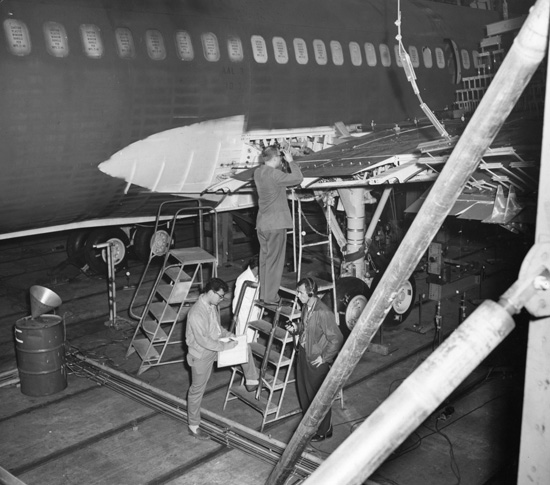
What makes the 990 unmistakable is the set of four large spindle-shaped fairings mounted on the wing trailing edge, two per side. Known as anti-shock bodies or Whitcomb bodies, they are the most visible application the area rule has ever had on a civil transport: by adding volume exactly where the wing stops contributing it, they smooth the cross-sectional distribution of the whole aircraft and delay the onset of shock waves, raising the critical Mach number and cutting transonic drag.
.jpg)
The inboard bodies, larger than the outboard ones, doubled as additional fuel tankage and as a conduit for the fuel-dump tubes, which terminate in a prominent outlet at their aft end. During development Convair decided to carry fuel in the outboard pods as well, but on the early test flights the extra weight caused the outboard engines to oscillate — to flutter — under certain conditions. The fix was to redesign the outboard pods and shorten them by 28 inches (710 mm); the outboard engine pylons were shortened on production aircraft too, leaving a characteristic notch in the profile. The price of the correction was increased drag, precisely the opposite of what had been sought.
The CJ805-23: a turbofan with the fan at the back
The 990 is powered by four General Electric CJ805-23 engines, and they are a technical rarity of the first order. Against the Pratt & Whitney JT3D of the competition, with its fan ahead of the compressor, the CJ805-23 placed the fan stage behind the turbine: an aft-fan, in which the bypass flow is accelerated by blades integral with a free turbine at the rear of the engine.
The CJ805 was originally a simplified, non-afterburning civil version of the General Electric J79 turbojet that powered the American supersonic fighters of the period. It shared with it one virtue — thrust — and one notorious defect: smoke. Like most versions of the J79, the CJ805 and CJ805-23 left an unmistakable black trail on take-off, to the point that photographs of a Coronado getting airborne are recognisable by the smoke column alone. By the 1970s Spantax had its own engines refitted with low-smoke combustion chambers.
_being_fueled_in_August_of_1963.jpg)
In the production variant, the 990A, each engine is a CJ805-23B delivering 16,050 lbf (71.4 kN) of thrust. The Swissair and Varig aircraft departed slightly from the standard: they carried CJ805-23Bs, could take more fuel and were somewhat heavier.
Flight testing: the 1961 record and the broken contract
The 990 began flight testing on 24 January 1961. In May of that same year one of the pre-production aircraft demonstrated the margin between its operating speed and its true capability in a dive at Mach 0.97 from 32,000 ft down to 22,500 ft, during which it reached 675 mph (1,086 km/h) at an altitude of 22,000 ft (6.7 km): the fastest true airspeed ever attained by a commercial jet transport up to that time.
The record did not save the contract. In level flight the maximum speed stopped at Mach 0.84, below the Mach 0.89 guaranteed to American Airlines, because drag levels with the anti-shock bodies proved far higher than predicted. To the parasitic drag added by the Krueger flaps and by the shortened outboard pods was added a fuel consumption some 500 kg per hour above the calculated figure. The promised cruising speed was around 1,021 km/h and range with maximum payload should have been 7,380 km; neither figure was met.
Deliveries slipped: the first aircraft should have reached Swissair as early as March 1961, and did not. Convair launched a drag-reduction programme, streamlining the engine pylon/wing interface and adding nacelle fairings, which did eventually achieve Mach 0.89. By then, however, American Airlines and Swissair had negotiated discounts for the shortfall in guaranteed performance, and American had cut its order.
The 990A: the redesign that came too late
The changes were consolidated in the 990A variant, defined by the nacelle fairings and the associated aerodynamic improvements, with a higher cruising speed and longer range than the original 990. The modification was so general that the thirty aircraft already built were converted to 990A standard: in practice what flew in commercial service was always the 990A, and total production stopped at 37 airframes.
_09.jpg)
The problem was not technical but a matter of timing. While Convair wrestled with the drag of its wing, Boeing brought the first turbofan-powered 707s to market, and the 990's strongest selling point — being the only airliner with a bypass engine — ceased to be exclusive. American Airlines and Swissair entered service with the Coronado in March 1962, but the aircraft never delivered on the promise of non-stop transcontinental flight between New York and Los Angeles: American's own timetables show little or no difference between the scheduled times of its 707s and its 990As.
The niche the 990 was meant to occupy was captured very quickly by the Boeing 720 and 720B, lightened derivatives of the 707, and later by the Boeing 727. American began disposing of its 990As in 1967, barely five years after putting them into service.
Technical data for the 990A
The figures below are for the 990A as published in *Jane's All the World's Aircraft 1965-66*, supplemented with published measurements of the airframe.
.jpg)
The aircraft is 139 ft 9 in (42.60 m) long overall — the fuselage proper measuring 41.07 m — with a span of 120 ft (36.60 m) and a height of 39 ft 6 in (12.04 m). Wing area is 2,250 sq ft (209 m²) and aspect ratio 6.2. Main gear track is 6.07 m and wheelbase 17.43 m.
In weights, empty is 133,000 lb (60,328 kg) — some 56,500 kg structural empty weight by other measurements, against 59,170 kg operating empty weight — maximum zero-fuel weight 160,000 lb (73,000 kg), maximum take-off weight 253,000 lb (114,759 kg) and maximum landing weight 202,000 lb (92,000 kg). Maximum structural payload is around 13,400 kg and usable fuel capacity 46,244 kg (58,910 litres).
Flight crew is four — pilot, co-pilot, navigator and flight engineer — plus cabin staff, typically five. The passenger cabin is 30.10 m long, 3.25 m at its widest and 2.15 m high, with a usable volume of 173 m³; the typical single-class layout seats 121 at a 34-inch pitch and the high-density arrangement reaches 149. The belly hold offers some 26.3 m³ of usable volume.
In performance, maximum speed is 540 kn (620 mph, 1,000 km/h) at 20,000 ft (6,100 m) at 200,000 lb (91,000 kg) all-up weight, equivalent to Mach 0.871, with a maximum permissible diving speed of Mach 0.91. Cruise is 484 kn (557 mph, 896 km/h), Mach 0.84, at 35,000 ft (11,000 m). Stall speed is 109 kn (125 mph, 202 km/h) at 170,000 lb (77,000 kg) with wheels and flaps down. Service ceiling is 41,000 ft (12,000 m). Wing loading works out at 112.44 lb/sq ft (549.0 kg/m²). Take-off run at maximum weight is 9,800 ft (3,000 m) and landing run 5,400 ft (1,600 m) at 170,000 lb, both to the SR-422B field-length criterion.
_04.jpg)
Range is 3,302 nautical miles (3,800 miles, 6,115 km) with 104,373 lb (47,343 kg) of usable fuel, 25,770 lb (11,690 kg) of payload and 18,000 lb (8,200 kg) of reserve fuel. As for consumption, in 1963 the 990A was reported to burn 13,750 lb (6.24 t) of fuel per hour at Mach 0.84 and 35,000 ft at a mass of 200,000 lb (91 t); for context, a modern Boeing 737 MAX 8 typically carries 162 passengers while burning 4,460 lb (2.02 t) per hour at Mach 0.78.
It carries no armament of any kind: it is a civil passenger transport with no armed military variants.
American Airlines, Swissair and the flag carriers
American Airlines was the principal operator and gave the fleet its commercial identity within its Astrojet branding. Its relationship with the aircraft was short and disappointing: a cut order, unmet performance and withdrawal beginning in 1967.
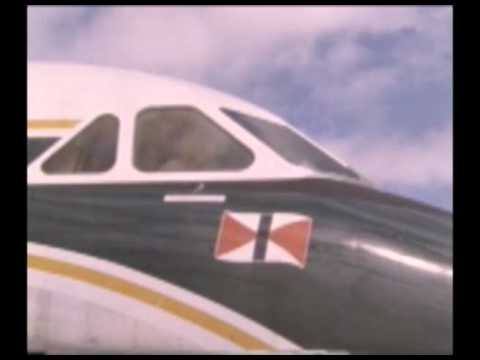
Swissair bought eight 990As from 1962 onwards and put them to far more ambitious use: long-haul routes to South America, West Africa, the Middle East and the Far East, as well as the busiest European routes, where the Coronado's speed did offer a noticeable advantage. The airline named its aircraft individually after Swiss cantons and cities. The fleet was withdrawn from service in 1975.
_03.jpg)
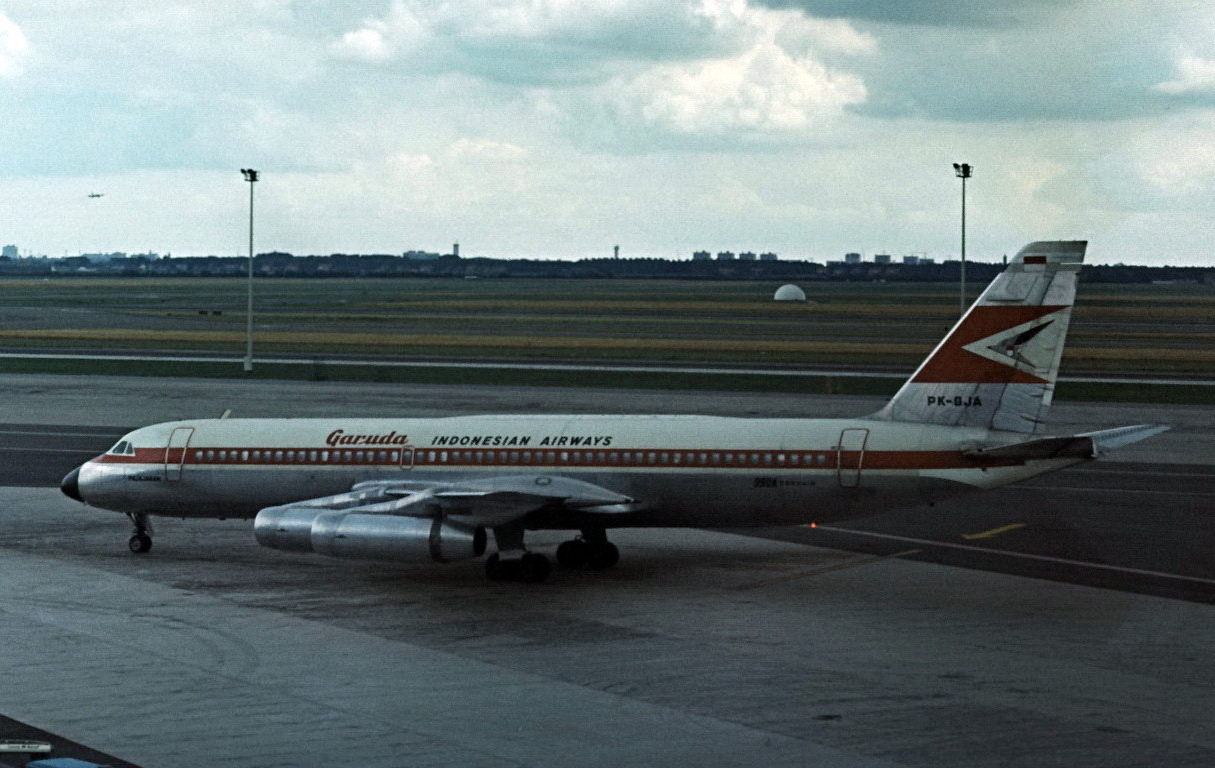
Scandinavian Airlines System also operated the 990A on its long-haul schedules to Tokyo and other Far Eastern destinations, and to South America and Africa. Garuda Indonesian Airways and Varig complete the list of original operators. Over time the Coronado also flew with Aerolíneas Peruanas, Air Afrique, Air Ceylon, Air France — one aircraft leased in 1967 — Alaska Airlines, Aerovías Ecuatorianas, Balair, Denver Ports of Call, El Al, Galaxy Airlines, Ghana Airways, Iberia — leased from Spantax — Internord Aviation, Lebanese International Airways, Middle East Airlines, Modern Air Transport, Nomads Travel Club, Nordair, Northeast Airlines, Paradise 1000 Travel Club, Spantax, Thai Airways International and NASA itself. In 1967 Alaska Airlines bought Convair 990 PP-VJE from Varig and operated it as N987AS in scheduled service until 1975.
The second life: charter work
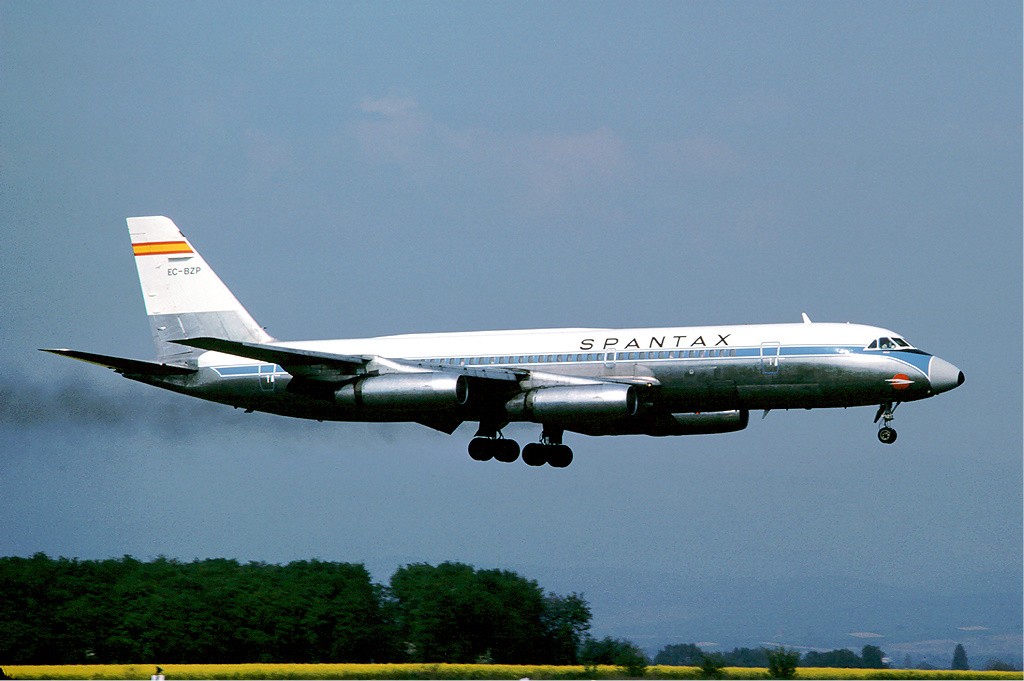
When the major airlines disposed of their Coronados, the type found a second market in charter flying, where its speed was still an argument and its heavy fuel burn mattered less than the second-hand purchase price. Spantax, the Spanish non-scheduled operator, assembled the largest fleet and kept it flying into the mid-1980s; in the United States, Denver Ports of Call did much the same.
Spantax was the Coronado's last major user, withdrawing the last of its fourteen aircraft in March 1987. Almost all were scrapped at Palma de Mallorca, save one that was preserved. It was Spantax, too, that had its CJ805-23s modernised with low-smoke combustion chambers in the 1970s, solving the aircraft's most visible image problem on its own initiative.
Accidents and incidents
The 990's safety record is marked by several serious events, some of them unrelated to the design of the aircraft.
_02.jpg)
On 28 May 1968 Garuda Indonesian Airways Flight 892 (PK-GJA) crashed after take-off from Bombay-Santacruz Airport, killing all 29 people on board and one person on the ground.
On 5 January 1970 a Spantax Convair 990 (EC-BNM) crashed at Stockholm-Arlanda Airport while taking off on a three-engine ferry flight to Zurich, killing five of the seven passengers; the three crew members survived.
On 21 February 1970 Swissair Flight 330 (HB-ICD) crashed near Würenlingen, Switzerland, while attempting to return to Zurich Airport after a bomb detonated in the aft cargo compartment. All nine crew and 38 passengers died. It was an act of sabotage, not an aircraft failure, and one of the most traumatic episodes in the history of Swiss civil aviation.
On 8 August 1970 a Modern Air Transport Convair 990 (N5603) being ferried from New York to Acapulco crashed on approach to Alvarez International Airport, Mexico. Nobody was killed, though one of the eight crew was badly injured.
_01.jpg)
On 3 December 1972 a Spantax Convair 990 (EC-BZR) crashed at Los Rodeos Airport in Tenerife while taking off in almost zero visibility, killing all seven crew and 148 passengers.
On 5 March 1973 Spantax Flight 400, a Convair 990 (EC-BJC) flying from Madrid to London, collided in mid-air with Iberia Flight 504, a McDonnell Douglas DC-9, over Nantes. The Coronado lost part of its left wing, but its pilots managed to land safely at Cognac-Châteaubernard Air Base. The DC-9 crashed, killing all 68 people on board.
On 12 April 1973 a NASA Convair 990 (N711NA) collided with a US Navy Lockheed P-3C on approach to NAS Moffett Field in Sunnyvale, California. Both aircraft came down on Sunnyvale Municipal Golf Course, half a mile short of the runway, killing everyone aboard except one Navy crewman, who was in the P-3's tail section and fell clear when it broke away as the 990 struck from above.
On 17 July 1985 another NASA Convair 990 (N712NA) suffered a blown tyre during take-off at Riverside-March AFB, California. While trying to clear the runway the rim shattered and punctured the right-wing fuel tank ahead of the right main gear. All 19 occupants survived, but the ensuing intense fire destroyed the aircraft, its equipment and its documentation.
NASA's Coronados
The 990's third life was scientific. NASA used a total of three aircraft as research platforms for atmospheric, meteorological, astronomical and solar experiments, exploiting a wide cabin, a high ceiling and an endurance that allowed heavy instrumentation to be installed and carried far.
One airframe was dedicated specifically to testing the Space Shuttle's landing gear, work that continued until 1995 — the type's retirement with NASA is given as September 1987 for general use and 1994 for the last aircraft, so the exact end date of the tests varies with the source. It was in this period that two aircraft were lost: N711NA in the Moffett Field collision of 1973 and N712NA in the March AFB fire of 1985.
NASA's last Coronado, registered N810NA, had previously flown with American Airlines and Modern Air Transport, and today stands as a gate guardian at Mojave Air and Space Port.
Convair's industrial disaster
The commercial failure of the 880 and 990 was of an unusual magnitude. When the assembly line stopped in 1963, General Dynamics' entire production of commercial jet airliners stood at 102 airframes across both models: 37 Coronados and the rest 880s. The 990 programme alone closed with losses of the order of 96.5 million dollars of the day, and the venture as a whole led General Dynamics to record one of the largest corporate losses in history.
The consequence was final: Convair left the complete-airliner business. The division survived and went on working in aviation, but as a structural subcontractor, building fuselages for McDonnell Douglas — specifically for the DC-10, the KC-10 and the MD-11. The Convair name, which had put everything from the CV-240 to the B-58 Hustler into the air, never appeared on the nose of an airliner again.
Survivors
Of the 37 Coronados built, five identified airframes survive today. Construction number 30-10-2, registered N990AB and once operated by Aerolíneas Peruanas, has been in storage since 1980 with Scroggins Aviation at Mojave Air and Space Port in California. 30-10-12A, HB-ICC, ex-Swissair, is on display at the Swiss Museum of Transport in Lucerne, its flight deck and interior open to the public. Of 30-10-18, EC-BZP, ex-Spantax, the forward fuselage is preserved at Sabadell Airport for cabin crew training. 30-10-29, N810NA, with a past at American Airlines, Modern Air Transport and NASA, guards the entrance to Mojave Air and Space Port. And 30-10-30, EC-BZO, ex-Spantax, has been stored at Palma de Mallorca Airport since 1987.
Legacy
The Convair 990 Coronado is one of commercial aviation's great near-misses: the fastest airliner of its time, with a bold aerodynamic solution and an engine without equivalent, defeated by a badly estimated drag margin and by a timetable that worked against it. Its commercial career was short and its balance sheet catastrophic, but its silhouette — the four spindles above the wing, the dorsal raceway, the column of black smoke on take-off — remains one of the most recognisable of the 1960s, and its scientific career with NASA gave it three decades of useful life that no airline would have granted it.
Variants
| 990 | 990A | |
|---|---|---|
| First flight | January 24, 1961 | — |
| Aircraft type | Medium-haul airliner | Medium-haul airliner |
| Powerplant | 4 × General Electric CJ805-23 aft-fan turbofans rated at 71.6 kN each | 4 × General Electric CJ805-23B aft-fan turbofans rated at 71.4 kN each, civil derivatives of the J79 turbojet |
| Powerplant | 4 × General Electric CJ805-23 | 4 × General Electric CJ805-23B |
| Thrust per engine | 71.6 kN Best value in this row | 71.4 kN |
| Length | 42.6 m Best value in this row | 42.6 m Best value in this row |
| Wingspan | 36.6 m Best value in this row | 36.6 m Best value in this row |
| Height | 12 m Best value in this row | 12 m Best value in this row |
| Wing area | 209 m² Best value in this row | 209 m² Best value in this row |
| Empty weight | — | 60,328 kg |
| MTOW | — | 114,759 kg |
| Top speed | — | 1,000 km/h |
| Max speed altitude | — | 6,100 m |
| Cruise speed | — | 896 km/h |
| Cruise altitude | — | 10,668 m |
| Service ceiling | — | 12,500 m |
| Initial climb rate | — | 17 m/s |
| Range | — | 6,115 km |
| Combat radius | 0 km Best value in this row | 0 km Best value in this row |
| Range conditions | Conceived to link the two US coasts nonstop, a goal the initial version never met in service. | 6,115 km carrying 11,690 kg of payload, with 47,343 kg of usable fuel and 8,200 kg held in reserve, per Jane's 1965-66. Cruising at 896 km/h and peaking at 1000 km/h at 6100 m, it was the fastest airliner of its day. |
| Armament | None | None |
| Max weapons load | 0 kg Best value in this row | 0 kg Best value in this row |
| Payload | — | 12,000 kg |
| Cargo capacity | Cabin seating 96 to 121 passengers in the initial layout; no cargo capability beyond the baggage holds. | 96 to 121 passengers in the normal layout and up to 149 in high-density seating; maximum structural payload of 12,000 kg, with no meaningful freight capability. |
| Crew | 4 Best value in this row | 4 Best value in this row |
| Passengers | 121 | 149 Best value in this row |
Images
Elsewhere
- FlightGlobalDespiece numerado (cutaway) del Convair CV-990, lámina del archivo de Flight International ↗
- JetPhotosN810NA Convair CV-990 Coronado (NASA) ↗
- JetPhotosN8357C Convair CV-990 Coronado (Ciskei International Airways) ↗
- JetPhotosHB-ICC Convair CV-990 Coronado (Swissair) ↗
- JetPhotosN8357C Convair CV-990 Coronado (Ciskei International Airways) ↗
- Airliners.netConvair 990A Coronado (30A-6) - Swissair ↗
- Airliners.netConvair 990A Coronado (30A-6) - Swissair ↗
- Airliners.netConvair 990A Coronado (30A-6) - Swissair ↗
- Airliners.netConvair 990A Coronado (30A-6) - Swissair ↗
- Planespotters.netEC-CNG Spantax Convair 990 30-A6 Coronado ↗
- Planespotters.netN810NA NASA Convair CV-990-30A-5 ↗
- AirHistory.netHB-ICH Convair 990A Coronado (30A-6) - Balair ↗
Show the 6 more
- AirHistory.netHB-ICC Convair 990A Coronado (30A-6) - Swissair ↗
- ABPicConvair 990-30A-5 Coronado OD-AFF - Middle East Airlines ↗
- ABPicConvair 990-30A-8 Coronado N987AS - Alaska Airlines ↗
- ABPicConvair 990-30A-5 Coronado N990AB ↗
- ABPicConvair 990-30A-5 Coronado N8357C - Denver Ports of Call Travel Club ↗
- The-Blueprints.comConvair CV-990 Coronado - three-view line drawing ↗