How the Consolidated B-24 Liberator Actually Worked
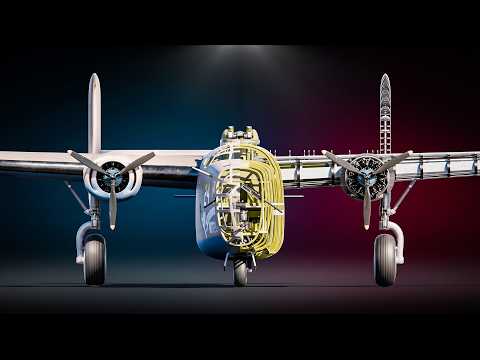
Video from the channel Deconstructed and Airspeed about Consolidated B-24 Liberator, linked on its Above Ten Thousand entry. Duration: 19:09. Language: English. Video type: Documentary.
What it covers
A technical walkthrough of the Consolidated B-24 Liberator, reconstructed in 3D from a late-production B-24D. It covers the exterior, defensive armament, structure, fuel system, engines and the five interior compartments, and explains how its ten crew members moved through them.
Historical context
In late 1938 the United States Army asked Consolidated to build B-17s under license, and the company instead offered a longer-range bomber of its own. By the end of World War II, about 18,500 Liberators had been built across five factories. At Ford's Willow Run plant in 1944, one rolled off the line roughly every 63 minutes. After the war, aircraft such as the B-29 superseded it, and it was quickly withdrawn from US service.
Key facts
The B-24D was 20.2 m long with a 33.5 m wingspan, and could weigh around 29 t. Its high, long, narrow Davis wing reduced drag but made it harder to fly at low speed. It was the first American production heavy bomber with tricycle landing gear. It carried four Pratt & Whitney R-1830 Twin Wasp engines of up to 1,200 hp with turbosuperchargers, reached about 490 km/h at 7,620 m, and had a range of about 3,400 km. It carried up to 3,600 kg of bombs behind roller-type bay doors and was armed with up to eleven .50-caliber (12.7 mm) machine guns.