Boeing B-29 Superfortress variant
Boeing B-29 Superfortress WB-29
Weather reconnaissance version of the B-29, with an observation position above the central fuselage and, on some aircraft, air sampling scoops. Besides flying into hurricanes and typhoons, a WB-29 collected on 3 September 1949 the radioactive debris of the first Soviet nuclear test, alert 112 of the USAF atomic detection system.
Boeing B-29 Superfortress sheet

History
Origin and development
The WB-29 was the weather reconnaissance version of the Superfortress: production aircraft which, once the war was over, were modified to turn the USAF's longest-legged, highest-flying bomber into a platform for atmospheric observation. The "W" stood for weather, and the mission belonged to the Air Weather Service. The Superfortress offered what the job demanded: the endurance to cover whole oceans and the ceiling to fly above much of the weather it was sent to observe.
Differences from the standard B-29
The most visible modification was an observation position fitted above the central section of the fuselage, from which the weather observer followed the state of the sky. Some WB-29s were also fitted with air sampling scoops to measure radiation levels in the atmosphere after nuclear weapons tests, in addition to the special filters described below. Airframe, engines and systems were otherwise those of the standard B-29.
Operational service
WB-29s flew routine data-gathering missions along fixed tracks, among them the flights out of the United Kingdom over the Atlantic. They were also given a more hazardous task: flying into the eye of hurricanes and typhoons to gather information from inside the storm. In 1954 the 53rd Weather Reconnaissance Squadron was still operating WB-29As.
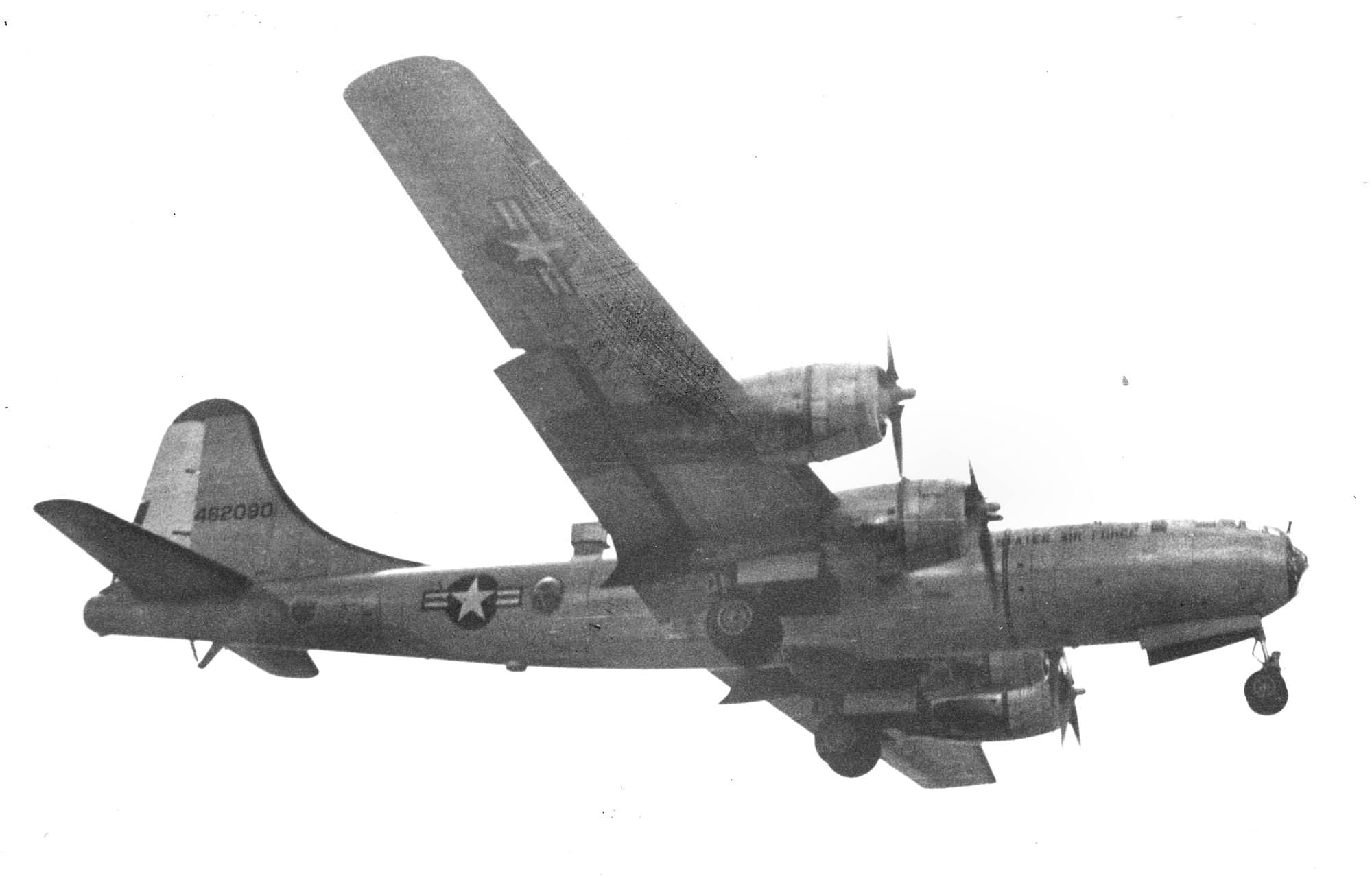
Their most consequential role, however, had nothing to do with weather. In September 1947 the Army Chief of Staff, Dwight D. Eisenhower, assigned the Army Air Forces, not yet an independent service, responsibility for setting up an Atomic Energy Detection System. Later that year the Air Force created the organisation that would become known as AFOAT-1 (Air Force Office of Atomic Energy-1, later renamed the Air Force Technical Applications Center, AFTAC), in charge of the surveillance programme. Its Interim Surveillance Research Net was working by the spring of 1949, and the flights that fed it with samples were flown by Air Weather Service WB-29s carrying special filters designed to trap the radiological debris that any atmospheric atomic explosion would inevitably produce. Until then none of the flights over the Northern Pacific had picked up anything.
On 3 September 1949 a WB-29 flew a routine mission from Japan (Misawa Air Force Base according to the National Security Archive; Yokota according to other sources) to Eielson Air Force Base in Alaska. When a large Geiger counter checked the filters on its return, the technicians found radioactive traces. It was alert number 112 of the system; the previous 111 had all been caused by natural events such as earthquakes. A complex chain of events followed: further flights to collect more air samples, consultations among government scientists, consultants and contractors, radiological analysis by Tracerlab, AFOAT-1's contractor, and coordination with the British government. When Washington warned London that an air mass carrying radioactive particles was about to pass north of Scotland, the British ordered special sampling flights; their next routine flight was not scheduled until 14 September, and without the American alert important evidence would have been missed.
On 9 September the Director of Central Intelligence, Admiral Roscoe Hillenkoetter, handed President Truman a report on "samples of air masses" from the Northern Pacific showing "abnormal radioactive contamination", while admitting that nobody yet knew whether it came from a nuclear test, an accident or something else altogether. By 21 September the intelligence community was advising Truman that the Soviet Union had tested a nuclear device; the Los Alamos laboratory, to which AFOAT-1 had sent a sample for independent analysis, confirmed that the activity came from fission products of recent origin, and the Weather Bureau's report back-tracked the air mass to a detonation somewhere between 27 and 29 August 1949. On 23 September the White House announced that it had evidence that "within recent weeks" an atomic explosion had occurred in the USSR, without saying how it had been detected. The test, carried out on 29 August at Semipalatinsk in Kazakhstan, was dubbed "Joe-1" by American analysts and its data given the codename "Vermont".
The detection was a triumph of technology and a failure of forecasting: analysts had put the most probable date for a first Soviet device at mid-1953. Its immediate consequences were Truman's decision to expand fissile material production, his authorisation of a thermonuclear weapons programme on 31 January the following year, and the impetus given to the NSC 68 report of April 1950. That it had all begun in the filters of a weather aircraft stayed secret for years.
Legacy
The WB-29 thus went down as the aircraft that discovered the United States had lost its nuclear monopoly. Its double life, hurricane and typhoon observer on one hand and collector of atomic dust for a secret organisation on the other, together with alert 112, is the episode for which this variant is remembered, even though for years nobody knew that the announcement of 23 September 1949 had been born in the filters of a weather plane.
Multimedia
