Bomber · Military · United States
Boeing B-29 Superfortress
- September 21, 1942
- First flight
- In service
- Status


-1600.webp)

-1600.webp)


-1600.webp)


-1600.webp)

-1600.webp)


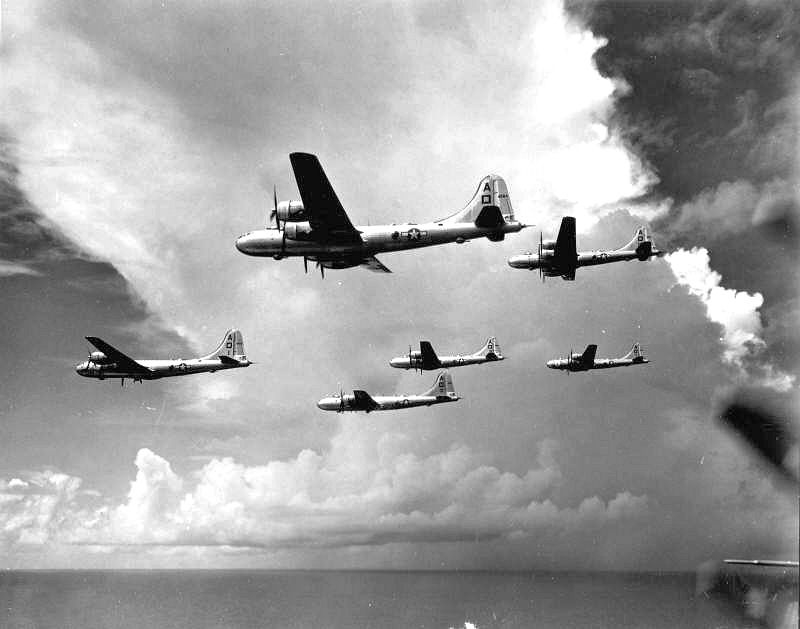
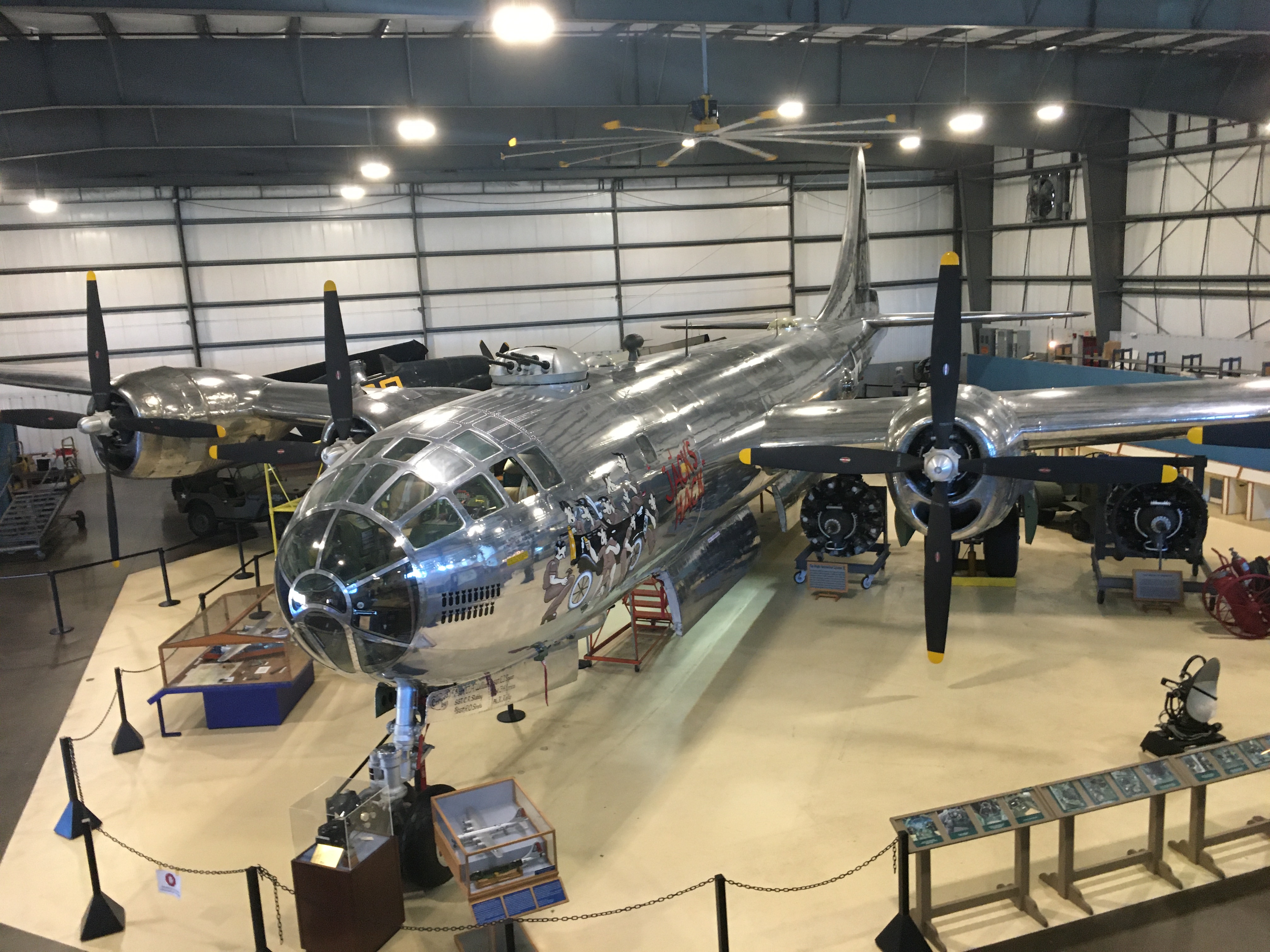
The Boeing B-29 Superfortress was the four-engined heavy bomber with which the United States carried the strategic air offensive to the Japanese home islands, and the most advanced aircraft to see combat in the Second World War. Its name deliberately echoed the B-17 Flying Fortress it succeeded, but the comparison undersells it: the B-29 was built for high-altitude strategic bombing and combined a pressurised cabin, dual-wheeled tricycle landing gear and an analogue-computer fire-control system that let a single gunner, coordinated by a fire-control officer, aim four remote turrets. Design and production cost some $3 billion — far more than the $1.9 billion spent on the Manhattan Project — making the B-29 the most expensive programme of the war, at a unit cost of $639,188. It also remains the only weapon system ever to have dropped atomic bombs in combat. That ambition was paid for during development. The first prototype took off from Boeing Field, Seattle, on 21 September 1942, and the combination of a design at the edge of the state of the art, demanding requirements and immense production pressure left a trail of setbacks. Engines were the chief cause of maintenance headaches and catastrophic failures: the four eighteen-cylinder, turbosupercharged Wright R-3350 Duplex-Cyclone radials of 2,200 hp each eventually became a dependable workhorse in large piston aircraft, but early examples suffered severe overheating. Pressurisation, developed by Garrett AiResearch, forced a characteristic compromise: the forward and rear crew compartments were pressurised while the bomb bays were not, the two being linked by a tunnel. Aircraft left the factories unfinished and had to be completed at open-air modification centres during a Kansas winter; that "Battle of Kansas" readied 150 aircraft over the five weeks from 10 March to 15 April 1944. The operational debut was no easier. Operation Matterhorn, ordered by Roosevelt as a promise to China, deployed the B-29 groups to five main bases in India and four forward fields in southern China: on 15 June 1944, 68 aircraft took off from the Chengdu bases and 47 bombed the Imperial Iron and Steel Works at Yawata, the first attack on the Japanese islands since the Doolittle Raid of April 1942. Supplying the effort over the Himalayas proved unsustainable and the campaign moved to the Marianas, from where the 73rd Bomb Wing flew a first mission of 111 aircraft against Tokyo on 24 November 1944. High-altitude daylight precision bombing achieved little against the jet stream and heavy cloud, and in early 1945 Major General Curtis LeMay, commanding XXI Bomber Command, ordered most of the defensive armament stripped out and the force sent in at night, at low level, with incendiaries. The result was the most destructive bombing raid in history: on the night of 9–10 March 1945, 279 B-29s destroyed 267,000 buildings and a quarter of Tokyo (Operation Meetinghouse), killing some 100,000 people. Less remembered, the aerial mining of Japanese ports and shipping lanes (Operation Starvation), begun in April 1945, choked the country's supply lines. In August, two B-29s modified under the Silverplate programme — bomb bay enlarged for Little Boy and Fat Man, fuel injection, reversible propellers and lightened armament — dropped the atomic bombs on Hiroshima and Nagasaki from the 509th Composite Group. The B-29 outlasted the war. It was the bomber on which Strategic Air Command was founded on 21 March 1946, and for years the 509th's Silverplate aircraft were the only ones able to deliver a nuclear weapon; the arrival of the huge Convair B-36 saw it reclassified as a medium bomber. In Korea it flew some 20,000 sorties and dropped 220,000 short tons of bombs, used 12,000 lb Tarzon guided weapons against the Yalu bridges and, once Soviet MiG-15 jets appeared in 1950, was pushed onto night missions; its gunners were credited with 27 kills and 78 aircraft were lost. It also served abroad: the Royal Air Force was loaned 87 Superfortresses under the designation Washington B.1, equipping eight Bomber Command squadrons between March 1950 and the return of the final aircraft in March 1954 — two passed to the Royal Australian Air Force in 1952, and the electronic-intelligence machines soldiered on until 1958. A total of 3,970 were built and retirement came in the early 1960s, but the airframe outlived the bomber. From it came the B-50, re-engined with Pratt & Whitney R-4360 Wasp Majors, whose Lucky Lady II made the first non-stop flight around the world in 1949 in 94 hours; the KB-29 tanker of 1948, the first link in American aerial refuelling; the C-97 Stratofreighter transport and its KC-97 tanker version; the Model 377 Stratocruiser airliner and, from it, the outsized-cargo Guppies. Several B-29s also served as motherships for experimental aircraft, among them the Bell X-1 of the first supersonic flight. The Soviet Union, without licence and working from aircraft interned after emergency landings on its territory, produced 847 Tupolev Tu-4s, a copy of the B-29 that gave Moscow its first strategic bomber. Twenty-two examples survive, most on static display. The representative variant spanned 141 ft 3 in (43.05 m) with a wing area of 1,736 sq ft, reached 357 mph, climbed to a 31,850 ft ceiling, ranged 3,250 miles and was flown by a crew of eleven.
Related events
Related sheets
Category
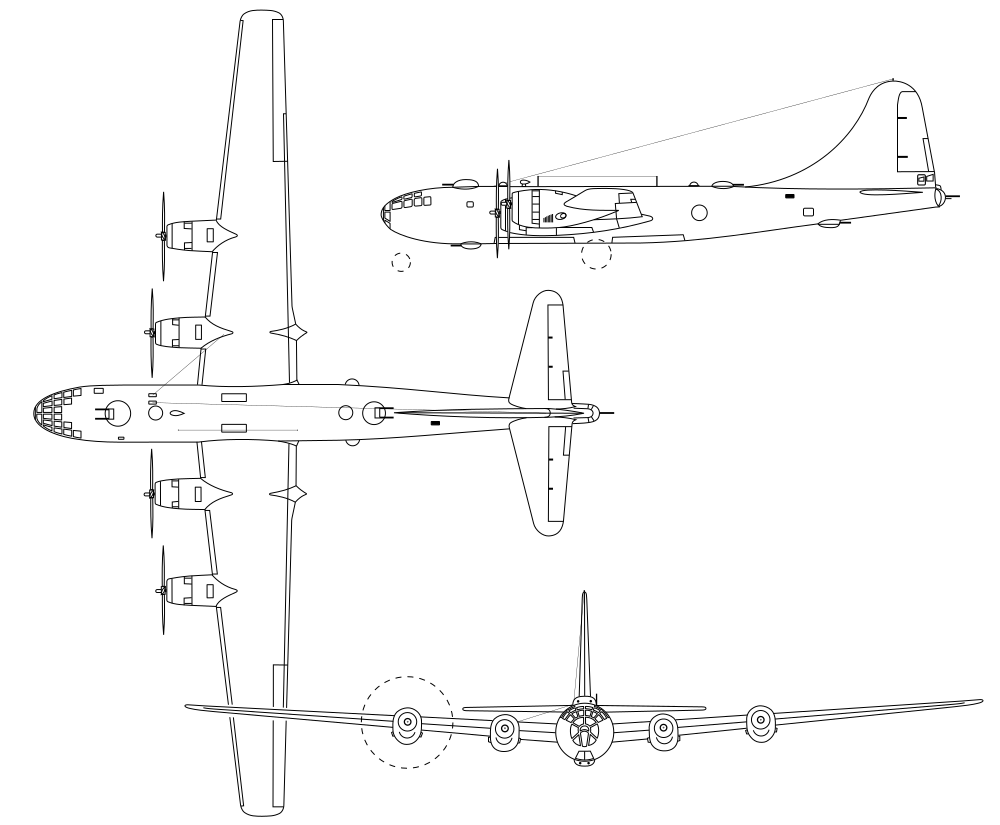
Three-view drawing
History
A superbomber for a war that had not started
When Boeing began studying very long-range bombers in 1938, the United States was not at war and the Army Air Corps had no money to pay for the idea. The in-house Model 334 study was essentially a pressurised B-17 Flying Fortress with tricycle landing gear, and the company kept it alive as a private venture because it expected a requirement to appear sooner or later. It appeared in December 1939, when the Air Corps formalised what it called a "superbomber", a machine able to carry a 20,000 lb (9,100 kg) bomb load against targets 2,667 mi (4,292 km) distant while flying at 400 mph (640 km/h). Nothing in the world did anything of the sort, and American industry itself would need years to grasp what the specification implied.
On 29 January 1940 the Air Corps requested proposals from five manufacturers for a four-engined bomber with a 2,000 mi (3,200 km) radius of action. Boeing submitted its Model 345 on 11 May 1940, competing against Consolidated's Model 33 — the future B-32 Dominator — the Lockheed XB-30 and the Douglas XB-31. Douglas and Lockheed dropped out early. On 24 August 1940 Boeing received an order for two flying prototypes, designated XB-29, plus an airframe for static testing; a third flyable aircraft was added on 14 December. Consolidated continued with its Model 33 because the Air Corps wanted an insurance policy in case the Boeing design failed, and on 6 September orders were placed for two experimental aircraft from each firm. In the parlance of the day these were VLR bombers, "very long range"; the name "Superfortress" was not assigned until March 1944, when the aircraft was about to enter combat.
The decisive step came on 17 May 1941, almost seven months before Pearl Harbor and sixteen months before the first XB-29 left the ground: Boeing received an initial order for 14 service-test aircraft and 250 production bombers, expanded to 500 in January 1942. The United States had bought by the hundred an aeroplane nobody had ever seen fly. That decision explains almost everything that followed, for better and for worse.
Four factories and an aircraft that did not yet exist
Building the B-29 required four final-assembly plants and thousands of subcontractors. Boeing ran two, at Renton in Washington State and at Wichita in Kansas. Bell assembled at Marietta, Georgia, outside Atlanta — the plant known as "Bell-Atlanta" — and Martin at Bellevue, Nebraska, at Offutt Field, the "Martin-Omaha". The Wichita plant, which in 1941 was building PT-13D and N2S-5 "Kaydet" biplane trainers and control surfaces for the B-17, needed a colossal expansion: ground was broken on 24 June 1941 for what became "Plant II", completed in January 1943 with equipment being installed six months before the building was finished. An army of workers had to be recruited across Kansas and neighbouring states, housed, and taught a trade almost none of them had. They were asked to build a kind of aircraft that resembled nothing before it.
The gap between ambition and reality was recorded by the participants themselves: three years passed from concept to series production, where a design of that complexity should have needed five years just to reach prototype stage. Engineering design, production and testing all proceeded simultaneously, with every predictable problem and a good many unpredictable ones. In June 1942 a gratuitous complication was added when Boeing-Wichita was also told to build 750 Waco CG-4 gliders. The first production B-29s out of Wichita were effectively hand-built, and surprising weight differences turned up between one aircraft and the next, caused by commercial tolerances in raw materials and by the accumulation of small assembly tolerances.
The programme's final cost was 3,000 million dollars of the day in design and production — roughly 54,000 million in 2025 terms — far above the 1,900 million spent on the Manhattan Project. The B-29 was the most expensive American programme of the war, ahead of the bomb it would eventually drop. Unit cost settled at 639,188 dollars, and the prototype at 3,392,396.60.
Boeing Field, 21 September 1942
The first prototype, XB-29 41-1002, flew from Boeing Field in Seattle on 21 September 1942. It was unarmed. The second, fitted with the Sperry defensive system of remote-controlled turrets aimed through periscopes, flew on 30 December 1942, and the flight had to be cut short by a serious engine fire. The warning was not acted on with the force it deserved.
On 18 February 1943 that same second prototype suffered another engine fire and crashed while trying to return to Boeing Field. Boeing's chief test pilot Edmund T. "Eddie" Allen and his ten crew were killed, along with twenty employees of the Frye Meat Packing Plant and one Seattle firefighter. Allen was not just any pilot: he headed Boeing's flight-test department and was one of the most authoritative technical voices in the country. His death, and that of his crew, on a Seattle street turned the B-29's troubles into a political matter.
The immediate consequence was a reorganisation. Colonel Harman of the USAAF proposed a plan to coordinate the debugging of the aircraft — its engines above all — by taking control of the whole effort: production, modification, flight testing and training. Approval of the "B-29 Special Project" came directly from President Roosevelt, advised by General Henry H. "Hap" Arnold. Even that did not avert the industrial disaster already under way: design changes were so continuous and so rapid that by early 1944 B-29s were coming off the assembly line and flying straight to modification centres for extensive rebuilding to incorporate the latest revisions. USAAF-contracted centres and the service's own air depot system could not cope, and some facilities had no hangars large enough for an aircraft of that size, so the work was done in the open in sub-zero temperatures.
Engineering (I): living at thirty thousand feet
The B-29 was the first Allied production bomber with a pressurised cabin, a system developed for it by Garrett AiResearch. The crew could fly at cruising altitude without oxygen masks and without the brutal cold that punished B-17 and B-24 crews over Europe, and this was no luxury: on missions exceeding twelve hours, fatigue was a tactical variable.
The design problem was well understood: a fully pressurised fuselage would force the aircraft to depressurise before opening the bomb bay doors, with all that implies over a target. The solution was to leave the bays unpressurised and connect the forward and rear crew compartments with a long tunnel running above the bomb bays. Crew members could crawl from one end to the other when required, and the tunnel became one of the features most vividly remembered by those who flew in the aircraft.
The other half of the altitude equation was turbosuperchargers and a high-aspect-ratio wing — aspect ratio 11.5, using the Boeing 117 aerofoil, 22 per cent thick at the root and 9 per cent at the tip — loaded to 337.5 kg/m². That wing, extraordinarily efficient in cruise, produced high stalling speeds and required enormous flaps; the result is an aircraft that in the air behaves with a nobility that surprises those who fly it today, and that on take-off and landing forgives nothing. In wartime conditions the B-29 flew as high as 31,850 ft (9,710 m) at 350 mph (560 km/h) true airspeed, and that combination was its best defence: Japanese fighters could barely reach that altitude, and very few could catch it once there.
Engineering (II): five computers for eleven men
The defensive system of the production B-29 was the first computer-controlled central fire-control system in combat aviation. General Electric's Central Fire Control directed four remote turrets, each with two 12.7 mm Browning M2 machine guns. All guns were aimed optically from five interconnected sighting stations — in the nose, in the tail and in three Plexiglas blisters in the mid-fuselage — and the gunnery solution was computed by analogue electrical instrumentation: five General Electric analogue computers, one dedicated to each sight, correcting for own airspeed, lead, gravity, temperature and humidity.
The doctrinal consequence was greater than the technical one. The computers allowed a single gunner to operate two or more turrets simultaneously, including the tail turret, so the aircraft's defensive fire was no longer tied to the physical position of the man firing. The upper-position gunner acted as fire control officer and allotted turrets among his crewmates according to the threat. The tail initially mounted two 12.7 mm Brownings and one 20 mm M2 cannon, and, when a target moved beyond the tail guns' maximum traverse, could take over the two rear turrets; if the tail or nose gunner was not using his own guns, control passed automatically to the waist gunners, providing 360 degrees of azimuth coverage and 60 degrees of elevation. Later aircraft deleted the 20 mm cannon, sometimes substituting a third machine gun for it.
In early 1945 Major General Curtis LeMay, who commanded XXI Bomber Command in the Marianas, ordered most of the defensive armament and remote sighting equipment stripped from the aircraft under his command. The logic was that of a changed mission: if bombing was to be done at night from low level with incendiaries, the weight of the turrets was worth more as fuel and bombs. The affected aircraft ended up with the same reduced defensive fit as the Silverplate airframes earmarked for nuclear weapons. Bell-Atlanta took the idea to the production line with a run of 311 B-29Bs with no turrets or sighting equipment except in the tail, fitted with AN/APG-15 fire-control radar; many could also carry the APQ-7 "Eagle" blind-bombing radar in an aerofoil-shaped radome under the fuselage, and most were assigned to the 315th Bomb Wing at Northwest Field, Guam.
Engineering (III): the engine that burned
The Wright R-3350 Duplex-Cyclone was a two-row radial of 18 cylinders and nearly 3,350 cubic inches (54.9 L) displacement, rated at between 2,200 and 3,700 hp (1,640-2,760 kW) according to the variant. Wright had derived it from the Cyclone from 1935 and first ran it in May 1937, but development was slow because internal priority went to the R-2600 Twin Cyclone, and it did not fly until 1941. When the long-range bomber contract appeared in 1940 and three of the four preliminary designs submitted that summer used the R-3350, the engine abruptly became a priority. In 1942 Chrysler began building the Dodge Chicago plant to produce it; the plant was ready in early 1944, which is to say late.
Through 1943 the B-29 flew with R-3350s that remained temperamental. The rear cylinders tended to overheat, partly because of insufficient clearance between the cylinder baffles and the cowling. Changes were introduced to improve cooling and the aircraft was sent to the Pacific in 1944; that was rash. Early B-29s taking off at maximum weight from tropical airfields in very high temperatures suffered overheating that was never fully cured, and the engines also had a habit of swallowing valves. The truly lethal factor was material: because of the high magnesium content of the crankcase, an engine fire could reach temperatures around 5,600 °F (3,090 °C) at its core, enough to burn through the main wing spar in seconds and cause catastrophic failure. An engine fire in a B-29 was not a malfunction; it was a countdown.
Palliatives were many and all partial: cuffs on the propeller blades to deflect more cooling air into the intakes, baffles inside those intakes to direct a jet of air onto the exhaust valves, increased oil flow to the valves, asbestos baffles around the pushrod housings to prevent oil loss, painstaking pre-flight inspections to catch improperly seated valves, and above all a brutal maintenance regime: crews frequently replaced the top five cylinders every 25 engine hours and the entire engine every 75. Early carburettors, with a poorly designed elbow intake to the supercharger, produced serious mixture problems; near the end of the war the engines switched to direct fuel injection, which improved reliability. The problem was not fully solved until the Pratt & Whitney R-4360 Wasp Major of the B-29D/B-50 programme, which arrived too late for the war.
The practical consequence is summed up by the pilots who fly FIFI, one of the two airworthy B-29s today: take-off is not about seeking altitude but about fighting urgently for speed. A radial needs airflow to stay cool, and failing to reach speed early could mean an engine failure and a fire. One useful technique was to check the magnetos during the take-off run rather than in the conventional static pre-flight check.
The Battle of Kansas
By mid-January 1944 Wichita had built 97 B-29s. Sixteen were fit to fly. The rest were tied up in modification centres or parked on the factory's delivery apron — 1,626,100 square feet, about 151,070 m² — awaiting urgent changes. The basic design was sound, but the shortcuts taken in the rush to get it into service had left a trail of defects: faulty pressure seals around the cockpit windows and the sighting blisters, which needed precise fitting to avoid leaks; problems with the sighting systems and with the turrets themselves; electrical failures caused by defective Cannon connectors in the ten miles (16 km) of wiring each aircraft carried; substandard glass in the cockpit transparencies that distorted the pilot's view; a necessary reinforcement of the wing structure. And above all, R-3350s that overheated relentlessly.
General Arnold visited the Wichita plant on 11 January 1944 with a concrete demand: 175 combat-ready B-29s for the XX Bomber Command. Walking the assembly lines, he picked fuselage section number 175, signed it and said: "This is the aircraft I want. I want it before the first of March." Two months later he discovered that not a single B-29 was combat-ready and that some had been waiting two months or more for parts. In March 1944 Arnold delegated to General Bennett Meyers full powers to act in his name and force the modifications through.
What followed is remembered as the "Battle of Kansas", or the "Battle of Wichita". USAAF specialists and ground technicians were called in from across the country, 600 workers were pulled off the Wichita assembly lines, and subcontractors were ordered to stop any work unrelated to the B-29 until they had met their commitments. With the thermometer often below freezing, the 1,200 technicians gathered at the factory and the modification centres partly removed wing skins to add the reinforcements and riveted them back on piece by piece, while the cowl flaps controlling airflow around the troublesome engines were modified. In the end 150 aircraft were reworked in a five-week push running from 10 March to 15 April 1944, in time to equip the first bombardment groups.
Those groups already existed: while the factory was being built, the USAAF had assembled the cadres of four bombardment groups — the 40th, 444th, 462nd and 468th — which together made up the 58th Bombardment Wing, the first unit that would take the B-29 into combat from bases in China that had not yet been built. A fifth group, the 472nd, was formed as an operational training unit, stayed in the United States and was disbanded in April 1944.
Matterhorn: bombing Japan from China
The idea of basing B-29s in China surfaced at the Casablanca Conference in January 1943. That September planners for the Combined Chiefs of Staff reported that basing B-29s in China would run into insurmountable logistical problems, and in August the Central Pacific offensive had already been authorised, including the capture of the Marianas, which were closer to Tokyo and far easier to supply and defend. Roosevelt decided for the Chinese bases anyway: he wanted Japan bombed as soon as possible and he wanted to sustain the Chinese war effort. At the Sextant Conference in Cairo late in 1943 he gave Chiang Kai-shek his word that the very heavy bombers would be based in his country. Arnold accepted it as a temporary expedient while continuing to prefer the Marianas.
The plan was named Operation Matterhorn. USAAF advance echelons reached India in December 1943 to organise airfield construction. Thousands of Indian labourers built four permanent bases in eastern India around Kharagpur, and a thousand miles (1,600 km) to the north-east, on the far side of the Himalayas, hundreds of thousands of Chinese labourers — the sources speak of about 350,000 workers, and another figure breaks them down into some 300,000 conscripts and 75,000 contract workers — built four staging bases in western China near Chengdu. The Chengdu area was chosen over Guilin, which was closer to Japan, to avoid having to arm, equip and train fifty Chinese divisions to protect forward bases from Japanese ground attack; the price was that Kyūshū became the only part of the Japanese archipelago within the B-29's 1,600 mi (2,600 km) combat radius. By April 1944 Asia held eight airfields fit for B-29 operations.
Also in April 1944, it was agreed to create the Twentieth Air Force as a command outside the theatres and directly controlled by the Joint Chiefs of Staff, to prevent theatre commanders from spending B-29s on tactical missions. Arnold appointed himself commander of that air force, with his air planner, General Haywood S. Hansell, as chief of staff. Running the Superfortresses from Washington was formal recognition that the B-29 was a strategic weapon transcending theatres and services. The XX Bomber Command, conceived as two combat wings of four groups each, was cut to a single wing of four groups for lack of aircraft, which limited in advance the effectiveness of any attack mounted from China.
The logistical cost was exactly what had been predicted. There was no land connection between India and China: every ton of supplies had to cross the Himalayas — "The Hump" — in transport aircraft or in the B-29s themselves, some stripped of armour and armament to carry fuel. B-29s began arriving in India in early April 1944, and the first flight over the Himalayas to the Chinese airfields was made on 24 April.
Nine raids and an expensive lesson
The B-29's first combat mission was flown on 5 June 1944 against the railway workshops of Bangkok, about a thousand miles from the Indian bases: of 98 bombers launched, 77 reached their targets and dropped 368 tons of bombs. Five B-29s were lost, none to enemy fire. The bombs fell more than 1.2 mi (2 km) from the aiming point; they damaged no civilian structures, destroyed some tram lines and wrecked a Japanese military hospital and the Japanese secret police headquarters. As a rehearsal for bombing Japan, the result was ambiguous.
On the night of 15 June 1944, 68 B-29s lifted off from the Chengdu staging bases against the Yawata Imperial Iron and Steel Works, in Kyūshū, more than 1,500 mi (2,400 km) distant. It was the first strike against the home islands since Doolittle's raid in April 1942, and it formally opened the strategic bombing campaign against Japan. Like Doolittle's, it achieved very little physical destruction: only 47 B-29s reached the target area; four turned back with mechanical trouble, four crashed, six dumped their bombs owing to malfunctions, and the rest attacked secondary or opportunity targets. A single bomb hit the factory complex. Japanese fighters destroyed one B-29 on the ground after it made an emergency landing in China, another was lost to anti-aircraft fire over Yawata, and a third — Stockett's Rocket, B-29-1-BW 42-6261 — disappeared over the Himalayas after taking off from Chakulia with twelve people aboard. The raid all but exhausted the fuel reserves of the Chengdu bases and forced operations to slow until they were replenished. The sources disagree on the detail: another reconstruction of the same night of 15/16 June gives 75 B-29s despatched and seven lost.
Arnold, impatient with the pace of results, relieved the commander of XX Bomber Command, Major General Kenneth B. Wolfe, shortly after Yawata, when it became clear that he could not repeat the attack for lack of fuel stockpiled in China. Brigadier General LaVerne G. Saunders held the command on an interim basis, pending the arrival of Major General Curtis E. LeMay from Europe as its permanent head. LeMay instituted a training programme and reorganised the B-29 maintenance units through August and September, and the command's performance improved.
It improved, but not enough. The second full raid did not come until 7 July 1944, when seventeen B-29s attacked Sasebo, Ōmura and Tobata to little effect; on the night of 10/11 August, twenty-four Superfortresses attacked Nagasaki. On 20 August, over Yawata, the force was intercepted by more than a hundred fighters and twelve of the 61 B-29s that reached the target area were shot down, one of them by a suicide ramming; Japanese propaganda claimed a hundred bombers downed and displayed the wreckage of one in Tokyo. An attack on Ōmura on 25 October destroyed the town's small aircraft factory; a repeat on 11 November failed. The ninth and last raid on Japan from China was flown on 6 January 1945, against Ōmura again.
Matterhorn's balance sheet was poor. The nine raids on Japan launched from China destroyed only the Ōmura aircraft factory. XX Bomber Command lost 125 B-29s in the whole of its operations out of India and China, of which the Japanese accounted for only 22 or 29; accidents claimed the rest. The B-29s were withdrawn from the Chinese airfields in late January 1945, and the last combat mission from India, against Singapore, was flown on 29 March 1945. The USAAF's official history concluded that the decisive factor in the failure was the difficulty of delivering adequate supplies to India and China, compounded by the aircraft's technical problems, the inexperience of the crews and the weather over Japan.
The Marianas: the right base, the wrong tactic
The answer was on the map. From Chinese bases the B-29 reached only a corner of Japan; from the Marianas — Saipan, Tinian and Guam, some 1,500 mi (2,400 km) from Tokyo — it reached the heart of the country and could be supplied by ship in a direct line from the United States, without exposure to Japanese ground offensives. The Joint Chiefs agreed to take the Marianas in December 1943.
American forces landed on Saipan on 15 June 1944 after four days of naval and air bombardment. Despite the Japanese naval counter-attack that led to the Battle of the Philippine Sea, and weeks of savage ground fighting that killed more than 3,000 Americans and 24,000 Japanese, the island was declared secure on 9 July. Guam and Tinian were attacked on 21 and 24 July; Tinian was secured on 1 August and Guam on 10 August.
The Navy construction battalions — the Seabees — began building before the fighting ended. Five major airfields were laid out: two on flat Tinian, one on Saipan and two on Guam, each with eventual capacity for a four-group bomb wing, about 180 B-29s. On Saipan, on the site of the former Japanese airfield at Aslito, Isley Field was built in a little over three months — named for Navy Commander Robert H. Isely, whose surname was permanently misspelled — sized to hold the 73d Bombardment Wing's 240 B-29s together with their logistical support. On Tinian, the 6th Naval Construction Brigade built North Field, the largest bomber base ever built, with four 8,500 ft (2,600 m) runways for the 313th Bombardment Wing, and, at the island's western end, West Field, whose two runways of the same length served the 58th Bombardment Wing. On Guam the 5th NCB laid out North Field, home to the 314th Bombardment Wing, and Northwest Field for the 315th.
The first B-29 reached Isley Field on 12 October 1944, and the first combat mission from Saipan was launched on 28 October with fourteen aircraft against Truk atoll. By 22 November there were more than a hundred B-29s at Isley. The mission assigned to XXI Bomber Command, under Major General Haywood S. Hansell, was to destroy the Japanese aircraft industry through daylight high-altitude precision attacks. Hansell knew his crews lacked the necessary experience, and the training raids on Truk on 27 and 30 October and 2 November confirmed it: mediocre results, ragged formations, aborts from the usual engine troubles and bombs scattered across the target area.
Before Japan could be attacked, someone had to know where Japanese industry actually was, and nobody did. On 1 November 1944, two days after arriving on Saipan, an F-13A of the 3d Photographic Reconnaissance Squadron — a B-29 configured for photo-reconnaissance — overflew Tokyo at 32,000 ft (9,800 m) for 35 minutes taking photographs; fighters reached its altitude but did not attack. That aircraft was christened "Tokyo Rose", and its photographs, together with other intelligence, finally gave XXI Bomber Command the location of the Japanese aircraft plants. The 3d PRS went on flying single-aircraft missions before and after every attack, with relatively light losses: the Japanese rarely managed to get fighters to 30,000 ft (9,100 m) in time to intercept.
The four groups of the 73d Wing flew their first mission against Japan on 24 November 1944 — Operation San Antonio I — putting 111 aircraft in the air against the Nakajima engine plant at Musashino in the Tokyo arsenal district. There the B-29 met the jet stream for the first time: a westerly wind blowing at up to 200 mph (320 km/h) precisely at bomber operating altitudes, which broke up formations and made accurate bombing impossible. Only 24 aircraft, all from the leading 497th Bomb Group, hit the primary; the remainder bombed the secondary target, the Tokyo docks. A hundred and twenty-five Japanese fighters intercepted the formation and shot down a single B-29.
The pattern repeated for weeks. Back to Musashino on 27 November and again on 3 December, with the jet stream once more scattering bombs and aircraft; 82 aircraft against the Iwo Jima airfields on 8 December; Nagoya on 18 and 22 December; Iwo Jima again on 24 December; Tokyo on 27 December. December also saw the introduction of another kind of single-aircraft sortie, the "weather strike", which gathered meteorological data over Japan and dropped harassment bombs: of 75 such missions flown that month only three aircraft were lost, while the 73d Wing lost 21 in the month's six collective raids. In January the tempo rose: Musashino on 9 January cost six aircraft and Nagoya on 14 January another five. New B-29s were arriving almost daily and new groups were reaching the Marianas, but the high-altitude precision campaign was not destroying Japanese industry.
LeMay, the night of 9/10 March and the incendiary turn
The incendiary campaign began with the bombing of Kobe on 4 February 1945. The reason for the change was not only the jet stream and the weather over Japan: much of the early-stage manufacturing of Japan's war industry was done in small dispersed workshops and in private homes, so destroying large factories cut production less than doctrine promised. Japanese cities, by contrast, were extraordinarily vulnerable to fire: congested layouts, buildings of paper and wood, industrial and military installations ringed by dense housing, fire services that were largely volunteer and equipped with obsolete gear, and fewer than 2 per cent of civilians with access to bomb-proof shelters.
LeMay, who had moved from XX to XXI Bomber Command, followed the reasoning to its operational conclusion: fly at night, at low level, without formation, with most of the defensive armament removed to carry more incendiaries. The first full application of that tactic — Operation Meetinghouse — was executed against Tokyo on the night of 9/10 March 1945 and was the single most destructive air raid of the entire war, atomic attacks included. The command made a maximum effort: 346 B-29s departed the Marianas for Tokyo on the afternoon of 9 March. The first arrived over the city at two in the morning Guam time on 10 March; 279 bombers unloaded 1,665 tons of bombs in all. The resulting firestorm completely overwhelmed Tokyo's civil defence and destroyed 16 square miles (41 km²) of the built-up area, seven per cent of the city's urban area. The Tokyo police and fire departments estimated 83,793 dead, 40,918 injured and slightly more than a million people made homeless; post-war estimates differ from that figure.
From that night the raids intensified and continued regularly until the end of the war. The campaign devastated most of Japan's large cities, sparing Kyoto and four reserved for nuclear attack, and severely damaged the war industry. Japanese defences were unable to hinder it appreciably: the number of fighters and anti-aircraft guns assigned to defending the home islands was insufficient, most had difficulty reaching the B-29's daylight altitudes or operating effectively at night, and acute fuel shortages, poor pilot training and lack of coordination between units limited what remained. In June 1945 the Japanese army decided to stop contesting most Allied raids in order to preserve aircraft for the invasion everyone expected.
Operation Starvation: mining as a decisive weapon
The least publicised B-29 campaign was probably the most efficient. Operation Starvation was a naval mining operation carried out by the USAAF to strangle Japanese maritime traffic, and it originated in pressure from Admiral Chester Nimitz, who wanted extensive bomber-laid mining of Japanese waters to complement his naval operations. Arnold considered it strictly a naval matter, but he assigned the task to LeMay.
LeMay allocated a force of about 160 aircraft of the 313th Bombardment Wing, with orders to sow 2,000 mines in April 1945. Mining was done by single B-29s, at night and at moderately low altitude, with radar providing the release information. The wing received classroom instruction in aerial mining while its aircraft went through the bomb bay modification needed to carry mines, and each crew flew four to eight training sorties with five radar approaches per sortie and a dummy mine drop on the last. From 27 March, a thousand parachute-retarded influence mines with magnetic and acoustic detonators were laid first, and many more followed, including designs with water-pressure displacement detonators.
The effect was devastating and remarkably cheap. Almost every important Japanese port and strait was mined repeatedly, to the point that 35 of the 47 essential convoy routes had to be abandoned. Traffic through Kobe fell 85 per cent, from 320,000 tons in March to only 44,000 in July. The Twentieth Air Force flew 1,533 mining sorties, 1,384 of them sowing the primary fields (90.3 per cent) and 42 the secondary ones (2.75 per cent), laying 12,135 mines — close to 9,100 tons — in 26 fields across 46 separate missions. All of it consumed just 5.9 per cent of XXI Bomber Command's successful sorties and cost 16 B-29s, three of them scrapped from battle damage. In exchange, the mines sank or damaged 670 ships totalling more than 1,250,000 gross tons. Crews counted 54 Japanese fighter attacks over the whole campaign and claimed one kill.
In damage-to-cost terms, aerial mining outperformed both strategic bombing and the American submarine campaign, and sank more tonnage in the last six months of the war than all other causes combined. After the surrender, the head of Japanese minesweeping operations stated that in his judgment the campaign alone could have brought about Japan's defeat had it begun earlier; American analysts of the Strategic Bombing Survey reached a similar conclusion in July 1946.
Silverplate: rebuilding a bomber for a bomb that did not exist
Silverplate was the codename for USAAF participation in the Manhattan Project. It began as the designation of the modification programme that would let a B-29 drop an atomic weapon and eventually covered the training and operational aspects of the effort as well. The original file name was "Silver Plated Project", and continued use shortened it to a single word; for security it was never officially registered, which caused some confusion when the War Department assigned "Silverplate" to another project and Arnold's office had to order the other agency to stop using it. The cover story held that Silverplate concerned the modification of a Pullman railway car for a secret Roosevelt–Churchill tour of the United States; the weapon names Thin Man and Fat Man lent themselves to the joke.
The project began in June 1943, when Norman Ramsey Jr. of Los Alamos group E-7 identified the B-29 as the only American aircraft able to carry either of the two proposed weapon shapes: the tubular Thin Man or the ovoid Fat Man. Before settling on it, the British Avro Lancaster was seriously considered — its 33 ft (10 m) bomb bay would have required far less modification — but it would have meant retraining American crews, and General Leslie R. Groves, director of the Manhattan Project, and Arnold both wanted an American aircraft if possible; the B-29's range and altitude performance made it the better candidate. Once B-29 modification began in November 1943, the Lancaster was never raised again.
Testing started with scale models at the Naval Proving Ground at Dahlgren, Virginia, in August 1943: since no available aircraft could carry the 17 ft (5.2 m) Thin Man, a 9 ft (2.7 m) scale model was used. The result was disappointing — the bomb fell in a flat spin — but it demonstrated the need for a serious test programme. On 30 November 1943 the USAAF sent instructions to its Materiel Command at Wright Field for a highly classified modification project. The chosen aircraft, B-29-5-BW 42-6259, was given the internal name "Pullman": its four 12 ft (3.7 m) bomb bay doors and the intermediate fuselage section were removed to create a single 33 ft (10 m) bay, with new suspensions and bracing for both weapon shapes and twin release mechanisms in each bay, adapted from glider-tow cable attachments and releases.
Pullman arrived at Muroc Army Air Field, California, on 20 February 1944, and testing began on the 28th. Twenty-four drops were made before the programme was suspended to improve the Thin Man. The bombs did not release immediately, which ruined calibration testing, and on the last flight of the series, on 16 March, a Thin Man released prematurely while the aircraft was en route to the range and fell onto the bomb bay doors, badly damaging the aircraft. All four failures were attributed to the glider mechanisms, unable to hold the weight of the bombs, and they were replaced by British Type G single-point attachments and Type F releases, the ones used by the Lancaster B.I Special to carry the 12,000 lb (5,400 kg) Tallboy.
With Pullman repaired at Wright Field, testing resumed and three Thin Man shapes plus nine Fat Man shapes were released during the final fortnight of June 1944. High-speed photography revealed that the tail fins folded under pressure, producing erratic descent; combinations of stabilising boxes and fins were tested until an arrangement nicknamed the "California Parachute" was approved — a cubic tail box with eight fins inside the sheet-metal frame, set 45° apart. Meanwhile the Thin Man design collapsed for reasons unrelated to aeronautics: when the Hanford reactors came on line in early 1944, the plutonium produced was a mixture of plutonium-239 and plutonium-240 with a high spontaneous fission rate, which demanded a far higher muzzle velocity and an impractically long gun barrel. The plutonium Thin Man was abandoned and the gun-type weapon redesigned around uranium-235, bringing the length of the resulting bomb, Little Boy, down to less than 10 ft (3.0 m). As it now fitted a standard bay, Pullman reverted to its original configuration with a normal rear bomb bay, and all later Silverplate aircraft were configured that way.
Sixty-five airframes and a line that outlived the war
After Pullman, Silverplate aircraft were ordered in three batches. The first, of 17 aircraft, was placed in August 1944 so that the 509th Composite Group could train on the type of aircraft it would take into combat and so that the 216th Army Air Forces Base Unit could test bomb configurations; production was assigned to the Glenn L. Martin Company modification centre at Offutt Field south of Omaha, as Project 98146-S. The first three were delivered in mid-October and flew to Wendover, with British single-point releases on a redesigned H-frame in the forward bay — leaving the rear bay free for additional tanks — and a new crew position on the flight deck, the "weaponeer" station, with a panel to monitor weapon release and detonation. The second batch, of 28 aircraft, was ordered in February 1945 as a new production run rather than one-off conversions of existing aircraft; it produced the aircraft that flew the atomic missions of August 1945. The third batch, 19 aircraft ordered in July 1945, arrived in the period from the end of the war to the close of 1947.
In all, 65 Silverplate airframes were completed during and after the war, with reversible-pitch Curtiss Electric propellers. After the war the codename was dropped and modifications continued under another, Saddletree, covering a further eighty aircraft; the last group of B-29s was modified in 1953 and never entered service.
Silverplate differences went well beyond the bomb bay. The aircraft had fuel-injected engines with improved cooling, reversible propellers, pneumatic actuators to open and close the bomb bay doors quickly, and all armour and turrets removed except the tail. The electronics changed too: jammers were removed and additional AN/APR-4 radio-frequency monitoring equipment installed, because the atomic bombs used a modified tail-warning radar as a radio altimeter and the C-3A release mechanism armed the weapon immediately, with no delay, so monitoring radio-altimeter frequencies was essential to avoid an unintended detonation just after release. Aiming was done with a licence-built version of the British H2S, designated AN/APQ-13 in American service, which served as navigational aid, sighting system and clock for timing the release precisely. Pilot Charles Sweeney credited the reversible propellers with saving Bockscar during its emergency landing on Okinawa after the Nagasaki mission.
The 509th Composite Group
The 509th Composite Group was formally constituted on 9 December 1944 and was activated on 17 December at Wendover Army Air Field, Utah, under Lieutenant Colonel Paul W. Tibbets, promoted to colonel in January 1945. In the first week of September 1944 he had been directed to organise a combat group that would develop the means of delivering an atomic weapon by aircraft against targets in Germany and Japan, and then command it in action; the initial assumption was that the group would be split in two, half for Europe and half for the Pacific. Because the organisation Tibbets built was self-sufficient, with flying squadrons of B-29 bombers and of transports, the group was designated "composite" rather than "bombardment".
Tibbets chose Wendover on 8 September, working with Groves, over Great Bend, Kansas, and Mountain Home, Idaho, because of its isolation. The 393d Bombardment Squadron arrived there on 14 September 1944 from Fairmont, Nebraska, where it had been in operational training with the 504th Bombardment Group. Of its initial twenty-one crews, fifteen were selected and organised into three flights of five. The squadron did ground training only until the delivery of three Silverplate aircraft in mid-October 1944 allowed flying to resume; five more arrived in November and six in December, reaching fourteen. In January and February 1945, ten of the fifteen crews went on temporary duty to Batista Field at San Antonio de los Baños, Cuba, to train in long-range overwater navigation.
The rest of the group was built around the same principle of self-sufficiency. The 320th Troop Carrier Squadron, nicknamed "The Green Hornet Line", grew out of the need to move personnel and materiel without depending on anyone else, and was manned by the five 393d crews not selected to continue on the B-29; it began with C-46s and C-47s already available at Wendover and received three C-54s in November 1944. On 6 March 1945, coinciding with the activation of Project Alberta — the part of the Manhattan Project responsible for weapon preparation and delivery, led by Navy Captain William S. Parsons — the 1st Ordnance Squadron, Special (Aviation) was activated at Wendover to provide "skilled machinists, welders and munition workers" and special equipment so the group could assemble atomic weapons at its operating base, allowing them to be transported in pieces more safely; the selection process was so strict that a rejection rate of 80 per cent is cited. The 390th Air Service Group provided general support, and the 603rd Air Engineering Squadron contributed a singular capability: depot-level B-29 maintenance in theatre, without returning aircraft to the United States for major repair.
With the 1st Ordnance on strength, the 509th had an authorised establishment of 225 officers and 1,542 enlisted men, almost all deployed to Tinian, plus 51 civilians and servicemen of Project Alberta and two representatives from Washington: Brigadier General Thomas Farrell, deputy director of the Manhattan Project, and Rear Admiral William R. Purnell. Security was extreme, and the anecdotes make the point: on 4 June 1945, while flying out to Tinian, the B-29 later known as The Great Artiste stopped at Mather Field near Sacramento and the general commanding the base tried to climb aboard for an inspection; a guard levelled his carbine at the general's chest and explained that he could not. On 26 July, at Hickam Field, a second lieutenant named William A. King, escorting the Fat Man plutonium core strapped to the floor of a C-54, used a .45 pistol to stop a combat unit commander from commandeering the aircraft to move his men.
In April 1945 the Silverplate aircraft of the third batch, the group's future combat aircraft, began coming off the Martin-Omaha line. Every bomber completed at least fifty practice drops with inert "pumpkin bombs" before Tibbets declared the group combat-ready. The ground support echelon — 44 officers and 815 enlisted men — left by rail on 26 April 1945 for its port of embarkation at Seattle, and the group began deploying to North Field, Tinian, in May 1945. Besides the two nuclear missions, the 509th flew fifteen practice missions against Japanese-held islands and twelve combat sorties over Japan with high-explosive pumpkin bombs.
Hiroshima
Enola Gay was a B-29-45-MO, serial 44-86292, Victor number 82, built by the Glenn L. Martin Company at Bellevue, Nebraska. It was one of the first fifteen aircraft completed to the Silverplate specification. Tibbets selected it personally on 9 May 1945, while it was still on the assembly line; the USAAF accepted it on 18 May and assigned it to the 393d Bombardment Squadron, and Captain Robert A. Lewis's crew B-9 flew it from Omaha to Wendover on 14 June. Thirteen days later it left for Guam, where it received a bomb bay modification, and reached North Field, Tinian, on 6 July. It initially carried Victor number 12, but on 1 August, for security, it received the 6th Bombardment Group's "circle R" tail markings, its Victor number becoming 82 so that it would not be confused with the group's actual aircraft. During July it made eight practice flights and two combat missions, on 24 and 26 July, dropping pumpkin bombs on industrial targets at Kobe and Nagoya, and on 31 July it flew the mission rehearsal.
The bomb came by sea. The partly assembled gun-type fission weapon, L-11, weighing 10,000 lb (4,500 kg), travelled in a 41 × 47 × 138 inch wooden crate lashed to the deck of USS Indianapolis, while the assembled projectile with its nine uranium-235 rings went in a 300 lb (140 kg) lead-lined steel container padlocked to brackets welded to the floor of Captain Charles B. McVay III's cabin. Both were delivered to Tinian on 26 July 1945; the six uranium-235 target discs arrived by air in three separate aircraft on 28 and 29 July.
On 5 August, as the mission was being prepared, Tibbets took the aircraft as his own and gave it the name of his mother, Enola Gay Tibbets. In the early hours of 6 August he had a mechanic, Private Nelson Miller, paint the name just below the pilot's window; Robert A. Lewis, the aircraft's usual commander, was already unhappy at having been displaced and became furious when he saw the aircraft lettered. Hiroshima was the primary target, with Kokura and Nagasaki as alternates. Enola Gay left North Field with two other B-29s in company: The Great Artiste, which carried instrumentation, and an aircraft still unnamed at the time, later called Necessary Evil, under Captain George Marquardt, to take photographs. Groves wanted the event recorded for posterity, so the take-off was floodlit; Tibbets leaned out of his window to wave the crowd of onlookers aside and gave the cameras a salute.
The three aircraft flew separately to Iwo Jima, where they rendezvoused at 2,440 m (8,010 ft) and set course for Japan. They reached the target in clear visibility at 9,855 m (32,333 ft). The mission commander, Navy Captain William S. "Deak" Parsons of Project Alberta, armed the bomb in flight so as to reduce the risk on take-off, and thirty minutes short of the target his assistant, Second Lieutenant Morris R. Jeppson, pulled the safety devices. The release, at 08:15 Hiroshima time, went as planned: Little Boy took 53 seconds to fall from the 31,060 ft (9,470 m) at which the aircraft was flying to the preset detonation height of about 1,968 ft (600 m) above the city. Enola Gay had travelled 11.5 mi (18.5 km) when the shock wave reached it; neither it nor The Great Artiste was damaged.
The detonation was equivalent to 15 kilotons of TNT (63 TJ), with only 1.7 per cent of the fissile material reacting: the uranium-235 weapon was considered very inefficient. Total destruction extended to a radius of about one mile (1.6 km), and fires spread over 4.4 sq mi (11 km²); the Americans calculated that 4.7 sq mi (12 km²) of the city was destroyed, and Japanese authorities determined that 69 per cent of Hiroshima's buildings were destroyed and another 6–7 per cent damaged. The blast and the ensuing firestorm killed between 70,000 and 80,000 people, 30 per cent of the city's population, and another 70,000 were injured; of the dead, 20,000 were military personnel and 20,000 Korean forced labourers. Enola Gay landed on Tinian at 14:58 after 12 hours 13 minutes in the air, before several hundred people including reporters and photographers. Tibbets was first out of the aircraft and was awarded the Distinguished Service Cross on the spot.
Nagasaki
The second mission had been scheduled for 11 August and was moved forward two days, to the 9th, because of a forecast of bad weather. The weapon was the implosion-type Fat Man, and Bockscar carried it. Enola Gay flew this time as weather reconnaissance aircraft over Kokura, the primary target, with Captain Marquardt's crew B-10, and reported clear skies; by the time Bockscar reached it, however, the city lay under smoke drifting from the fires set the previous day when 224 B-29s bombed Yahata conventionally.
Bockscar was B-29-36-MO 44-27297, Victor number 77, also built at Martin's Bellevue plant and delivered to the USAAF on 19 March 1945. A Block 35 aircraft modified to Silverplate standard and redesignated "Block 36", it was assigned to Captain Frederick C. Bock and his crew C-13 and flew to Wendover in April; the name, a pun on its commander's surname, was painted on after the mission. It left Wendover on 11 June 1945 and reached Tinian on the 16th. Like Enola Gay, it changed its markings on 1 August — receiving the triangle N of the 444th Bombardment Group — and its Victor number went from 7 to 77. Before the atomic mission it had flown thirteen training and practice missions from Tinian and three combat missions dropping pumpkin bombs on Niihama, Musashino and Koromo.
The 9 August mission was flown by three B-29s: Bockscar, The Great Artiste as observation and instrumentation aircraft, and The Big Stink as camera aircraft, the latter commanded by the group operations officer, Major James I. Hopkins Jr. Bockscar was flown by crew C-15, which normally flew The Great Artiste, with Major Charles W. Sweeney — commander of the 393d Bombardment Squadron — in command and Lieutenant Charles Donald Albury as co-pilot. The aircraft swap has a prosaic explanation: The Great Artiste, the aircraft assigned to the crew Sweeney usually flew with, had been earmarked in preliminary planning to drop the second bomb, but observation instrumentation had been installed in it for the Hiroshima mission three days earlier, and transferring that equipment to Bockscar would have been slow and awkward; when the mission was brought forward, the crews swapped aircraft instead of moving the instrumentation. So the bomb travelled in Bockscar while The Great Artiste's crew flew the aeroplane. Sweeney and his crew had made three drop rehearsals with inert assemblies in the previous eight days, including one the day before.
The primary target was Kokura with its arsenal, the secondary Nagasaki, where Mitsubishi had two large armament plants. After three fruitless passes over smoke-shrouded Kokura, the mission diverted to Nagasaki. Fat Man detonated with a yield equivalent to 21 kilotons of TNT (88 TJ): it wrecked roughly 44 per cent of the city, with 35,000 killed and 60,000 injured.
The return leg was nearly a second catastrophe. With an inoperative fuel transfer pump, Bockscar did not have enough fuel to reach the emergency field on Iwo Jima, so Sweeney set course for Okinawa. On arrival he circled for twenty minutes trying to raise the tower for landing clearance before concluding that his radio was out. Critically low on fuel, the aircraft barely made the runway at Yontan with margin for a single attempt: Sweeney and Albury brought it in at 150 mph (240 km/h) instead of the normal 120 mph (190 km/h), firing distress flares to warn the field of an unauthorised landing. The number two engine died of fuel starvation on final approach. The aircraft hit the runway hard, slewed left towards a row of parked B-24s and came to a stop. The reversible propellers, in Sweeney's judgment, saved the situation.
From demobilisation to Strategic Air Command
B-29 production stopped after the war: the last aircraft left the Renton factory on 28 May 1946, for a total of 3,970 built. Many went into storage, were declared surplus and were eventually scrapped. Others remained in the active inventory and equipped Strategic Air Command when it was established on 21 March 1946. At that moment the 509th's Silverplate aircraft were the only aircraft in the world able to deliver an atomic bomb, which made the unit America's nuclear instrument: the 509th was one of SAC's ten original bombardment groups and the only one with atomic capability, and it took part in the Operation Crossroads test series, in which the B-29 Dave's Dream released a Fat Man bomb during the Able test on 1 July 1946.
The immediate post-war years were also the years of demonstration flights. In September 1945, Generals Curtis LeMay, Barney M. Giles and Emmett O'Donnell Jr. flew three specially converted B-29s out of Chitose Air Base, in Hokkaidō, to Chicago Municipal Airport and onward to Washington: 6,400 mi (10,300 km), the longest non-stop distance a US Army aircraft had then covered, and the first direct flight between Japan and Chicago. Colonel Clarence S. Irvine repeated the feat two months later, taking another modified B-29, Pacusan Dreamboat, from Guam to Washington: 7,916 mi (12,740 km) in 35 hours, at a maximum take-off weight of 155,000 lb (70,000 kg). In October 1946 the same aircraft flew 9,422 mi (15,163 km) non-stop from Oahu to Cairo in under 40 hours, demonstrating that air routes could be plotted over the polar ice.
The B-29 also gave SAC the technique that would define its reach: in 1948 Boeing introduced the KB-29 tanker, the first series application of air-to-air refuelling in the American bomber force, and several B-29s were modified as testbeds for refuelling systems. The canonical demonstration came with the B-50: between 26 February and 2 March 1949, B-50A 46-0010 Lucky Lady II made the first non-stop flight around the world, refuelled four times in the air by KB-29s belonging to the 43rd Air Refuelling Squadron, above the Azores, over Saudi Arabia, the Philippines and Hawaii; the whole flight took 94 hours 1 minute and covered 23,452 mi (37,743 km) at an average 247 mph (398 km/h).
Other B-29s found less glamorous and far more durable roles. Some, fitted with filtered air-sampling intakes, monitored American and Soviet atmospheric nuclear tests by measuring airborne radioactive contamination: they were the world's first nuclear verification system. The USAF further employed the type for long-range weather reconnaissance (WB-29), for signals intelligence (EB-29) and for photo-reconnaissance (RB-29). Once the enormous Convair B-36 arrived, the B-29 was redesignated a medium bomber.
Korea: the last combat
The B-29 fought in Korea from 1950 to 1953. It was used at first on daylight conventional strategic bombing missions, but North Korea had few strategic targets and industries, and they were destroyed early. The decisive development was the appearance in 1950 of the Soviet MiG-15 jet fighter: after losing 28 aircraft, B-29 raids were restricted to night missions, largely supply interdiction. A bomber designed to fly higher than fighters had lost that refuge for good.
In the night role the aircraft was effective and went on providing what only it could. It dropped the 1,000 lb (450 kg) VB-3 "Razon" guided bomb — a range-controllable development of the earlier Azon device — as well as the 12,000 lb (5,400 kg) VB-13 "Tarzon", radio-guided in MCLOS mode, mainly to demolish large bridges such as those over the Yalu river and to attack dams. It also flew countless leaflet-dropping propaganda missions, including those of Operation Moolah. And it took part in the campaign of systematic city destruction and dam bombing in the north — Toksan, Kuwonga, Namsi, Taechon — whose figures for urban devastation, from 20 per cent of Uiju to 95 per cent of Manp'ochin, remain a subject of historical and moral debate.
The war's balance sheet in Korea: 20,000 sorties flown by B-29s and 220,000 short tons (200,000 t) of bombs dropped. Their gunners were credited with 27 enemy aircraft shot down; against that, 78 B-29s were lost, 57 of them — bombers and reconnaissance variants — in action and 21 to non-combat causes. Soviet archives confirm a single MiG-15 shot down by a B-29 in the whole war: that of Lieutenant N. Serikov, on 6 December 1950. A Superfortress of the 91st Strategic Reconnaissance Squadron flew the type's last mission of the war on 27 July 1953.
Washington B.1 and Tu-4: the B-29 in other hands
The B-29 was not exported, but it served in three other air forces. In Europe it was seen only in passing during the war: YB-29-BW 41-36393 Hobo Queen, one of the service-test aircraft, toured several British airfields in early 1944 as part of a disinformation programme — including a mention in a German-language propaganda leaflet — intended to convince the Reich that the B-29 would be deployed to Europe. The aircraft was used exclusively in the Pacific.
After the war, American military assistance programmes transferred 87 Superfortresses to the RAF to equip eight Bomber Command squadrons. In British service it was called the Washington B.1 and it served from March 1950 to March 1954. Its deployment was restricted to long-range training for strategic attacks on the Soviet Union, which lay beyond the radius of the RAF's Avro Lincolns; withdrawal was prompted by the delivery of the jet English Electric Canberra. Three Washingtons modified for ELINT work and a standard bomber version in support, in 192 Squadron, were not retired until 1958, replaced by De Havilland Comets. Two British Washington B.1s were transferred to the Royal Australian Air Force in 1952, attached to the Aircraft Research and Development Unit for trials on behalf of the British Ministry of Supply; they were stored in 1956 and sold for scrap in 1957.
The Soviet case was very different. At the end of the war, Soviet development of modern four-engined heavy bombers lagged far behind the West: the Petlyakov Pe-8, the Soviet air force's only heavy bomber, had first flown in 1936 and only 93 were built by the end of the war. Between 1944 and 1945, four B-29s made emergency landings on Soviet territory after raids over Manchuria and Japan. On 31 July 1944, Ramp Tramp (42-6256) of the 462nd Bomb Group diverted to Vladivostok with a failed engine whose propeller could not be feathered, during a hundred-aircraft raid on the Japanese Showa steel works at Anshan. On 20 August, Cait Paomat (42-93829) was damaged by flak over the Yawata steel works, diverted to the USSR and crashed in the Sikhote-Alin foothills east of Khabarovsk after its crew bailed out. On 11 November, during a night raid on Ōmura, General H. H. Arnold Special (42-6365) was damaged and diverted to Vladivostok; Ding How (42-6358) suffered the same fate on 21 November.
Under Soviet neutrality in the Pacific war, the bombers were interned despite American requests for their return. The interned crews were allowed to "escape" to American-occupied Iran in January 1945, but no aircraft came back: Stalin had instructed the Tupolev OKB to study the B-29 and reproduce it, with a design ready for series production as soon as possible. The copy was not a copy. Because Soviet aluminium was supplied in different gauges — metric rather than the American imperial sizes — the entire aircraft had to be redesigned; Tupolev also substituted his own aerofoils for Boeing's, and the powerplant became the Shvetsov ASh-73, an 18-cylinder Soviet radial derived from the Wright R-1820 with power and displacement comparable to the Duplex-Cyclone's. In 1947 the Soviets unveiled the Tupolev Tu-4 — NATO reporting name "Bull" — and its transport variant, the Tu-70. In all, 847 Tu-4s were built, and B-29-style tail gunner positions reappeared in many later Soviet bombers and transports.
The descendants: B-50, C-97, Model 377 and the X-1 mothership
The B-29 was the trunk of a family of bombers, transports, tankers, reconnaissance aircraft and trainers built by Boeing for nearly two decades. The B-29D, which led to the interim XB-44 designation and then to the B-50 Superfortress family, replaced the R-3350s with four Pratt & Whitney R-4360-35 Wasp Majors of 3,500 hp (2,600 kW), finally solving the engine problem; 370 were produced. The B-50 took on secondary roles — air-sea rescue, electronic intelligence, air refuelling, weather reconnaissance — and in the early 1950s the Boeing B-47 Stratojet displaced it from its primary role, before itself giving way to the B-52 Stratofortress. The last versions in active service, the KB-50 and WB-50, were retired in the mid-1960s; the last example left service in 1965.
The transport branch was equally fertile. The Boeing C-97 Stratofreighter, using the B-29's wing, tail and engines under a new double-bubble fuselage, first flew in 1944, and in 1947 came its civil version, the Boeing Model 377 Stratocruiser, the double-deck pressurised airliner with which Pan American crossed the Atlantic and the Pacific in the 1950s. In 1948 Boeing introduced the KB-29 tanker and in 1950 the KC-97, derived from the 377. And from retired Stratocruiser airframes came, in the 1960s, the Guppy, Mini Guppy and Super Guppy line of outsize cargo transports, still in service with NASA and other operators: the B-29's aerodynamic lineage still flies today in that improbable shape.
As a testbed, the B-29 opened more doors than almost any other aircraft of its generation. Several were converted to KB-29s to experiment with air-to-air refuelling. The XB-29G stowed prototype jet engines in its bomb bay and let them down into the airstream to be measured. Others served as motherships for parasite fighters, including the McDonnell XF-85 Goblin and in-flight hook-up and release trials with the Republic F-84 Thunderjet, and were used in the development of the airborne early warning programme from which modern radar aircraft descend. A B-29 with its original Duplex-Cyclones served as launch aircraft for the Bell X-1: on 14 October 1947, over the Mojave desert, Captain Charles "Chuck" Yeager was dropped from its bomb bay aboard 46-062 Glamorous Glennis and reached Mach 1.06 (700 mph; 1,100 km/h) in the first piloted supersonic flight in history. The same type launched Cherokee rockets to test ejection seats. Four B-29s went to the US Navy as P2Bs and served as motherships for high-speed research.
Variants and secondary roles
B-29 variants were nearly indistinguishable to the eye but were built around different wing centre sections that changed the span. The wing of the B-29A-BN built at Renton used a different sub-assembly process and was one foot greater in span. The Georgia-built B-29B-BA weighed less thanks to reduced armament — 311 aircraft with no turrets except the tail. A C series with more reliable R-3350s was planned and never built. Engine packages varied, including propeller types and variable-pitch range, and the most notable example of that variation was the 65 Silverplate and "Saddletree" airframes with reversible-pitch Curtiss Electric propellers.
The rest of the family came from adding equipment for different roles: cargo carriers (CB), rescue aircraft (SB), weather aircraft (WB), trainers (TB) and tankers (KB). There were genuinely marginal uses, such as the airborne television relays of the Stratovision system, and some B-29s were modified as testbeds for fire-control systems, cold-weather operation and assorted armament fits.
Survivors
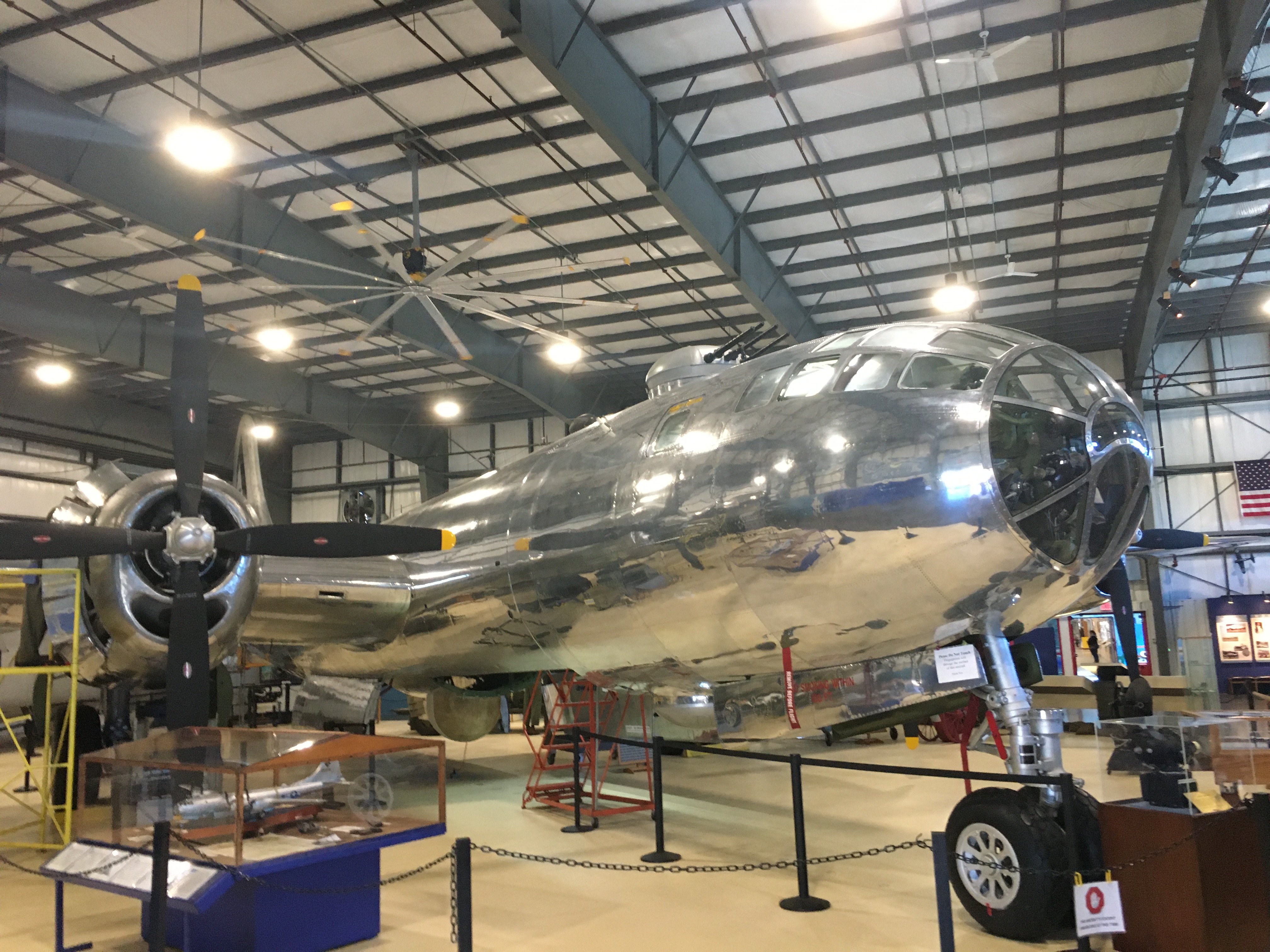
Twenty-two B-29s are preserved in museums around the world, and only two are airworthy. FIFI belongs to the Commemorative Air Force; its restoration to the organisation's airworthiness standards was a long and costly project requiring more than three years of fundraising and work, and in late 1974 the aircraft was christened and joined the CAF's historic fleet. Beyond air shows, FIFI has appeared in several films, among them Roswell (1994) and The Right Stuff (1983), where it stood in for the Bell X-1's mothership, as well as the 1980 Enola Gay: The Men, The Mission, and the Atomic Bomb.
The second is Doc, owned by Doc's Friends and restored in Wichita, the city where it was built. On 18 September 2015 it completed the first start-ups and tests of all four engines; on 11 May 2016 it made the first of its low-speed taxi tests, the first time since 1956 that the aircraft had moved under its own power, travelling more than half a mile and allowing brakes and steering to be checked. The FAA granted its airworthiness certificate on 20 May 2016, and on 17 July 2016 it flew for the first time in sixty years, with members of FIFI's flight crews aboard; the take-off was held up by trouble closing the forward bomb bay doors and the flight was made with the landing gear extended. Today both aircraft are displayed at different venues and offer paid rides to the public.
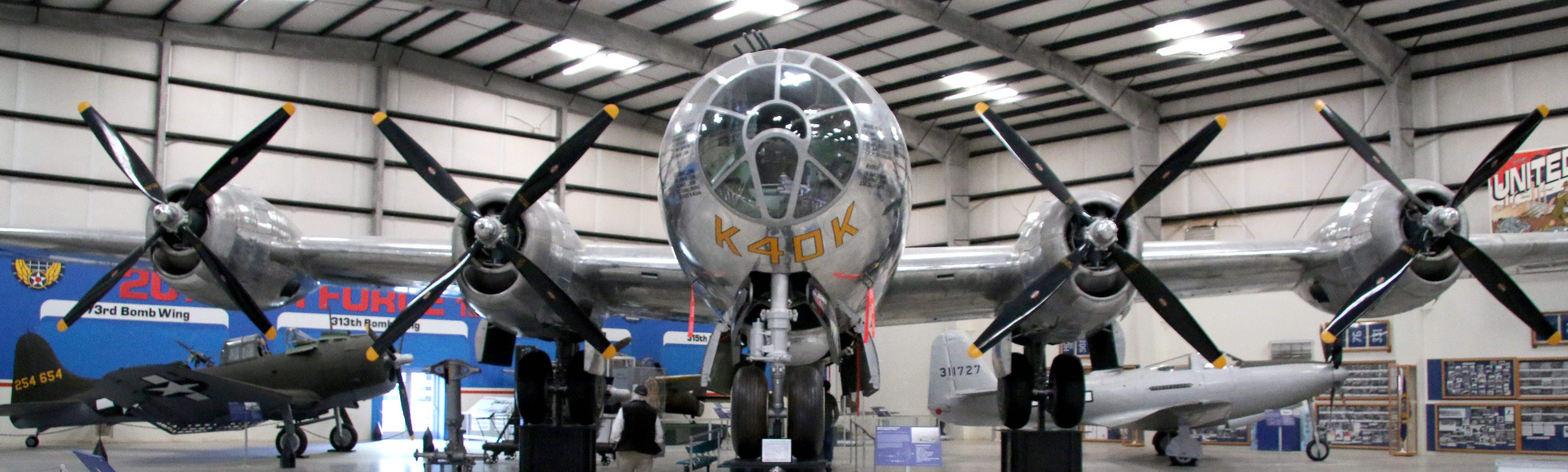
Three of the Silverplate aircraft modified to drop nuclear weapons survive. 44-86292 Enola Gay, nose number 82, was fully restored and has been on display since 2003 at the Steven F. Udvar-Hazy Center of the National Air and Space Museum, next to Dulles airport; it got there by a troubled route that included years in the open at various bases, disassembly and storage at Suitland, Maryland, from 1961, and the bitter public controversy of the 1980s and 1990s over how to exhibit it, which culminated in 1995 with only the cockpit and nose section being displayed on the National Mall for the fiftieth anniversary of the bombing. Theodore Van Kirk, the last of its crew to survive, died on 28 July 2014 at the age of 93. 44-27297 Bockscar, nose number 77, is displayed restored in its original markings at the National Museum of the United States Air Force in Dayton, Ohio, beside a replica Mark 3 Fat Man bomb; it flew into the museum on 26 September 1961. The third is 45-21748, handed over on 9 August 1945 and now shown at Albuquerque's National Museum of Nuclear Science and History, in New Mexico. Of the twenty-two aircraft preserved in museums, only two are outside the United States: one sits at the KAI Aerospace Museum in Sacheon, South Korea, and It's Hawg Wild at the Imperial War Museum, Duxford.
The most famous of the non-survivors is Kee Bird, which crashed in Greenland in 1947 during a flight to the geographic north pole and lay there almost intact for decades, until in 1995 it was destroyed by fire during the attempt to recover it, when it was on the point of flying again.
Accidents that left a mark beyond aviation
Some B-29 accidents had consequences reaching far outside aviation. The 1948 Waycross accident gave rise to the litigation in United States v. Reynolds, the judgment that established the state secrets privilege in the United States. The Lake Mead crash, also in 1948, occurred during the "Sun Tracker" project, which sought to develop a guidance system for intercontinental ballistic missiles based on the sun's position. On 3 November 1948, a B-29 crashed on Bleaklow moor near Glossop in Derbyshire; much of the wreckage is still visible and can be reached on foot from the summit of Snake Pass. On 11 April 1950, a B-29 that had taken off from Kirtland crashed into a mountain on the Manzano base three minutes later: it was carrying a nuclear bomb with detonators installed, and although the casing was destroyed and part of the high explosive burned, the nuclear capsule was aboard uninserted, so there was no possibility of a nuclear detonation. On 5 August 1950 a B-29 with a Mark 4 bomb aboard crashed shortly after taking off from Fairfield-Suisun with twenty men on board; twelve died, among them Brigadier General Robert F. Travis, and seven more died on the ground when the aircraft exploded. The base was renamed Travis.
Assessment
The B-29 was the most expensive industrial project of the American war effort and probably the hardest aircraft of its era to manufacture. It went to war half-debugged, killed its own crews in engine fires and take-off accidents, failed at the mission it had been conceived for — daylight high-altitude precision bombing — and only became decisive when LeMay turned it into something else: a low-level night incendiary bomber and a minelayer. In that second life it destroyed most of Japan's cities and strangled the country's maritime traffic, and in its third, that of the Silverplate aircraft, it opened the nuclear age.
Its technical progeny — pressurisation, computer-directed fire control, air-to-air refuelling, the B-50/C-97/Stratocruiser family, the Soviet Tu-4 and with it the whole of the USSR's heavy bomber aviation — weighs as heavily as its combat record. Three thousand nine hundred and seventy aircraft built, two still flying eighty years later, and the historical distinction of being the only weapon system ever to have delivered nuclear weapons in combat.
What remains to be documented
This history has been written against the reference material captured for this entry, and there are gaps worth declaring rather than filling:
- **Conflicting figures for Yawata (15/16 June 1944).** The sources consulted give two reconstructions of the first raid on Japan: 68 aircraft launched with 47 over the target in one, and 75 despatched with seven losses in the other. Both are recorded here without choosing between them. - **Census of conversion derivatives.** The KB-29, WB-29, SB-29, EB-29 and RB-29 series are described qualitatively here because no census with conversion quantities per variant has been located. Specific figures await the variants pass. - **Institutional airframe documentation.** No institutional manufacturer or museum material on the aircraft's structure (general arrangement drawings, maintenance manuals, test reports) has been incorporated. Everything structural here comes from secondary sources. - **Marianas campaign losses.** No consolidated, comparable figure for B-29s lost across the whole incendiary campaign has been located in the material, nor a breakdown by cause (enemy action, accident, ditching). - **The XB-39 and other re-engining experiments** are mentioned without figures for lack of corroborated material in the current capture.
Variants
| XB-29 | B-29 | B-29A | B-29B | B-29D | EB-29 | F-13 | KB-29M | KB-29P | P2B | RB-29 | SB-29 | TB-29 | Washington B.1 | WB-29 | XB-39 | YB-29 | |
|---|---|---|---|---|---|---|---|---|---|---|---|---|---|---|---|---|---|
| First flight | September 21, 1942 | — | — | — | — | — | — | — | — | — | — | — | — | — | — | — | — |
| Aircraft type | — | Strategic high-altitude heavy bomber | — | — | — | — | — | — | — | — | — | — | — | — | — | — | — |
| Powerplant | — | Four Wright R-3350-23 Duplex-Cyclone 18-cylinder air-cooled turbosupercharged radial piston engines, each rated at 2,200 hp (1,600 kW). | — | — | — | — | — | — | — | — | — | — | — | — | — | — | — |
| Powerplant | 4 × Wright R-3350-13 Duplex-Cyclone | 4 × Wright R-3350-23 Duplex-Cyclone | 4 × piston | 4 × piston | 4 × Pratt & Whitney R-4360-35 Wasp Major | 4 × piston | 4 × piston | 4 × piston | 4 × piston | 4 × piston | 4 × piston | 4 × piston | 4 × piston | 4 × piston | 4 × piston | 4 × Allison V-3420-17 | 4 × Wright R-3350-21 Duplex-Cyclone |
| Power per engine | — | 2,146 hp | — | — | 3,487 hp Best value in this row | — | — | — | — | — | — | — | — | — | — | — | — |
| Length | — | 30.2 m | — | — | — | — | — | — | — | — | — | — | — | — | — | — | — |
| Wingspan | — | 43.1 m | — | — | — | — | — | — | — | — | — | — | — | — | — | — | — |
| Height | — | 8.5 m | — | — | — | — | — | — | — | — | — | — | — | — | — | — | — |
| Wing area | — | 161 m² | — | — | — | — | — | — | — | — | — | — | — | — | — | — | — |
| Empty weight | — | 33,793 kg | — | — | — | — | — | — | — | — | — | — | — | — | — | — | — |
| MTOW | — | 60,555 kg | — | — | — | — | — | — | — | — | — | — | — | — | — | — | — |
| Top speed | — | 575 km/h | — | 586 km/h Best value in this row | — | — | — | — | — | — | — | — | — | — | — | — | — |
| Cruise speed | — | 350 km/h | — | — | — | — | — | — | — | — | — | — | — | — | — | — | — |
| Service ceiling | — | 9,710 m | — | — | — | — | — | — | — | — | — | — | — | — | — | — | — |
| Initial climb rate | — | 4.6 m/s | — | — | — | — | — | — | — | — | — | — | — | — | — | — | — |
| Range | — | 5,230 km | — | — | — | — | — | — | — | — | — | — | — | — | — | — | — |
| Ferry range | — | 9,000 km | — | — | — | — | — | — | — | — | — | — | — | — | — | — | — |
| Combat radius | — | 2,575 km | — | — | — | — | — | — | — | — | — | — | — | — | — | — | — |
| Range conditions | — | Range of 5,230 km and ferry range of 9,000 km. Combat radius is 2,575 km carrying 2,268 kg of bombs at high altitude, or 5,443 kg at medium altitude; the maximum 9,072 kg load can only be carried at low level over short distances. | — | — | — | — | — | — | — | — | — | — | — | — | — | — | — |
| Armament | — | Ten 12.7 mm Browning M2/AN machine guns in remote-controlled turrets, plus two 12.7 mm machine guns and one 20 mm M2 cannon in the tail position, the cannon later removed. Maximum bomb load of 9,072 kg. | — | Nur Heckstand: zwei Maschinengewehre AN/M2 des Kalibers .50 (12,7 mm) und eine 20-mm-Kanone M2 in den ersten Serien, später durch ein drittes .50-Maschinengewehr ersetzt; alle übrigen Abwehrtürme wurden entfernt. | — | — | — | — | — | — | — | — | — | — | — | — | — |
| Max weapons load | — | 9,072 kg | — | — | — | — | — | — | — | — | — | — | — | — | — | — | — |
| Payload | — | 0 kg | — | — | — | — | — | — | — | — | — | — | — | — | — | — | — |
| Cargo capacity | — | There is no cargo or passenger configuration: the eleven crew members occupy the pressurised compartments and the whole useful load is carried in the two bomb bays. | — | — | — | — | — | — | — | — | — | — | — | — | — | — | — |
| Crew | — | 11 | — | — | — | — | — | — | — | — | — | — | — | — | — | — | — |
| Passengers | — | 0 | — | — | — | — | — | — | — | — | — | — | — | — | — | — | — |
| Units built | 3 | 2,513 Best value in this row | 1,119 | 311 | 1 | — | 118 | — | — | 4 | 118 | 16 | — | 88 | — | 1 | 14 |
Images
Elsewhere
- National Archives (NARA)Boeing B-29 "Cosmic Ray Research" used for the Army Air Forces eclipse expedition (1947) ↗
- National Archives (NARA)New wheel installation on a Boeing B-29 ↗
- National Archives (NARA)Lt. Gen. James Doolittle in a B-29 Superfortress ↗
- National Archives (NARA)B-29 tail gunner loads his .50 cal. guns ↗
- National Archives (NARA)Beginning the bomb run: pilot on autopilot, bombardier at the sights ↗
- National Archives (NARA)Mines parachuting from a B-29 over Japanese home waters ↗
- National Archives (NARA)B-29 falling in flames after a direct flak hit over Japan ↗
- National Archives (NARA)Reconnaissance photo of Kagi airdrome, Formosa, after B-29 attacks ↗
- National Archives (NARA)B-29 waist gunner watches escorting P-51 Mustangs ↗
- National Archives (NARA)B-29 of the 509th Composite Group returns to Tinian ↗
- National Archives (NARA)B-29 of the 509th Composite Group takes off from Tinian ↗
- National Archives (NARA)B-29 after a crash landing on Saipan, 500th Bomb Group ↗
Show the 15 more
- National Archives (NARA)First engine change for a Superfortress at a Saipan base ↗
- National Archives (NARA)Mechanics pull the prop through on the first B-29 overhauled at Guam Air Depot ↗
- National Archives (NARA)B-29 "Tokyo Local" taking off from an airstrip on Saipan ↗
- National Archives (NARA)Remains of a B-29 on Saipan after the Japanese raid of 7 December 1944 ↗
- National Archives (NARA)Burned-out industrial areas of Yokohama after 20th Air Force B-29 raids ↗
- National Archives (NARA)Kobe, Japan, photographed on 19 January 1945 before the B-29 attacks ↗
- NASAB-29 Superfortress engine in the Altitude Wind Tunnel, 1944 ↗
- NASAB-29 Superfortress carrying a ramjet missile, 1948 ↗
- NASAB-29 Superfortress at the Lewis Flight Propulsion Laboratory, 1947 ↗
- NASAB-29 mothership #800 with the X-1B attached, taxiing off the lakebed, 1958 ↗
- Smithsonian National Air and Space MuseumBoeing B-29 Superfortress "Enola Gay" in the museum collection ↗
- The Museum of FlightBoeing B-29 Superfortress preserved at The Museum of Flight ↗
- Hill Aerospace MuseumBoeing B-29 Superfortress on display at Hill Aerospace Museum ↗
- Doc's FriendsB-29 "Doc" in flight and under restoration - photo gallery ↗
- Commemorative Air Force B-29/B-24 SquadronB-29 "FIFI", the flying Superfortress of the CAF B-29/B-24 Squadron ↗