Boeing 747: The Plane That Nearly Destroyed Its Maker
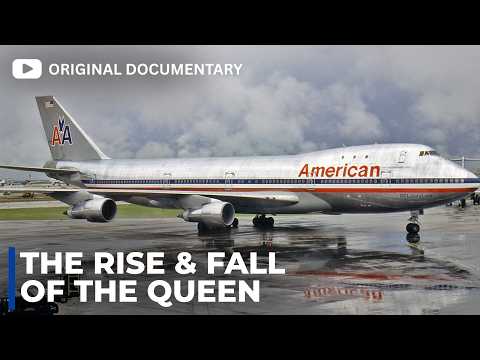
Video from the channel Plane Curious about Boeing 747, linked on its Above Ten Thousand entry. Duration: 42:35. Language: English. Video type: Documentary.
What it's about
Documentary about the complete history of the Boeing 747, from Pan Am's order to the end of its production. It reviews the aircraft's development, the construction of the Everett plant, the early years in service, the family of variants, competition from other manufacturers, its role in freight transport, and its government and military uses.
Historical context
In the mid-1960s air travel was expensive and low-capacity: the 707 carried about 140 passengers, and long routes required stopovers. Juan Trippe, head of Pan Am, asked Boeing for an aircraft for about 400 people capable of crossing the Atlantic nonstop. Boeing drew on the work from its proposal for the contest won by the Lockheed C-5 Galaxy. Thinking of a future freighter that would load through the nose, it raised the flight deck to an upper level, which is the origin of the aircraft's characteristic hump. In 1966 the company committed to the program with heavy debt and built, in Everett, Washington, the largest building in the world by volume while the design was still being finalized, with the engineering team led by Joe Sutter. The prototype flew on February 9, 1969, with Jack Waddell at the controls, the FAA certified it in December of that year, and on January 22, 1970, Pan Am launched commercial service between New York and London. Initial failures of the Pratt & Whitney JT9D engines and the economic crisis of the early seventies brought Boeing to the brink of bankruptcy. Cargo capacity and the recovery of demand consolidated the aircraft's success by around 1972.
Key facts
The documentary covers the variants: the -200 (1971); the SP (1976, of which 45 were built); the -300 (1983, with the extended upper deck); the -400 (1989, with a two-crew glass cockpit and winglets, 694 delivered), and the -8 (launched in 2005, 155 built, mostly freighters). It reviews competition from the DC-10, the L-1011, the A340, and the A380, and attributes its actual replacement to the 777 and the evolution of ETOPS rules. It mentions singular uses, such as the presidential VC-25As, the E-4B, the aircraft that carried the Space Shuttle and the YAL-1, and the record set during Operation Solomon in 1991, with 1,088 people aboard an El Al 747. The last example, a 747-8F for Atlas Air, rolled off the assembly line on December 6, 2022, and was delivered in January 2023, bringing total production to 1,574 aircraft.