Avião comercial · Civil · Reino Unido
Vickers VC10
- 29 de junho de 1962
- Primeiro voo
- 1964
- Entrada ao serviço
- 2013
- Retirado
- 54
- Unidades construídas


-1600.webp)


O Vickers VC10 foi um quadrimotor a jato britânico de longo alcance concebido para operar a partir de pistas curtas e de aeroportos quentes e de altitude das rotas da BOAC. Voou pela primeira vez em 1962 e, terminada a sua carreira comercial, serviu durante décadas na Royal Air Force até 2013.
Eventos relacionados
Fichas relacionadas
Categoria
História
O VC10 nasceu de uma exigência peculiar da BOAC: um avião a jato de longo alcance capaz de descolar das pistas curtas, quentes e em altitude das suas rotas africanas e asiáticas, onde os jatos norte-americanos da época operavam com penalizações. A Vickers respondeu com uma configuração pouco comum: quatro motores Rolls-Royce Conway agrupados na cauda e uma asa limpa de grande sustentação. O protótipo descolou de Brooklands a 29 de junho de 1962 e o tipo entrou ao serviço na BOAC em 1964.
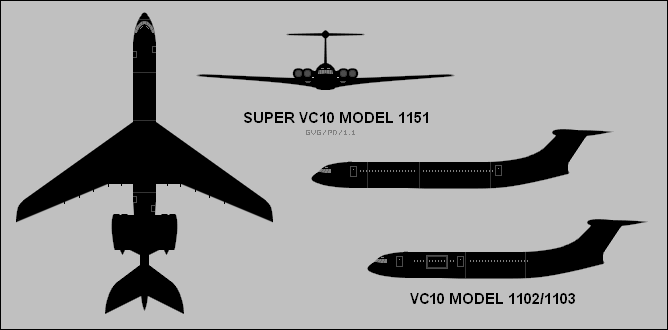
A versão alongada Super VC10 ampliou a capacidade para as rotas atlânticas, nas quais o avião ganhou fama de rápido, silencioso em cabina e apreciado pelos passageiros; um VC10 conseguiu a travessia do Atlântico mais rápida alguma vez registada por um avião de linha subsónico. Ainda assim, a sua economia de exploração não pôde competir com os jatos norte-americanos e a produção encerrou com apenas 54 unidades construídas.
A sua segunda vida foi militar: a Royal Air Force empregou-o como transporte e, sobretudo, como avião-tanque de reabastecimento em voo, papel no qual o VC10 continuou a operar até à sua retirada definitiva em 2013, quase meio século depois do primeiro voo.
Variantes
| Vickers VC10 Type 1100 | BAC Super VC10 Type 1151 | BAC Standard VC10 Type 1102 | BAC Standard VC10 Type 1103 | BAC Standard VC10 Type 1104 | BAC Standard VC10 Type 1106 | BAC Standard VC10 Type 1109 | BAC Super VC10 Type 1150 | BAC Super VC10 Type 1152 | BAC Super VC10 Type 1154 | BAC Super VC10 Type 1180 | BAC Super VC10 Type 1181 | BAC Type 1125 | BAC VC10A Type 1110 | BAC VC10A Type 1111 | BAC VC10 Type 1101 | BAC VC11 Type 1400 | VC10 C.1 | VC10 C.1K | VC10 K.2 | VC10 K.3 | VC10 K.3A | VC10 K.4 | |
|---|---|---|---|---|---|---|---|---|---|---|---|---|---|---|---|---|---|---|---|---|---|---|---|
| Primeiro voo | 29 de junho de 1962 | 7 de maio de 1964 | — | — | — | — | — | — | — | — | — | — | — | — | — | — | — | — | — | — | — | — | — |
| Tipo de aeronave | Long-haul airliner prototype | Long-haul airliner | Long-haul airliner | Long-haul airliner | Long-haul airliner (not built) | Strategic military transport | Long-haul airliner | Long-haul airliner | Long-haul airliner (not built) | Long-haul airliner | Long-haul airliner (not built) | Long-haul airliner (not built) | Long-haul airliner (not built) | Long-haul airliner (not built) | Avión comercial de largo radio (no construido) | Long-haul airliner | Medium-haul airliner (not built) | Strategic military transport | Military transport and aerial tanker | Aerial refuelling tanker | Aerial refuelling tanker | Aerial refuelling tanker (not built) | Aerial refuelling tanker |
| Grupo motopropulsor | Four Rolls-Royce Conway RCo.42 turbofans paired on either side of the rear fuselage, with thrust reversers on all four engines, an arrangement the production series dropped. | Four Rolls-Royce Conway RCo.43D Mk.550 turbofans of 96.97 kN each (21,800 lbf), in nacelles angled three degrees nose-up and with reversers on all four engines. | Four Rolls-Royce Conway RCo.42 Mk.540 turbofans of 93.4 kN each, with the 4% chord leading-edge extension and an extra wing fence near the root. | Four Rolls-Royce Conway RCo.42 Mk.540 turbofans of 93.4 kN each, with the same extended leading-edge wing as the Ghana Airways series. | Four Rolls-Royce Conway turbofans in rear pairs, like the rest of the Standard series; the order was cancelled before the available sources pinned down the exact engine mark. | Four Rolls-Royce Conway RCo.43 Mk.301 turbofans of 96.97 kN each (21,800 lbf dry), the same uprated engines as the Super VC10, fed as well by the fin fuel tank. | Four Rolls-Royce Conway turbofans in rear pairs; the sources consulted do not state the exact mark carried after the conversion. | Four Rolls-Royce Conway RCo.43D Mk.550 turbofans of 96.97 kN each (21,800 lbf), with thrust reversers on all four engines and an extra fin fuel tank. | Four Rolls-Royce Conway turbofans of the Super VC10 family; the order was cancelled before the sources pinned down the exact mark. | Four Rolls-Royce Conway RCo.43D Mk.550 turbofans of 96.97 kN each (21,800 lbf), identical to those of BOAC's Super VC10. | Four Rolls-Royce Conway turbofans in rear pairs, following the Super VC10 layout the project derived from. | Four Rolls-Royce Conway turbofans in rear pairs, following the Super VC10 layout. | Four Rolls-Royce Conway turbofans in rear pairs; the study never reached a documented engine designation. | Four Rolls-Royce Conway turbofans in the VC10's characteristic rear arrangement; the project never settled on a documented engine designation. | Cuatro turbofanes Rolls-Royce Conway en parejas traseras, según el esquema del proyecto VC10A. | Four Rolls-Royce Conway RCo.42 Mk.540 turbofans of 93.4 kN each (21,000 lbf), paired on either side of the rear fuselage; thrust reversers were retained only on the inboard engines. | Four Rolls-Royce Spey turbofans in the rear arrangement inherited from the VC10; sources do not state the engine mark. | Four Rolls-Royce Conway RCo.43 Mk.301 turbofans of 96.97 kN each (21,800 lbf dry), with a tail APU for self-sufficiency at bases without ground support equipment. | Four Rolls-Royce Conway RCo.43 Mk.301 turbofans of 96.97 kN each (21,800 lbf dry), unchanged from the C Mk.1 the conversion came from. | Four Rolls-Royce Conway RCo.43 Mk.550B turbofans of 96.97 kN each (21,800 lbf): the conversion brought the Standard airframes up to the C Mk.1 engine standard to unify the fleet. | Four Rolls-Royce Conway RCo.43 Mk.550B turbofans of 96.97 kN each (21,800 lbf); the conversion sealed the cargo door and removed the inboard thrust reversers. | Four Rolls-Royce Conway turbofans of the Super VC10 family; the conversion was never carried out and no engine designation is documented. | Four Rolls-Royce Conway RCo.43 Mk.550B turbofans of 96.97 kN each (21,800 lbf), the same as the K Mk.3 the conversion follows. |
| Motorização | 4 × Rolls-Royce Conway RCo.42 | 4 × Rolls-Royce Conway RCo.43D Mk.550 | 4 × Rolls-Royce Conway RCo.42 Mk.540 | 4 × Rolls-Royce Conway RCo.42 Mk.540 | 4 × turbofan | 4 × Rolls-Royce Conway RCo.43 Mk.301 | 4 × turbofan | 4 × Rolls-Royce Conway RCo.43D Mk.550 | 4 × turbofan | 4 × Rolls-Royce Conway RCo.43D Mk.550 | 4 × turbofan | 4 × turbofan | 4 × turbofan | 4 × turbofan | 4 × turbofan | 4 × Rolls-Royce Conway RCo.42 Mk.540 | 4 × Rolls-Royce Spey | 4 × Rolls-Royce Conway RCo.43 Mk.301 | 4 × Rolls-Royce Conway RCo.43 Mk.301 | 4 × Rolls-Royce Conway RCo.43 Mk.550B | 4 × Rolls-Royce Conway RCo.43 Mk.550B | 4 × turbofan | 4 × Rolls-Royce Conway RCo.43 Mk.550B |
| Impulso unitário | 93,4 kN | 97 kN Melhor valor da linha | 93,4 kN | 93,4 kN | — | 97 kN Melhor valor da linha | — | 97 kN Melhor valor da linha | — | 97 kN Melhor valor da linha | — | — | — | — | — | 93,4 kN | — | 97 kN Melhor valor da linha | 97 kN Melhor valor da linha | 97 kN Melhor valor da linha | 97 kN Melhor valor da linha | — | 97 kN Melhor valor da linha |
| Comprimento | 48,4 m | 52,3 m Melhor valor da linha | 48,4 m | 48,4 m | 48,4 m | 48,4 m | 48,4 m | 52,3 m Melhor valor da linha | 52,3 m Melhor valor da linha | 52,3 m Melhor valor da linha | — | — | — | — | — | 48,4 m | — | 48,4 m | 48,4 m | 48,4 m | 52,3 m Melhor valor da linha | 52,3 m Melhor valor da linha | 52,3 m Melhor valor da linha |
| Envergadura | 42,7 m | 44,6 m Melhor valor da linha | 44,6 m Melhor valor da linha | 44,6 m Melhor valor da linha | 44,6 m Melhor valor da linha | 44,6 m Melhor valor da linha | 44,6 m Melhor valor da linha | 44,6 m Melhor valor da linha | 44,6 m Melhor valor da linha | 44,6 m Melhor valor da linha | — | — | — | — | — | 44,6 m Melhor valor da linha | — | 44,6 m Melhor valor da linha | 44,6 m Melhor valor da linha | 44,6 m Melhor valor da linha | 44,6 m Melhor valor da linha | 44,6 m Melhor valor da linha | 44,6 m Melhor valor da linha |
| Altura | 12 m Melhor valor da linha | 12 m Melhor valor da linha | 12 m Melhor valor da linha | 12 m Melhor valor da linha | — | 12 m Melhor valor da linha | 12 m Melhor valor da linha | 12 m Melhor valor da linha | 12 m Melhor valor da linha | 12 m Melhor valor da linha | — | — | — | — | — | 12 m Melhor valor da linha | — | 12 m Melhor valor da linha | 12 m Melhor valor da linha | 12 m Melhor valor da linha | 12 m Melhor valor da linha | — | 12 m Melhor valor da linha |
| Área alar | — | 272 m² | 273 m² Melhor valor da linha | 273 m² Melhor valor da linha | — | 272 m² | 272 m² | 272 m² | 272 m² | 272 m² | — | — | — | — | — | 265 m² | — | 272 m² | 272 m² | 265 m² | 272 m² | — | 272 m² |
| Peso vazio | — | 71 937 kg | 66 670 kg | 66 670 kg | — | 66 224 kg | — | — | — | 70 160 kg | — | — | — | — | — | 67 980 kg | — | 66 224 kg | — | 60 875 kg Melhor valor da linha | — | — | — |
| MTOW | — | 151 953 kg Melhor valor da linha | 141 520 kg | 141 520 kg | — | 146 510 kg | — | — | — | 151 953 kg Melhor valor da linha | — | — | — | — | — | 142 430 kg | — | 146 510 kg | 146 510 kg | 135 622 kg | 146 513 kg | — | 146 513 kg |
| Velocidade máxima | — | 935 km/h Melhor valor da linha | 914 km/h | 914 km/h | — | 935 km/h Melhor valor da linha | — | — | — | 935 km/h Melhor valor da linha | — | — | — | — | — | 914 km/h | — | 935 km/h Melhor valor da linha | 935 km/h Melhor valor da linha | 914 km/h | 935 km/h Melhor valor da linha | — | 935 km/h Melhor valor da linha |
| Altitude da velocidade máxima | — | 9450 m | 9450 m | 9450 m | — | 9450 m | — | — | — | 9450 m | — | — | — | — | — | 9450 m | — | 9450 m | 9450 m | 9450 m | 9450 m | — | 9450 m |
| Velocidade de cruzeiro | — | 886 km/h Melhor valor da linha | 886 km/h Melhor valor da linha | 886 km/h Melhor valor da linha | — | 684 km/h | — | — | — | 886 km/h Melhor valor da linha | — | — | — | — | — | 886 km/h Melhor valor da linha | — | 684 km/h | 684 km/h | 886 km/h Melhor valor da linha | 886 km/h Melhor valor da linha | — | 886 km/h Melhor valor da linha |
| Altitude de cruzeiro | — | 11 600 m | 11 600 m | 11 600 m | — | 9145 m | — | — | — | 11 600 m | — | — | — | — | — | 11 600 m | — | 9145 m | 9145 m | 11 600 m | 11 600 m | — | 11 600 m |
| Teto de serviço | — | 12 800 m Melhor valor da linha | 12 800 m Melhor valor da linha | 12 800 m Melhor valor da linha | — | 12 800 m Melhor valor da linha | — | — | — | 12 800 m Melhor valor da linha | — | — | — | — | — | 12 800 m Melhor valor da linha | — | 12 800 m Melhor valor da linha | 12 800 m Melhor valor da linha | 12 800 m Melhor valor da linha | 12 800 m Melhor valor da linha | — | 12 800 m Melhor valor da linha |
| Razão de subida inicial | — | 11,7 m/s | 9,8 m/s | 9,8 m/s | — | 15,5 m/s Melhor valor da linha | — | — | — | 11,7 m/s | — | — | — | — | — | 9,8 m/s | — | 15,5 m/s Melhor valor da linha | — | — | — | — | — |
| Alcance | — | 7596 km | 8115 km Melhor valor da linha | 8115 km Melhor valor da linha | — | 6273 km | — | — | — | 7596 km | — | — | — | — | — | 8115 km Melhor valor da linha | — | 6273 km | — | — | — | — | — |
| Alcance de transferência | — | 11 470 km Melhor valor da linha | 9765 km | 9765 km | — | — | — | — | — | 11 470 km Melhor valor da linha | — | — | — | — | — | 9765 km | — | — | — | — | — | — | — |
| Raio de ação | 0 km Melhor valor da linha | 0 km Melhor valor da linha | 0 km Melhor valor da linha | 0 km Melhor valor da linha | 0 km Melhor valor da linha | 0 km Melhor valor da linha | 0 km Melhor valor da linha | 0 km Melhor valor da linha | 0 km Melhor valor da linha | 0 km Melhor valor da linha | 0 km Melhor valor da linha | 0 km Melhor valor da linha | 0 km Melhor valor da linha | 0 km Melhor valor da linha | 0 km Melhor valor da linha | 0 km Melhor valor da linha | 0 km Melhor valor da linha | 0 km Melhor valor da linha | 0 km Melhor valor da linha | 0 km Melhor valor da linha | 0 km Melhor valor da linha | 0 km Melhor valor da linha | 0 km Melhor valor da linha |
| Condições de alcance | Development airframe devoted to certification testing, with no published range figures of its own; the programme ended with type certification in April 1964. | Range of 7,596 km with maximum payload and up to 11,470 km with maximum fuel, without reserves; the fin tank is the key to the jump over the Standard series. | Range of 8,115 km with maximum payload and 9,765 km with maximum fuel, without reserves. | Range of 8,115 km with maximum payload and 9,765 km with maximum fuel, without reserves. | No range figures of its own: the variant was never built. | Range of 6,273 km with maximum payload; the extra fin tank and the more powerful engines offset the heavier military airframe. | No published range figures of its own; with the Type 1106 wing its behaviour was close to that of the production Standard series. | A family tuned for payload rather than take-off performance; the actual range figures belong to the 1151 and 1154 series. | No range figures of its own: the variant was never built. | Range of 7,596 km with maximum payload and up to 11,470 km with maximum fuel, without reserves. | No range figures: the project never got past the study stage. | No range figures: the project never got past the study stage. | No range figures: the project got no further than a commercial proposal. | No range figures: the project never left the drawing board. | Sin cifras de alcance: la variante no llegó a construirse. | Range of 8,115 km with maximum payload and up to 9,765 km with maximum fuel, both figures without reserves; the high-lift wing let it work from the short, hot runways of Africa and the Middle East. | No range figures: the project was dropped before any aircraft was built. | Range of 6,273 km with maximum payload, enough for Transport Command's strategic routes to Cyprus, Gan, Singapore and Hong Kong. | Carrying no extra fuel, its radius of action remains that of the transport: whatever it passes to the receiver comes off its own range. | Maximum take-off weight drops to 135,622 kg because the mission is to deliver fuel rather than cover distance: useful endurance depends on how much it gives away. | The long fuselage and maindeck tanks give it the fleet's greatest offload capacity; maximum take-off weight is 146,513 kg. | No range figures: the conversion was never carried out. | Without maindeck tanks it offloads less fuel than the K Mk.3 in exchange for a lighter airframe; maximum take-off weight stays at 146,513 kg. |
| Armamento | None | None | None | None | None | None | None | None | None | None | None | None | None | None | Ninguno | None | None | None | None | None | None | None | None |
| Carga bélica máxima | 0 kg Melhor valor da linha | 0 kg Melhor valor da linha | 0 kg Melhor valor da linha | 0 kg Melhor valor da linha | 0 kg Melhor valor da linha | 0 kg Melhor valor da linha | 0 kg Melhor valor da linha | 0 kg Melhor valor da linha | 0 kg Melhor valor da linha | 0 kg Melhor valor da linha | 0 kg Melhor valor da linha | 0 kg Melhor valor da linha | 0 kg Melhor valor da linha | 0 kg Melhor valor da linha | 0 kg Melhor valor da linha | 0 kg Melhor valor da linha | 0 kg Melhor valor da linha | 0 kg Melhor valor da linha | 0 kg Melhor valor da linha | 0 kg Melhor valor da linha | 0 kg Melhor valor da linha | 0 kg Melhor valor da linha | 0 kg Melhor valor da linha |
| Carga útil | — | 22 860 kg | 18 039 kg | 18 039 kg | — | 26 037 kg | — | — | — | 27 360 kg Melhor valor da linha | — | — | — | — | — | 17 840 kg | — | 26 037 kg | — | — | — | — | — |
| Capacidade de carga | Test airframe without a definitive commercial cabin: prototype G-ARTA flew with the short 42.72 m span wing and squared tips before the series aerodynamic refinements were fitted. | Fuselage stretched 3.96 m over the Standard: BOAC's typical layout of 16 first-class and 123 economy seats, up to 174 in a high-density cabin, with a maximum payload of 22,860 kg. | Combi version for Ghana Airways: up to 151 economy seats and, on the second airframe, a large side cargo door for mixed passenger and freight work, with a maximum payload of 18,039 kg. | Combi version for British United Airways, very close to the Type 1102 and also fitted with a cargo door; up to 151 seats and 18,039 kg maximum payload. One airframe came from a cancelled Ghana Airways order. | Standard series ordered by Nigeria Airways with the usual VC10 cabin; the two-aircraft order was cancelled and none was ever built. | Manufacturer designation of the RAF's VC10 C Mk.1: shortened Super VC10 fuselage with a large port-side cargo door and a tail APU, for 150 passengers or 76 stretchers with six medical attendants and up to 26,037 kg of freight. | Type 1100 prototype rebuilt with the Type 1106 wing and leased to Laker Airways, with a cabin of up to 151 economy seats. | Generic designation of the Super VC10, with a fuselage stretched 3.96 m over the Standard and seating for 163 to 174 economy passengers. | Combi Super VC10 for BOAC, with a large cargo door and a freight handling system for mixed operations; the thirteen-aircraft order was cancelled. | Combi Super VC10 for East African Airways, with a large freight door on the port side ahead of the wing: up to 174 economy seats or mixed passenger and cargo loads with a maximum payload of 27,360 kg, the highest in the family. | Double-deck Super VC10 project for high passenger capacity; sources disagree on the exact seat count and none was built. | A second double-deck Super VC10 project, of even greater capacity than the Type 1180; it was not built either. | Hybrid project between the Standard series and the Super VC10 offered to Aerolíneas Argentinas; none was built. | Generic designation of the VC10A project, a development of the Standard series that was never built. | Versión del VC10A destinada a BOAC; la compañía prefirió el Super VC10 y no se construyó ningún ejemplar. | Production series for BOAC in a typical layout of 16 first-class and 93 economy seats, stretchable to 151 in a high-density cabin; maximum payload is 17,840 kg. | Scaled-down VC10 with a six-abreast cabin for 80 to 138 passengers; cancelled in favour of the BAC One-Eleven. | RAF transport with the short Super VC10 fuselage and a large cargo door: 150 passengers or 76 stretchers with six medical attendants, and up to 26,037 kg of payload. | Thirteen C Mk.1s converted to transport/tanker standard: they keep the transport's passenger and freight cabin and add two underwing hose units, with no extra fuselage tanks. | Five Type 1101s converted to tankers, without a cargo door: five extra fuselage tanks, three hose drum units and only 18 seats for support personnel. | Four East African Airways Super VC10 Type 1154s converted into three-point tankers, with maindeck tanks and 17 seats for support crew. | RAF designation for four proposed Type 1166 tanker conversions; none was converted. | Five British Airways Super VC10 Type 1151s converted into three-point tankers like the K Mk.3, but without maindeck tanks, so the volume they can offload is smaller. |
| Tripulação | — | 4 Melhor valor da linha | — | — | — | 4 Melhor valor da linha | — | — | — | — | — | — | — | — | — | 4 Melhor valor da linha | — | 4 Melhor valor da linha | 4 Melhor valor da linha | 4 Melhor valor da linha | 4 Melhor valor da linha | — | 4 Melhor valor da linha |
| Passageiros | — | 174 | 151 | 151 | — | 150 | 151 | 174 | 174 | 174 | 239 Melhor valor da linha | 239 Melhor valor da linha | — | — | — | 151 | 138 | 150 | 150 | 18 | 17 | — | 17 |
| Unidades construídas | 1 | 17 Melhor valor da linha | 3 | 2 | 0 | 14 | 1 | — | 0 | 5 | 0 | 0 | 0 | 0 | 0 | 12 | 0 | 14 | 13 | 5 | 4 | 0 | 5 |
Imagens