The Soyuz launch sequence explained
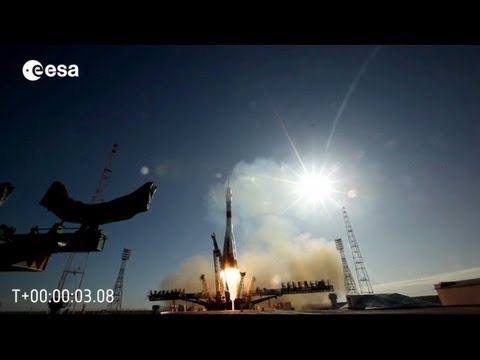
Video from the channel European Space Agency, ESA about Soyuz (cohete), linked on its Above Ten Thousand entry. Duration: 11:30. Language: English. Video type: Documentary.
What it's about
Educational ESA video, based on a class given to its astronaut class, explaining the parts of the Soyuz rocket and the launch sequence into orbit, with animations of the rocket and its trajectory.
Historical context
It presents the Baikonur Cosmodrome, on the steppes of Kazakhstan, from where Yuri Gagarin departed and from where every Soyuz carries three crew members to the International Space Station after training at Star City, near Moscow. It recalls the only use of the escape tower in Russian spaceflight: in September 1983, during a launch toward the Salyut 7 station, a valve failed to close 90 seconds before ignition, the spilled kerosene caught fire, and controllers activated the system. Strekalov and Titov endured between 14 and 17 g for 5 seconds and landed about 4 km from the pad.
Key facts
The rocket is about 50 m long and up to 10 m in diameter, weighs about 310 tonnes, and burns kerosene and liquid oxygen across three stages. At 45 seconds it reaches 11 km and 1,640 km/h, the moment of maximum pressure on the structure. Around two minutes, above 40 km, the escape tower is jettisoned and the four boosters separate; maximum acceleration for the crew reaches 3.5 g. The second stage runs for three more minutes, the payload fairing is released, and the third stage ignites before the second shuts down, at 170 km and 13,250 km/h. Around nine minutes, at about 220 km, the last engine shuts down, the spacecraft separates, and deploys its antennas and solar panels.